

Adults Retake GCSE Design and Technology: A Guide
Adults retake GCSE Design and Technology through a college or private exam centre. Learn about courses, NEA, fees, exam dates and revision.
A GCSE result can feel permanent when it arrives. Years later, it often looks more like an unfinished decision. Perhaps Design and Technology now matters for a college course, apprenticeship or career change. Perhaps you simply want to complete something that did not go well the first time.
The short answer is yes: adults retake GCSE Design and Technology by enrolling on a suitable course or entering through an approved exam centre as a private candidate. The difficult part is not your age. It is finding a centre able to supervise, authenticate and mark the non-exam assessment, known as the NEA.
That practical requirement makes this retake different from sitting a written paper alone. Here is how to organise it properly.
Your GCSE Design and Technology retake checklist
Before paying for a course or beginning a project, confirm:
- which exam board you will use: AQA, Pearson Edexcel, OCR or Eduqas
- whether a local college offers an evening, part-time or adult course
- whether the centre accepts private candidates for a subject containing NEA
- whether you must complete a new NEA or can carry forward an eligible previous result
- where supervised designing and manufacturing will take place
- which examination series is available
- the centre's entry, tuition, workshop and administration fees
- whether access arrangements need to be organised
- which specification and current contextual challenge you must follow
The order matters. Find the centre first. Starting an independent project before a centre agrees to oversee it may leave you with work that cannot be authenticated or submitted.
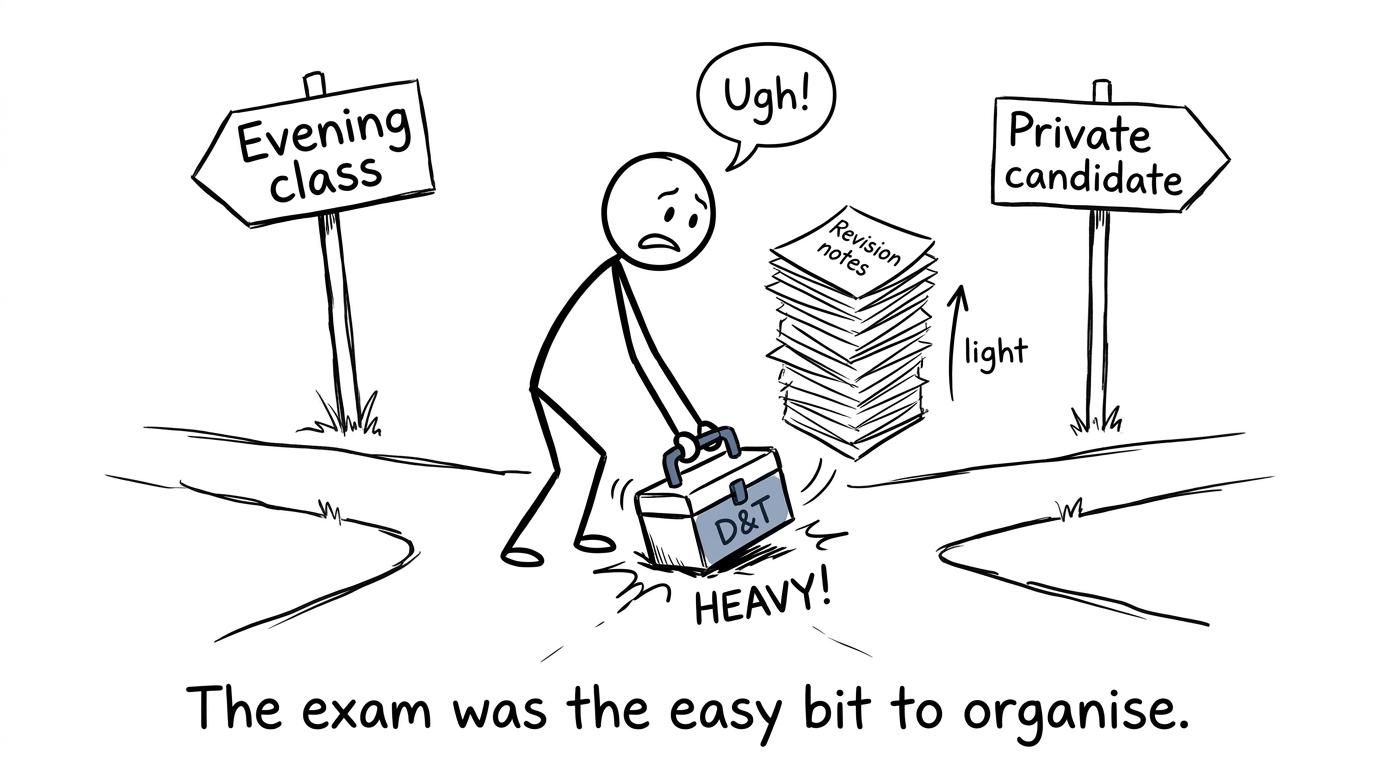 An adult choosing between an evening class and private candidate route
How adults can retake GCSE Design and Technology
There are two main routes. Neither is automatically better; the right choice depends on local availability, your practical experience and the support you need.
Enrol on an evening or part-time course
A college course is usually the simplest route when one is available. The provider can teach the specification, arrange workshop access, supervise the NEA, make your exam entry and explain internal deadlines.
Search local further education colleges and adult learning providers for GCSE Design and Technology, product design or a clearly stated equivalent. Provision varies considerably. A D&T course needs specialist staff, equipment and safe workshop facilities, so it is less widely offered to adults than GCSE English or maths.
Ask the provider these questions before enrolling:
- Is this the full GCSE graded 999 to 111?
- Which awarding organisation and specification do you teach?
- Does the course include the written examination and NEA?
- When are classes and supervised workshop sessions held?
- Are materials and examination fees included?
- What happens if I miss a practical session?
Do not assume that an online course includes an examination place. Teaching, assessment and exam entry can be separate services.
Enter as a private candidate
A private candidate prepares independently but is entered by an approved school, college or examination centre. The centre makes the official entry; you cannot enter directly with JCQ.
Design and Technology makes this route more complicated because the qualification includes practical assessment. Under current JCQ rules, a centre accepting a candidate for a specification with NEA must administer the relevant assessment arrangements. That can include task setting, supervision, authentication, marking and submission to the awarding organisation.
Consequently, a centre that accepts private candidates for written GCSEs may still refuse D&T. Contact several centres early and state the full subject, board and specification code. Ask explicitly whether they support the Design and Technology NEA, not merely whether they host GCSE examinations.
The centre may set its own fees and internal deadlines. Costs can include the awarding organisation's entry fee, administration, tuition, workshop supervision, materials and NEA marking. Request a written breakdown rather than relying on a general private-candidate price.
Why the NEA changes the process
Across the current AQA, Edexcel, OCR and Eduqas GCSE Design and Technology specifications, the qualification is divided equally between a written examination and a design-and-make NEA:
Written examination=50%,NEA=50%.\text{Written examination} = 50\%, \qquad \text{NEA} = 50\%.Written examination=50%,NEA=50%.The NEA normally requires you to investigate a contextual challenge, identify a user need, develop a specification, generate and refine ideas, manufacture a prototype, and test and evaluate the outcome. Exact requirements and recommended time vary by board. For example, AQA describes an NEA lasting approximately 303030 to 353535 hours, while Eduqas describes approximately 353535 hours.
This is not ordinary homework that can simply be posted to an exam centre. The entering centre must be confident that the submitted work is yours and that it was produced under the required conditions. Practical work may require direct supervision, while the centre must also provide appropriate facilities and qualified assessment staff.
A distance-learning provider does not remove this requirement. JCQ guidance says a distance learner must register or enrol with an approved entering centre before beginning NEA work. Confirm who will supervise, authenticate, mark and submit your project before purchasing any online package.
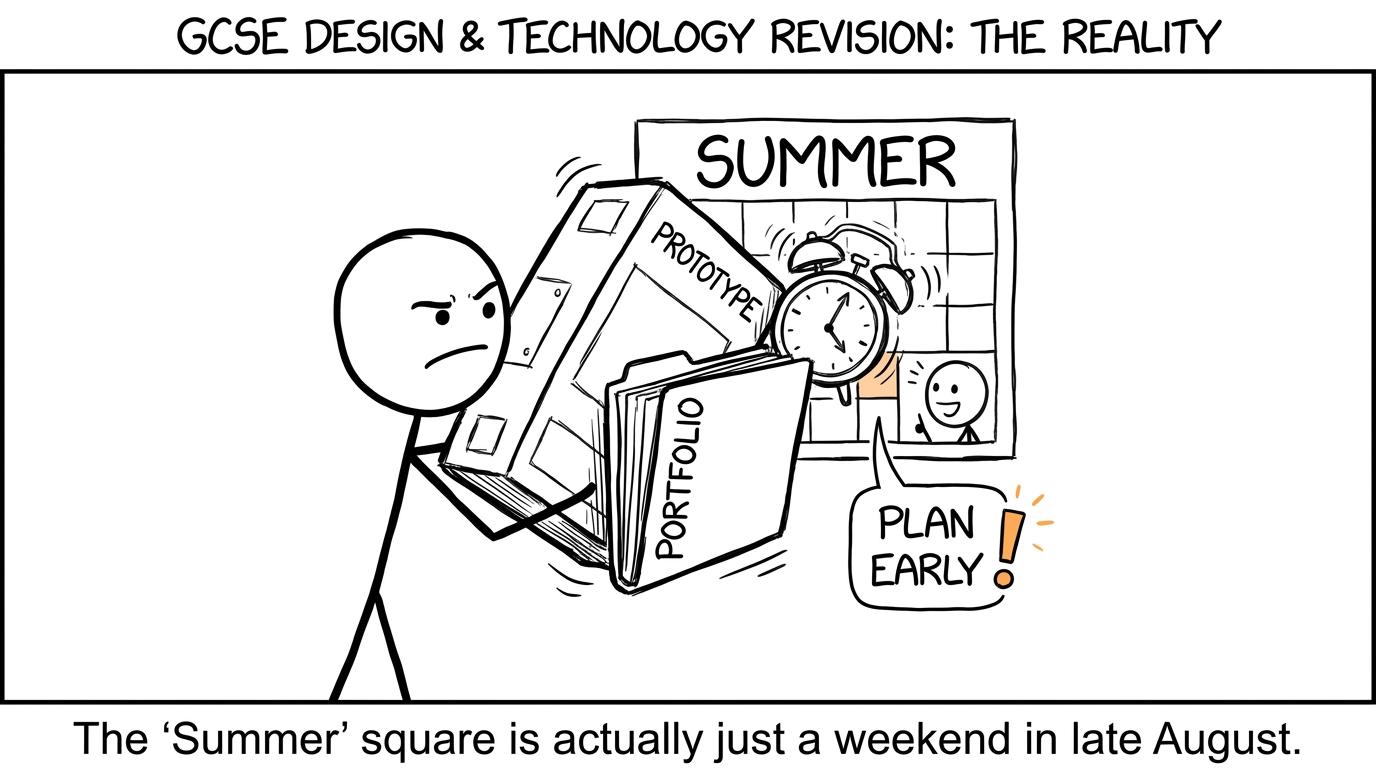 An adult trying to fit a prototype and portfolio into the summer calendar
Can a previous NEA result be carried forward?
Possibly. Some specifications provide a carry-forward entry option for candidates retaking the qualification. OCR, for example, states that retaking learners can either retake its Iterative Design Challenge or carry forward their most recent result using the correct entry option.
Eligibility and entry procedures depend on the awarding organisation, specification and your previous assessment record. Changing boards can also affect what is possible. Give the centre your previous statement of results, candidate details and Unique Candidate Identifier if available, then ask it to confirm the current rule with the exam board.
Do not assume that a portfolio saved at home can simply be resubmitted. A carried-forward component result is different from submitting old work again.
When can you sit the retake?
Plan for the summer examination series. GCSE Design and Technology is generally assessed in May and June, whereas the November GCSE series is principally available for GCSE Mathematics and English Language.
Your centre's internal entry deadline may be earlier than the awarding organisation's deadline, especially where NEA supervision must be arranged. A sensible sequence is to find a provider before the academic year begins, confirm the assessment route, and leave enough time for the design-and-make task.
The exam board publishes the final written-paper date, but your centre controls practical sessions, portfolio checkpoints and submission arrangements. Keep all dates in one calendar. D&T rewards iteration, and rushed iteration is usually just a sequence of hurried decisions.
Funding and costs for adult learners
Do not assume that the retake will be free. In England, the well-known adult statutory entitlement to free GCSE tuition applies particularly to English and maths for eligible learners who have not achieved grade 444 or above. Design and Technology does not automatically receive the same universal treatment.
Funding varies according to your age, prior qualifications, circumstances, location, provider and the qualification's current funding status. Scotland, Wales and Northern Ireland have different education and funding systems. Ask the college for an individual fee assessment and enquire about learner support, bursaries or help with materials and travel.
If you enter privately, compare the total cost rather than the examination fee alone. Workshop time and NEA administration may form a significant part of the price.
The maths you will need for D&T
Design begins with an idea, but manufacturing depends on measurement. GCSE D&T can involve ratios, scale, percentages, tolerances, area, volume, material quantities, graphs and basic financial calculations. AQA specifies that at least 15%15\%15% of its written examination assesses maths in a D&T context.
This is useful news rather than an extra obstacle. These are skills you can practise systematically. Begin with the MathsGenie GCSE maths revision hub, then use the GCSE maths topics by exam board and tier guide to identify gaps.
Geometry is particularly valuable when interpreting dimensions, scale drawings and three-dimensional products. The similar shapes, area and volume revision lesson supports the relationship between linear measurements, surface area and volume.
If your foundations feel uncertain, follow the best order for learning GCSE maths topics rather than selecting difficult questions at random. The goal is not to revise every maths topic for D&T. It is to become reliable with the calculations your specification expects.
A practical revision plan for an adult retake
Treat the course as two connected projects: completing the NEA correctly and preparing for the written examination.
Build the year around fixed commitments
Enter workshop sessions, centre checkpoints and exam dates first. Then add short theory sessions around work and family commitments. A realistic timetable survives busy weeks; an ambitious timetable that collapses after a fortnight does not.
The approach in MathsGenie's one-month GCSE maths revision plan can be adapted: diagnose weaknesses, practise focused skills, mark the work, then revisit errors. For longer preparation, use the GCSE maths revision timetable guide to build a repeatable weekly structure.
Revise from the correct specification
Download the current specification from your awarding organisation and turn it into a checklist. Separate core technical principles, specialist material knowledge, designing and making principles, and mathematical requirements.
Use current board-specific D&T past papers and official mark schemes supplied by the awarding organisation or your centre. For your supporting maths practice, MathsGenie's guide to starting GCSE past papers at the right time explains how to move from topic questions to timed work without using papers too early.
Keep an evidence trail
Follow the centre's instructions for portfolio files, photographs, source acknowledgement and version storage. Your centre must authenticate your work, so transparent records matter. Back up digital files securely, but do not treat unsupervised work as assessable unless the centre has confirmed that it is permitted.
 A prototype bravely sitting an examination for its designer
Common mistakes when arranging a D&T retake
Beginning the NEA before securing a centre
This is the most serious planning error. The centre needs to oversee the assessment under the current rules and may not be able to authenticate work completed beforehand.
Booking an exam-only centre
A desk for the written paper is not enough. Confirm provision for workshop access, NEA supervision, authentication, marking and moderation administration.
Using an outdated contextual challenge
Awarding organisations release current tasks or challenges for a particular assessment cycle. Use only the material confirmed by your centre.
Assuming November is available
Unlike GCSE maths and English Language, D&T is normally taken in the summer series. Build your plan around May and June unless your centre confirms otherwise.
Ignoring the written paper while making the prototype
The prototype can become absorbing, but it represents only 50%50\%50% of the qualification. Protect regular time for technical knowledge, analysis, extended responses and calculations.
Choosing an exam board before finding a centre
Your preferred board is irrelevant if no accessible centre can support its NEA. Find realistic centres, compare their specifications and then decide.
Your next step
An adult GCSE retake is not an attempt to travel backwards. It is a decision to make an old qualification useful now. For Design and Technology, the decisive first move is practical: contact colleges and approved private-candidate centres, and secure full NEA arrangements before beginning the project.
Then build the knowledge patiently. Use the MathsGenie GCSE revision resources for free revision lessons, practice questions, mini tests and board-specific materials. As your examination approaches, add past papers, predicted papers, mark schemes and video solutions. One carefully corrected weakness at a time is how a complicated retake becomes a manageable plan.











