

AI Tools Revise GCSE Biology: What Actually Helps?
AI tools revise GCSE Biology best through quizzes, feedback and planning. Learn what to verify, what to avoid and how to prepare safely for exams.
Revision can feel strangely productive when an AI chatbot is doing the talking. A difficult process is summarised in seconds. Ten flashcards appear instantly. Every answer sounds confident.
But confidence is not the same as correctness. If you searched for “ai tools revise gcse biology”, the short answer is yes: ChatGPT and similar tools can help you retrieve facts, organise topics, generate questions and identify gaps. They should not replace your specification, teacher, textbook, exam questions or mark schemes.
The safest principle is simple: use AI to make yourself think, not to avoid thinking.
This matters especially for students balancing Biology with GCSE Maths. Biology papers can include calculations, graphs, ratios, units and practical data. AI may explain these skills, but only independent practice shows whether you can use them under exam conditions.
A quick checklist for using AI in Biology revision
Before opening an AI tool, decide what job it will perform:
- Check the exact topic against your Edexcel, AQA, OCR or Eduqas specification.
- Ask for retrieval questions rather than a long summary.
- Answer without notes before requesting feedback.
- Verify scientific claims using trusted course materials.
- Compare exam answers with an official mark scheme.
- Keep personal information, school details and assessment material private.
- Never use AI during an exam or submit generated work as your own.
The final point is not merely good advice. Current JCQ guidance says AI tools cannot be used in an examination or another assessment where exam rules apply. Work submitted for assessment must be the student's own, and permitted AI use must be acknowledged according to the relevant instructions. Ask your teacher if there is any uncertainty.
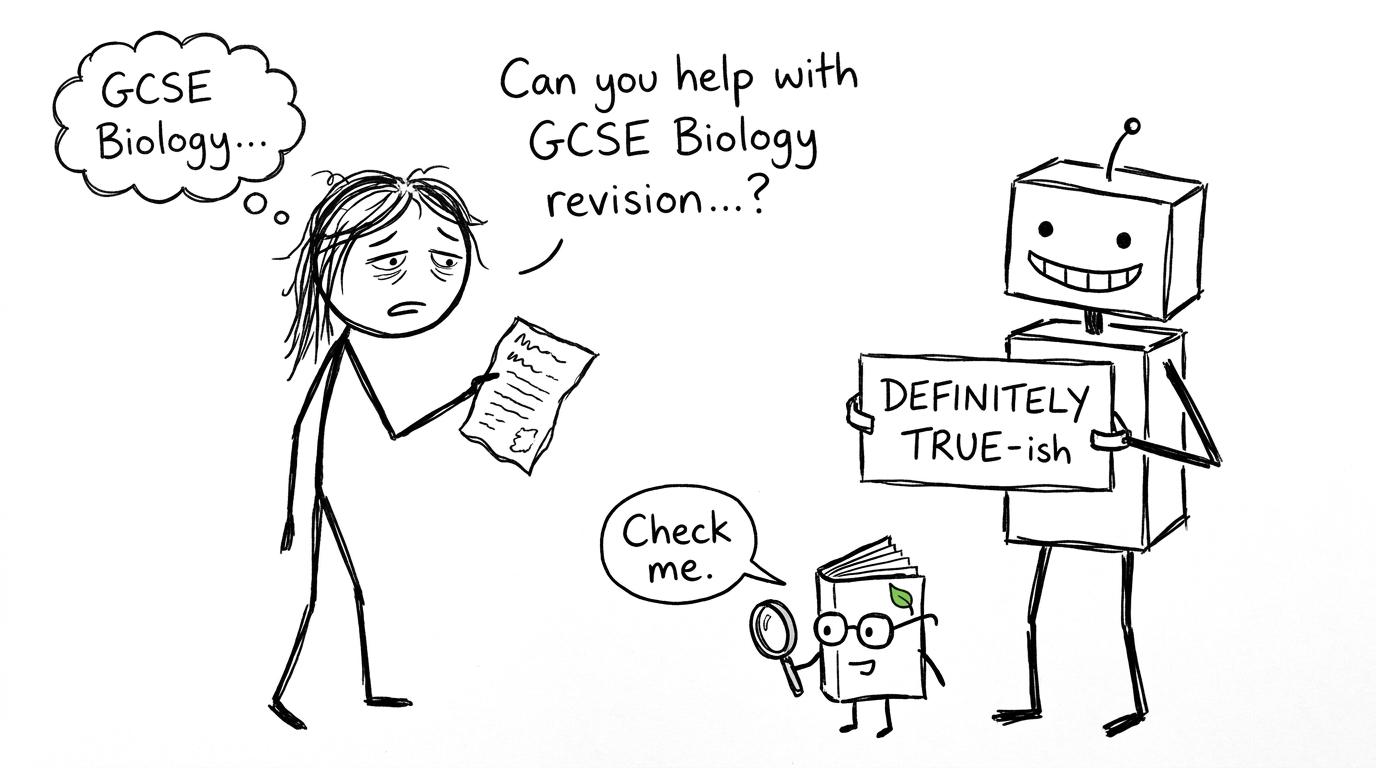 A student and robot learn that confident revision answers still need checking
Where AI tools can genuinely help
AI is most useful when it performs a narrow, testable task. “Teach me all of cell biology” invites a broad answer that is difficult to check. “Quiz me on cell structure using my exam board's topic list, one question at a time” gives you something active and measurable.
Creating retrieval questions
A chatbot can quickly turn a verified topic list into short-answer questions, flashcard prompts or multiple-choice questions. Ask it to withhold the answers until you respond. You then have to retrieve the knowledge rather than recognise a polished explanation.
A useful prompt structure is:
Quiz me on this GCSE Biology topic one question at a time. Do not reveal the answer until I reply. After each response, identify what is correct, what is missing and what I should verify in my course materials.
Paste only a topic heading or material you are allowed to share. Do not assume that adding an exam board's name guarantees perfect specification alignment.
Explaining a difficult idea in different ways
Sometimes a textbook explanation simply does not land. AI can restate an idea using simpler language, an analogy or a sequence of short questions. That flexibility can help with processes such as enzyme action, inheritance, homeostasis or natural selection.
The risk is that simplification removes an essential condition or technical term. Once the basic idea makes sense, return to your specification and rewrite it using accurate scientific vocabulary.
Planning revision around weak areas
AI can help turn a large topic list into a manageable timetable. Give it the topics you have already classified as secure, uncertain or weak, along with the time genuinely available. Keep the plan specific enough to follow and flexible enough to change after a test.
The diagnosis must come first. A chatbot cannot know your weaknesses merely because you say Biology feels difficult. Use marked classwork or exam questions as evidence. The same principle is explained in MathsGenie's guide to finding your weakest GCSE topics.
For students managing several subjects, the GCSE maths revision timetable guide also shows how to combine focused topic sessions with timed practice without filling every free hour.
Giving feedback on your explanation
Try explaining a process from memory, then ask the tool to identify unclear statements, missing stages or incorrect terminology. Tell it not to rewrite the whole response immediately. A hint preserves more of the thinking.
Afterwards, verify the feedback. For an exam-style response, the official mark scheme remains more authoritative than an AI-generated judgement. Biology marks can depend on precise relationships, comparisons and named structures that a general answer may overlook.
Supporting the maths inside Biology
GCSE Biology may require you to interpret graphs, rearrange equations, use ratios, calculate percentages and work with standard form. Common relationships include magnification:
magnification=image sizeactual size\text{magnification}=\frac{\text{image size}}{\text{actual size}}magnification=actual sizeimage sizeand percentage change:
percentage change=changeoriginal value×100\text{percentage change}=\frac{\text{change}}{\text{original value}}\times 100percentage change=original valuechange×100AI can ask you which operation is needed, check units or provide a hint. It should not become a calculator you copy from. You need to set out the method independently and judge whether the result is sensible.
If powers of ten cause difficulty, use MathsGenie's standard form revision resources. For experimental data and likelihood, the probability revision guide can strengthen the underlying maths. Check that any topic resource matches the maths course and level you need.
Where AI tends to lead students astray
The central weakness of generative AI is easy to miss: it produces plausible language, not guaranteed truth. UK government guidance warns that generated content can be inaccurate, biased, out of date, unsafe or unreliable.
Invented facts and references
An AI response may include a convincing technical detail or source that does not exist. The danger is greatest when the answer is close enough to your knowledge to feel believable.
Ask for sources if that helps you investigate, but open and verify the original material yourself. Never treat a citation as genuine merely because it has a scientific-looking title.
Mixing specifications and qualification levels
Edexcel, AQA, OCR and Eduqas do not organise every topic identically. Separate Biology and Combined Science also differ in breadth, while foundation and higher tier requirements can vary. AI may blend GCSE content with A Level detail or introduce terminology your specification does not require.
Extra knowledge is not automatically harmful, but it can consume revision time and blur the concise answer the question needs. Your specification defines the boundary.
Producing weak exam answers
A fluent paragraph may explain the general science yet miss the wording rewarded by a mark scheme. AI also struggles to judge context reliably. “Describe”, “explain”, “compare”, “evaluate” and “calculate” demand different responses.
Use AI to question your understanding, then use real exam questions to learn assessment. This mirrors effective maths revision: MathsGenie's GCSE predicted papers are useful because they require you to produce answers, while mark schemes and video solutions reveal what your working must communicate.
Making revision passive
Reading a generated summary can create familiarity without recall. The page looks clear, so the topic feels learned. Then the information disappears when the notes close.
A better rhythm is question, attempt, check, correct and retest. The 20-minute GCSE revision routine uses the same active structure for maths and can be adapted to Biology.
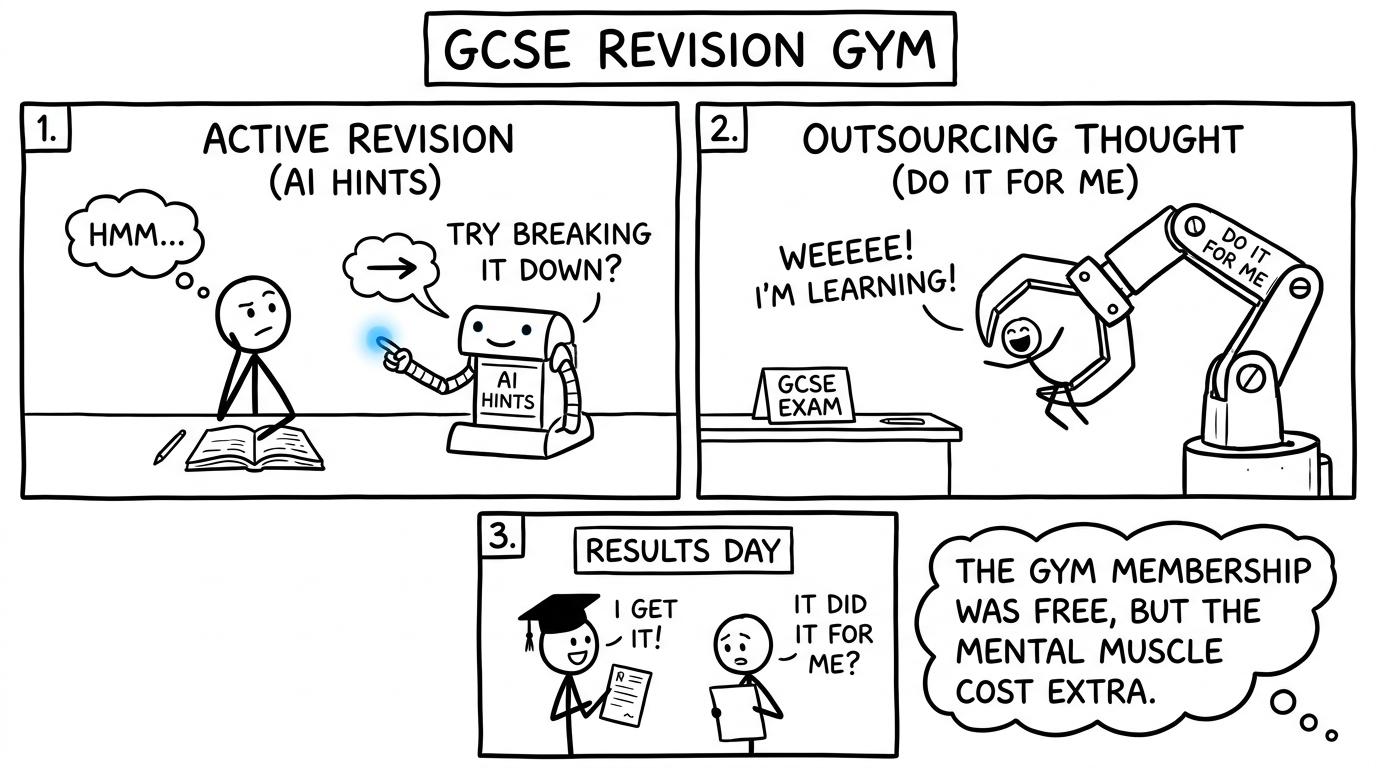 A revision gym contrasts helpful AI hints with letting a machine do all the thinking
A safer AI revision routine
A productive session can follow five stages.
Start with an authoritative boundary
Choose one specification point, teacher checklist or verified textbook section. This prevents the conversation from drifting into unrelated material.
Retrieve before receiving help
Write everything you remember. Draw the process if useful. Only then ask AI to quiz you or identify possible omissions. The attempt is where learning begins.
Request hints before answers
Ask for one prompt at a time. If the tool immediately supplies a complete response, you practise reading rather than solving.
Verify and record corrections
Check claims against your approved materials. Record only the correction you need, not another page of notes. If the disagreement cannot be resolved, ask your teacher.
Finish without AI
Complete a fresh question under timed conditions with the chatbot closed. Mark it using the supplied scheme. This final independent attempt tells you whether the session worked.
Maths students can use the same loop with GCSE mini tests: attempt independently, mark carefully, revisit the weak skill and test it again.
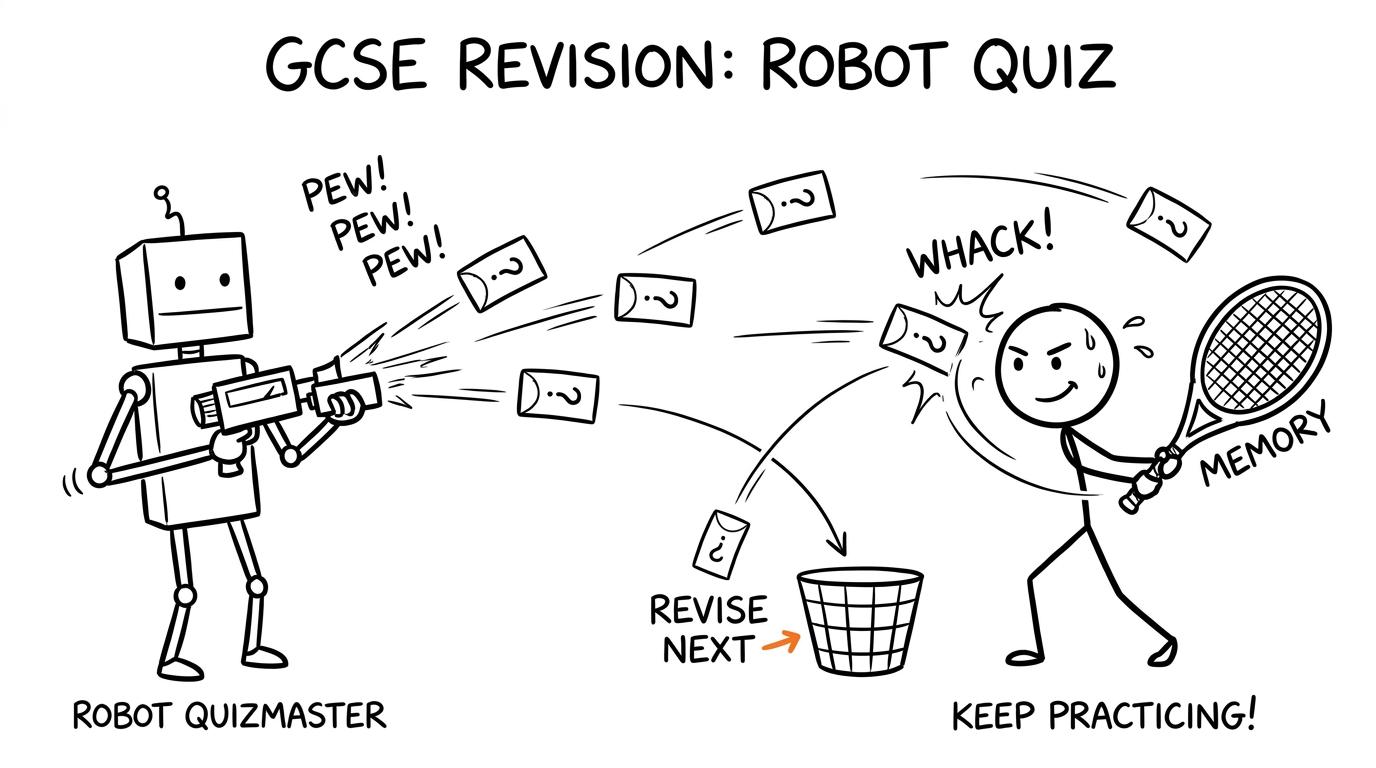 A robot quizmaster turns mistakes into a clear revise-next list
Common mistakes when revising Biology with AI
Trusting the first response
Never confuse a quick response with a checked response. Verify definitions, equations, practical methods and specification claims.
Asking questions that are too broad
Broad prompts generate broad notes. Name one topic, one level and one task, such as retrieval, feedback or planning.
Copying instead of recalling
If the tool writes every answer, it is practising more than you are. Close the response and reproduce the idea independently.
Letting AI mark everything
AI feedback can suggest improvements, but it is not an official examiner. Use teacher feedback and mark schemes for exam-standard decisions.
Ignoring units and scale
In biological calculations, an answer can have correct arithmetic but incorrect units. Write the units at each stage and check conversions independently.
Sharing restricted or personal material
Do not upload confidential assessment questions, names, login details or identifying information. Follow your school's rules and the platform's age and privacy requirements.
Make AI the assistant, not the revision method
AI can remove friction. It can produce questions, rephrase an explanation and help organise tomorrow's session. What it cannot do is build recall on your behalf or guarantee that an answer fits your specification.
The quiet advantage comes from keeping the roles clear. Let AI prompt. Let authoritative materials verify. Let exam questions measure. Let your own corrections drive the next session.
For the maths skills supporting Biology and your wider GCSE preparation, make MathsGenie your free revision base. Use revision lessons to rebuild a method, practice questions and mini tests to make it secure, then past papers and predicted papers to test it. Mark schemes and video solutions complete the loop. Start with one weak skill today, attempt it without help and make the next answer your own.










