GCSE Physics Results Day Questions Answered
GCSE physics results day questions answered: understand grades, boundaries, marking reviews, scripts and practical next steps for students and parents.
Results day can make one printed line feel larger than the two years behind it. Yet a Physics result is information, not a verdict. This guide answers the most common GCSE physics results day questions for students and parents, including what grades mean, how boundaries work and what to do if something appears wrong.
For the June 2026 exam series, GCSE results are released on Thursday 20 August 2026. Your school or exam centre will confirm when and how you can collect them. If a result is unexpected, speak to the exams officer before requesting anything: a script can often be checked first, while a review of marking can move a mark up, down or leave it unchanged.
Your results-day checklist
- Confirm your school's collection time and arrangements.
- Bring any identification your centre requests.
- Check whether the result is for separate Physics or Combined Science.
- Keep your results slip safe for sixth-form or college enrolment.
- Ask for your component marks if they are not shown.
- Speak to a teacher or exams officer before requesting a review.
- Contact your intended sixth form or college promptly if an offer is affected.
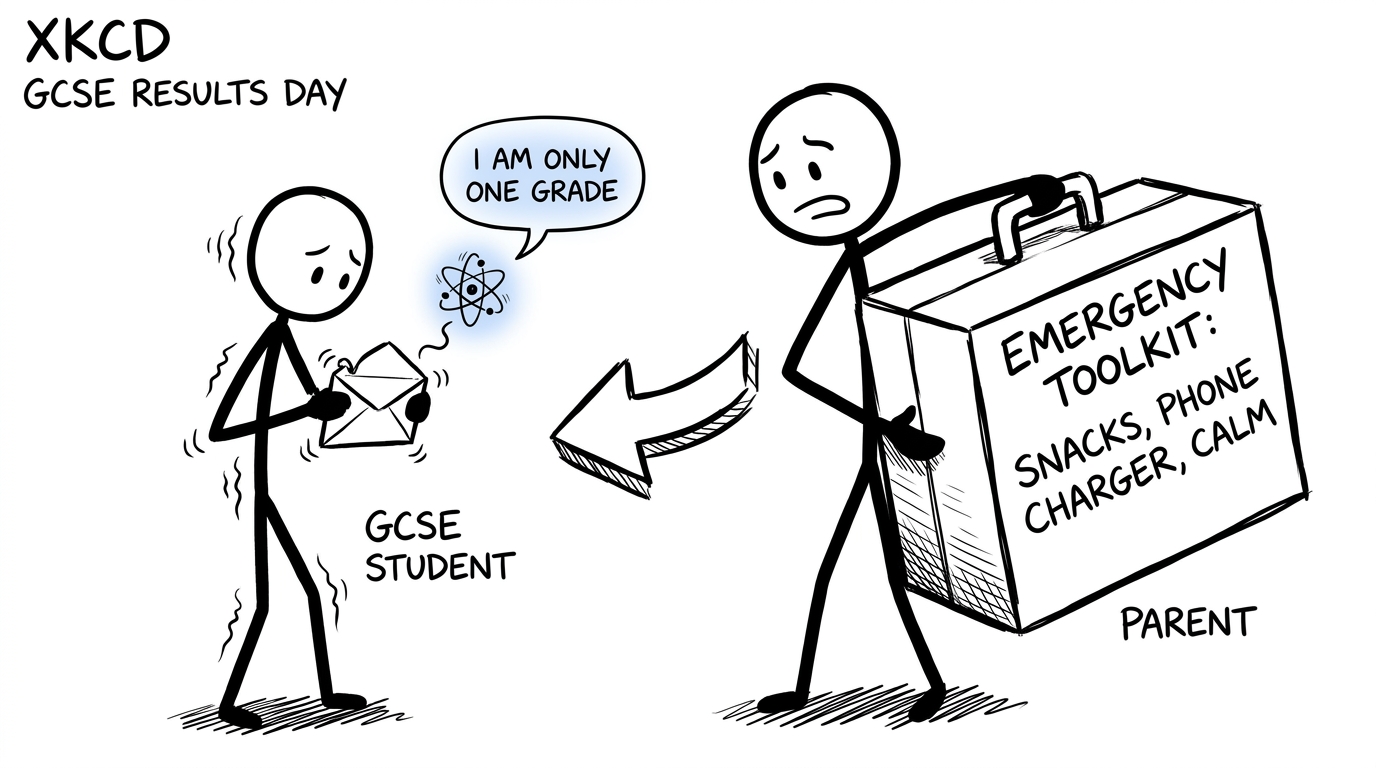 A GCSE student opening a results envelope beside a reassuringly overprepared parent
When is GCSE Physics results day in 2026?
GCSE results from the June 2026 series are released to candidates on Thursday 20 August 2026. Results must not be given to students before the official release time, although schools receive confidential access earlier so that staff can prepare.
Your centre decides the practical details. Some schools distribute printed slips; others also provide secure online access. Check messages from your school rather than assuming that arrangements will match another centre.
What will my Physics result look like?
If you took separate sciences, Physics is an individual GCSE graded from 9 to 1, with 9 the highest grade. Your overall result normally reflects your combined performance across the Physics papers, rather than giving you a separate qualification grade for each paper.
You may also see paper marks or component information. If these are missing, ask your exams officer. They can help you compare the result with the correct grade boundaries for your exam board and tier.
Why do Combined Science students receive two grades?
Combined Science is worth two GCSEs, so students receive a double grade such as 7-7 or 6-5. It is a combined award based on assessment across Biology, Chemistry and Physics; there is no separate certified Physics grade.
A strong Physics performance can contribute to the overall result, but it cannot usually be separated and presented as its own GCSE. This matters when discussing entry requirements, so ask the sixth form or college how it treats Combined Science grades.
How are GCSE Physics grade boundaries decided?
A grade boundary is the minimum mark required for a particular grade in that exam series. Exam boards set boundaries after the papers have been taken and marked, accounting for how demanding the assessments proved to be.
Boundaries can therefore change between years. Last year's figures may help with past-paper practice, but they cannot predict this year's result exactly. Use the boundary document for your board: Edexcel, AQA, OCR or Eduqas, and check that you have selected the correct specification and tier.
For future preparation, the Maths Genie GCSE Physics revision hub organises resources by exam board.
What should I do if my Physics grade is lower than expected?
Pause before deciding that the marking must be wrong. First:
- confirm the exam board, qualification and tier;
- request the paper or component marks;
- compare the total with the published boundary;
- ask a Physics teacher whether the result fits the evidence;
- check whether access to the marked scripts would be useful.
A script allows a teacher to look for an unmarked response, a totalling issue or a possible marking error. It can also show that the marks were awarded correctly, even when the result feels disappointing.
Students preparing for another assessment can rebuild confidently through AQA GCSE Physics past papers, Edexcel Physics revision guides or the relevant board area on Maths Genie.
Is a review of marking the same as a remark?
Not quite. The official process is a review of marking. A reviewer checks whether the original marking contained errors; the paper is not automatically marked again from scratch simply because the student was close to a boundary.
Requests are normally submitted by the school or college, with the student's written consent. Private candidates may be able to approach the exam board directly. Fees and arrangements vary, so ask your centre before proceeding.
For the June 2026 series, the JCQ deadline for awarding organisations to receive most review-of-results requests is 24 September 2026. Schools often set earlier internal deadlines.
Can my grade go down after a review?
Yes. A review can increase the mark, leave it unchanged or reduce it. That is why informed consent is required. Being one mark below a boundary does not, by itself, prove that an error occurred.
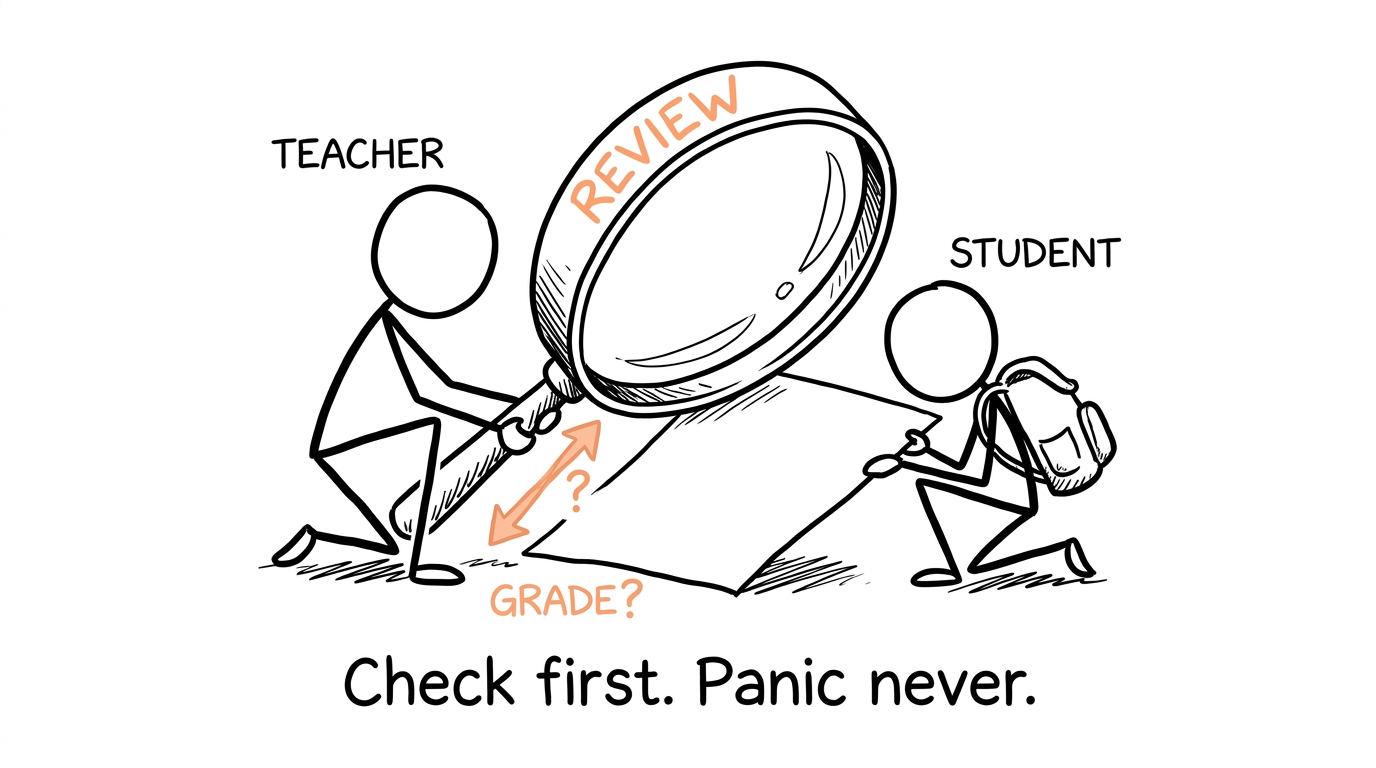 A teacher and student inspecting an exam paper with an enormous review magnifying glass
Will a lower Physics grade affect sixth-form or college entry?
It depends on the provider and course. A Level Physics commonly has subject-specific Physics or Combined Science requirements, often alongside a GCSE Maths requirement, but each institution sets its own policy.
If you narrowly miss an offer, contact the provider on results day. Give the exact grades and ask whether it can consider your full profile, a marking review in progress or an alternative course. Do not assume the decision before speaking to someone.
Strong algebra, graphs, proportional reasoning and standard form remain important for Physics. The GCSE Maths revision area can help strengthen those foundations.
What should I revise after results day?
Your next step should match your destination. Students moving towards A Level Physics can revisit equations, units, graphs and experimental reasoning. Those resitting or consolidating GCSE content should begin with marked questions, identify recurring gaps and then practise those topics deliberately.
Use the correct board resources, including OCR Twenty First Century Physics revision and CCEA GCSE Physics revision where relevant. Maths Genie's GCSE predicted papers and revision resources can support a broader exam plan.
Common results-day mistakes
The most common mistakes are comparing boundaries with the wrong board, treating a Combined Science grade as a separate Physics result, assuming a review cannot lower a mark and waiting too long to contact a school or college.
Parents can help most by slowing the first conversation down. Record the marks, boundaries, deadlines and available options. A calm decision made with evidence is usually better than an immediate request made from disappointment.
Turn one result into a useful next step
A result closes one exam series, but it also shows where to begin next. Check the details, ask sensible questions and use the formal post-results process only when the evidence supports it.
Then return to what can still be changed. Explore Maths Genie's free GCSE Physics resources, choose your exam board and build your next stage around revision lessons, practice questions, past papers, predicted papers, mini tests, mark schemes and video solutions.