

GCSE Physical Education Remark: Results Day Guide
GCSE physical education remark guide: understand reviews of marking, PE moderation, deadlines, risks and when asking your school is worthwhile.

Results day can reduce two years of work to one unsettling question: was that mark right? If your PE grade is lower than expected, a GCSE physical education remark may be worth discussing. The short answer is to speak to your teacher or exams officer quickly, check your component marks and grade boundary, and ask whether the evidence suggests a marking error.
A “remark” is officially a review of marking. It is not a fresh mark from scratch, and your mark can rise, stay unchanged or fall. Physical Education also includes non-exam assessment, so the correct process depends on whether your concern involves a written paper or moderated practical and analytical work.
Your results-day decision checklist
Before requesting anything, establish:
- which exam board you took: AQA, Edexcel, OCR, Eduqas or WJEC;
- your total mark and the boundary for the grade above;
- whether the concern relates to a written examination or PE non-exam assessment;
- whether your teacher can inspect a copy of the marked script;
- whether there is specific evidence of a marking or administrative error;
- what your school charges and when its internal deadline falls;
- whether you accept that an individual reviewed mark can decrease.
Use the relevant MathsGenie pages to inspect AQA GCSE Physical Education grade boundaries, Eduqas GCSE Physical Education grade boundaries or WJEC GCSE Physical Education grade boundaries. AQA students can also explore the Physical Education grade calculator.
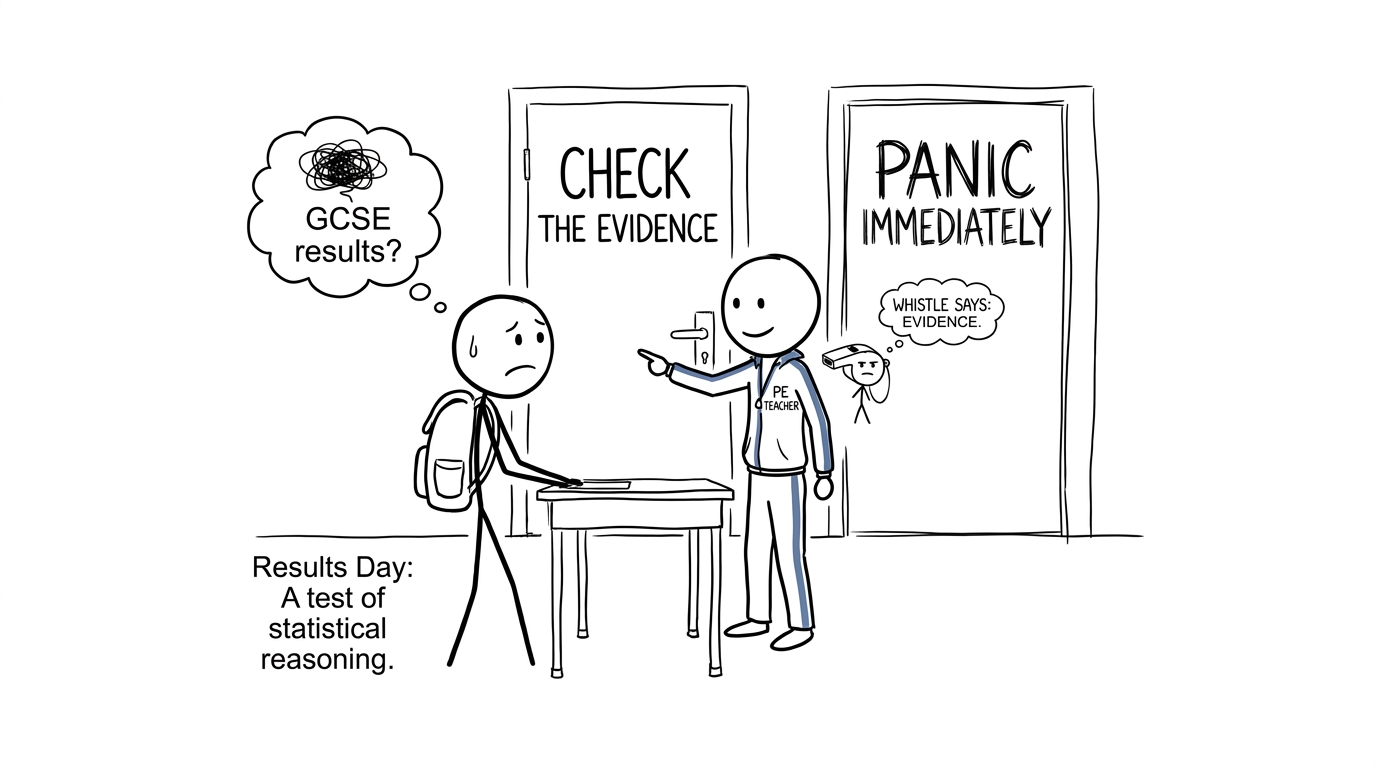 A student choosing between checking evidence and panicking on results day
How the GCSE physical education re-mark process works
Speak to your school first
Internal candidates cannot normally send a review request directly to an exam board. Contact your PE teacher, head of department or exams officer. Your school will explain its procedure, fees and internal deadline. Private candidates should follow their exam board’s instructions.
For the June 2026 series, the JCQ deadline for clerical re-checks, reviews of marking and reviews of moderation is 24 September 2026. Schools often set earlier deadlines so that they have time to examine the evidence and submit requests. Do not wait until the final week.
Identify the component causing concern
GCSE PE combines externally marked written examinations with internally assessed, externally moderated work. These need different post-results services.
| Concern | Relevant service | Individual request? |
|---|---|---|
| A question may be unmarked or marks may be totalled incorrectly | Clerical re-check | Yes |
| The mark scheme may have been applied incorrectly on a written paper | Review of marking | Yes |
| The centre’s PE non-exam assessment may have been moderated incorrectly | Review of moderation | No, this concerns the centre’s original sample |
A review of marking includes a clerical check. The reviewer checks whether the original marking correctly applied the mark scheme; they do not simply mark the entire paper again without regard to the first decision.
Ask whether the script can be checked
Where access to scripts is available, a teacher can compare your responses with the mark scheme before recommending a review. This is more useful than relying only on how the examination felt.
Strong reasons might include an apparently unmarked response, a total that looks wrong or an answer that your teacher believes has not been credited according to the mark scheme. Being one mark below a boundary makes the outcome more consequential, but it does not itself prove an error.
Give informed consent
Your school must obtain your written consent after results are published before requesting a clerical re-check or review of marking. That is because the component mark and overall grade may go down, remain the same or go up.
A standard review of marking is normally completed within 20 calendar days of the awarding body receiving it. A clerical re-check is normally completed within 10 calendar days. Costs vary by board and school policy, so obtain the current figure from your exams officer rather than relying on an older online fee table.
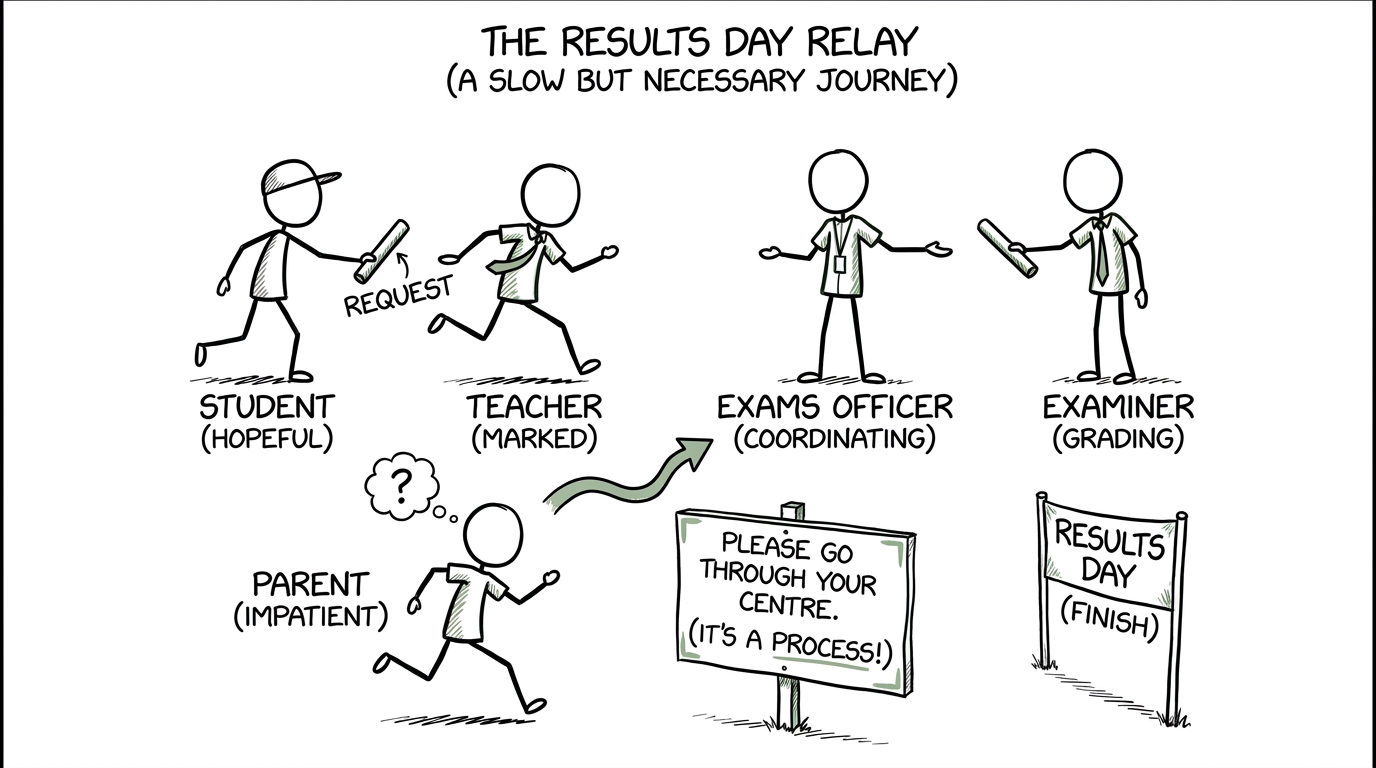 A results review request passed between student, teacher, exams officer and examiner like a relay baton
The important difference for PE non-exam assessment
The practical performance and associated analytical or evaluative work are generally marked by teachers and moderated by the exam board. After results day, an individual student cannot request a review of moderation solely for their own work.
Instead, the school decides whether to request Service 3, which reviews whether moderation was applied fairly, reliably and consistently to the original sample. It is not a new assessment of one student’s sporting performance. The process may take up to 35 calendar days after the reviewer receives the sample.
Under JCQ rules, a review of moderation may change candidate marks, but published subject grades are not lowered for that series as a consequence of the review. If your concern is about your school’s original internal marking, the opportunity to challenge that should have been provided before marks were submitted to the exam board.
When requesting a review is sensible
Consider proceeding when your teacher identifies a plausible error, the script contains a response that may not have been credited, or a small mark change would affect an important next step.
Pause when the argument is only “I usually get a higher grade”, when nobody has inspected the component evidence, or when you have not understood the risk and fee. A narrow boundary gap tells you what change is needed. It does not tell you how likely that change is.
If the review does not resolve a genuine concern, appealing a GCSE Physical Education grade is a later and separate process. An appeal normally follows a completed review and focuses on whether the exam board followed its procedures and applied the mark scheme properly. Your centre submits it; an appeal is not simply another attempt to secure a more generous academic judgement.
Common mistakes to avoid
- Calling it an automatic re-mark: the official service reviews whether the original marking was correct.
- Confusing papers with NEA: individual written papers can be reviewed; moderation is a centre-level process.
- Missing the school deadline: it may be earlier than the awarding body’s deadline.
- Assuming a boundary gap proves an error: proximity matters, but evidence matters more.
- Ignoring downward movement: written-paper marks and grades can fall after a review.
- Trying to apply directly: most students must make the request through their school or college.
Make the next decision calmly
Results day rewards a short sequence: check the boundary, identify the component, inspect the evidence and speak to the exams officer. Start with MathsGenie’s GCSE Physical Education grade-boundary pages, then follow your school’s current post-results policy.
Once the decision is made, turn your attention towards what comes next. Use the free GCSE maths revision hub for revision lessons, practice questions, past papers, mark schemes and video solutions. You can organise the work with the MathsGenie revision planner and build exam confidence through GCSE predicted papers. Evidence is the best guide for a review, and it remains the best guide for improving your next result.











