

GCSE Physical Education Grade: Sixth Form Guide
GCSE physical education grade sixth form guide: understand entry expectations, A Level PE readiness, alternatives and the next steps to take now.
Opening a sixth-form prospectus can make one GCSE result feel like a verdict on your future. It is not. Your GCSE physical education grade sixth form options depend on the provider: many ask for grade 555 or 666 in PE, while others accept a strong grade in Biology, Combined Science, English or Maths instead. Some also expect regular competitive participation in an approved sport.
The important point is simple: there is no single entry grade used by every sixth form or college. Check the published requirements for each course, then ask the PE department how it treats predicted grades, near misses and students who did not take GCSE PE.
Your quick sixth-form checklist
Before choosing A Level Physical Education, check:
- the course-specific GCSE PE requirement;
- the provider's general GCSE entry requirements;
- any required grades in Science, English or Maths;
- whether GCSE PE is compulsory or merely desirable;
- whether your sport and performer or coach role are permitted;
- expectations for training, competition and evidence;
- alternatives such as a vocational Sport qualification.
Entry criteria can change between admission years, so use the prospectus for the year in which you intend to start.
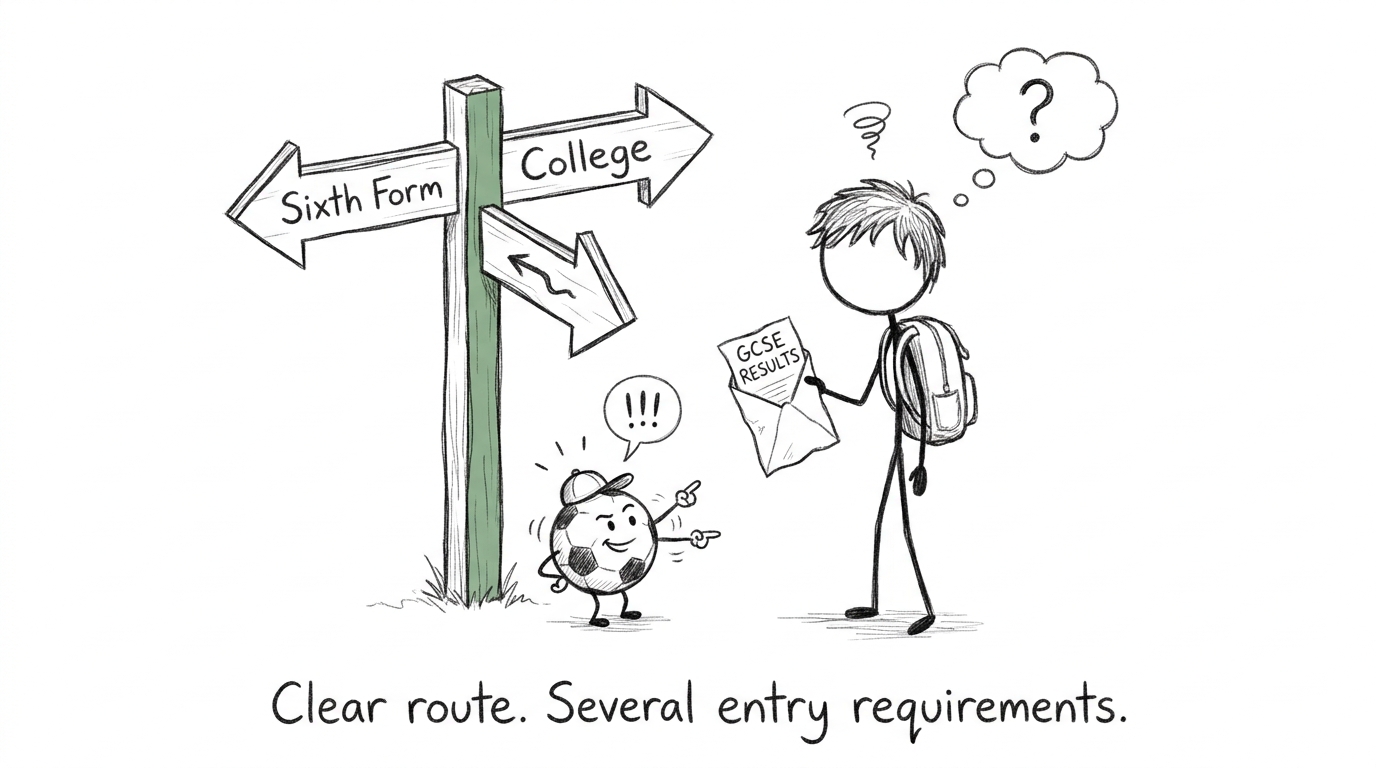 A student consulting a confusing sixth-form signpost
GCSE Physical Education grade meaning, grade by grade
A grade shows your performance across the qualification, not simply how good you are at sport. GCSE PE combines examined theory with non-exam assessment, although the precise structure depends on whether you study AQA, Edexcel, OCR or Eduqas.
Grades 999 to 777: a strong academic foundation
These grades suggest that you can recall subject knowledge, apply it to sporting contexts and analyse performance effectively. You are likely to satisfy the PE grade requirement at many providers, but admission is never automatic. General sixth-form requirements and grades in subjects such as Science, English and Maths may still apply.
Use this position to prepare for the jump in depth rather than assuming the course will be easy. Review anatomy and physiology through resources such as the GCSE PE muscles revision guide, and keep developing your written analysis.
Grade 666: the common target worth checking
Grade 666 appears frequently in published A Level PE entry criteria. It normally places you in a strong position, particularly when supported by secure Science and English results and meaningful participation in your chosen activity.
However, one provider may ask specifically for grade 666 in PE, while another may accept grade 666 in Biology or Combined Science instead. Read the wording closely. An alternative condition is not the same as an additional condition.
Grade 555: possible at many providers
A grade 555 can meet the requirement at some sixth forms and colleges, but not all. Your next step should be to make a shortlist and compare the exact conditions rather than ruling yourself in or out.
Ask whether the department considers your theory-paper performance, practical profile or Science grade. If Maths is part of the offer, use the GCSE Maths revision hub to target the grade you need with revision lessons, questions and papers.
Grade 444: a pass, but options vary
Grade 444 is a standard pass and may be accepted by providers with broader entry criteria. Elsewhere, it may fall below the requirement for A Level PE but satisfy entry to a vocational Sport course.
Do not treat this as a closed door. Contact the department before applying, especially if you have a stronger Biology or Combined Science grade, substantial sporting involvement or a predicted result above grade 444.
Grades 333 to 111: build a different route
These grades are unlikely to satisfy typical direct entry requirements for A Level PE. A vocational Sport qualification, GCSE resit plan or another Level 333 subject combination may provide a better immediate route.
That is a change of route, not the end of the destination. Sport-related progression can begin through different qualifications, provided you check the requirements for whatever you hope to do later.
What progressing to A Level Physical Education involves
A Level PE is not simply more practical sport. Current AQA, Edexcel and OCR specifications devote substantial assessment to written theory. Depending on the board, content can include anatomy and physiology, exercise physiology, biomechanics, skill acquisition, sport psychology, society and technology in sport.
Practical performance and performance analysis remain important. For example, current AQA, Edexcel and OCR structures allocate 30%30\%30% overall to non-exam assessment, although the components and assessment arrangements differ. A high GCSE practical mark alone therefore does not guarantee an easy transition.
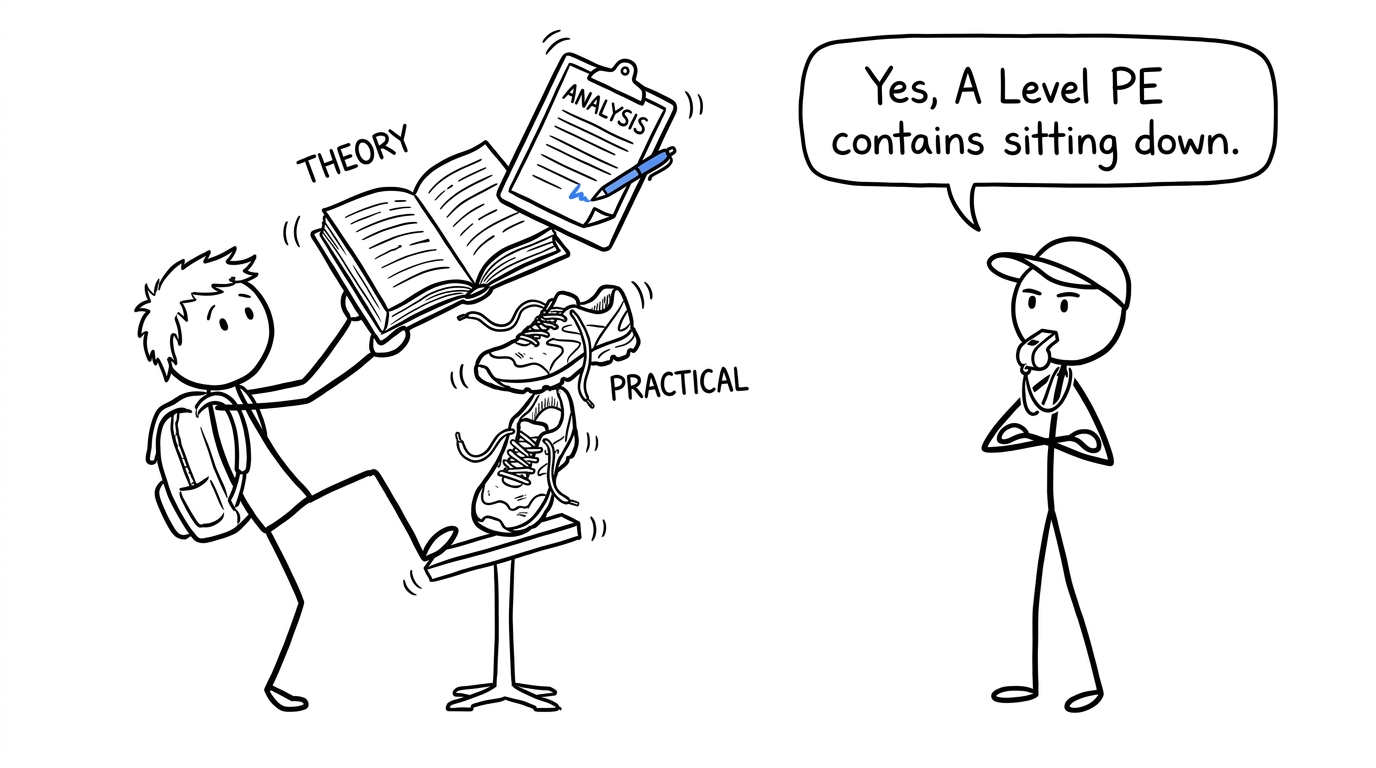 A student balancing theory, practical work and analysis
The writing matters too. Students must explain, apply, analyse and evaluate rather than list isolated facts. The health benefits of physical activity revision guide shows how knowledge can be connected to a relevant sporting example.
Why your Maths grade can affect the decision
Some providers include grade 444, 555 or 666 in Maths within either their general entry rules or PE-specific expectations. A Level PE also involves data, graphs, movement, measurements and quantitative skills, so numerical confidence is useful even when Maths is not an explicit condition.
Choose resources matching your board: AQA GCSE Maths revision, OCR GCSE Maths revision, Eduqas GCSE Maths revision or the Edexcel GCSE Maths revision hub. Topic questions can repair individual gaps, while timed papers reveal whether the skill remains secure under pressure.
Common mistakes when judging your options
- Assuming every provider asks for the same grade. Entry requirements are set locally and vary considerably.
- Looking only at GCSE PE. Science, English and Maths may form part of the offer.
- Confusing athletic ability with course readiness. A Level PE requires extensive theory, application and evaluation.
- Ignoring practical eligibility. Check that your activity and role appear in the relevant specification.
- Treating predicted grades as guaranteed admission. Providers normally explain how offers and final enrolment decisions work.
- Giving up after a near miss. Ask about alternative conditions, vocational Sport courses and the provider's policy before deciding.
Turn the requirement into a revision target
Once you know the entry grade, make it concrete. Use the free MathsGenie revision planner to organise short sessions, then combine revision lessons with practice questions, mini tests and past papers. Mark every attempt, record why marks were lost and revisit the same weakness.
If you progress to A Level PE, the AQA A Level Physical Education grade calculator can help you understand how examined marks relate to an indicative overall grade using published boundaries. It is a planning tool, not a substitute for your teacher's assessment or official results.
Your GCSE PE grade is best viewed as information. It tells you which doors may already be open and which ones require a conversation or another route. Check your chosen provider, protect the supporting grades it requires, and keep building the habits that post-161616 study rewards.
Start with MathsGenie's free revision lessons and practice questions, then test your progress using mark schemes, video solutions, past papers and predicted papers. A sixth-form requirement feels much less mysterious once it becomes a clear, workable target.











