GCSE Physical Education Grade Boundaries 2026
GCSE physical education grade boundaries for 2026, with official AQA, Edexcel, OCR and Eduqas marks plus clear results-day advice for students.
Results day can make one number feel larger than it really is. Two years of lessons, practical assessments and written papers appear to have been compressed into a single grade on a page.
Yet GCSE physical education grade boundaries are not a hidden judgement about your ability. They are simply the minimum overall marks required for each grade. Your exam and non-exam assessment marks are combined, then compared with the official boundary table for your exam board.
The physical education grade boundaries 2026 are now confirmed. GCSE results were released on Thursday 20 August 2026, when exam boards also published their final boundaries. The tables below give the official marks for AQA, Edexcel, OCR and the Eduqas Full Course.
You can also explore free board-specific resources through the GCSE Physical Education revision hub.
GCSE PE results day checklist
Before interpreting your marks, check that you have:
-
identified your exam board and specification;
-
found the table for the June 2026 series;
-
checked the qualification's maximum mark;
-
used your overall qualification mark, rather than one paper mark;
-
confirmed whether any component marks have been scaled;
-
spoken to your school before considering a review of marking or moderation.
The exam boards use different maximum totals, so marks cannot be compared directly across boards. An AQA mark out of 260260260, for example, cannot be placed against an Edexcel boundary out of 350350350.
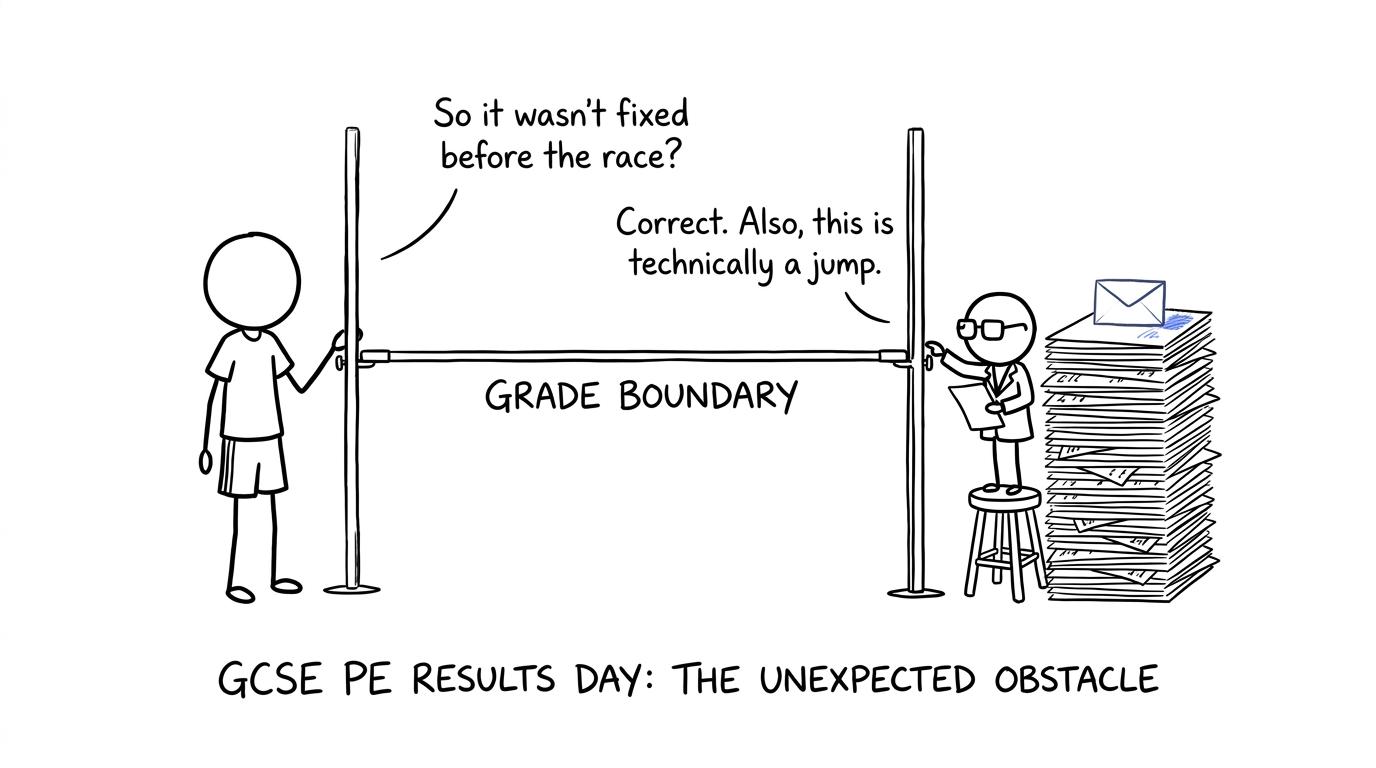 A student learns that a grade boundary is set after the assessments have been marked
Official GCSE physical education grade boundaries 2026
These are the overall June 2026 boundaries for the principal GCSE Physical Education qualifications graded from 999 to 111.
Exam board and specification | Maximum mark | Grade 999 | Grade 888 | Grade 777 | Grade 666 | Grade 555 | Grade 444 | Grade 333 | Grade 222 | Grade 111 |
|---|---|---|---|---|---|---|---|---|---|---|
AQA 858285828582 | 260260260 | 216216216 | 202202202 | 188188188 | 170170170 | 153153153 | 136136136 | 103103103 | 707070 | 383838 |
Edexcel 1PE01PE01PE0 | 350350350 | 295295295 | 278278278 | 261261261 | 237237237 | 214214214 | 191191191 | 146146146 | 101101101 | 575757 |
OCR J587J587J587 | 200200200 | 162162162 | 152152152 | 143143143 | 129129129 | 116116116 | 103103103 | 808080 | 575757 | 343434 |
Eduqas Full Course C550QSC550QSC550QS | 200200200 | 180180180 | 168168168 | 156156156 | 139139139 | 122122122 | 106106106 | 787878 | 515151 | 242424 |
A boundary is inclusive. Reaching the published number is enough for that grade. For example, an AQA total of 188188188 earns grade 777, while 187187187 falls below the grade 777 boundary and would receive grade 666.
Students taking the Eduqas Short Course need a different table:
Course | Maximum mark | Grade 999 | Grade 888 | Grade 777 | Grade 666 | Grade 555 | Grade 444 | Grade 333 | Grade 222 | Grade 111 |
|---|---|---|---|---|---|---|---|---|---|---|
Eduqas Short Course C555QTC555QTC555QT | 100100100 | 838383 | 777777 | 727272 | 646464 | 575757 | 505050 | 393939 | 282828 | 171717 |
Historical figures and subject tables are available through MathsGenie's AQA GCSE PE grade boundaries, Edexcel GCSE PE grade boundaries and Eduqas GCSE PE grade boundaries pages. The wider GCSE grade boundaries hub can help you check your other subjects.
How GCSE PE grade boundaries work
A grade boundary is the lowest total mark that receives a particular grade. It is not the average mark, a target percentage or a prediction made before the assessments.
Suppose an OCR student received 138138138 marks. The relevant boundaries are 129129129 for grade 666 and 143143143 for grade 777. Since
129leq138<143,129 \leq 138 < 143,129leq138<143,
the student receives grade 666.
Their percentage is
frac138200times100=69\frac{138}{200}\times 100=69%.frac138200times100=69
That percentage can be useful for understanding performance, but it does not decide the grade independently. The official comparison is between the student's total mark and the OCR June 2026 qualification boundaries.
There is no permanent rule stating that 7070%70 must equal grade 777, or that 5050%50 must equal grade 444. The required proportion changes because each series contains different assessments.
Why boundaries change each year
Exam boards aim to keep the standard represented by each grade comparable over time, but no two papers have precisely the same difficulty.
If an assessment proves more demanding, fewer marks may be required to demonstrate the standard associated with a grade. If it is more accessible, the mark boundary may rise. Exam boards consider evidence including marked student work, mark distributions, question performance and comparisons with previous series before confirming the boundaries.
This explains why historical figures provide context rather than certainty. A boundary rising does not necessarily mean that standards became harsher. It may show that students found that year's assessment more accessible.
Nor is there a fixed quota requiring a predetermined number of students to pass or fail. The proportion receiving each grade can vary.
Why written and practical marks both matter
GCSE PE is not awarded from the written examination alone. For the main AQA, Edexcel, OCR and Eduqas specifications, examined assessment contributes 6060%60 of the qualification and non-exam assessment contributes 4040%40.
The structure differs by board:
-
AQA uses two written papers worth 3030%30 each, with practical performance and analysis and evaluation forming the remaining 4040%40.
-
Edexcel uses two written papers worth a combined 6060%60, practical performance worth 3030%30 and a personal exercise programme worth 1010%10.
-
OCR uses two written papers worth 3030%30 each, practical performances worth 3030%30 and analysis and evaluation of performance worth 1010%10.
-
Eduqas Full Course uses one written examination worth 6060%60 and non-exam assessment worth 4040%40.
Some marks are scaled so that each component contributes its intended weighting. That is why adding numbers copied from several documents can produce the wrong total. Ask your school for the official overall qualification mark if it is not shown clearly on your results information.
Overall boundaries and notional component boundaries
The grade on your certificate comes from the overall qualification boundary. Written papers and practical components contribute marks towards that total, but they do not normally receive separately certificated GCSE grades.
Exam boards may publish notional component boundaries. These help teachers understand how performance on an individual paper broadly compares with a grade standard, but they are analytical guides rather than separate awards.
A student might appear to perform at grade 555 on one component and grade 777 on another. The final result is still calculated from the combined subject total. Strong practical marks can balance weaker written marks, just as strong theory marks can support a lower practical total.
What to do if your PE result is unexpected
Start by asking your school for three pieces of information:
-
your overall qualification mark;
-
your marks for each component;
-
the number of marks between your total and the next boundary.
A disappointing result is not, by itself, evidence of a marking error. Your teacher or exams officer can help decide whether a clerical check, review of marking or review of moderation is appropriate.
A review can cause a mark or grade to rise, stay unchanged or fall. Practical work is internally assessed and externally moderated, so the correct process may differ from the review used for a written paper. Discuss the evidence, deadline, fee and possible consequences before giving consent.
If the result affects a sixth-form, college or apprenticeship place, contact the provider promptly. Explain your confirmed grade and ask whether there is any flexibility, rather than assuming that one boundary has ended the conversation.
Common mistakes when reading PE boundaries
Using the wrong exam board
A total of 190190190 means something different on each specification. Check the board, course code, series and maximum mark before making any comparison.
Treating a percentage as a fixed grade
There is no universal GCSE PE percentage scale. Always use the official mark boundary for your qualification.
Comparing 2026 marks with an older table
Boundaries change between series. A 2025 table may help you see a pattern, but it cannot replace the June 2026 figures.
Using a component boundary as the final result
Notional paper boundaries do not award your qualification grade. The combined overall mark is decisive.
Assuming one mark below guarantees a successful review
Distance from a boundary tells you how much movement is needed. It does not prove that an assessment was marked incorrectly.
Turn the result into a useful next step
A grade boundary tells you where your mark landed. More importantly, your component marks can show where improvement is possible.
Use the AQA GCSE PE past papers, Edexcel GCSE PE past papers, OCR GCSE PE past papers or Eduqas GCSE PE past papers to practise with the correct specification. Complete a paper under timed conditions, compare your answers with the mark scheme and record the topics where marks were lost.
MathsGenie brings revision lessons, practice questions, past papers, mark schemes and video solutions together for free. If you are preparing for mocks, a resit or your next set of maths exams, the MathsGenie revision planner can turn those gaps into a realistic day-by-day plan.
Results day gives you a number. Good revision gives that number context, and gives you a next move.