GCSE Maths Resit Pass Rate: Beat the Odds
GCSE maths resit pass rate figures look daunting. Understand the November 2025 results and follow a focused revision plan to reach grade 4 or above again.

A resit can feel heavier than the first attempt. You already know what an exam hall feels like, and you may be balancing maths, English Language, college work and everything else that did not pause when Year 11 ended.
The GCSE maths resit pass rate confirms that the challenge is real, but it does not decide your result. JCQ's provisional November 2025 figures show that about 23%23\%23% of maths entries achieved grade 444 or above. For English Language, the corresponding figure was about 37.5%37.5\%37.5%.
Those numbers describe a national group, not your personal probability of passing. The practical answer is to identify where your marks were lost, rebuild those areas through active practice and use timed papers to make the improvement visible.
Your resit checklist
A successful plan should include:
- your previous grade and, if available, your marks by paper
- the correct exam board and tier for maths
- a topic audit based on questions, not memory
- short, regular sessions for both maths and English Language
- marked exam questions followed by corrections
- timed past papers before the exam
- a clear record of recurring mistakes
Start with the free GCSE Maths revision hub, where you can choose your exam board and find relevant revision materials, papers and mark schemes.
What the November 2025 resit statistics mean
A grade 444 is generally described as a standard pass, while grade 555 is a strong pass. When people discuss the maths resit pass rate, they usually mean the proportion of entries awarded grade 444 or above.
The rounded November 2025 figures can be pictured like this:
Maths grade 4+≈23%\text{Maths grade } 4+ \approx 23\%Maths grade 4+≈23% English Language grade 4+≈37.5%\text{English Language grade } 4+ \approx 37.5\%English Language grade 4+≈37.5%In a hypothetical group of 100100100 entries, that would be about 232323 grade 4+4+4+ results in maths and about 373737 or 383838 in English Language. It does not mean that every student has exactly those chances. National figures combine candidates with different starting grades, attendance, preparation time, tiers and personal circumstances.
They also measure results in one exam series. They do not directly tell us how many marks each student improved or how consistently each person revised. That distinction matters. Statistics describe the crowd; revision changes the individual.
Why the GCSE maths resit pass rate is low
JCQ result tables show outcomes, rather than proving why each candidate received a particular grade. Still, several structural difficulties help explain why November resits are demanding.
The turnaround is short
Students receiving summer results have only a limited period before a November examination. Some of that time is spent enrolling at college, adjusting to a new timetable and arranging the resit. If revision begins slowly, there may be little time left for diagnosis, topic practice and full papers.
The answer is not to revise everything at once. It is to find the topics that can return the most marks soonest.
Old revision habits often produce old results
Watching a solution can create a feeling of understanding. The real test is whether you can answer a similar question later without help.
Effective revision has a simple rhythm: attempt, mark, correct and retry. MathsGenie's free GCSE resources support that process with revision lessons, practice questions, video solutions and exam-style work. Videos should explain the method; questions should prove that you can use it.
Resitters have competing demands
Many candidates are taking both maths and English Language alongside a full college or sixth-form timetable. English may be neglected because maths feels more urgent, or maths may be avoided because it feels less comfortable.
Treat the subjects differently. Maths improves through repeated methods, accurate working and exposure to unfamiliar wording. English Language needs regular reading, planning and timed writing. Both benefit from frequent practice more than occasional marathon sessions.
The problem may be exam execution, not just knowledge
A student can understand percentages and still lose marks by misreading a change question. Another may know the correct method but show too little working to access method marks.
This is why papers matter. Students following Edexcel can use the Edexcel GCSE Maths past papers, while those taking other specifications should select the matching exam board. AQA GCSE Maths revision includes both foundation and higher routes.
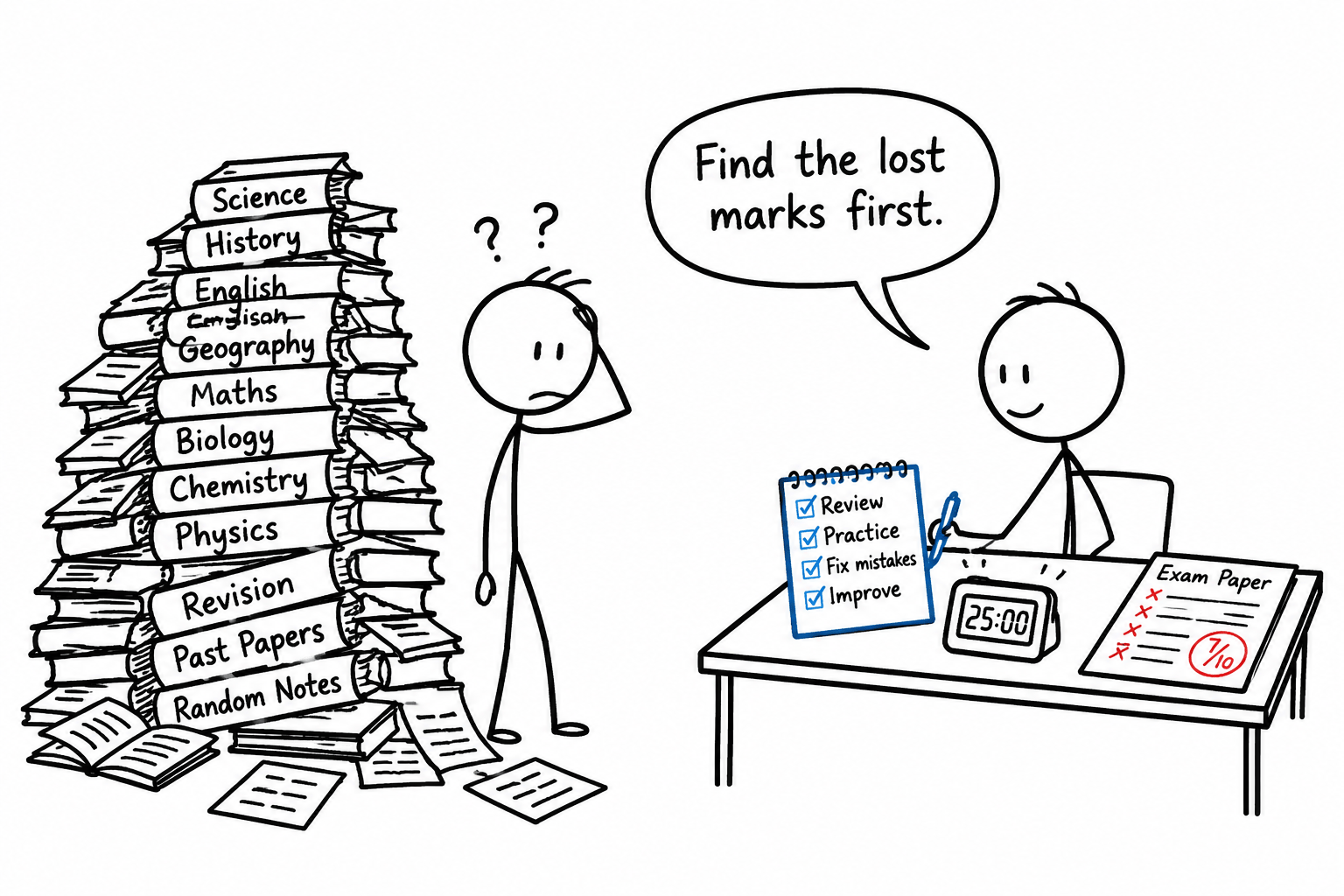 Stick figures compare random revision with a calm checklist and marked paper
What successful resitters do differently
Passing is rarely the result of discovering one secret topic. It usually comes from collecting marks that were previously being left behind.
They begin with evidence
Complete a paper or a representative set of questions without notes. Mark it honestly and label each lost mark:
- knowledge gap
- method error
- arithmetic error
- misread question
- incomplete working
- time pressure
This creates a useful revision list. “Revise algebra” is vague. “Practise expanding brackets and solving equations with an unknown on both sides” is actionable.
If your exam board is CCEA, use the dedicated CCEA GCSE Maths papers. Students following WJEC can work from the WJEC GCSE Maths past-paper collection. Specification-matched practice matters because paper structures and assessment arrangements differ.
They prioritise reliable marks
If the immediate goal is grade 444, begin with accessible topics that appear across the course: number operations, fractions, decimals, percentages, ratio, basic algebra, measures, area, probability and interpreting graphs.
That does not mean ignoring harder questions forever. It means securing foundational marks before spending an entire evening on one demanding problem.
Foundation tier awards grades 111-555, while higher tier awards grades 444-999, with grade 333 available in limited circumstances. Tier decisions should be made with your teacher or exam centre using current performance, not pride or fear.
They correct every paper
A marked paper is not the end of a task. It is the start of the most valuable part.
For each error:
- identify why the mark was lost
- review the relevant lesson or video solution
- complete several similar questions
- return to the original question without notes
- record the topic for another check later
Mark schemes help you notice required working, units, notation and acceptable answers. Predicted papers can provide fresh exam-style practice near the examination, but they should supplement revision rather than replace past papers or the specification.
They build consistency before intensity
A realistic weekly plan might contain four short maths sessions, two English Language sessions and one timed paper block. A MathsGenie revision planner, mini tests and topic practice can help turn a broad intention into specific tasks.
Thirty focused minutes with completed questions is usually more useful than two distracted hours with a video playing in the background. Protect the routine. Motivation often arrives after progress becomes visible, not before.
A focused resit revision cycle
Use three repeating stages.
Diagnose
Sit a paper or mini test under controlled conditions. Note your score, but study the pattern behind it. Which topics repeatedly cost marks? Are you running out of time? Do calculator mistakes appear across several topics?
Repair
Choose two or three weaknesses at a time. Use a revision lesson, then complete questions without copying the method. Mark the work immediately and retry errors after a short gap.
For English Language, repair might mean planning responses more quickly, using evidence precisely or reserving enough time for the extended writing task. Follow your own exam board's specification and mark schemes.
Rehearse
Return to timed papers. Use the permitted equipment, observe the official time and do not pause to check notes. Your score should eventually become stable around or above the relevant recent grade boundary, ideally with a cushion because boundaries vary between exam series.
Repeat the cycle until weaknesses become narrower and your timing becomes predictable.
Common resit mistakes to avoid
Revising only comfortable topics. Confidence matters, but repeatedly answering questions you can already do creates little improvement.
Completing papers without analysing them. A score records the past. Corrections change the next score.
Memorising a grade boundary. Boundaries change between exam series. Focus on gaining as many marks as possible rather than aiming at one assumed total.
Hiding working. Clear mathematical steps can earn method marks and make errors easier to find.
Using the wrong paper or tier. Confirm the exam board, specification and foundation or higher entry with your centre.
Treating November results as destiny. GCSE resit statistics describe previous entries. They cannot measure the quality of the plan you follow now.
Your next result is built before exam day
The November 2025 figures are sobering: approximately 23%23\%23% reached grade 4+4+4+ in maths, compared with about 37.5%37.5\%37.5% in English Language. But the most useful lesson is not that passing is rare. It is that vague revision is too risky.
Find the missing marks. Practise the exact skills. Correct mistakes until they stop recurring. Then rehearse under timed conditions.
Use MathsGenie's free revision lessons, practice questions, mini tests, past papers, predicted papers, mark schemes and video solutions to begin that cycle today. Your previous result is evidence about where to start, not a verdict on where you must finish.