

Iteration GCSE Maths: Revise for Your Mock
Iteration GCSE maths revision made clear: learn the method, try two exam-style questions, avoid common slips and prepare confidently for your next mock exam.
A December mock can make iteration feel complicated. The notation looks unfamiliar, and one wrong calculator button can make every later answer look strange. Yet iteration GCSE maths questions usually test a repeatable process: start with the given value, substitute it into the formula, then use each new answer to find the next one.
You need to understand the notation, use your calculator accurately and show your values clearly. This guide explains the method through two exam questions, then helps you build focused mock practice.
Your iteration mock revision checklist
Before your mock, make sure you can:
- recognise what xnx_nxn and xn+1x_{n+1}xn+1 mean;
- identify the starting value;
- substitute into the iteration formula;
- retain full calculator precision;
- write down each requested term;
- recognise when values are settling;
- round to the required accuracy.
Iteration is higher-tier GCSE Maths content. Use resources matched to your specification, whether you take Edexcel, AQA, OCR or Eduqas. The free GCSE Maths revision hub helps you find relevant lessons, questions and papers.
What iteration means in GCSE Maths
Iteration means repeating a calculation. When used to solve equations numerically, it can produce increasingly accurate approximations. An iteration formula may look like this:
xn+1=f(xn)x_{n+1}=f(x_n)xn+1=f(xn)Here, xnx_nxn is your current value, xn+1x_{n+1}xn+1 is the next value, and f(xn)f(x_n)f(xn) describes the calculation.
If you are given x1x_1x1, substitute it to calculate x2x_2x2. Then substitute x2x_2x2 to calculate x3x_3x3. Each output becomes the next input.
Think of it as a calculator relay race: each answer passes the baton to the next calculation.
The subscript labels a term's position; it is not a multiplier. Also, xn+1x_{n+1}xn+1 means the next term, not the current value with one added. Recognising this distinction makes the notation much easier to read under exam pressure.
The MathsGenie iteration revision lesson offers further support if the notation feels uncertain.
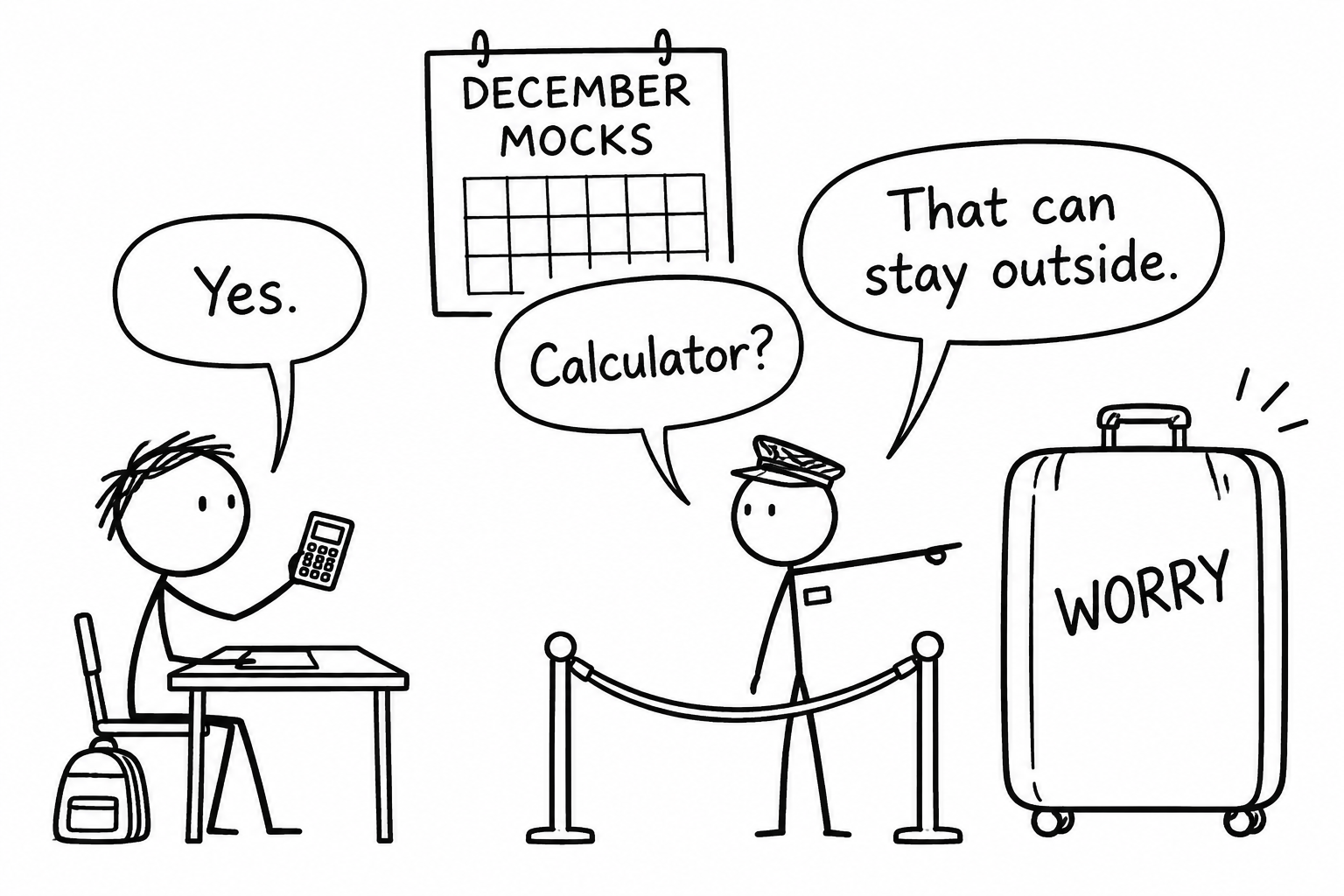 A student leaves worry outside the December mock
A reliable method for iteration exam questions
Find the starting value
Check whether the question gives x0x_0x0 or x1x_1x1. If x1=2x_1=2x1=2, your first calculation produces x2x_2x2.
Substitute into the whole formula
Replace every xnx_nxn on the right-hand side with the current value. Check brackets carefully, especially around fractions, powers and negative values.
Keep full calculator precision
Store each answer or use the calculator's Ans function. Rounding before the next substitution can affect later terms.
Practise the button sequence on the calculator you will use in your mock. Check how its square root template closes and how to recall the previous answer. Familiarity reduces the attention spent on buttons, leaving more attention available for interpreting the question.
Record the requested values
Write down each required term with its label. Your calculator does the arithmetic, but your written sequence makes the method visible.
Round as instructed
Keep unrounded values internally, even if the question asks you to record each term to 333 decimal places.
Worked question: calculating specified terms
An iteration formula is
xn+1=10−xn.x_{n+1}=\sqrt{10-x_n}.xn+1=10−xn.Given x1=2x_1=2x1=2, calculate x2x_2x2, x3x_3x3 and x4x_4x4 to 333 decimal places.
Substitute the starting value:
x2=10−2=8=2.828427…x_2=\sqrt{10-2}=\sqrt{8}=2.828427\ldotsx2=10−2=8=2.828427…Therefore,
x2=2.828.x_2=2.828.x2=2.828.Use the unrounded calculator value for the next term:
x3=10−2.828427…=2.677979…x_3=\sqrt{10-2.828427\ldots}=2.677979\ldotsx3=10−2.828427…=2.677979…Therefore,
x3=2.678.x_3=2.678.x3=2.678.Repeat using the unrounded value of x3x_3x3:
x4=10−2.677979…=2.705923…x_4=\sqrt{10-2.677979\ldots}=2.705923\ldotsx4=10−2.677979…=2.705923…Therefore,
x4=2.706.x_4=2.706.x4=2.706.The values alternate above and below their eventual limit. That does not automatically indicate a mistake: some convergent sequences behave this way.
Next, try the iteration exam booklet independently. Mark it afterwards to distinguish calculation errors from misunderstandings.
Worked question: finding an approximate solution
The equation
x2−x−6=0x^2-x-6=0x2−x−6=0can be rearranged, for its positive solution, into the iteration formula
xn+1=6+xn.x_{n+1}=\sqrt{6+x_n}.xn+1=6+xn.Starting with x1=2x_1=2x1=2, find the positive solution to 333 decimal places.
Substitute and repeat, retaining full calculator precision:
x2=6+2=2.828427…x_2=\sqrt{6+2}=2.828427\ldotsx2=6+2=2.828427… x3=6+2.828427…=2.971267…x_3=\sqrt{6+2.828427\ldots}=2.971267\ldotsx3=6+2.828427…=2.971267… x4=6+2.971267…=2.995207…x_4=\sqrt{6+2.971267\ldots}=2.995207\ldotsx4=6+2.971267…=2.995207… x5=6+2.995207…=2.999201…x_5=\sqrt{6+2.995207\ldots}=2.999201\ldotsx5=6+2.995207…=2.999201… x6=6+2.999201…=2.999867…x_6=\sqrt{6+2.999201\ldots}=2.999867\ldotsx6=6+2.999201…=2.999867…One more iteration gives
x7=2.999978…x_7=2.999978\ldotsx7=2.999978…The last two values both round to the required answer, supporting the observed convergence towards 333:
x=3.000.x=3.000.x=3.000.At a limit, the input and output approach the same value. This explains why the iteration connects to the original equation: replacing both successive terms by the limit recovers the rearranged equation. However, a rearrangement does not automatically produce a convergent sequence for every starting value.
Show enough terms to support the stated accuracy. The AQA iteration question bank provides further practice.
Common iteration mistakes
Starting with the wrong term
Substituting x1x_1x1 produces x2x_2x2. Label terms as you work so your answers match the question.
Reusing the starting value
Feed each new answer into the formula. Reusing the original value produces the same output repeatedly.
Rounding intermediate answers
Keep the full calculator value for subsequent calculations. Round only the values you record, following the question's instructions.
Entering the formula incorrectly
For xn+1=10−xnx_{n+1}=\sqrt{10-x_n}xn+1=10−xn, the entire expression 10−xn10-x_n10−xn belongs inside the square root. Check the display before pressing equals.
Stopping too soon
Close terms alone do not guarantee accuracy. For the convergent sequence in your question, continue until the rounded answer remains stable, following any specified stopping instructions.
Giving no working
Write the requested terms. A bare final answer does not demonstrate how you used iteration.
A focused plan before your mock
Start with notation and calculator technique, then answer questions without notes. Mark them immediately and classify errors: substitution, calculator entry, rounding or unclear working. This makes your next revision session specific.
When checking a solution, find the first term where your answer differs from the mark scheme. Later differences may simply follow from that first slip. Correct the original entry, restart from the last accurate value and finish the sequence again. This turns marking into useful practice rather than copying answers.
Return to the skill after a gap. Use GCSE Maths past papers to practise recognising iteration among other topics. A worksheet tells you which method to use; a mixed paper tests whether you can choose it independently.
If algebra is the obstacle, revisit rearranging harder formulae. Understanding the rearrangement helps connect the original equation with the repeated calculation.
Turn revision into confident practice
Confidence grows as the process becomes familiar. Repeat the worked questions without looking, then tackle fresh questions to check that you can apply the method independently.
Open the free MathsGenie Mock Exam Builder for targeted practice. Work under timed conditions, review lost marks and return to relevant revision lessons and video solutions. Your mock provides useful information: use it to decide what to practise next.















