

GCSE Maths OCR vs WJEC Grade Boundaries
GCSE maths OCR vs WJEC grade boundaries compared for results day, with 2025 marks, tier differences, grading scales and advice for reading results.
Results day has a way of making every mark feel unusually heavy. Yet a boundary number means little until you know its scale. The short answer to GCSE maths OCR vs WJEC grade boundaries is that they should not be compared mark for mark: OCR GCSE Mathematics uses grades 999 111 and totals 300300300 marks, while the WJEC Wales qualification shown here uses letter grades, different tier structures and totals of either 130130130 or 160160160 marks.
The tables below use the June 2025 boundaries, the latest complete summer series available before GCSE results day on Thursday 20 August 2026. The 2026 boundaries will not be confirmed until results are released.
Results day comparison checklist
Before comparing OCR grade boundaries with WJEC grade boundaries, check:
- the exam series, such as June 2025;
- the exact qualification: WJEC Mathematics is distinct from Mathematics-Numeracy;
- the tier entered;
- the maximum available mark;
- whether the qualification uses numerical or letter grades;
- the overall qualification boundary, rather than a notional paper boundary.
You can find historical figures through MathsGenie's OCR GCSE Maths grade boundaries and WJEC GCSE Maths grade boundaries pages.
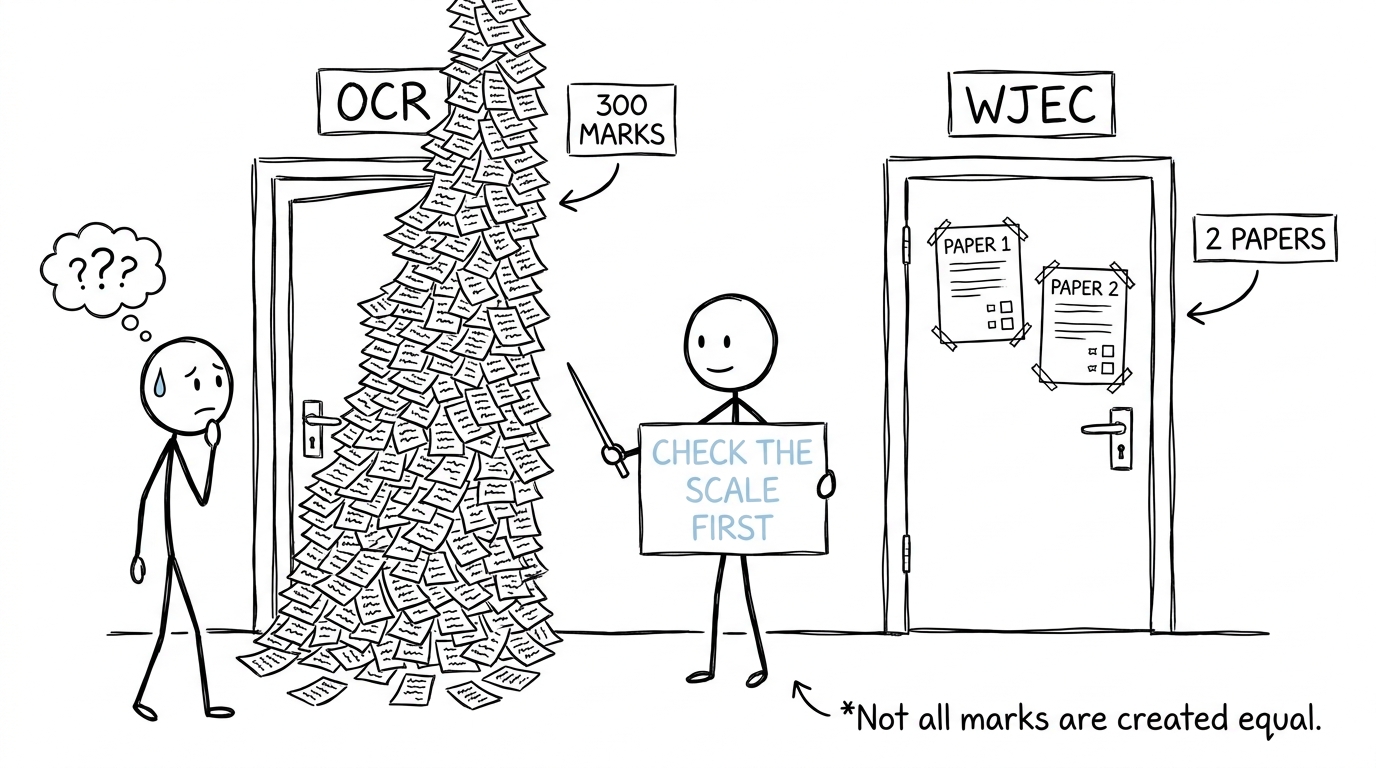 A student discovers that OCR and WJEC results use different scales
OCR vs WJEC grade boundaries at a glance
These are official qualification-level boundaries from the June 2025 series. A boundary is the minimum mark needed for that grade.
| Board and tier | Maximum mark | June 2025 boundaries |
|---|---|---|
| OCR Higher | 300300300 | Grade 999: 258258258; 888: 212212212; 777: 166166166; 666: 126126126; 555: 868686; 444: 474747; 333: 272727 |
| OCR Foundation | 300300300 | Grade 555: 182182182; 444: 134134134; 333: 959595; 222: 565656; 111: 171717 |
| WJEC Higher | 160160160 | Grade A∗A^*A∗: 122122122; AAA: 929292; BBB: 606060; CCC: 292929 |
| WJEC Intermediate | 160160160 | Grade BBB: 106106106; CCC: 696969; DDD: 424242; EEE: 212121 |
| WJEC Foundation | 130130130 | Grade DDD: 656565; EEE: 484848; FFF: 323232; GGG: 161616 |
The most important lesson is not that one board has a higher or lower number. It is that the qualifications are built differently. OCR's 258258258 for a grade 999 comes from a total of 300300300, whereas WJEC's 122122122 for an A∗A^*A∗ comes from 160160160. Even percentages do not establish that one board is easier: the papers, grading scales, tier routes and awarding evidence differ.
Why OCR and WJEC boundaries look so different
OCR has three equally weighted papers
OCR J560 students take three papers at their chosen tier. Each paper is worth 100100100 marks and lasts 111 hour 303030 minutes, producing a total of:
100+100+100=300 100+100+100=300 100+100+100=300One paper is non-calculator and two permit a calculator. Foundation primarily awards grades 111 to 555, while Higher provides access to grades 444 to 999, with a grade 333 safety-net boundary where applicable.
Use the OCR GCSE Maths revision hub to match your revision to this structure, or practise complete assessments through the OCR GCSE Maths past papers collection.
WJEC uses three tiers and letter grades
The WJEC Wales Mathematics qualification represented in the 2025 table has Foundation, Intermediate and Higher tiers. Each route contains a non-calculator unit and a calculator unit. Foundation totals 130130130 marks, while Intermediate and Higher each total 160160160.
This is why asking whether an OCR grade 777 has the same raw boundary as a WJEC grade AAA leads nowhere useful. The grades sit within different systems. For WJEC-specific lessons and questions, begin with the WJEC GCSE Maths revision hub, then use WJEC GCSE Maths past papers to judge performance on the correct scale.
Do not silently substitute Eduqas boundaries for WJEC figures. Although the organisations are connected, Eduqas GCSE Mathematics in England uses grades 999 to 111 and is a separate qualification from the WJEC Wales course shown above.
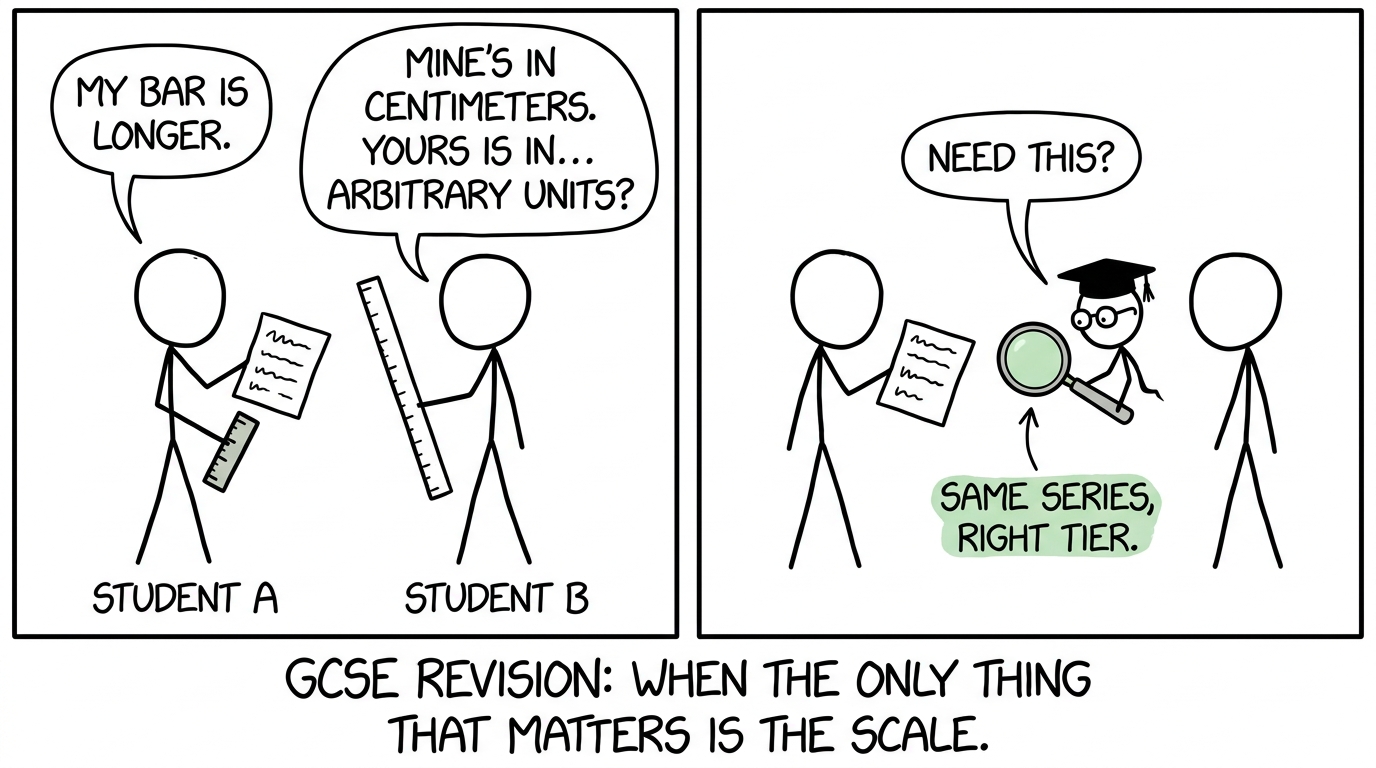 Students compare exam marks before noticing that their rulers use different scales
What grade boundaries mean on GCSE maths results day
Grade boundaries are set after most marking has been completed. Awarding organisations use statistical evidence and expert judgement, including reviewing work around proposed boundaries. They move boundaries when papers vary in difficulty so that the standard represented by a grade remains comparable.
A higher boundary therefore does not automatically mean it became harder to earn the grade. It may indicate that the paper was more accessible. There is also no fixed quota requiring a particular number of students to pass or fail.
On results day, compare your total mark with the row for your exact board, tier and series. If your mark is close to a boundary and the result affects sixth-form or college entry, speak to your school or exams officer. They can explain your component marks and the available post-results options.
Common mistakes when comparing boundaries
- Comparing raw marks directly: OCR is out of 300300300; WJEC totals depend on tier.
- Using the wrong WJEC course: Mathematics and Mathematics-Numeracy have separate boundaries.
- Mixing WJEC with Eduqas: their grading systems and specifications are not interchangeable.
- Using last year's boundary as a prediction: historical boundaries are useful guides, not guaranteed targets.
- Reading a paper boundary as the final grade: component boundaries may be notional; the qualification total determines the official result.
- Comparing different series: June and November papers receive separate boundaries.
MathsGenie's GCSE grade boundaries hub helps you select the correct board and year before drawing conclusions.
The takeaway for students and teachers
The fair comparison is structural, not numerical. OCR uses three papers, 300300300 total marks and grades 999 with 111. WJEC Mathematics in Wales uses two units, three tier routes, letter grades and totals that depend on the tier. Neither set of raw boundaries proves that one board is easier.
During revision, use past boundaries as a broad reference while aiming comfortably above them. Start at the GCSE Maths revision hub, choose the correct board and tier, then move through revision lessons, practice questions and video solutions. Finish with timed past papers, predicted papers, mini tests and honest marking against the mark schemes. Boundaries are decided later. The marks you can build now are the part you control.











