

GCSE Maths OCR vs CCEA Grade Boundaries
GCSE maths OCR vs CCEA grade boundaries explained with 2025 figures, grading differences and practical results-day advice for students and teachers.
Results day has a strange way of turning one number into the only number that seems to matter. Yet when comparing GCSE maths OCR vs CCEA grade boundaries, the first thing to understand is that the numbers do not speak the same language. OCR reports grades 999-111 from a linear qualification, while CCEA uses a unitised course and an A*-GGG scale that includes C*.
So the short answer is simple: do not compare OCR raw-mark boundaries directly with CCEA uniform-mark boundaries. Compare the final grade standards, the structure of each qualification and the correct boundary document for your exam series.
GCSE maths results day checklist
Before interpreting your result, check:
- your exam board and specification;
- your tier or CCEA unit combination;
- whether the figure is a raw mark, weighted mark or uniform mark;
- the correct examination series;
- your final qualification grade, not an isolated paper result;
- whether a review of marking is worth discussing with your school.
You can begin with MathsGenie's GCSE grade boundaries hub, then open the resources for the board you actually sat.
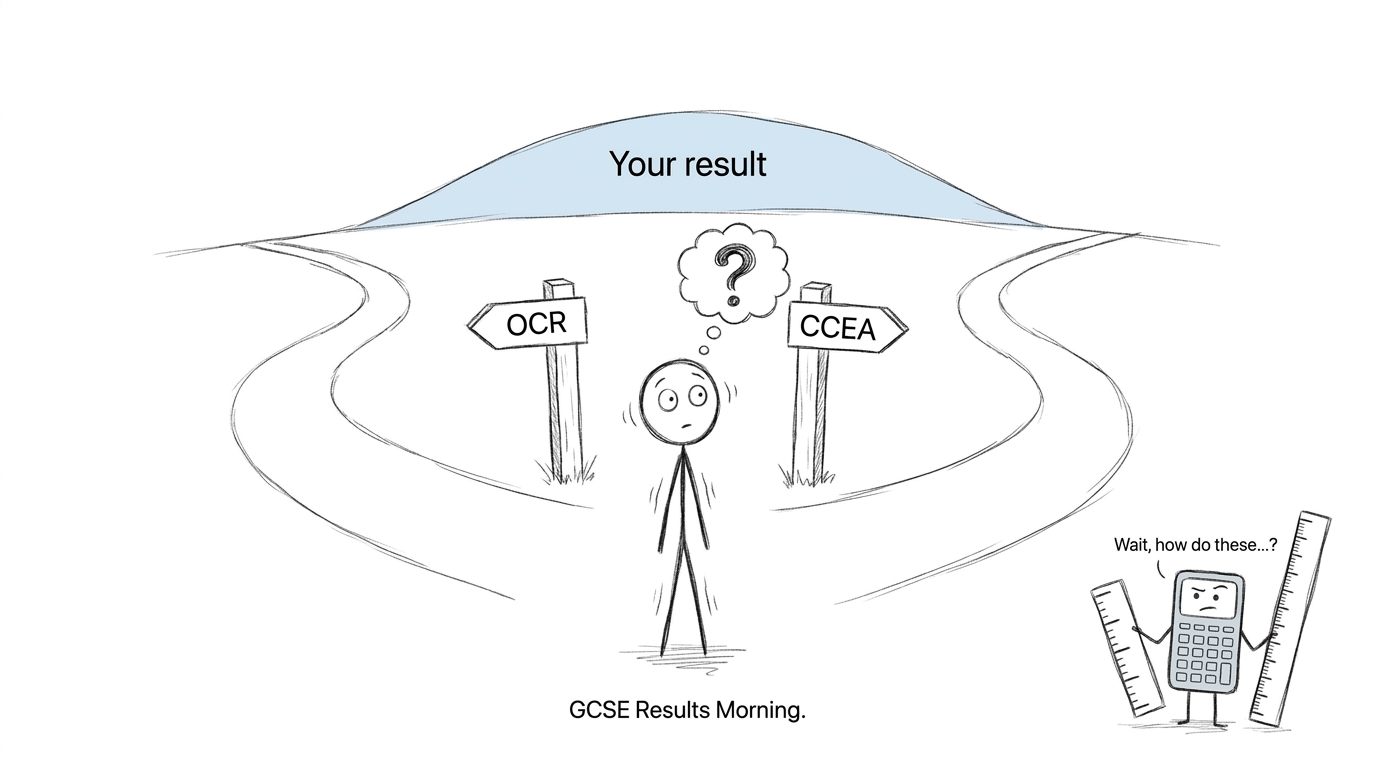 A student choosing between OCR and CCEA signposts while a calculator compares two different rulers
OCR vs CCEA grade boundaries at a glance
| Feature | OCR GCSE Mathematics | CCEA GCSE Mathematics |
|---|---|---|
| Grading scale | Grades 999-111, with 999 highest | Grades A*-GGG, including C* |
| Qualification structure | Linear: three papers taken in the same examination series | Unitised: one unit from M1-M4 and one completion unit from M5-M8 |
| Reporting basis | Total raw marks across the three papers | Raw unit marks converted to uniform marks and aggregated |
| Total used for grading | 300300300 raw marks | 400400400 uniform marks |
| Broad grade alignment | Grade 999 is the highest; grade 555 is above grade 444 | A* aligns with grade 999; C* aligns with grade 555; C aligns with grade 444 |
| Can old boundaries predict this year? | No: they are historical guides | Raw boundaries cannot; subject-level uniform boundaries are stable |
This is why a claim such as “CCEA has lower boundaries than OCR” is usually misleading. Different papers, marks, tiers, units and reporting systems are being compressed into one comparison.
OCR grade boundaries: the latest complete summer figures
OCR GCSE Mathematics J560 has three 100100100-mark papers, giving a total of 300300300 marks. The official June 2025 qualification boundaries shown on MathsGenie were:
| Grade | Higher tier boundary | Foundation tier boundary |
|---|---|---|
| 999 | 258258258 | Not available |
| 888 | 212212212 | Not available |
| 777 | 166166166 | Not available |
| 666 | 126126126 | Not available |
| 555 | 868686 | 182182182 |
| 444 | 474747 | 134134134 |
| 333 | 272727 | 959595 |
| 222 | Not available | 565656 |
| 111 | Not available | 171717 |
These figures apply only to the June 2025 series. OCR grade boundaries are set after marking is nearly complete, so the next series may be higher or lower depending on the demand of its papers.
For previous years and both tiers, use the OCR GCSE Maths grade boundaries. If you have individual paper marks, the OCR GCSE Maths grade calculator can help you interpret their total against published historical boundaries.
How CCEA grade boundaries work differently
CCEA GCSE Mathematics uses two assessment units. Students take one unit from M1-M4, worth 45%45\%45%, and one completion unit from M5-M8, worth 55%55\%55%. The completion assessment contains a non-calculator paper and a calculator paper.
Raw boundaries for individual units can change between examination series. CCEA then converts raw marks to uniform marks so results from different units and series can be aggregated fairly. The complete qualification has 400400400 uniform marks.
The stable subject-level boundaries are:
| CCEA grade | Minimum uniform marks | Percentage of 400400400 uniform marks | Broad alignment |
|---|---|---|---|
| A* | Determined at qualification level | Not a fixed percentage boundary | Grade 999 |
| A | 320320320 | 80%80\%80% | Grades 777-888 range |
| B | 292292292 | 73%73\%73% | Grade 666 |
| C* | 268268268 | 67%67\%67% | Grade 555 |
| C | 240240240 | 60%60\%60% | Grade 444 |
| D | 200200200 | 50%50\%50% | Grade 333 |
| E | 160160160 | 40%40\%40% | Grade 222 |
| F | 120120120 | 30%30\%30% | Grade 111 |
| G | 808080 | 20%20\%20% | Below grade 111 alignment |
The important distinction is that these percentages describe uniform marks, not the percentage of raw questions answered correctly. For unit-specific papers, always use CCEA's raw-to-uniform conversion information for that series.
MathsGenie's CCEA GCSE Maths revision page brings together board-specific papers, lessons, questions and revision tools.
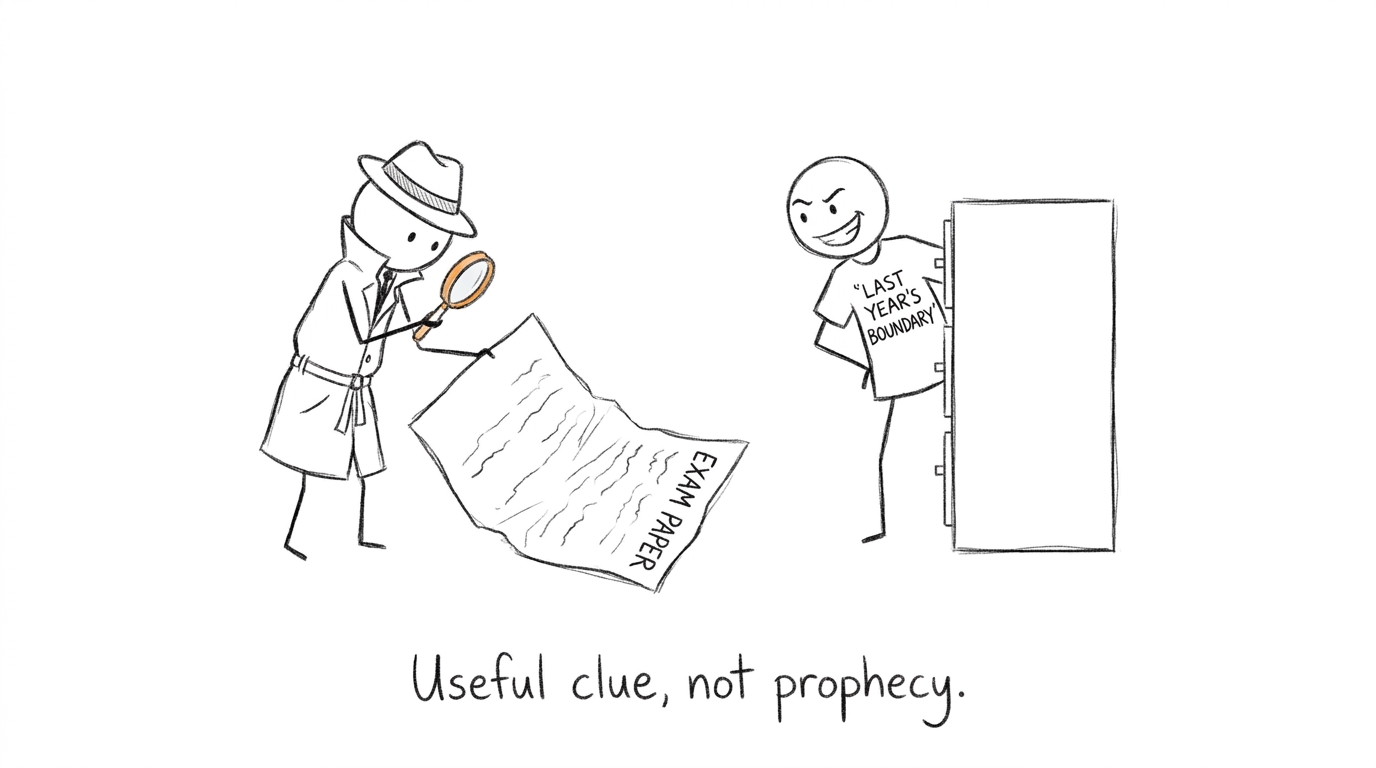 A student detective discovers that last year's grade boundary is a clue rather than a prophecy
Why boundaries move without making grading unfair
Grade boundaries are not decided before students sit the papers. Awarding organisations consider how demanding the assessments proved to be, statistical evidence and examples of work around proposed boundaries.
A harder paper may therefore have lower raw boundaries; an easier paper may have higher ones. A higher boundary does not automatically mean that students were treated more harshly. The purpose is to maintain a comparable standard of achievement.
This matters during revision too. Historical boundaries can provide a rough target, but they are not a promise. A safer approach is to use the OCR GCSE Maths revision hub or the CCEA hub, complete timed papers and aim comfortably above the relevant historical threshold.
Common mistakes when comparing OCR and CCEA
Comparing unlike marks
An OCR total out of 300300300 is a raw-mark total. A CCEA qualification result out of 400400400 is based on uniform marks. Converting both into percentages does not make them directly equivalent.
Treating C* as an unfamiliar extra grade
CCEA's C* was introduced to align with grade 555. C aligns broadly with grade 444, while A* aligns with grade 999.
Using the wrong examination series
June and November OCR boundaries can differ. CCEA raw unit boundaries also vary by series. Check the year, season, tier, unit and specification code.
Predicting boundaries from online reactions
Comments about a paper being “easy” or “impossible” are not reliable evidence. Boundaries are confirmed only after marking and awarding.
Takeaway summary
OCR and CCEA aim to recognise comparable achievement, but they reach the final grade through different structures. OCR adds three raw paper marks and applies a qualification boundary out of 300300300. CCEA converts unit marks to a uniform scale and combines them out of 400400400.
On GCSE maths results day, trust your official final grade first. Use boundaries to understand it, not to compare your worth with someone who sat a different specification.
For your next step, open the GCSE Maths revision hub, choose OCR or CCEA, and turn the result into a practical plan. MathsGenie offers free revision lessons, practice questions, mark schemes, video solutions, mini tests and past papers. When the next exam series approaches, add GCSE predicted papers and organise the work with the MathsGenie revision planner. Boundaries are outside your control. Better preparation is not.











