GCSE Maths Numeracy Paper 2: What to Expect
GCSE Maths Numeracy Paper 2 explained: check your WJEC specification, calculator rules, timings, question styles and a practical revision plan.
The hardest part of an exam is sometimes not the mathematics. It is the uncertainty: what equipment can you use, how long do you have, and will the questions look anything like the ones you revised?
For GCSE Maths Numeracy Paper 2, the short answer is this: under the legacy WJEC Mathematics and Numeracy specification, Paper 2 is the calculator-allowed paper. It lasts 111 hour 303030 minutes at foundation tier and 111 hour 454545 minutes at intermediate or higher tier. It is worth half of the qualification and tends to place mathematical skills inside practical, multi-step contexts.
There is, however, an important specification change to understand before revising.
First, check which WJEC qualification you are taking
The phrase “Paper 2” can now refer to two different assessment structures in Wales.
The legacy WJEC GCSE Mathematics and Numeracy qualification has two units:
| Legacy unit | Calculator rule | Weighting |
|---|---|---|
| Unit 1 | Non-calculator | 50%50\%50% |
| Unit 2 | Calculator allowed | 50%50\%50% |
This is the qualification most students mean when searching for GCSE Maths Numeracy Paper 2. Its qualification code begins with 331033103310, and it includes foundation, intermediate and higher tiers.
Wales is replacing the separate Mathematics and Mathematics and Numeracy GCSEs with the WJEC GCSE Mathematics and Numeracy Double Award. This new qualification was introduced for teaching from September 2025 and uses three units. Crucially, Unit 2 in the new Double Award is non-calculator, while Units 1 and 3 allow calculators. The new course also has only foundation and higher tiers.
Do not revise from the title alone. Check the qualification code, tier and front page of your paper, or ask your teacher to confirm your specification. The WJEC GCSE Maths revision hub can then help you choose suitable lessons and questions.
GCSE Maths Numeracy Paper 2 at a glance
If you are taking legacy WJEC Mathematics and Numeracy Unit 2, expect:
- a calculator-allowed examination;
- 656565 marks in 111 hour 303030 minutes at foundation tier;
- 808080 marks in 111 hour 454545 minutes at intermediate and higher tier;
- short and longer questions;
- structured and unstructured problems;
- some multiple-choice questions;
- practical information presented through text, tables, charts or diagrams;
- calculations that may require several connected steps;
- marks for communicating and organising your response accurately.
A ruler, protractor and pair of compasses may also be required. Read the instructions on your own examination paper because they are the final authority.
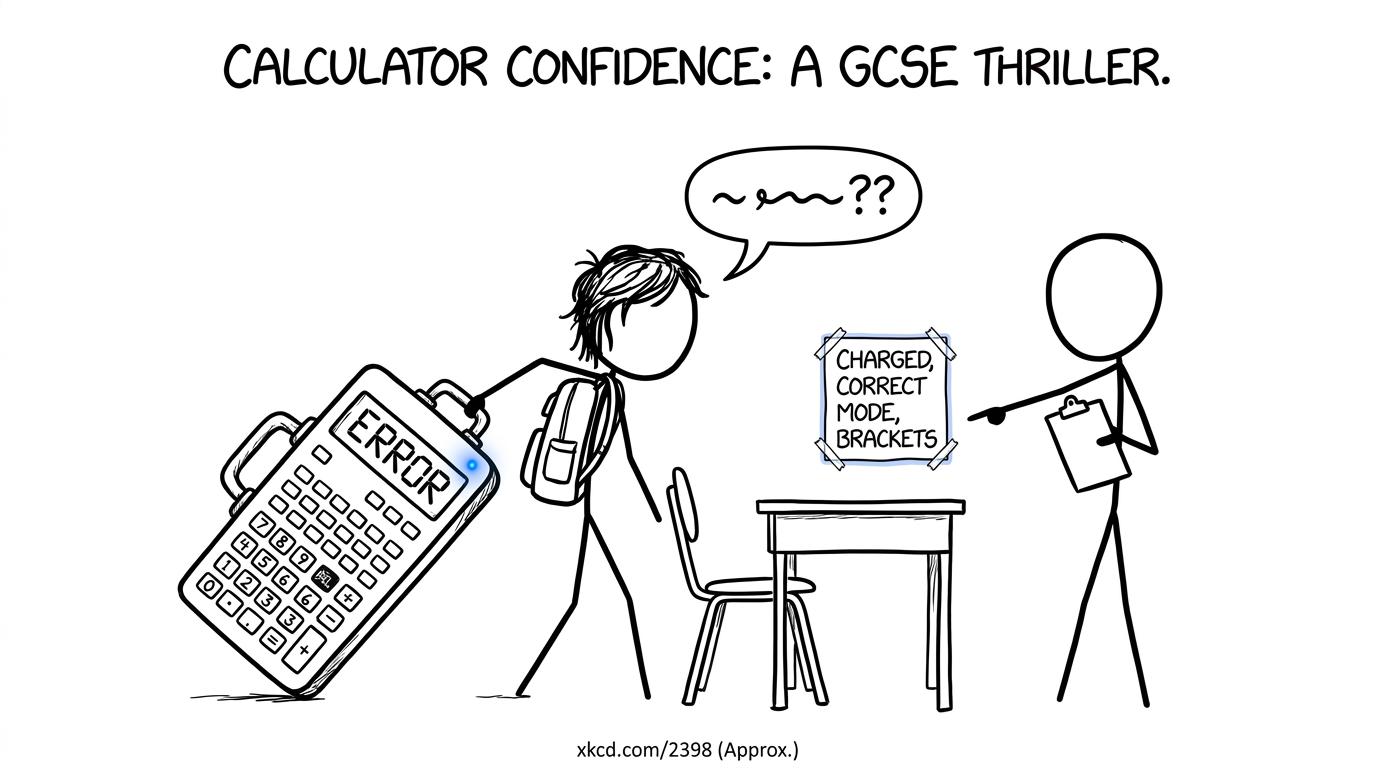 A student arrives with an enormous calculator while an invigilator points to a simple calculator checklist
What is actually different about Paper 2?
The obvious difference is the calculator. The more important difference is what the calculator allows the examiner to ask.
Paper 2 can use awkward values, longer chains of calculation and realistic data without turning the examination into a test of written arithmetic. The challenge shifts from “Can you multiply these numbers?” towards “Do you know which numbers should be multiplied, and why?”
That distinction matters. A calculator completes an instruction. It cannot decide what the question means.
More emphasis on selecting a method
Numeracy questions often provide more information than you need immediately. You may have to identify relevant values, convert units, choose a formula and decide how to present the result.
The paper can assess areas such as:
- percentages and repeated percentage change;
- ratio, proportion and scale;
- money, rates, bills and exchange rates;
- time, distance and compound measures;
- perimeter, area, surface area and volume;
- interpreting graphs, tables and statistical diagrams;
- averages, spread and comparisons between data sets;
- probability in practical situations;
- estimation, bounds and sensible accuracy.
This is not a guaranteed topic list. Under the legacy specification, content from across your tier can appear on either unit. Paper 2 does not have a secret collection of calculator-only topics.
Longer real-world contexts
A question may begin with a timetable, building plan, price list, map or set of survey results. Several parts can then assess different skills within that same setting.
The context is not decorative. It tells you what the numbers represent and often determines whether you should add, divide, compare, round up or round down. Words such as “maximum”, “at least”, “per”, “difference” and “altogether” can change the entire calculation.
For a broader map of the skills involved, use the GCSE Maths topics by exam board and tier guide. Remember that WJEC qualifications in Wales use their own grading and tier arrangements rather than England's grades 999 to 111 structure.
Calculator skill is assumed
You should be able to use brackets, powers, roots, memory functions and appropriate statistical or trigonometric functions for your tier. You must also understand the order in which your calculator evaluates operations.
Check that you can:
- enter a complete calculation using brackets;
- interpret standard-form displays;
- distinguish a negative sign from subtraction;
- use the correct angle mode when trigonometry is required;
- round to a stated number of decimal places or significant figures;
- keep an unrounded value for later stages;
- recognise when a displayed answer is unreasonable.
Calculator fluency is a revision topic in its own right. Do not wait until the examination morning to discover where a function is located.
How to manage the timing
The timings produce a rough average of approximately 1.31.31.3 minutes per mark. That is a guide, not a command. Some one-mark questions take seconds, leaving more time for extended problems.
Use a three-pass approach:
First pass: collect accessible marks
Answer questions where you can identify a starting method quickly. Write down the calculation or formula rather than producing an unexplained calculator result.
If you make no meaningful progress after roughly 909090 seconds, mark the question and move on. One stubborn problem should not consume the time available for several easier ones.
Second pass: return to demanding contexts
Go back to questions that require more reading or several stages. Underline units, label intermediate values and ask what the final answer represents.
Final pass: inspect the details
Use the closing minutes to check:
- units;
- decimal places and significant figures;
- money notation;
- whether a practical answer must be rounded up;
- whether you copied values correctly;
- whether every part has been attempted.
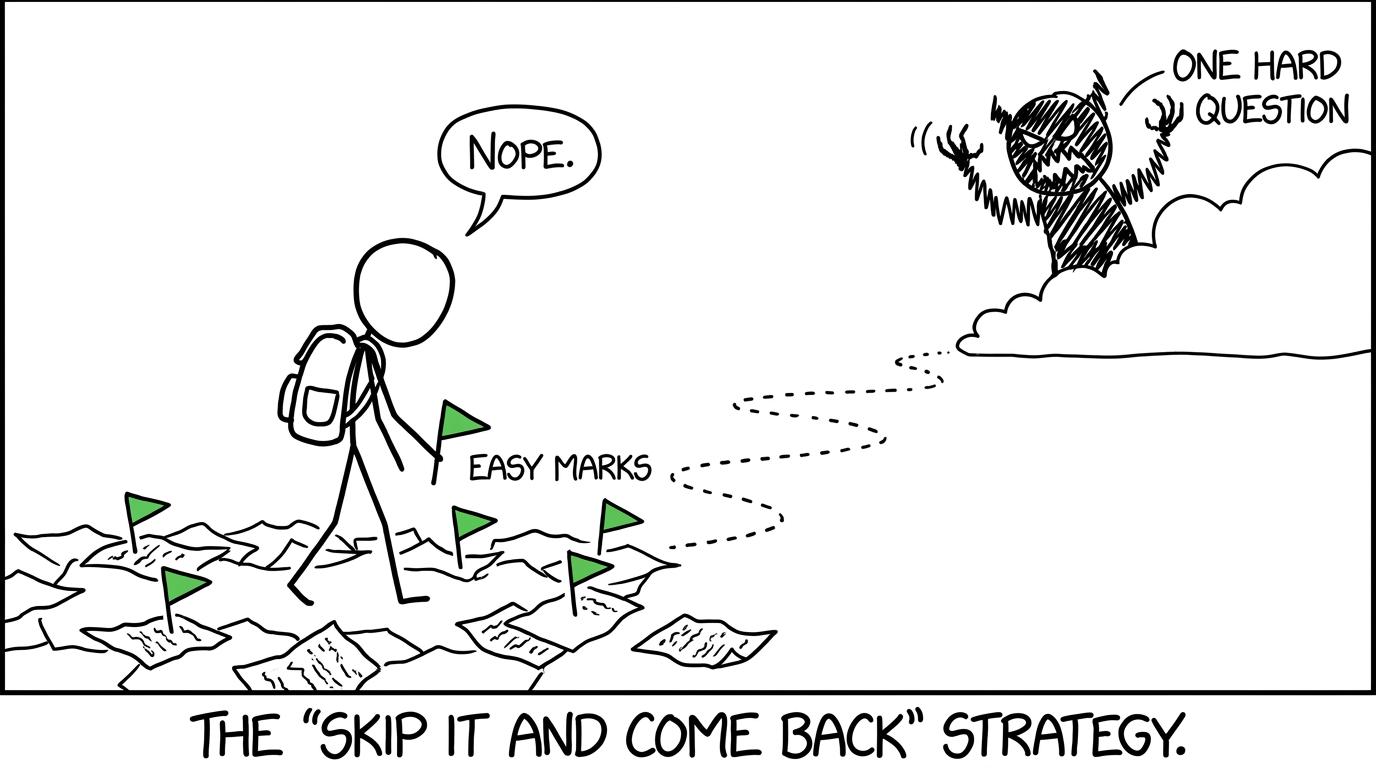 A student calmly collects easy marks while one dramatic hard-question monster waits in the distance
What the questions reward
Strong responses do more than reach a number. They make the mathematical decision visible.
Method marks may be available when a final answer is incorrect, but the relevant method has been shown. Write formulas, substitutions and key intermediate results. This also makes your own checking easier.
For longer communication questions, organise the solution logically and use accurate mathematical language, notation and units. Under the legacy WJEC specification, each paper includes 222 additional marks linked to communicating, organising and writing accurately.
A reliable sequence is:
- identify what is required;
- select the necessary information;
- state or show the method;
- calculate without premature rounding;
- interpret the result in context;
- give the requested units and accuracy.
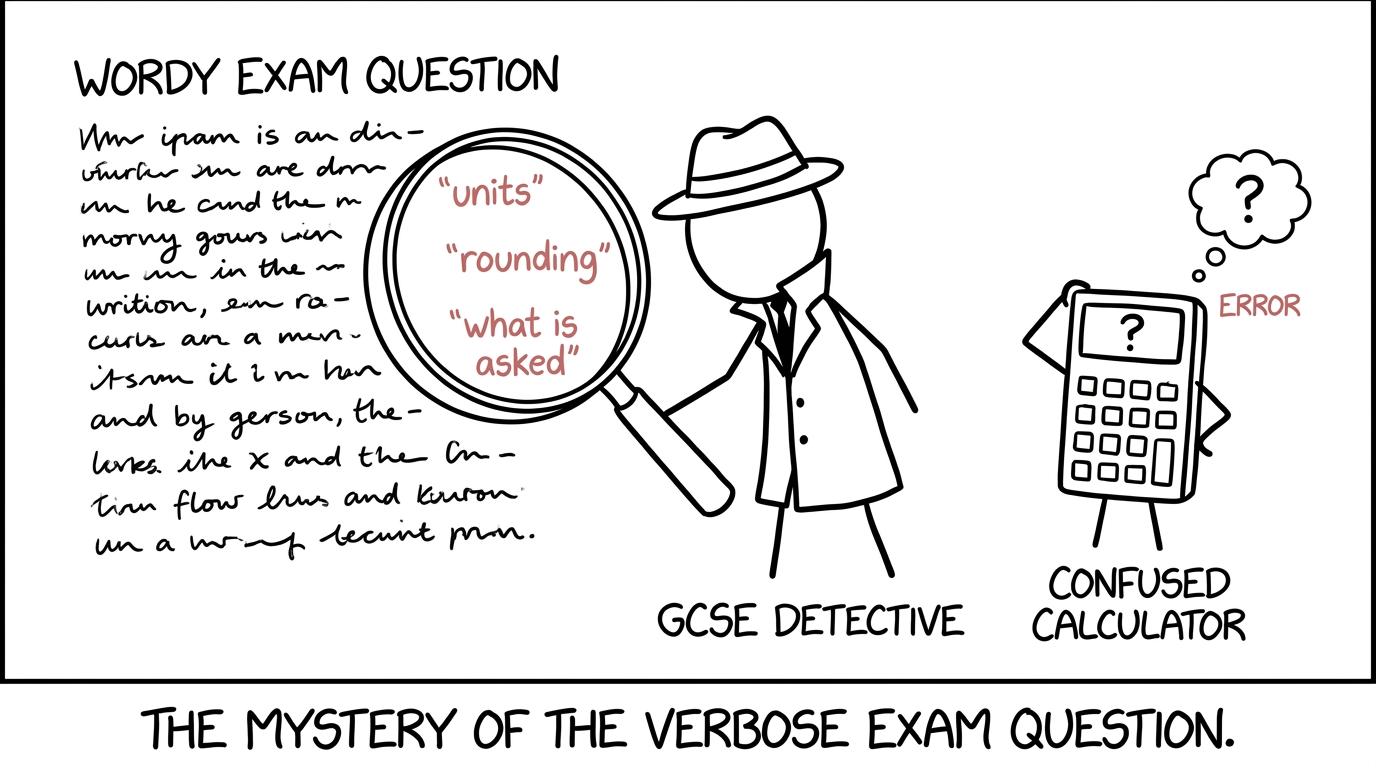 A student detective searches a wordy question for clues labelled units, rounding and what is asked
How to revise for the paper effectively
Begin with evidence, not guesswork. Choose the correct tier from the WJEC GCSE Maths past papers, complete a section under timed conditions and mark it carefully.
Sort each lost mark into one of four causes:
- Knowledge: you did not know the method.
- Selection: you knew the mathematics but chose the wrong operation.
- Accuracy: the method was sound but the calculation failed.
- Communication: working, units or required accuracy were missing.
This classification turns a disappointing mark into a revision plan. The guide to finding your weakest GCSE topics explains how to make that diagnosis more precise.
Next, repair one weakness at a time with a MathsGenie revision lesson and focused practice questions. Then retest it inside a mixed question set. If you need a sustainable weekly structure, follow the GCSE maths revision timetable.
Past papers should form a feedback loop:
paper →\rightarrow→ mark →\rightarrow→ fix →\rightarrow→ retest
The guide to using GCSE past papers properly will help you avoid completing paper after paper without correcting the underlying mistakes. Nearer the examination, add mini tests and predicted papers for fresh questions, but do not use predictions as a replacement for the full specification.
Common mistakes on GCSE Maths Numeracy Paper 2
Trusting the calculator without estimating
A misplaced bracket or mistyped digit can produce a polished but impossible result. Make a rough estimate before accepting the display.
Rounding during the calculation
Store or write the full calculator value and round only at the end unless the question instructs otherwise. Early rounding can move the final answer outside the accepted range.
Ignoring units
A correct calculation can still answer the wrong question if centimetres, metres, minutes, hours, grams or kilograms have been mixed. For area and volume, remember that conversion factors must be squared or cubed where appropriate.
Giving only a calculator answer
An unsupported number hides your method. Show the formula, substitution or operation so the examiner can follow your reasoning and award any available method marks.
Assuming every answer should be rounded normally
Context controls rounding. The number of vehicles, boxes or tickets required may need to be rounded up, even when the decimal part is small.
Revising only favourite topics
Comfort is not the same as progress. Use marked work to choose what comes next. The most efficient GCSE maths revision approach is built around the marks you actually lose.
Go into Paper 2 knowing what you are practising
The calculator changes the arithmetic, but it does not remove the thinking. GCSE Maths Numeracy Paper 2 rewards students who can read carefully, choose a method, organise several steps and judge whether an answer makes sense.
Start by confirming whether you are taking legacy Unit 2 or the new Double Award Unit 2. Then use MathsGenie as your revision base: learn with free revision lessons, build accuracy with practice questions, and test your decisions with WJEC past papers and mark schemes. Add mini tests and predicted papers when you need fresh timed practice, and use video solutions to understand the step where your method broke.
One paper will show you more about your next revision step than another hour of guessing. Choose the correct tier, set the timer and let the evidence guide you.