

GCSE Maths Mock Revision Timetable That Works
GCSE maths mock revision timetable for November and December, with a practical weekly plan, mock exam tips and targeted MathsGenie practice.
November can make a mock exam feel much closer than it did in September. One week, lessons are moving along normally. The next, a date appears on the school calendar and every unfinished topic suddenly seems urgent.
A GCSE maths mock revision timetable gives that urgency somewhere useful to go. Its purpose is not to fill every evening. It is to identify what you need to improve, schedule focused practice and leave enough time to test whether that practice worked.
For a Year 10 or Year 11 student moving through November towards December mocks, the central idea is simple: mocks are a diagnostic, not a verdict. They show where your knowledge stands today. Your timetable helps decide where it goes next.
Your mock timetable checklist
Before planning individual sessions, collect five things:
- your mock date and likely paper format
- confirmation of your exam board and tier
- a topic list from your teacher, if one is available
- results from recent tests, homework or practice papers
- the equipment permitted and needed for each paper
Schools set their own mock content and arrangements, so do not assume that every topic or paper will match another school's mocks. Ask your teacher what has been taught, whether you are sitting foundation or higher tier, and which papers are included.
Then build a plan containing three types of session:
- Learn: revisit a weak skill using a revision lesson or video.
- Practise: answer questions without copying a method.
- Test and review: complete mixed questions under timed conditions, mark them and correct mistakes.
You can find free videos, worksheets, past papers and mark schemes on the MathsGenie GCSE Maths revision hub. The important part is using each resource for a clear purpose rather than collecting materials you never open.
A practical November to December timetable
Imagine a student whose mock is four weeks away. They do not need a heroic first weekend. They need a repeatable routine that survives ordinary school days.
The plan below uses four main sessions each week. Sessions can last around 30-45 minutes, although your own timetable should account for homework, other subjects and school guidance.
| Day | Session | Purpose |
|---|---|---|
| Monday | Weak topic practice | Learn one method, then answer questions independently |
| Wednesday | Second priority topic | Strengthen another gap from lessons or assessments |
| Friday | Mixed mini test | Retrieve several topics without prompts |
| Sunday | Timed practice and review | Practise exam decisions, mark answers and update priorities |
Tuesday, Thursday and Saturday can remain free for other subjects, schoolwork or rest. A timetable that allows recovery is more useful than one that looks impressive but is abandoned after three days.
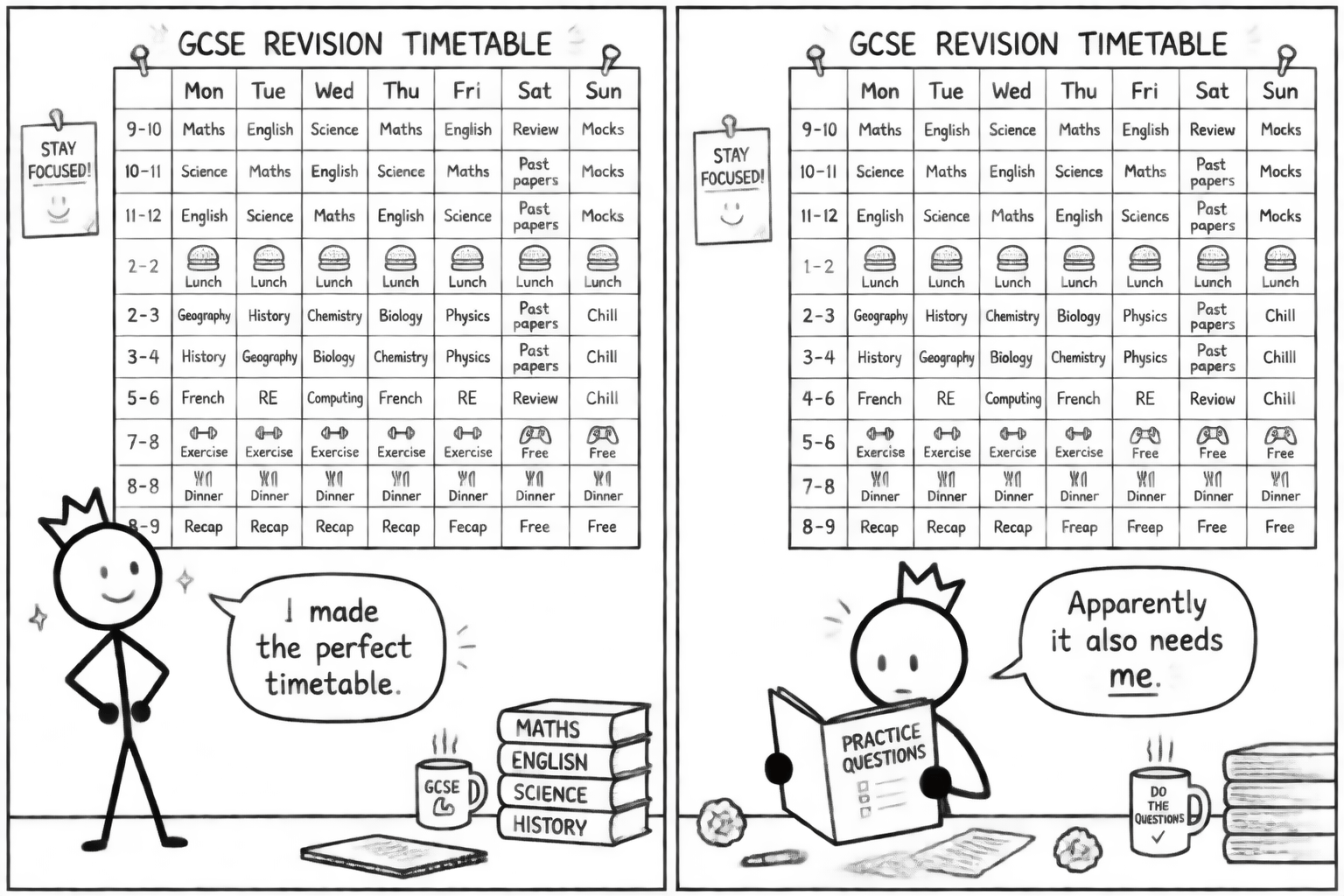 A student discovers that making a perfect timetable is different from using it
Four weeks before the mock: diagnose
Start with evidence. Complete a mixed mini test, selected questions from a suitable paper, or use recent school assessments. Mark the work carefully and sort errors into four groups:
- knowledge: you did not know the rule or method
- application: you knew the skill but did not recognise when to use it
- accuracy: arithmetic, algebra or calculator work went wrong
- exam technique: you misread the question, missed units or did not show enough working
This distinction matters. Watching another video may help a knowledge gap, but it will not automatically fix rushed reading. Likewise, completing an entire paper is inefficient if three missing skills cause most of the lost marks.
Use MathsGenie's topic-by-grade GCSE resources to revisit the weakest areas, then answer the accompanying practice questions. Choose two or three priorities, not fifteen.
Three weeks before the mock: repair weak topics
Now the timetable becomes targeted. Each topic session should have a small, observable goal, such as completing a set of rearranging formulae questions or improving accuracy with fractions.
A useful session follows this pattern:
- Recall the method before opening notes.
- Use a revision lesson or video to fill a genuine gap.
- Attempt practice questions independently.
- Check answers and correct every mistake.
- Write down the topic to revisit later.
Correction is where much of the learning happens. If an answer is wrong, do not merely replace it with the mark scheme's answer. Identify the first step at which your reasoning changed course, then attempt the question again without looking.
Two weeks before the mock: mix the topics
Topic practice can create a comfortable illusion because you already know which technique the worksheet expects. A mock paper does not provide that hint.
Begin mixing questions from different areas. Include topics you revised the previous week alongside skills you already know. This checks whether you can select a method, not just perform it.
Add one timed section at the weekend. Use a paper appropriate to your exam board and tier from the GCSE past papers and mark schemes collection. Past papers are especially valuable when they are followed by honest marking and correction, rather than treated as a prediction of the exact questions that will appear.
If you need help interpreting how marks are awarded, read the MathsGenie guide to using GCSE mark schemes. Method marks can reveal that your approach was partly secure even when the final answer was not.
The final week: rehearse and reduce
In the final week, avoid trying to relearn the entire specification. Complete one realistic timed practice, review recurring errors and revisit a short list of high-priority skills.
A sensible final week might include:
- one timed paper or substantial paper section
- two short sessions on recurring weaknesses
- one mixed mini test
- brief recall of formulae and methods
- an equipment check and a normal night's sleep before the mock
The final evening is not the moment for a marathon. Preparation should become lighter and more selective as the exam approaches.
How parents can support the timetable
Parents can help most by making the plan easier to follow, not by turning every evening into a progress inspection.
Ask practical questions: Which topic are you working on today? What did the last test show? When will you check whether this has improved? These keep the conversation centred on process rather than predicted grades.
A visible timetable can also reduce negotiation. Agree on realistic session times, protect a suitable workspace and allow plans to change when schoolwork becomes unusually heavy. Missed sessions should be rescheduled only when they still serve a purpose. They should not accumulate into an impossible weekend.
MathsGenie's free revision lessons, practice questions, mini tests and video solutions give students a clear place to start. The MathsGenie revision planner can also help turn broad intentions into specific tasks.
Mock exam tips that make revision measurable
A useful timetable records outcomes rather than just time. After each session, use one of three labels:
- secure: you can answer unfamiliar questions independently
- improving: the method is clearer, but errors remain
- priority: you still need teaching or guided practice
Move topics between these labels as new evidence appears. This prevents a common mistake: continuing to revise favourite topics because success feels reassuring.
Your Sunday review can be brief. Note what improved, what repeatedly went wrong and which two topics deserve attention next week. The timetable should evolve with you.
Common timetable mistakes
Planning every available hour
An overloaded plan has no room for homework, tiredness or another subject's deadline. Schedule fewer sessions and complete them properly.
Revising only by watching
Videos can explain a method, but improvement must be tested through independent questions. Pause before worked solutions and attempt each problem yourself.
Completing papers without reviewing them
A mark is information, not the end of the task. Use the mark scheme, correct errors and return to weak topics. MathsGenie's article on when to start GCSE past papers explains how papers fit into a broader revision routine.
Treating the mock grade as permanent
A mock reflects your performance on particular questions, on a particular day, after the preparation completed so far. Take the result seriously, but not personally. Its greatest value is the revision map it produces.
Turn your timetable into targeted practice
By December, the student who began with a vague sense of worry now has something more useful: evidence. They know which topics are secure, where marks are being lost and what to practise next.
That is what a strong GCSE maths mock revision timetable provides. Not certainty, and not a promise that every question will feel easy. It provides direction.
Start with the free MathsGenie GCSE revision resources, then use the MathsGenie Mock Exam Builder to build a targeted practice paper around the areas that need attention. Complete it, mark it and let the result shape your next week. Each cycle turns the mock from a judgement into what it was always meant to be: useful feedback.















