

GCSE Maths Eduqas vs WJEC Grade Boundaries
GCSE maths Eduqas vs WJEC grade boundaries compared for results day, including 2025 marks, grading systems, tiers and practical advice for students.
Results day has a peculiar kind of tension. You know the mark you earned, but until you find the correct boundary, the number feels unfinished. For anyone searching GCSE maths Eduqas vs WJEC grade boundaries, the first answer is simple: do not compare the raw marks directly. Eduqas and WJEC use different grading systems, tier structures and total marks.
The latest complete summer boundaries available are from June 2025. Boundaries for the June 2026 series will be released on GCSE results day, Thursday 20 August 2026. Until then, previous boundaries are useful reference points, not predictions.
Results-day checklist
Before interpreting a maths result, check:
- the exam board named on the result slip;
- the qualification and entry code;
- whether the entry was foundation, intermediate or higher tier;
- the examination series;
- the overall qualification boundary rather than a notional paper boundary;
- whether the result uses grades 999 to 111 or A∗A^*A∗ to GGG.
MathsGenie's complete GCSE grade boundaries hub lets students and teachers select the relevant board rather than relying on an out-of-context screenshot.
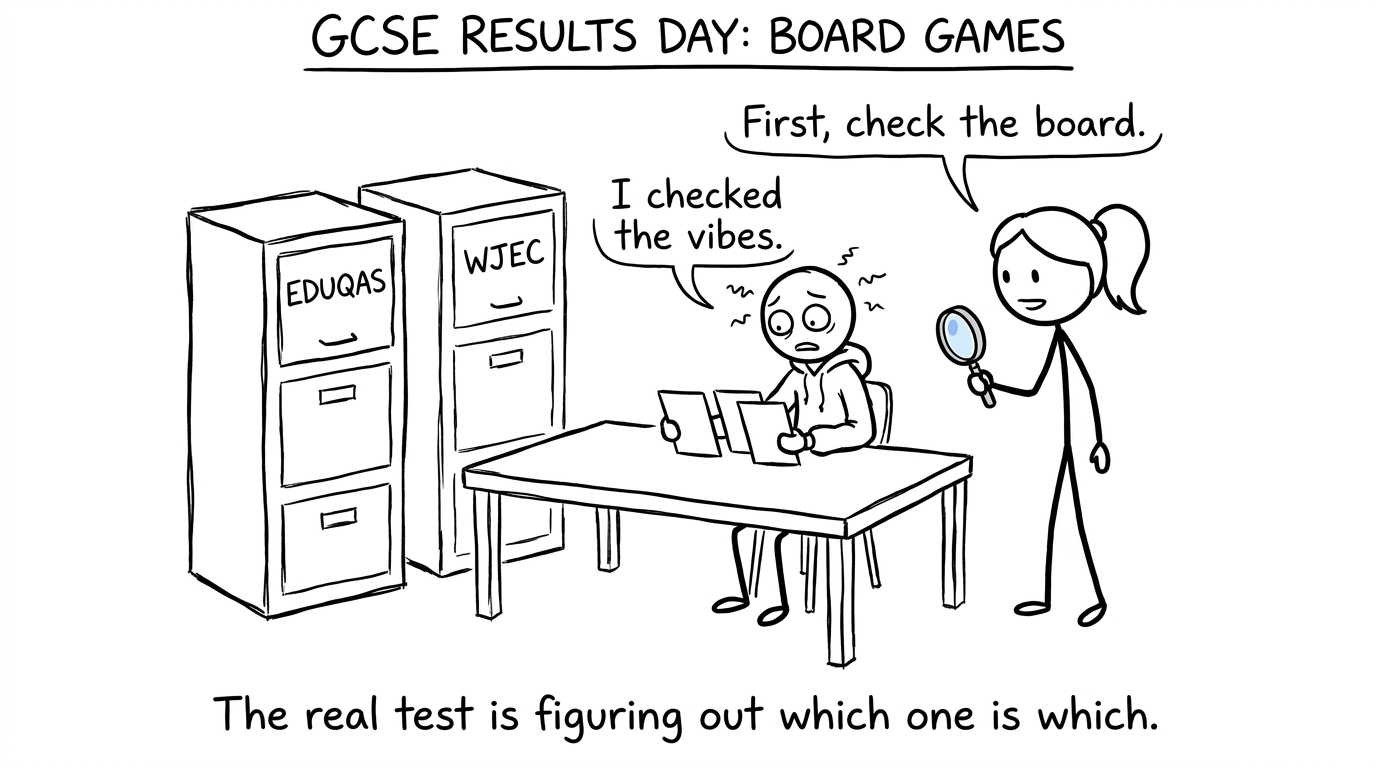 A student checking whether results belong to Eduqas or WJEC
Eduqas vs WJEC grade boundaries compared
Eduqas and WJEC belong to the same awarding organisation group, but their GCSE qualifications are not interchangeable. Eduqas GCSE Mathematics is primarily the Ofqual-regulated qualification used in England and reports grades 999 to 111. The established WJEC GCSE Mathematics qualification in Wales reports grades A∗A^*A∗ to GGG.
Here is the essential comparison using June 2025 qualification-level boundaries.
| Feature | Eduqas GCSE Mathematics | WJEC GCSE Mathematics |
|---|---|---|
| Grading scale | 999 to 111 | A∗A^*A∗ to GGG |
| Tier structure | Foundation and higher | Foundation, intermediate and higher |
| Maximum qualification mark | 240240240 | Foundation: 130130130; intermediate and higher: 160160160 |
| Foundation boundaries | Grade 555: 141141141; grade 444: 111111111; grade 333: 818181; grade 222: 515151; grade 111: 212121 | Grade DDD: 656565; grade EEE: 484848; grade FFF: 323232; grade GGG: 161616 |
| Intermediate boundaries | Not applicable | Grade BBB: 106106106; grade CCC: 696969; grade DDD: 424242; grade EEE: 212121 |
| Higher boundaries | Grade 999: 196196196; grade 888: 155155155; grade 777: 115115115; grade 666: 858585; grade 555: 565656; grade 444: 272727; grade 333: 121212 | Grade A∗A^*A∗: 122122122; grade AAA: 929292; grade BBB: 606060; grade CCC: 292929 |
You can inspect the full historical data on the dedicated Eduqas GCSE Maths grade boundaries page and WJEC GCSE Maths grade boundaries page.
Why the raw marks look so different
A boundary is the minimum mark required for a grade in one particular qualification and series. Eduqas had 240240240 available marks in June 2025, while the WJEC totals varied by tier. A comparison such as 196196196 against 122122122 therefore says little by itself.
Even converting both figures into percentages would not make the grades equivalent. The papers assess different specifications through different tier and grading structures. Regulators require awarding to maintain appropriate standards, while boundaries move to account for differences in paper difficulty.
This is why a higher numerical boundary does not automatically mean that an exam board is harder. Boundaries are set after the examinations have been marked, using statistical evidence and expert judgement. There is no fixed quota requiring a particular number of students to pass or fail.
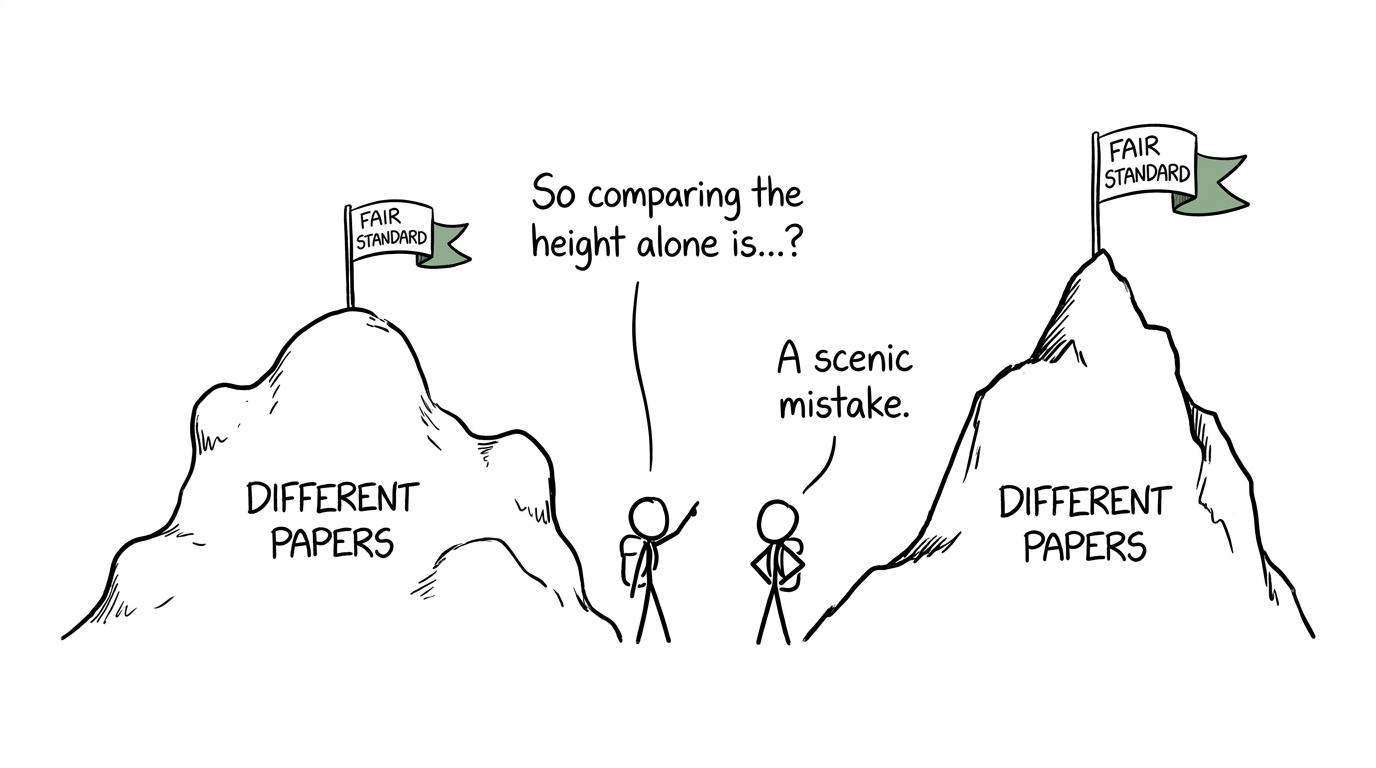 Two hikers discovering why different grade-boundary hills cannot be compared directly
What happens on GCSE maths results day?
For the June 2026 series, candidates receive GCSE results on Thursday 20 August 2026. Eduqas and WJEC state that qualification boundaries are published on results day. Your school or examination centre issues your result.
For a linear qualification, the overall boundary determines the final grade. Paper-level or component boundaries may be described as notional. They help teachers analyse performance, but they are not separate official grades and should not replace the qualification-level total.
If a result is close to a boundary, speak to your teacher or examinations officer. They can check the mark breakdown and explain the available post-results services. A review of marking is not a free extra mark: the mark may remain unchanged, rise or fall.
Teachers should also note that WJEC qualifications in Wales are changing under Curriculum for Wales. The new GCSE Mathematics and Numeracy double award has its first award from November 2026. Always check the exact qualification title and entry code before applying a historical WJEC table.
Common grade-boundary mistakes
Treating Eduqas and WJEC as the same qualification
The names are connected, but the grading scales, tiers and maximum marks differ. Use the board printed on the result slip.
Using last year's boundary as a promise
Previous boundaries can suggest a broad target, but they cannot reveal the next boundary. Papers change and awarding happens after marking.
Adding notional component boundaries
For a linear qualification, use the published overall boundary. Notional paper boundaries are analytical guides, not independent grades.
Comparing marks without checking the denominator
A mark out of 240240240 cannot be compared sensibly with a mark out of 160160160 or 130130130 without context. Even percentage comparisons do not align different specifications perfectly.
The practical takeaway
The useful question is not which board has the lower-looking boundary. It is whether your total mark reaches the boundary for your exact board, tier, qualification and series.
If you are still preparing for the examination, turn historical boundaries into sensible targets rather than forecasts. Start with the Eduqas GCSE Maths revision hub or WJEC GCSE Maths revision hub. Then complete the matching Eduqas past papers or WJEC past papers, mark them carefully and repair the topics costing you marks.
MathsGenie keeps that process free and focused: revision lessons for understanding, practice questions and mini tests for accuracy, mark schemes and video solutions for feedback, and GCSE predicted papers for structured preparation. Check the correct board-specific boundary page, choose your next weak topic, and make the next mark more controllable than the final grade feels today.











