

GCSE Maths Eduqas vs CCEA Grade Boundaries
GCSE maths Eduqas vs CCEA grade boundaries explained for results day, including 2025 Eduqas marks, CCEA UMS, tiers and practical next steps.
Results day has a strange way of making one number feel like the whole story. Yet when comparing GCSE maths Eduqas vs CCEA grade boundaries, the numbers do not even speak the same language. Eduqas uses grades 999 to 111 and combines raw marks from two linear papers. CCEA uses lettered grades, including C*, and converts unit marks to a Uniform Mark Scale (UMS).
The short answer is simple: you cannot compare Eduqas and CCEA boundaries mark for mark. Their grading scales, assessment structures and methods of combining results are different. You must first identify the board, tier, examination series and units taken.
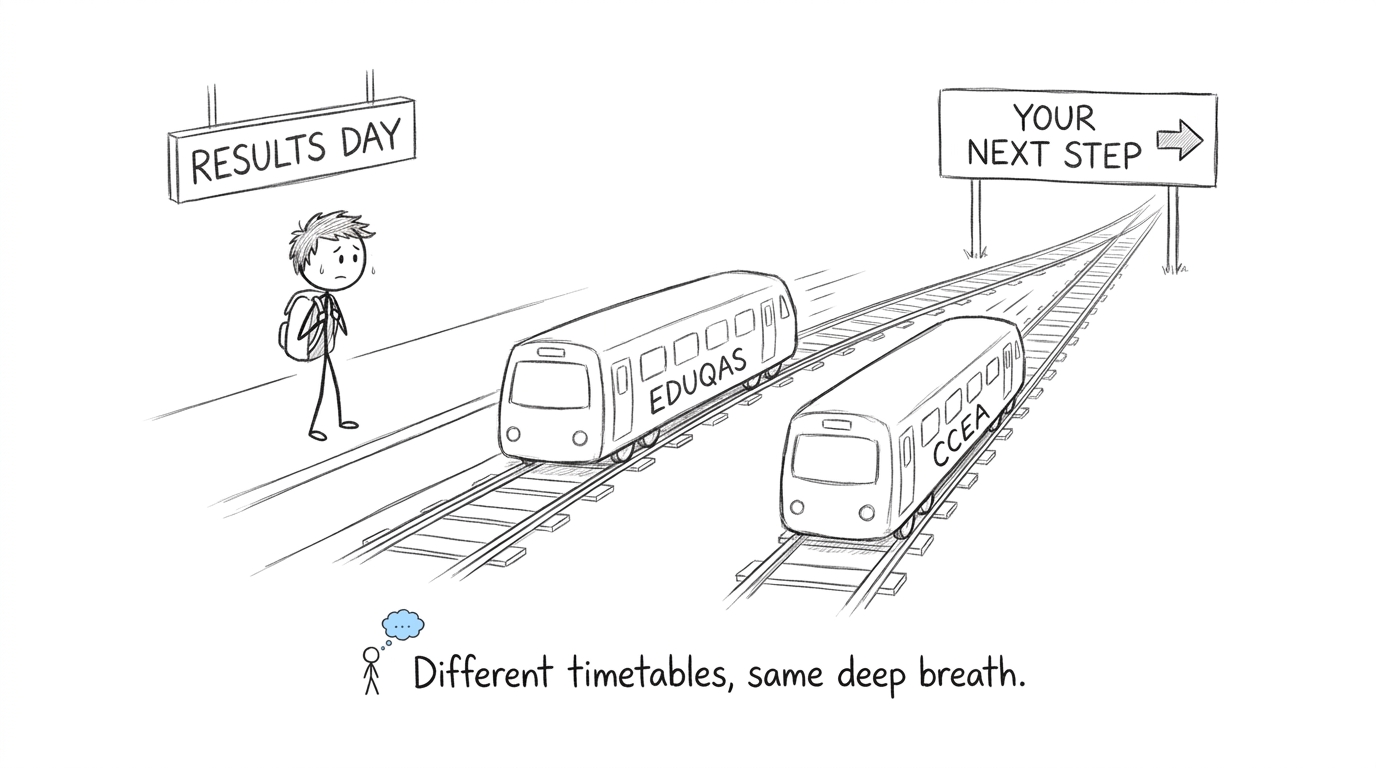 A student choosing between Eduqas and CCEA trains on results day
Results day comparison checklist
Before interpreting a result, check:
- whether the qualification is Eduqas or CCEA;
- the examination series shown on the statement of results;
- foundation or higher tier for Eduqas;
- the CCEA unit combination, such as M2 and M6 or M4 and M8;
- whether a figure is a raw mark, UMS mark or overall grade;
- the boundaries for the correct year, rather than a prediction based on an older paper.
MathsGenie's GCSE grade boundaries centre is a useful starting point when checking the board and series.
Eduqas vs CCEA at a glance
| Feature | Eduqas GCSE Mathematics | CCEA GCSE Mathematics |
|---|---|---|
| Grading scale | Grades 999 to 111 | Grades A* to G, including C* |
| Qualification structure | Linear qualification with two components | Unitised qualification formed from two units |
| Assessment weighting | Each component is worth 50%50\%50% | First unit is worth 45%45\%45% and completion unit is worth 55%55\%55% |
| Calculator arrangement | One non-calculator and one calculator component | Initial unit uses a calculator; completion unit contains non-calculator and calculator papers |
| Combining marks | Raw component marks combine to a total out of 240240240 | Raw unit marks are converted to UMS and combined out of 400400400 |
| Boundary interpretation | Use the overall qualification boundary | Check unit conversion and overall UMS award rules |
The Eduqas GCSE Maths revision hub and CCEA GCSE Maths revision hub keep board-specific resources separate, which matters because the paper structures are not interchangeable.
Eduqas grade boundaries for June 2025
The latest completed summer series at the time of writing is June 2025. Eduqas Mathematics had a maximum total of 240240240 marks across two components worth 120120120 marks each.
| Tier | 999 | 888 | 777 | 666 | 555 | 444 | 333 | 222 | 111 |
|---|---|---|---|---|---|---|---|---|---|
| Higher | 196196196 | 155155155 | 115115115 | 858585 | 565656 | 272727 | 121212 | N/A | N/A |
| Foundation | N/A | N/A | N/A | N/A | 141141141 | 111111111 | 818181 | 515151 | 212121 |
These are overall qualification boundaries, not targets for each individual paper. Eduqas also publishes notional component boundaries, but those are intended for analysis rather than awarding separate component grades.
For historical comparisons and November series data, use the dedicated Eduqas GCSE Maths grade boundaries. The accompanying Eduqas predicted grade calculator can help with mock analysis, but an estimate is not an official result.
How CCEA grade boundaries work
CCEA's structure makes a single raw-mark table misleading. Students take one unit from M1 to M4 and an appropriate completion unit from M5 to M8. Raw boundaries are set for individual units, then raw marks are converted to UMS before the final award is calculated.
The overall qualification has a maximum of 400400400 UMS. Published CCEA guidance gives these subject-level thresholds:
| CCEA grade | Minimum overall UMS |
|---|---|
| A | 320320320 |
| B | 292292292 |
| C* | 268268268 |
| C | 240240240 |
| D | 200200200 |
| E | 160160160 |
| F | 120120120 |
| G | 808080 |
A* is awarded at qualification level through the M4 and M8 route and depends on performance in the relevant examination series. Therefore, students should use CCEA's official unit conversion information rather than assuming that a fixed raw percentage guarantees A*.
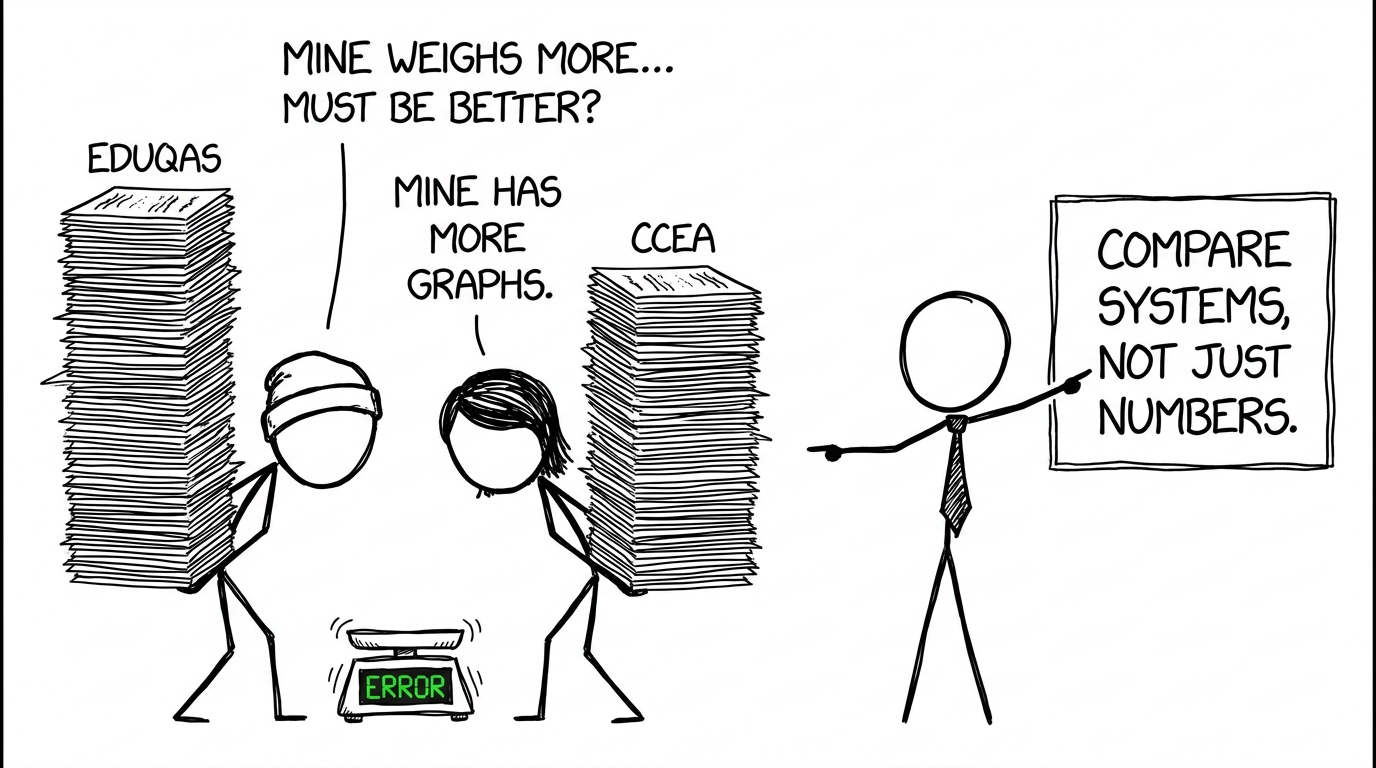 Students trying to weigh incomparable Eduqas and CCEA paperwork
What the comparison really tells you
An Eduqas grade 444 and a CCEA grade C are commonly treated as broad reporting benchmarks, while Eduqas grade 777 and CCEA grade A are often grouped in national results summaries. That does not make their raw boundaries equivalent.
For example, dividing an Eduqas boundary by 240240240 produces a percentage of available raw marks. Dividing a CCEA UMS threshold by 400400400 produces a percentage of the uniform scale. Those calculations describe different things because UMS is a reporting scale created after raw unit boundaries have been established.
The useful comparison is structural:
- Eduqas students should total both component marks and use the correct tier table.
- CCEA students should check both unit results, their UMS values and the permitted grade range for their unit combination.
- Everyone should use boundaries from the actual examination series shown on the result.
Common mistakes on GCSE maths results day
Comparing raw totals directly
A CCEA UMS total is not the same as an Eduqas raw total. Even when two figures look similar, their denominators and purposes differ.
Using the wrong Eduqas tier
Foundation and higher have separate boundaries. Foundation offers grades 111 to 555, while higher normally covers grades 444 to 999, with a possible grade 333 for a narrowly missed grade 444 boundary under the specification rules.
Treating component boundaries as final grades
Eduqas awards one qualification grade from the combined result. Notional paper boundaries are diagnostic guides, not independent grades.
Ignoring the CCEA unit pathway
M1 and M5, M2 and M6, M3 and M7, and M4 and M8 target different grade ranges. The unit combination affects which final grades are available.
Assuming last year's boundary will repeat
Raw boundaries can move because papers vary in demand. Historical data is helpful for planning, but it cannot confirm a future grade.
Takeaway for students and teachers
Grade boundaries are best understood as a translation tool, not a revision target. They translate performance in one examination series into a grade after the papers have been marked and reviewed.
On results day, begin with the board and assessment structure. Eduqas requires the correct total out of 240240240; CCEA requires the relevant unit and UMS information. If anything appears inconsistent, ask the school's examinations officer to confirm the component or unit breakdown before considering a review of marking.
For the next examination series, turn the comparison back into action. Start from free GCSE Maths revision resources, practise with board-specific questions and mark schemes, then build examination stamina using GCSE predicted papers. MathsGenie brings revision lessons, past papers, predicted papers, practice questions, mini tests and video solutions together so that your next result is shaped by preparation rather than boundary guesswork.











