GCSE Maths: Edexcel vs Eduqas Grade Boundaries
GCSE maths Edexcel vs Eduqas grade boundaries compared for results day, with 2025 marks, tier differences and clear next steps for students and teachers.
Results day has a strange ability to make one number feel like the whole story. Yet when comparing GCSE maths Edexcel vs Eduqas grade boundaries, the headline is simple: the raw boundaries differ, but that does not make one exam board easier. For the latest completed summer series, June 202520252025, both qualifications had 240240240 available marks. Eduqas boundaries were generally lower than Edexcel boundaries, particularly on higher tier, reflecting differences in the papers rather than a lower grading standard.
The boundaries for the June 202620262026 exams are not known in advance. They will be confirmed after marking and published on GCSE results day, Thursday 20 August 2026.
 A nervous GCSE student waits beside two exam-board envelopes while a remarkably calm cat watches
Results-day checklist
Before comparing numbers, check four things:
- your exam board: Edexcel or Eduqas;
- your tier: foundation or higher;
- the exam series, such as June 202520252025;
- your total subject mark, not a boundary from one component.
The quickest routes are MathsGenie's Edexcel GCSE Maths grade boundaries and Eduqas GCSE Maths grade boundaries. Each lets you compare the correct board, subject and series rather than relying on an unofficial social-media graphic.
Edexcel vs Eduqas grade boundaries compared
The following figures are the confirmed overall boundaries for June 202520252025. A dash means that the grade is unavailable on that tier.
| Tier and grade | Edexcel boundary | Eduqas boundary | Difference |
|---|---|---|---|
| Higher grade 999 | 217217217 | 196196196 | 212121 |
| Higher grade 888 | 186186186 | 155155155 | 313131 |
| Higher grade 777 | 156156156 | 115115115 | 414141 |
| Higher grade 666 | 121121121 | 858585 | 363636 |
| Higher grade 555 | 878787 | 565656 | 313131 |
| Higher grade 444 | 535353 | 272727 | 262626 |
| Higher grade 333 | 363636 | 121212 | 242424 |
| Foundation grade 555 | 175175175 | 141141141 | 343434 |
| Foundation grade 444 | 144144144 | 111111111 | 333333 |
| Foundation grade 333 | 105105105 | 818181 | 242424 |
| Foundation grade 222 | 676767 | 515151 | 161616 |
| Foundation grade 111 | 292929 | 212121 | 888 |
Both totals are out of 240240240, which makes the raw comparison unusually straightforward. Nevertheless, it is not a measure of which board is more generous. Grade boundaries respond to the demand of the assessment. If a paper proves more challenging, a comparable standard of performance may correspond to fewer raw marks.
This is why a student with 140140140 marks cannot use an Eduqas table to predict an Edexcel grade, even though the qualifications assess GCSE maths. The correct boundary belongs to the exact qualification and exam series.
Why the boundaries are so different
Edexcel uses three papers worth 808080 marks each: one non-calculator paper and two calculator papers. Eduqas uses two papers worth 120120120 marks each: one non-calculator component and one calculator-allowed component.
Paper structure, question style and the performance of the cohort all feed into awarding. Exam boards set boundaries after the papers have been taken and marked. The aim is comparable grading standards across boards and years rather than not identical raw marks.
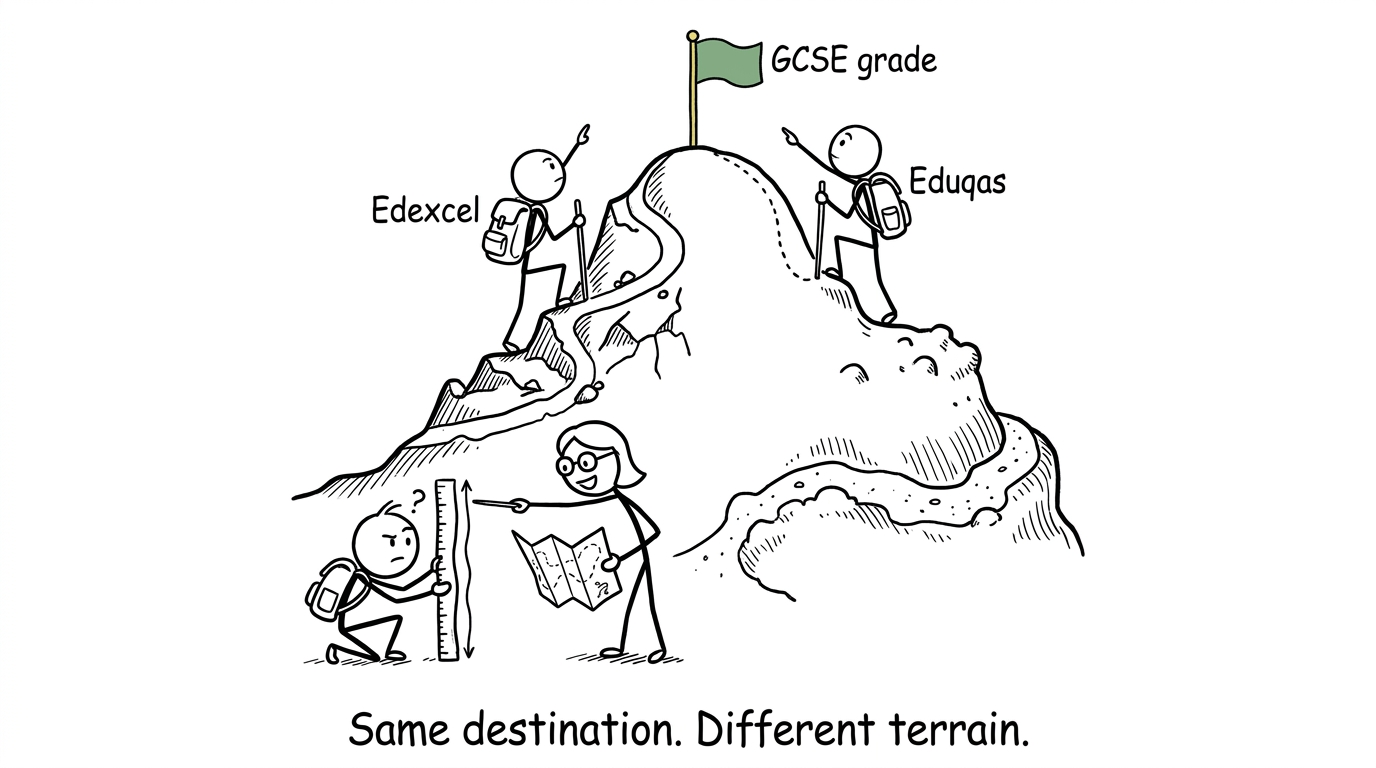 Two exam-board hikers take different routes towards the same GCSE grade
Think of the two boards as different routes up a hill. Counting steps tells you something about each route, but it does not prove that the destination changed.
What the comparison means for your grade
Foundation tier awards grades 111 to 555. Higher tier targets grades 444 to 999, with a narrowly available grade 333 below the normal higher-tier range. Grade 444 is commonly described as a standard pass, while grade 555 is a strong pass.
On results day, the useful question is not, “Would another board have given me a higher grade?” It is, “Was my total mark placed against the correct boundary?” Use the Edexcel predicted grade calculator or Eduqas predicted grade calculator when checking past-paper performance. For a live result, your official grade remains the final outcome unless a post-results service changes it.
If your mark is close to a boundary and the grade matters for sixth-form or college entry, speak to your school or exams officer. They can explain your component marks, access to scripts and review-of-marking options. A boundary being one mark away does not automatically mean a review will add that mark.
Common mistakes when reading grade boundaries
Comparing different exam series
June and November boundaries can differ. Always match the table to the series printed on the paper or results information.
Adding notional component grades
GCSE maths is awarded as an overall qualification. Notional paper or component boundaries are guides, not separate grades to combine.
Treating a lower boundary as an easier qualification
A lower raw boundary usually reflects a more demanding assessment. It does not show that the board applies a weaker grade standard.
Using foundation boundaries for higher tier
The tiers have different papers and boundaries. Check the tier before interpreting any mark.
Revising to last year's exact boundary
Boundaries move. A safer revision target includes a margin above previous thresholds rather than assuming the next boundary will stay fixed.
Takeaway summary
The June 202520252025 Eduqas grade boundaries were lower than the corresponding Edexcel boundaries, but students should not interpret that as Eduqas being easier. The boards used different assessments, and the raw marks needed to demonstrate a grade therefore differed.
For future results days:
- wait for confirmed boundaries rather than trusting predictions;
- compare the correct board, tier and series;
- use the overall mark out of 240240240;
- ask your school for guidance if a result affects your next step.
Until results day, focus on the part you can change. Choose the Edexcel GCSE Maths revision hub or Eduqas GCSE Maths revision hub, then combine revision lessons and practice questions with board-specific Edexcel past papers or Eduqas past papers. Mark each attempt carefully, use video solutions to repair weak methods, and add shorter practice through MathsGenie's mini tests and predicted-paper resources.
Grade boundaries are decided later. Better habits can begin today.