GCSE Maths AQA vs WJEC Grade Boundaries
GCSE Maths AQA vs WJEC grade boundaries explained for results day, with a 2025 comparison, tier differences and advice on reading marks correctly and calmly.
There is a particular kind of uncertainty before results day: you remember difficult questions, hear rumours about low boundaries and begin comparing marks with friends on another exam board. But GCSE maths AQA vs WJEC grade boundaries cannot be compared mark for mark. The boards use different specifications, totals, tiers and grading scales.
For GCSE maths results day in 2026, the official boundaries will not be known until results are released on Thursday 20 August 2026. Until then, the June 2025 figures below are useful historical context, not predictions.
The comparison at a glance
Before reading any boundary table, check:
- your exam board and exact specification;
- your tier of entry;
- the correct exam series;
- whether the figure is an overall boundary or a notional component boundary;
- the maximum available mark;
- whether the qualification uses grades 999-111 or A∗A^*A∗-GGG.
The most important point is simple: a higher raw boundary does not prove that one board is harder. Boundaries respond to the demand of that board's papers and are set after marking.
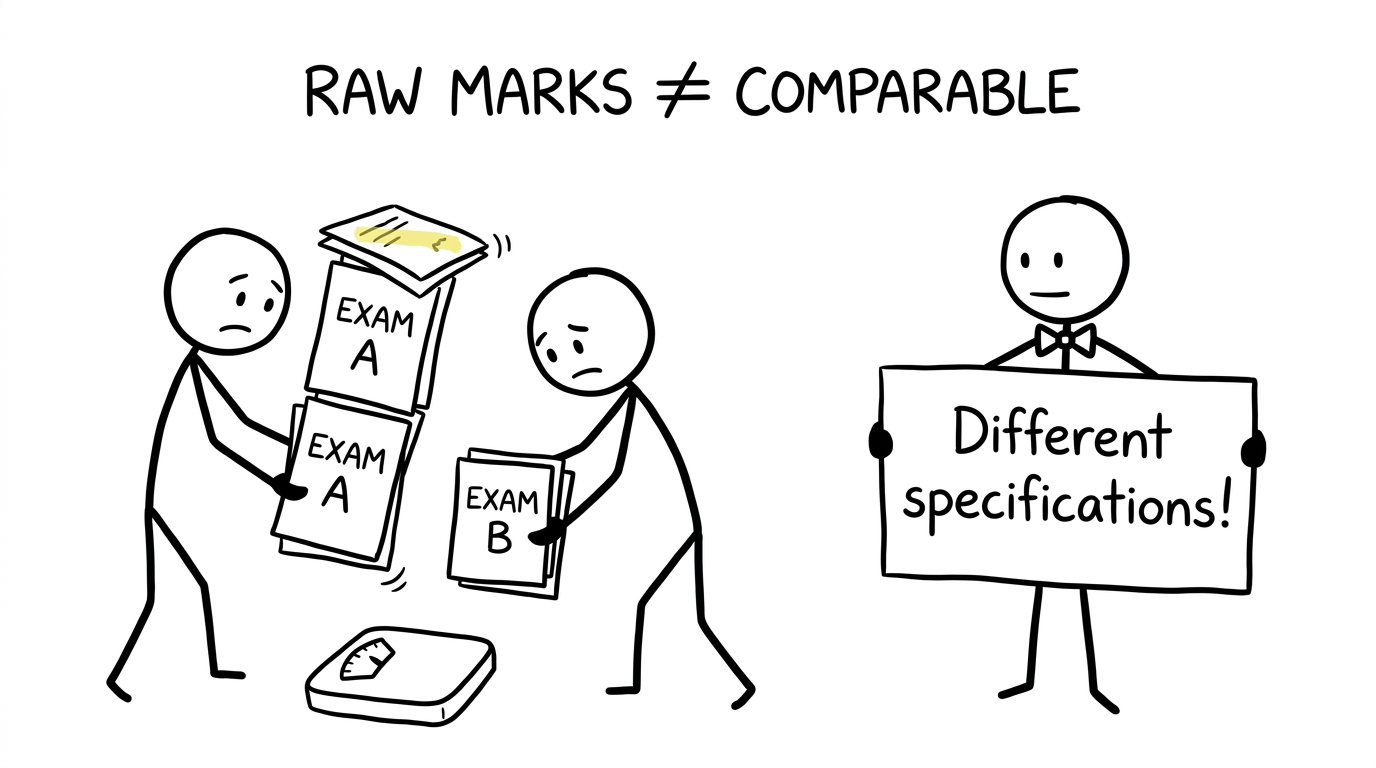 Students comparing differently sized sets of exam papers
AQA vs WJEC maths grade boundaries compared
The latest complete summer series available before 2026 results day is June 2025. These are overall raw-mark boundaries published for that series.
| Feature | AQA GCSE Mathematics | WJEC GCSE Mathematics |
|---|---|---|
| Grading shown in June 2025 | Grades 999-111 | Grades A∗A^*A∗-GGG |
| Available tiers | Foundation and higher | Foundation, intermediate and higher |
| Maximum overall mark | 240240240 on either tier | 130130130 foundation; 160160160 intermediate or higher |
| Highest grade available on foundation | Grade 555 | Grade DDD |
| June 2025 higher boundaries | Grade 999: 219219219; grade 888: 191191191; grade 777: 164164164; grade 666: 130130130; grade 555: 969696; grade 444: 636363; grade 333: 464646 | A∗A^*A∗: 122122122; AAA: 929292; BBB: 606060; CCC: 292929 |
| June 2025 intermediate boundaries | Not applicable | BBB: 106106106; CCC: 696969; DDD: 424242; EEE: 212121 |
| June 2025 foundation boundaries | Grade 555: 188188188; grade 444: 160160160; grade 333: 119119119; grade 222: 797979; grade 111: 393939 | DDD: 656565; EEE: 484848; FFF: 323232; GGG: 161616 |
You can explore the full historical records on the AQA GCSE grade boundaries page and the board-specific WJEC GCSE Maths grade boundaries page.
Why direct grade matching is misleading
It may be tempting to place grade 999 beside A∗A^*A∗, or grade 444 beside CCC, and compare the raw marks. That does not create a fair board comparison. The qualifications have different assessment structures and maximum marks, while the grades come from different national systems.
Even converting each boundary into a percentage does not solve the problem. The calculation is:
Boundary percentage=boundary markmaximum mark×100\text{Boundary percentage}=\frac{\text{boundary mark}}{\text{maximum mark}}\times 100Boundary percentage=maximum markboundary mark×100That can describe where a boundary sits within one assessment, but it cannot measure the relative difficulty or value of two qualifications. Ofqual's guidance for regulated qualifications in England is clear that different boundaries usually reflect differences in paper demand, not an easier route to a grade.
WJEC must also not be confused with Eduqas. Although both names belong to the same awarding organisation, their specifications and boundary documents are separate. Always follow the board and entry information supplied by your school.
How grade boundaries are decided
Exam boards do not choose boundaries before students sit the papers. Once marking is substantially complete, assessment experts examine performance data and senior examiners review work around possible boundaries. The aim is to maintain a comparable standard when one year's paper proves more or less demanding than another.
This is why predicted boundaries should remain estimates. They may help you consider possible outcomes, but they cannot confirm a grade. On results day, use your official series and specification. AQA states that its grade boundaries are published at 8.00 am8.00\text{ am}8.00 am on results days, while WJEC publishes boundaries on results day.
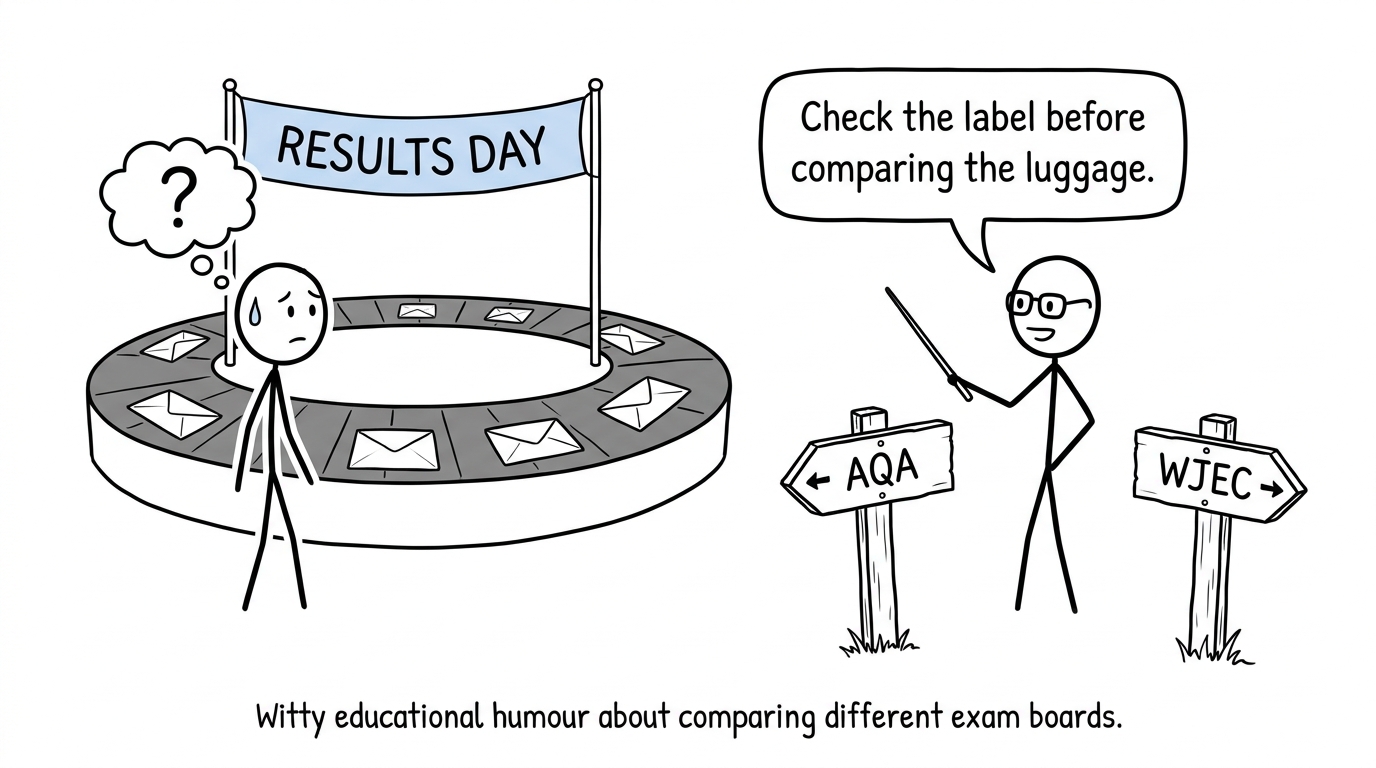 A student waiting for the correct exam-board results envelope
What to do before GCSE maths results day
Uncertainty becomes easier when it is turned into a checklist.
First, save the correct board page. AQA students can use the AQA GCSE Maths revision hub and AQA predicted grade calculator. WJEC students should use the WJEC GCSE Maths revision hub.
Next, remember that your results slip may show your grade without all the underlying raw marks. Your teacher or examinations officer can explain the available mark information and the school's process if you are close to another grade.
If you are still preparing for your exams, boundaries should guide targets rather than replace revision. Complete board-specific material from the AQA GCSE Maths past papers or WJEC GCSE Maths past papers, mark it carefully and identify where the next few marks can come from.
Common mistakes when reading grade boundaries
- Using another exam series: June and November boundaries can differ.
- Mixing foundation and higher: the available grades and required marks are not the same.
- Comparing raw marks without checking totals: 122122122 out of 160160160 is not directly comparable with 122122122 out of 240240240.
- Treating component boundaries as final grades: notional paper boundaries may support analysis, but the overall subject boundary determines the qualification grade.
- Assuming last year's boundary will return: each series is set after that series has been marked.
- Confusing WJEC with Eduqas: use the exact board and specification printed on your examination information.
The takeaway
AQA and WJEC grade boundaries belong to different assessment systems. Read each within its own specification, tier and exam series; never judge fairness from the raw numbers alone.
For calm, board-specific preparation, begin with the MathsGenie GCSE Maths revision hub. Use free revision lessons and practice questions to repair weak topics, then test progress with past papers, mark schemes, video solutions, predicted papers and mini tests. Results day matters, but the useful work happens earlier: one accurately marked paper and one corrected mistake at a time.