

GCSE Maths AQA vs OCR Grade Boundaries
GCSE maths AQA vs OCR grade boundaries compared using 2025 marks and percentages, with Results Day guidance and free MathsGenie revision links.
There is a particular kind of uncertainty before GCSE Maths Results Day. You know how the papers felt, perhaps you have estimated your marks, but you do not yet know where the final boundary will fall. Looking at GCSE maths AQA vs OCR grade boundaries can help, provided you compare percentages rather than raw marks.
The short answer is that AQA and OCR boundaries can look very different because AQA GCSE Maths is marked out of 240240240, while OCR is marked out of 300300300. Their papers, assessment structures and candidate cohorts also differ. A lower raw boundary does not make one board easier, and the current year's boundaries cannot be known before they are officially set.
The essential Results Day checklist
Before comparing the numbers:
- Check whether you took AQA or OCR.
- Check whether you sat foundation or higher tier.
- Use the boundary for the correct exam series.
- Compare percentages, not raw marks alone.
- Remember that historical boundaries are a guide, not a prediction.
- Ask your school for your component marks if you need more detail.
For the full historical record, use MathsGenie's AQA GCSE Maths grade boundaries and OCR GCSE Maths grade boundaries.
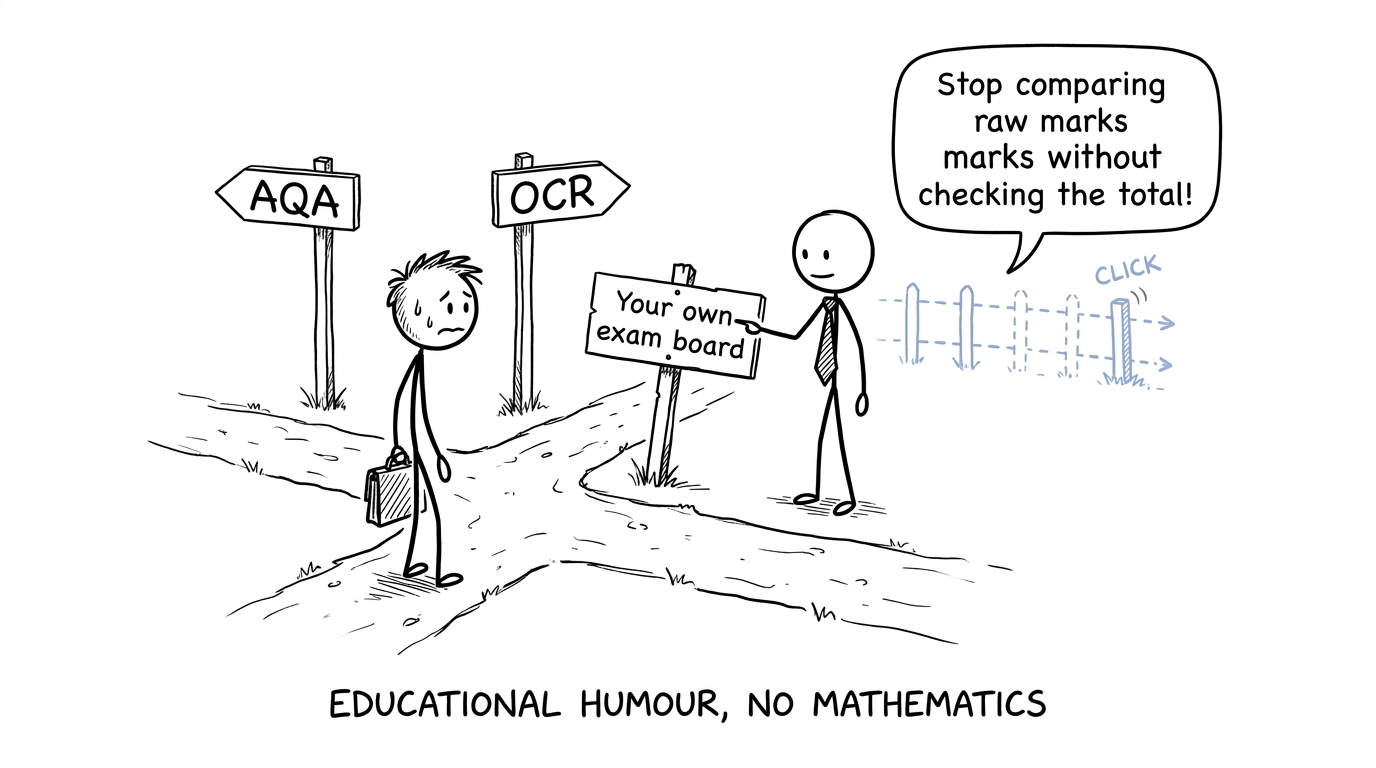 A GCSE student choosing between AQA and OCR signs while a teacher points towards the correct exam board
AQA vs OCR grade boundaries compared
The table below uses the latest complete summer series available before GCSE Results Day 202620262026: June 202520252025. The percentages have been rounded to one decimal place so that the different total marks can be compared fairly.
Higher-tier boundaries
| Grade | AQA marks out of 240240240 | AQA percentage | OCR marks out of 300300300 | OCR percentage |
|---|---|---|---|---|
| 999 | 219219219 | 91.3%91.3\%91.3% | 258258258 | 86.0%86.0\%86.0% |
| 888 | 191191191 | 79.6%79.6\%79.6% | 212212212 | 70.7%70.7\%70.7% |
| 777 | 164164164 | 68.3%68.3\%68.3% | 166166166 | 55.3%55.3\%55.3% |
| 666 | 130130130 | 54.2%54.2\%54.2% | 126126126 | 42.0%42.0\%42.0% |
| 555 | 969696 | 40.0%40.0\%40.0% | 868686 | 28.7%28.7\%28.7% |
| 444 | 636363 | 26.3%26.3\%26.3% | 474747 | 15.7%15.7\%15.7% |
| 333 | 464646 | 19.2%19.2\%19.2% | 272727 | 9.0%9.0\%9.0% |
Foundation-tier boundaries
| Grade | AQA marks out of 240240240 | AQA percentage | OCR marks out of 300300300 | OCR percentage |
|---|---|---|---|---|
| 555 | 188188188 | 78.3%78.3\%78.3% | 182182182 | 60.7%60.7\%60.7% |
| 444 | 160160160 | 66.7%66.7\%66.7% | 134134134 | 44.7%44.7\%44.7% |
| 333 | 119119119 | 49.6%49.6\%49.6% | 959595 | 31.7%31.7\%31.7% |
| 222 | 797979 | 32.9%32.9\%32.9% | 565656 | 18.7%18.7\%18.7% |
| 111 | 393939 | 16.3%16.3\%16.3% | 171717 | 5.7%5.7\%5.7% |
These are overall subject boundaries, not targets for individual papers. Your marks across all three papers are combined before the overall boundary is applied.
Why AQA and OCR boundaries differ
The most visible difference is the total mark. AQA has three 808080-mark papers, giving:
3×80=2403 \times 80 = 2403×80=240OCR has three 100100100-mark papers, giving:
3×100=3003 \times 100 = 3003×100=300The non-calculator paper also appears in a different position: Paper 111 for AQA and Paper 222 for OCR. More importantly, the questions and overall demand are not identical.
Ofqual requires awarding organisations to maintain comparable standards between years and exam boards. Boundaries are set after most marking has been completed, using statistical evidence alongside expert examination of students' work. If a paper proves more demanding, its boundaries may be lower. If it proves less demanding, they may be higher.
That is why OCR's lower percentage boundaries in June 202520252025 do not prove that OCR was an easier route to a particular grade. The boundary reflects that specific assessment and cohort.
What happens on GCSE Maths Results Day?
GCSE Results Day 202620262026 is Thursday 20 August. The new AQA grade boundaries and OCR grade boundaries for the June 202620262026 series will not be confirmed until the awarding process is complete.
When you receive your result:
- read the awarded grade before searching for boundaries;
- confirm your tier and exam board;
- ask for your total raw mark where it is not shown;
- compare that mark with the official subject boundary;
- speak to your school if you are close to the next grade.
A review of marking is not an automatic extra mark. Marks can remain unchanged, rise or fall, so discuss the evidence and possible consequences with your exams officer.
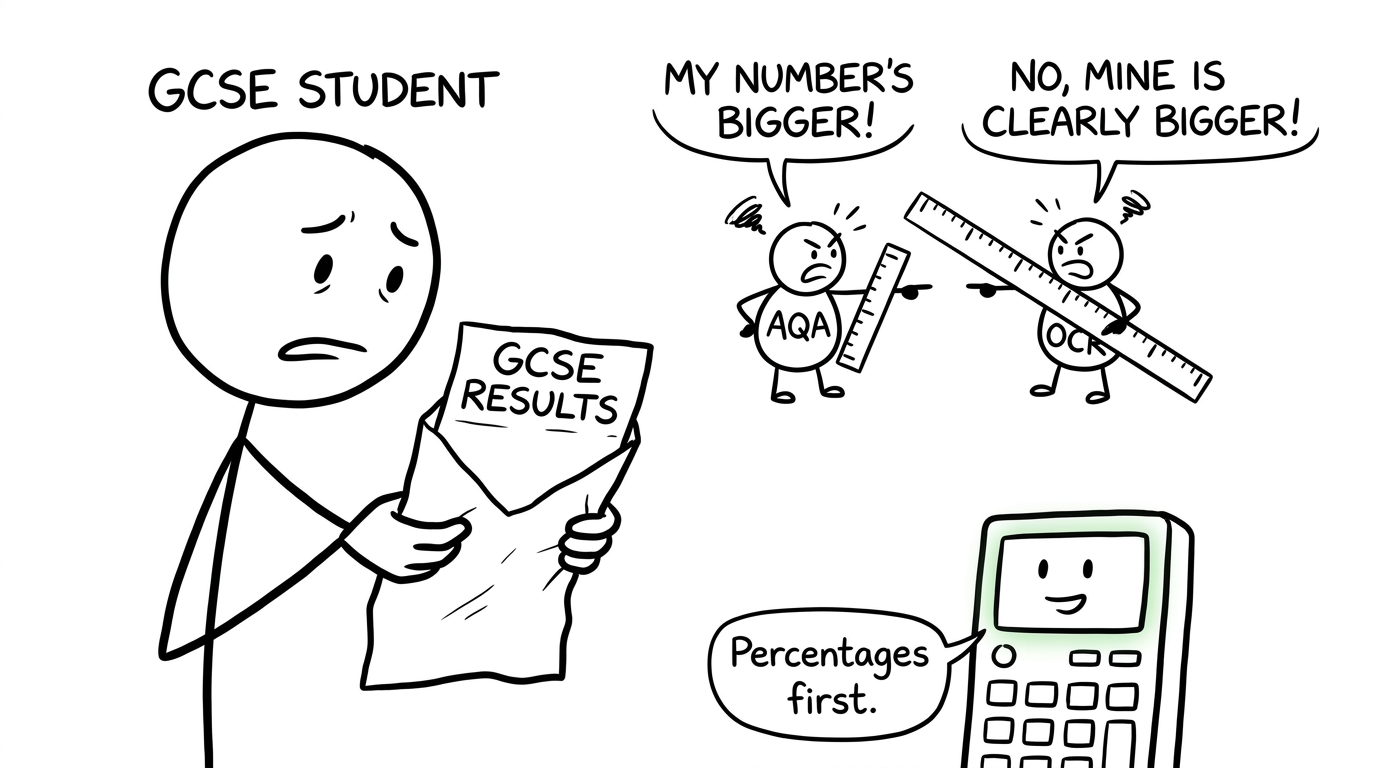 A student opens a results envelope while AQA and OCR mascots compare rulers and a calculator recommends percentages
Using boundaries before the exams
Grade boundaries are most useful as context, not as a revision target. If a previous Grade 777 boundary was 164164164, aiming for exactly 164164164 leaves no room for normal variation, a difficult topic or a few avoidable errors.
Instead, complete a timed paper, mark it strictly and record the marks you lost by topic. AQA students can use the AQA GCSE Maths predicted grade calculator, while OCR students can use the OCR GCSE Maths predicted grade calculator. These tools estimate a grade from previous boundaries; they cannot guarantee the boundary for a future series.
Follow the estimate with board-specific practice. The AQA GCSE Maths revision hub includes lessons, questions and revision tools, while the OCR GCSE Maths revision hub keeps your practice aligned with OCR's paper structure. AQA students can also work through AQA past papers and mark schemes.
Common mistakes when comparing boundaries
Comparing raw marks directly
An AQA mark out of 240240240 cannot be compared directly with an OCR mark out of 300300300. Convert both to percentages first.
Mixing foundation and higher tier
Foundation and higher papers have separate boundaries. Foundation offers grades 111 to 555, while higher offers grades 444 to 999, with a narrow Grade 333 safety net.
Treating last year's boundary as a promise
Boundaries move because paper demand and student performance change. They are not fixed pass marks written before the examination.
Assuming lower means easier
A low boundary may indicate a more demanding paper. It does not show that one specification gives grades away more generously.
Takeaway summary
The fairest GCSE maths AQA vs OCR grade boundaries comparison uses percentages, the same tier and the same exam series. June 202520252025 OCR boundaries were lower as percentages than AQA's, but that does not make OCR easier. Standards are designed to remain comparable, while the raw marks adjust to the demand of each assessment.
For Results Day, go straight to MathsGenie's board-specific AQA boundaries or OCR boundaries. Before the exams, turn those numbers back into something useful: revision lessons, practice questions, past papers, predicted papers, mini tests, mark schemes and video solutions. Boundaries tell you where a line once stood. Focused practice is what helps you move beyond it.











