GCSE Japanese: Revise Every Day or Take Rest Days?
GCSE Japanese revise every day or rest? Learn how spacing, retrieval and recovery improve retention, then build a balanced revision schedule that lasts.
The short answer: consistency needs recovery
When exams approach, taking a day off can feel strangely irresponsible. Vocabulary remains unlearnt, kanji still blur together, and the calendar keeps moving. So, should you gcse japanese revise every day or rest?
The most effective answer is usually a mixture: maintain frequent contact with Japanese, but include recovery days from demanding revision. Short, focused sessions spread across the week are generally better for long-term retention than one exhausting weekend block. Yet revising intensely every day is neither necessary nor automatically productive.
Research into spacing and retrieval practice consistently supports revisiting material across separate sessions. Sleep also contributes to memory consolidation. This means a sensible rest day is part of learning, not an interruption to it.
For a student balancing Japanese with GCSE maths and other subjects, the goal is not to create the longest possible streak. It is to build a routine you can repeat until the final exam.
A practical revision checklist
A balanced week should include:
- short Japanese sessions on most days;
- active recall rather than repeated reading;
- practice across listening, speaking, reading and writing;
- at least one lighter or complete rest day;
- enough sleep to protect concentration and memory;
- longer gaps before revisiting secure material;
- flexibility for maths, science and other GCSE subjects;
- occasional exam-style practice under timed conditions.
Think of daily contact and daily hard revision as different things. Five minutes recalling vocabulary can maintain momentum without becoming a full revision session.
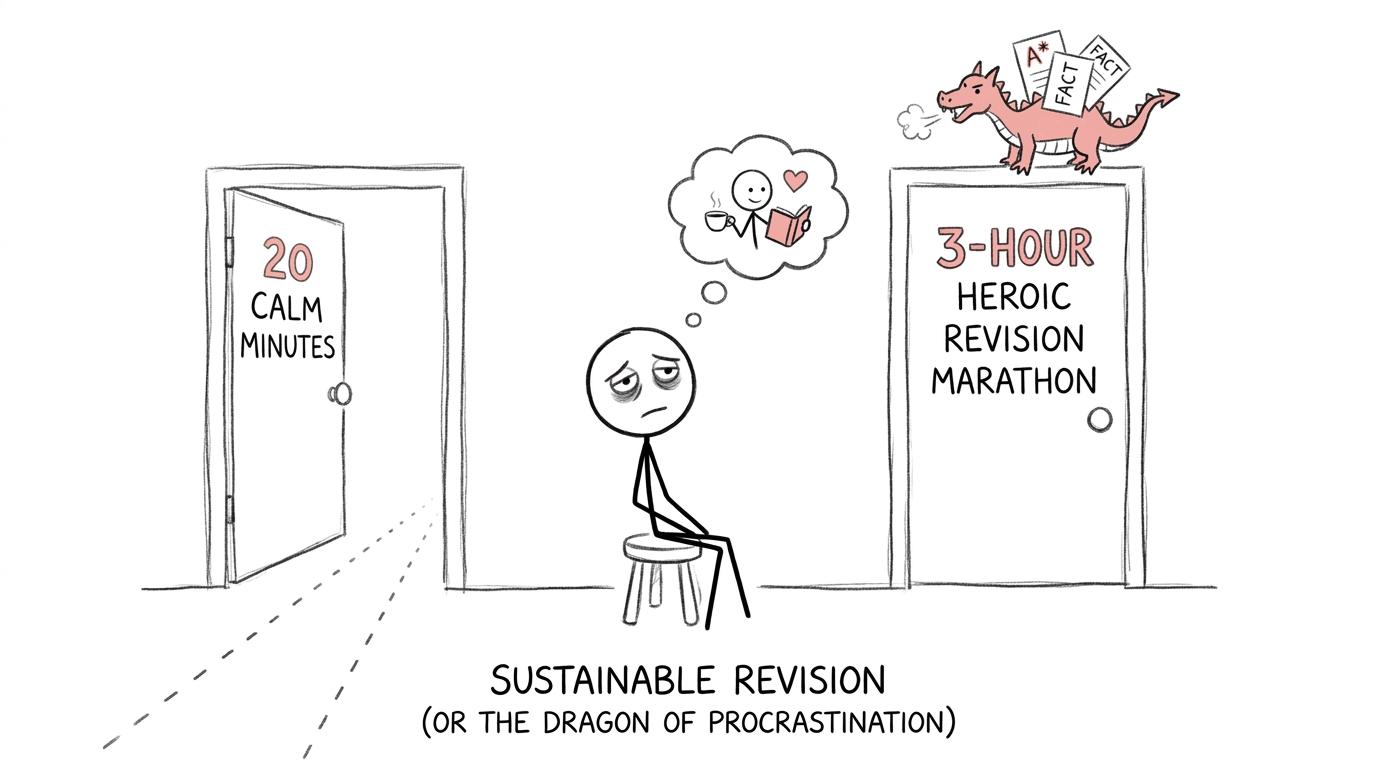 A student choosing between calm revision and an intimidating flashcard marathon
Why revising every day can help
Japanese contains several kinds of knowledge that become stronger through repeated retrieval. You need to recognise vocabulary, read different scripts, recall grammatical structures and produce accurate language without always having prompts in front of you.
Frequent contact reduces the amount that feels unfamiliar each time you return. A short vocabulary test today, a listening task tomorrow and a writing check later in the week create several opportunities to retrieve what you know.
This is especially useful because GCSE Japanese is not assessed through one general paper. The current Pearson Edexcel GCSE includes separate papers for listening, speaking, reading and writing, with foundation and higher tiers. Revision therefore needs to develop all four skills rather than becoming an endless sequence of vocabulary lists.
Daily revision can work well when:
- sessions are brief and purposeful;
- different language skills are rotated;
- previously learnt material is retrieved from memory;
- mistakes influence the next session;
- the routine leaves enough energy for other subjects.
The key word is brief. A sustainable session might last 151515 to 252525 minutes. More time is not always more learning, particularly once attention has faded.
Why rest days can improve retention
Memory does not develop only while you are looking at a page. Learning continues after a session as memories stabilise and become easier to retrieve. Sleep is particularly important within this process.
Spacing research shows that repetitions separated in time generally support longer-lasting retention more effectively than massed repetitions completed close together. Retrieval practice strengthens this approach because it requires you to reconstruct an answer rather than merely recognise it.
A rest day naturally creates space. When you return to a word or structure and have to work slightly harder to remember it, that effort can be useful. Instant recall immediately after reading something may feel fluent, but it does not prove that the information will remain accessible next week.
Rest also protects the quality of future sessions. Fatigue can lead to passive rereading, careless answers and the illusion of progress. Stopping before revision becomes empty allows you to return with better attention.
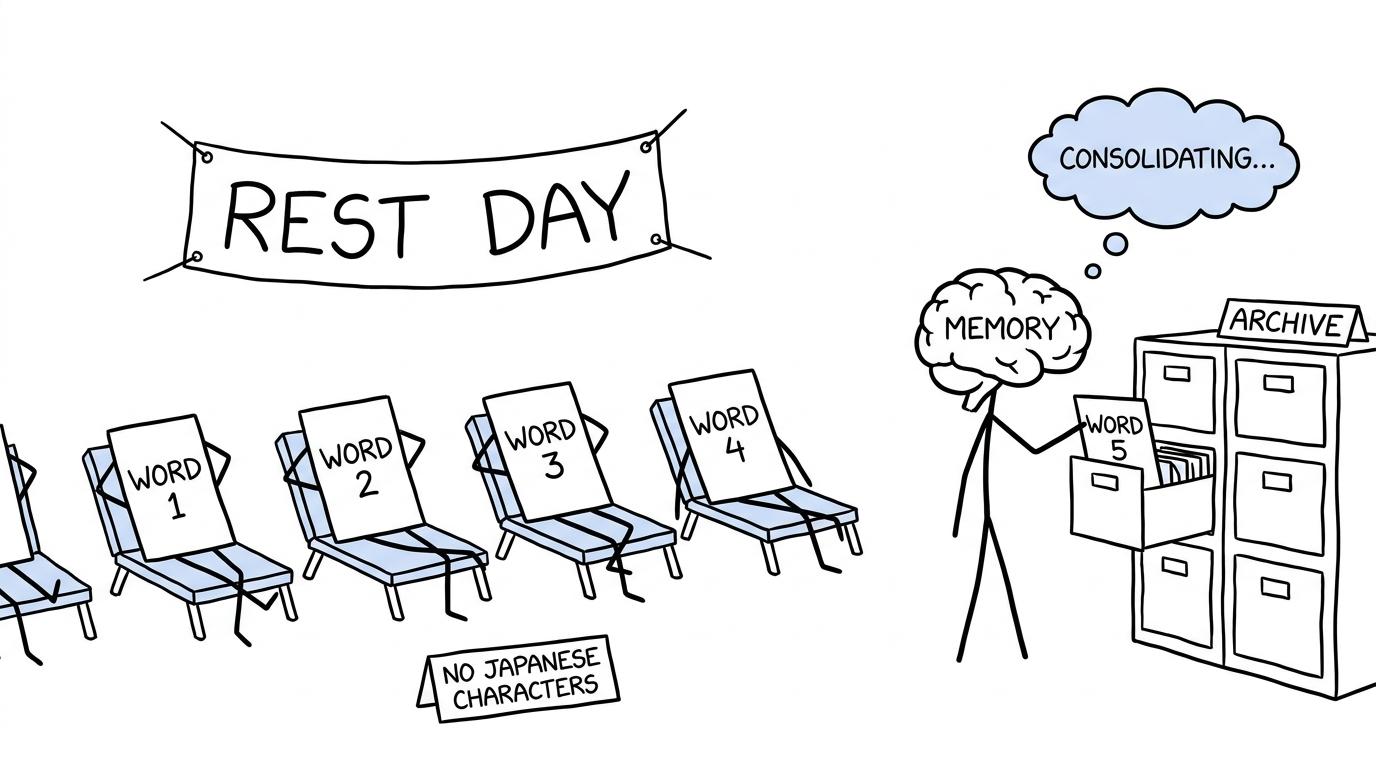 Japanese vocabulary cards enjoying a rest while memory quietly organises them
Daily contact is not the same as daily pressure
The apparent choice between revising every day and taking rest days is too simple. There are at least three useful levels of activity.
A focused revision session
This might involve vocabulary retrieval, listening practice or planning and checking a written response. It requires concentration and has a clear outcome.
A light-contact day
Spend 555 to 101010 minutes recalling a small set of words, saying a few sentences aloud or checking yesterday's errors. This keeps Japanese familiar without taking much energy.
A complete rest day
Do no Japanese revision. Use the time for recovery, sleep, exercise, family commitments or another subject. One missed day does not erase what you have learnt.
This distinction matters for students preparing for maths exams too. A day containing a Japanese lesson, maths questions and science revision is already cognitively demanding. Treating every subject as if it deserves a full session every day soon creates an impossible timetable.
MathsGenie's GCSE maths revision timetable guide follows the same broad principle: revisit content regularly, practise actively and leave room for rest and catching up.
A balanced weekly pattern for GCSE Japanese
A useful starting point is four focused sessions, two light-contact days and one complete rest day. Adjust this around lessons, homework and the proximity of your examinations.
- Monday: vocabulary retrieval and kanji recognition for 202020 minutes;
- Tuesday: listening practice for 202020 to 252525 minutes;
- Wednesday: light recall for 555 to 101010 minutes;
- Thursday: speaking or writing practice for 202020 to 303030 minutes;
- Friday: complete rest from Japanese;
- Saturday: reading and mixed exam questions for 303030 to 404040 minutes;
- Sunday: light review of errors for 101010 minutes.
This is a template, not a universal prescription. If Japanese is one of your weakest subjects, add another focused session. If you have a Japanese lesson on a particular day, that lesson may already provide meaningful contact.
The best schedule is the one that survives an ordinary week. MathsGenie's one-month GCSE revision plan offers a useful model for balancing retrieval, focused practice and exam questions across a limited period. You can apply the same planning logic to Japanese while using the GCSE maths revision hub for your maths workload.
What to do during each Japanese session
Spacing helps only if the activity inside each session is worthwhile. Give every session one primary purpose.
Retrieve before reviewing
Close your notes and attempt to recall vocabulary, readings or grammatical structures first. Then check the answer. The check provides feedback; the retrieval attempt creates the useful mental effort.
Rotate the assessed skills
Do not let the ease of flashcards crowd out listening, speaking, reading and writing. Vocabulary supports each skill, but knowing an isolated word is not identical to understanding it in speech or producing it accurately in a sentence.
Revisit mistakes after a gap
Keep a short error list containing forgotten vocabulary, confused characters, inaccurate particles and recurring writing problems. Test these again after a day or two, then later in the week. Secure items can wait longer before returning.
Finish while attention is still useful
A planned stopping point prevents a short session from expanding into an exhausting one. If you consistently avoid starting, reduce the session before abandoning the routine.
The same learn, practise, mark and retest cycle works in maths. MathsGenie's free GCSE maths resources combine revision lessons with exam-style practice, while the GCSE maths resit revision plan explains how an error log can turn lost marks into specific targets.
How to balance Japanese with GCSE maths
Japanese and maths demand different forms of recall, but both reward active practice. Reading a Japanese vocabulary list repeatedly is no more reliable than watching a maths solution and assuming you could reproduce the method alone.
Give each subject protected space. Rather than revising both heavily every evening, alternate the main emphasis. A Japanese-focused day might contain only a short maths mini test. A maths-focused day might include only five minutes of Japanese retrieval.
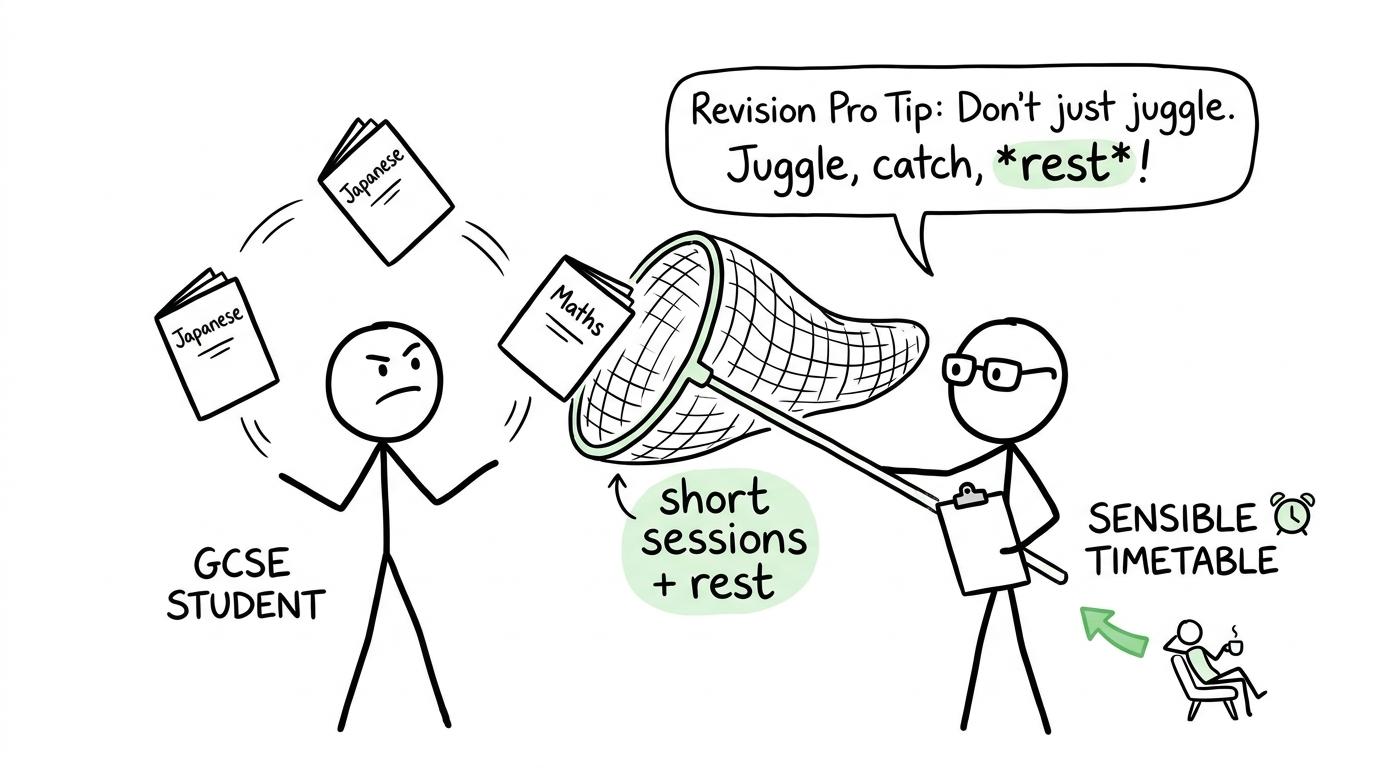 A student balancing Japanese and maths with help from a sensible timetable
As maths exams approach, choose resources matching your board and tier. MathsGenie supports Edexcel, AQA, OCR and Eduqas, alongside other boards, through revision lessons, practice questions, past papers, mark schemes and video solutions. The OCR GCSE revision efficiency guide, for example, shows how short feedback-led sessions can replace unfocused hours.
Near an exam, resist sacrificing sleep for one more large revision block. The GCSE maths night-before plan uses a limited, calm review rather than a late-night marathon. The same principle is sensible before Japanese assessments.
Common mistakes when planning Japanese revision
Treating a streak as the goal
A long streak records attendance, not learning. Track what you can retrieve and use instead. Taking a planned rest day is not failure.
Cramming one skill
Vocabulary may feel measurable, so it can dominate revision. However, GCSE Japanese assesses listening, speaking, reading and writing. Your timetable should reflect that range.
Rereading instead of recalling
Looking over familiar notes creates recognition. Exams require recall, interpretation and production. Attempt an answer before uncovering it.
Making every session too long
An ambitious routine often collapses because it was designed for an unusually energetic day. Start with a duration you can repeat during a normal school week.
Ignoring signs of fatigue
If you are repeatedly reading the same line, guessing carelessly or retaining very little, extending the session may add time without adding value. Stop, rest and return later.
Allowing one missed day to ruin the week
Do not repay a missed session with a punishing double session. Continue with the next planned activity and move unfinished work to a catch-up slot if it remains important.
Build a rhythm that lasts
You do not need intense GCSE Japanese revision every day. Frequent, short contact can support vocabulary and script recognition, while planned rest protects attention and gives learning time to settle. In most weeks, combine focused sessions, light-contact days and at least one genuine break.
The broader lesson applies across GCSE revision: durable progress comes from returning, retrieving, checking and adjusting. It rarely comes from one heroic evening.
Use your Japanese specification and teacher guidance to organise the four assessed skills. Then bring the same disciplined rhythm to maths with MathsGenie's free revision lessons, practice questions, mini tests, past papers, predicted papers, mark schemes and video solutions. Start at the MathsGenie GCSE maths revision hub, choose your exam board and tier, and make your next session short enough to begin today.