GCSE Italian Paper 3: What to Actually Expect
GCSE Italian Paper 3 explained: timings, reading questions, translation, tier differences and a focused revision plan for AQA and Edexcel students.
The unsettling thing about a reading exam is that you can understand nearly every word and still lose marks. One small negative, a change of tense or an answer copied from the wrong part of the passage can alter everything.
GCSE Italian Paper 3 is the reading paper for both AQA and Pearson Edexcel. It tests whether you can understand written Italian, identify precise details, interpret opinions and translate Italian into English. It is not a writing paper in disguise: most of your marks come from understanding what the text communicates, not producing elaborate Italian.
The exact format depends on your exam board, so check the qualification code on your timetable or statement of entry before revising. For the specifications covered here, both AQA and Edexcel offer Foundation and Higher tiers, with Paper 3 contributing 25%25\%25% of the qualification.
GCSE Italian Paper 3 at a glance
Before thinking about technique, establish what will actually be on your desk.
- AQA Foundation: 454545 minutes, 606060 marks.
- AQA Higher: 111 hour, 606060 marks.
- Edexcel Foundation: 454545 minutes, 505050 marks.
- Edexcel Higher: 111 hour, 505050 marks.
- Both boards assess reading comprehension and translation from Italian into English.
- Questions may require answers in English, Italian or a non-verbal response such as selecting a box.
- Dictionaries are not permitted.
- You must normally take the same tier across all four language skills.
These details come from the published AQA and Pearson Edexcel specifications available for the qualification. Specifications can be amended, so your board's current candidate information and your school's instructions should always take priority.
If you are taking Pearson Edexcel, you can begin with the Edexcel GCSE Italian past papers on MathsGenie. A real paper removes the mystery more effectively than another hour spent rereading a vocabulary list.
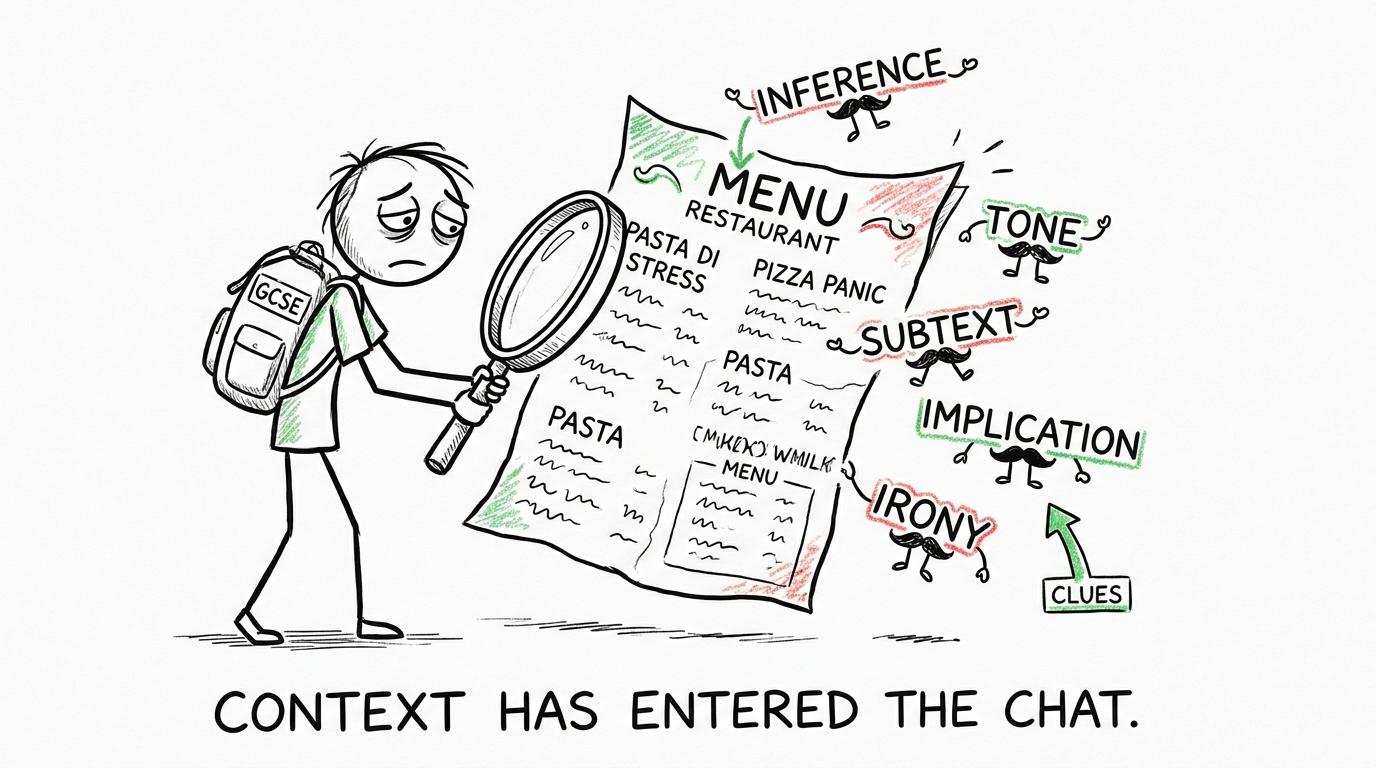 A student detective searching an Italian text for context clues
What is different about Paper 3?
Paper numbers can make the GCSE feel like one long examination split into pieces. In reality, each component demands a different kind of attention.
Listening asks you to process language at a pace controlled by the recording. Speaking asks you to retrieve language while someone waits for your response. Writing rewards your ability to construct accurate Italian.
Paper 3 gives you control over the pace, but that freedom creates its own challenge. You can revisit a sentence, compare two paragraphs and inspect an unfamiliar word. You can also spend six minutes worrying about one mark and leave an easier question unfinished.
The paper therefore favours three habits:
- locating evidence rather than relying on the general mood of a passage;
- noticing small grammatical signals;
- moving on when one word cannot be decoded.
Reading is not a test of whether you know every item in the vocabulary list. It is a test of whether you can build a reliable meaning from the information available.
How AQA Paper 3 is organised
AQA Paper 3 assesses understanding of different forms of written language. Texts may include personal communication, public information, factual material and literary passages.
Section A
The questions are written in English. You respond in English or non-verbally, depending on the task. This section removes the need to compose Italian, but it still requires precision. If a question asks why someone changed their plans, simply identifying the new plan may not earn the mark.
Section B
Questions are written in Italian and answers are given in Italian or non-verbally. The first task is often understanding the instruction itself. Command words, question words and the required number of details matter.
Your Italian answer does not need to become a miniature essay. A concise response drawn accurately from the passage is usually safer than an ambitious sentence containing unnecessary language.
Section C
The final section is translation from Italian into English. The AQA specification states a minimum source-text length of 353535 words at Foundation and 505050 words at Higher.
A good translation should sound natural in English while preserving the original meaning. Every clause matters. Pronouns, negatives, time references and verb tenses are frequent sources of lost marks.
How Edexcel Paper 3 is organised
Pearson Edexcel calls the component Reading and understanding in Italian. Its published format contains 101010 questions across three sections, although the shape and length of individual tasks vary.
Sections A and B
Questions in Section A are set in English, while questions in Section B are set in Italian. The passages are drawn from the themes in the specification and may range from short messages to longer factual or literary material.
Expect a mixture of multiple-choice selections, matching tasks and short responses. A multiple-choice question is not automatically easy: the incorrect options are often connected to words that genuinely appear in the passage. Your job is to match the complete meaning, not the most recognisable noun.
Section C
Section C contains translation into English. Pearson's sample assessment guidance advises Foundation candidates to allow approximately 101010 minutes and Higher candidates approximately 151515 minutes for the translation. That is guidance rather than a rule, but it is a useful reminder not to reach the final task with only a few hurried minutes remaining.
The question types Paper 3 favours
Some questions reward direct retrieval. Others ask whether you have understood the relationship between ideas.
Exact details
Dates, places, people, reasons and sequences of events are common targets. Scan for the relevant part of the passage, then read the whole sentence around it. The nearest familiar word is not necessarily the answer.
Opinions and attitudes
You may need to decide whether a speaker is enthusiastic, disappointed, doubtful or critical. Adjectives help, but so do contrast words and changes in tone. A sentence can begin positively before reversing its meaning.
Time frames
Paper 3 regularly distinguishes between what happened, what usually happens and what will happen. Verb endings and time phrases can separate three plausible answer choices.
Inference
Higher-tier texts are more likely to require meaning that is implied rather than directly repeated. Inference is still evidence-based. You should be able to underline the phrase that supports your conclusion, even when the answer uses different vocabulary.
Literary language
A literary extract may feel less predictable than a notice or email. Concentrate on who is involved, what changes and how the character reacts. You do not need to analyse it as if it were an English Literature essay.
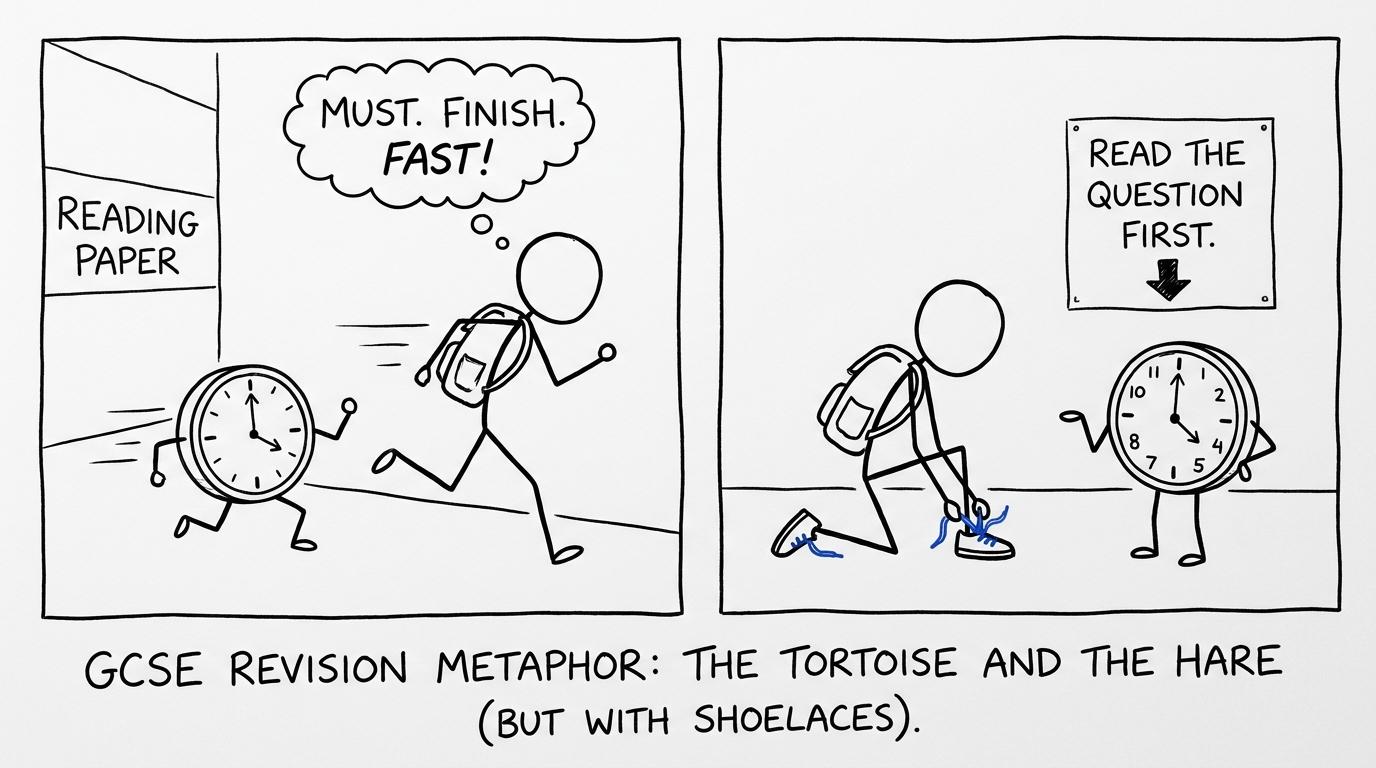 A student learning to stop racing the clock and read the question
Foundation and Higher tier differences
The Higher paper is not merely the Foundation paper with longer paragraphs. Higher-tier reading generally brings denser language, less obvious paraphrasing and a greater need to infer meaning. The translation is also longer.
Foundation candidates should not mistake accessibility for simplicity. Short texts can still test negatives, time frames and very specific details. There is little room for careless reading when each sentence carries useful information.
At either tier, practise with the paper you will actually sit. Completing Higher material when you are entered for Foundation may teach vocabulary, but it is not the best rehearsal of your timing or question format.
This principle transfers directly to maths revision. Students balancing Italian with GCSE maths should select the correct board and tier through the GCSE Maths revision hub, rather than treating every paper as interchangeable. The GCSE maths topics by board and tier guide can help you organise that side of your timetable.
A practical timing strategy
A reading paper rewards flexible timing more than a rigid schedule. Nevertheless, you need boundaries.
Start by checking the instructions and looking at the marks available. Work steadily through the paper, but mark any stubborn question and return later. Spending several minutes decoding one adjective is rarely sensible when other marks remain available.
Protect time for translation from the beginning. For Edexcel, the published guidance of roughly 101010 minutes at Foundation or 151515 minutes at Higher is a sensible planning point. AQA candidates can develop their own target by completing timed past papers.
During the final check:
- revisit unanswered questions;
- check that you supplied the requested number of details;
- look for missed negatives;
- make sure every translation sentence is complete;
- confirm that answers are in the required language.
If timing is a wider weakness across your subjects, the process in how to use past papers properly is transferable: complete the paper under realistic conditions, mark it strictly, classify each error and revisit the weak skill.
How to revise for the reading paper
Vocabulary matters, but isolated vocabulary revision is not enough. Paper 3 presents words inside sentences containing tense, tone and context.
Use a simple cycle:
- revise vocabulary from the specification themes;
- complete one short reading task without notes;
- mark it carefully;
- record whether each error came from vocabulary, grammar, instruction-reading or timing;
- repeat the task after a gap.
Build confidence with word families, common prefixes and familiar roots. Learn connectives and negative expressions because they reveal how ideas relate. Regularly translate short passages into natural English, checking meaning clause by clause rather than replacing each Italian word mechanically.
Past papers should eventually become the centre of preparation. If you also have maths papers approaching, use MathsGenie's Edexcel GCSE Maths past papers, best order for learning GCSE maths topics and night-before GCSE maths plan to keep both subjects structured without turning revision into an endless list.
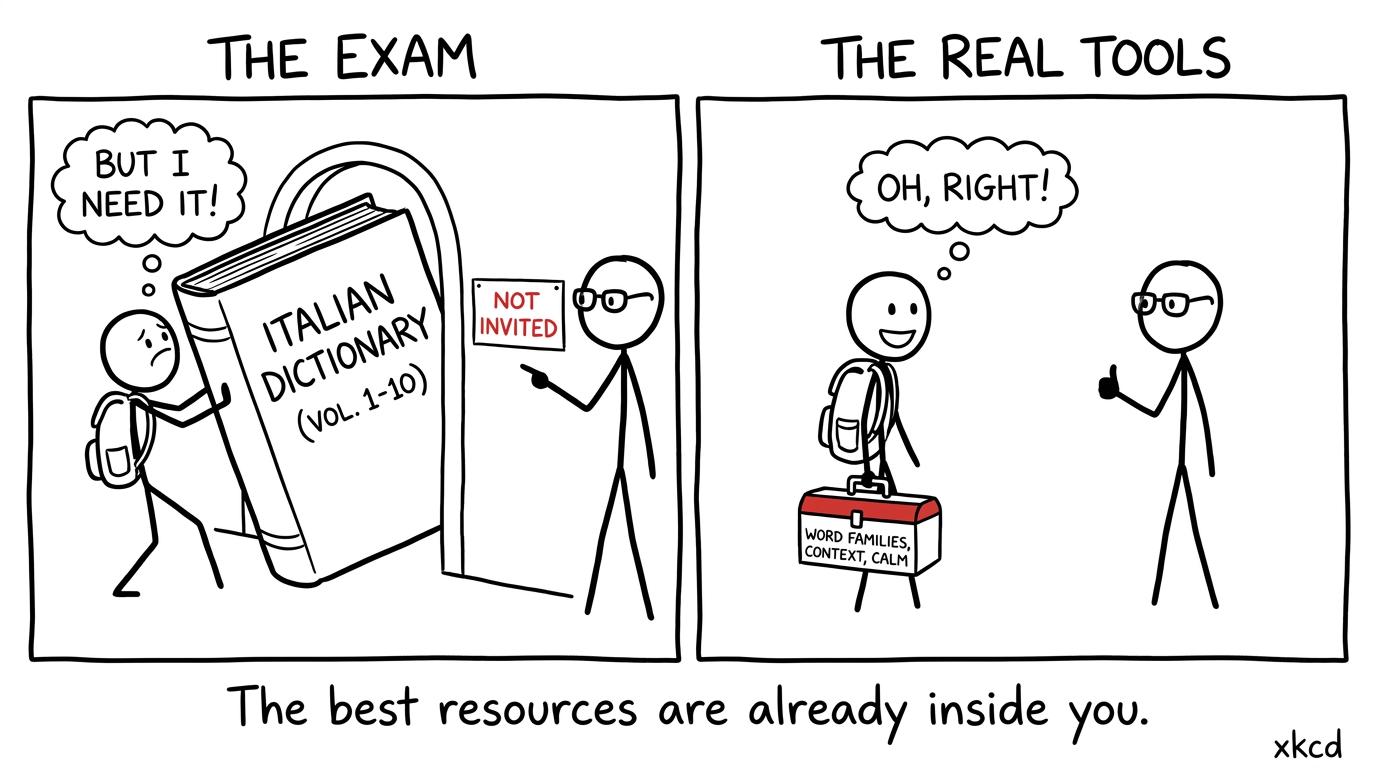 A dictionary discovering that it is not invited into the exam hall
Common mistakes on GCSE Italian Paper 3
Matching words instead of meanings
An incorrect option may repeat vocabulary from the passage. Read the full idea and check whether the relationship between the words actually matches.
Ignoring negatives
Expressions such as non, mai, nessuno and niente can reverse a sentence. Circle or underline them when the paper permits annotation.
Answering in the wrong language
Section changes matter. Check whether the response must be in English, Italian or non-verbal form before writing.
Giving too many answers
If the question requests two details, give two clear details. Adding an unsupported third statement can create ambiguity and may prevent the response from being credited under the relevant marking guidance.
Translating word by word
Italian and English do not always organise ideas in the same order. Preserve the tense, person and meaning, then make the English natural.
Leaving the translation until too late
Translation carries several marks and requires careful checking. Reserve time for it instead of treating it as whatever remains after the comprehension tasks.
Make the unfamiliar feel routine
Paper 3 becomes less intimidating when you stop expecting complete understanding. Strong reading is selective. You locate evidence, recognise signals, tolerate an unfamiliar word and continue building the meaning.
Begin with the Edexcel GCSE Italian paper collection if that is your board. Sit a paper to time, use the mark scheme honestly and turn every lost mark into a specific next action.
For the maths exams competing for space in the same revision calendar, make MathsGenie's free GCSE revision resources your base. Use revision lessons and practice questions to repair individual topics, mini tests to check recall, and past papers or predicted papers to build exam stamina. Mark schemes and video solutions then show you exactly what to correct.
The aim is not to make every paper predictable. It is to make your response to it reliable.