GCSE Simultaneous Equations: How to Improve Fast
GCSE simultaneous equations made easier: learn substitution, elimination and graphs with worked examples, common mistakes and Maths Genie practice links.
Simultaneous equations have a particular way of making capable students feel… oddly stuck. You look at two lines of algebra, you know you’ve seen the method, and yet your brain insists it’s a magic trick you weren’t invited to learn.
If that’s you, you’re not behind. You’re human. And the good news is that improving at simultaneous equations is one of the most reliable wins in GCSE maths revision: the questions repeat, the methods are consistent, and the marks are generous if your working is organised.
This guide shows you how to improve at simultaneous equations using the three core approaches (elimination, substitution and graphs), plus the habits that turn “I get it when I watch it” into “I get the marks in the exam”. Along the way, you’ll find targeted Maths Genie practice so your GCSE progress is measurable.
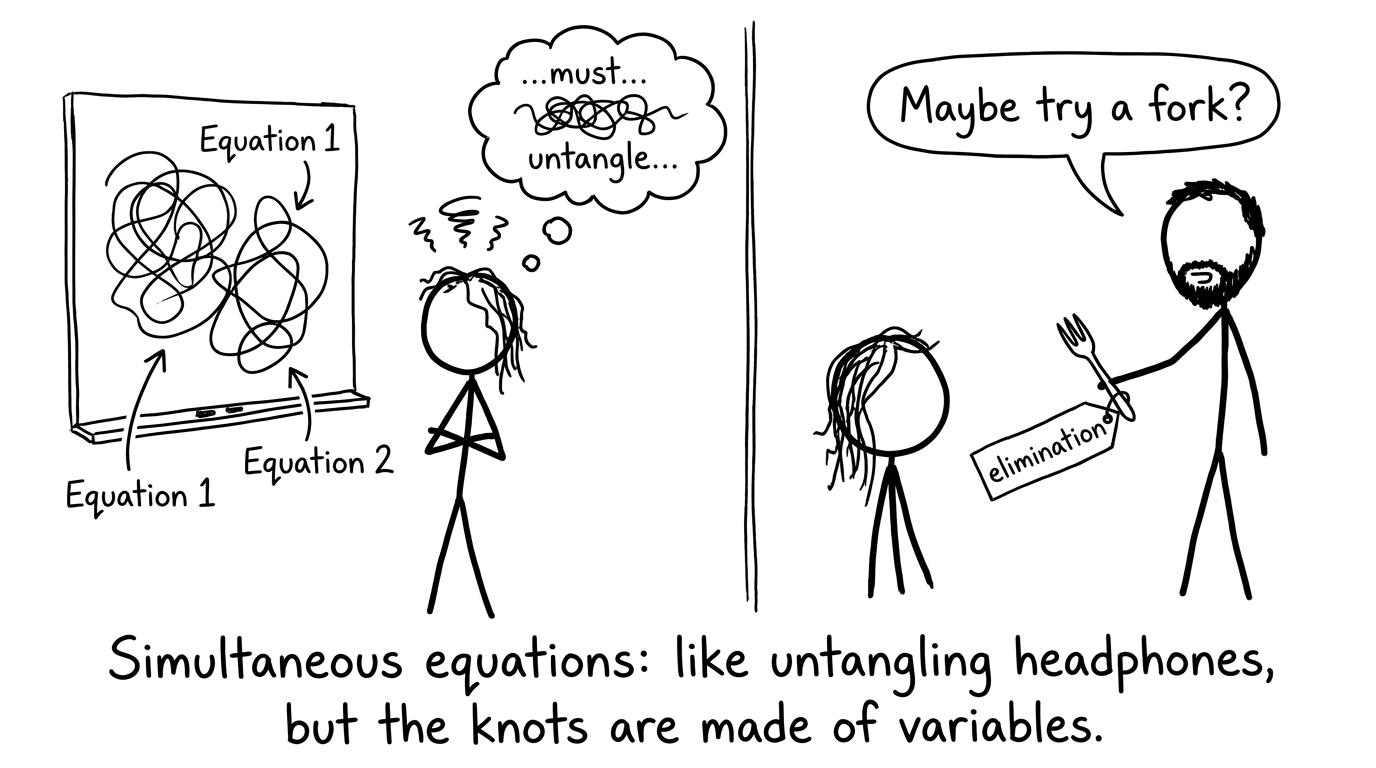 Two equations as tangled spaghetti, teacher offers fork labelled elimination
A quick checklist for getting better at simultaneous equations
When students improve quickly, it’s rarely because they found a new trick. It’s because they became consistent with a small set of decisions.
- Choose the best method: elimination, substitution, or graphs.
- Keep equations aligned and do the same thing to both sides.
- Use brackets properly when substituting.
- After solving, check by substituting your solution back into both equations.
- Practise exam-style questions with mark schemes and video solutions.
On Maths Genie, you can build that routine using the Simultaneous Equations exam questions (Grade 7) and the Simultaneous Equations topic practice (Grade 5).
What simultaneous equations really are (and why that matters in GCSE)
At GCSE, most simultaneous equations are two straight lines. You’re looking for the one pair (x,y)(x,y)(x,y) that makes both equations true at the same time. That’s it. One point. One intersection.
Thinking of “intersection” matters because it stops the algebra feeling random. When you eliminate a variable, you’re not doing a ritual. You’re reducing two lines into one statement that pins down the meeting point.
Graph methods make this visual. Algebra methods make it efficient. Both are checking the same idea: two equations, one shared solution.
If you want the picture-first version, the Maths Genie resource Solving Simultaneous Equations Graphically is ideal for foundation and higher tier GCSE.
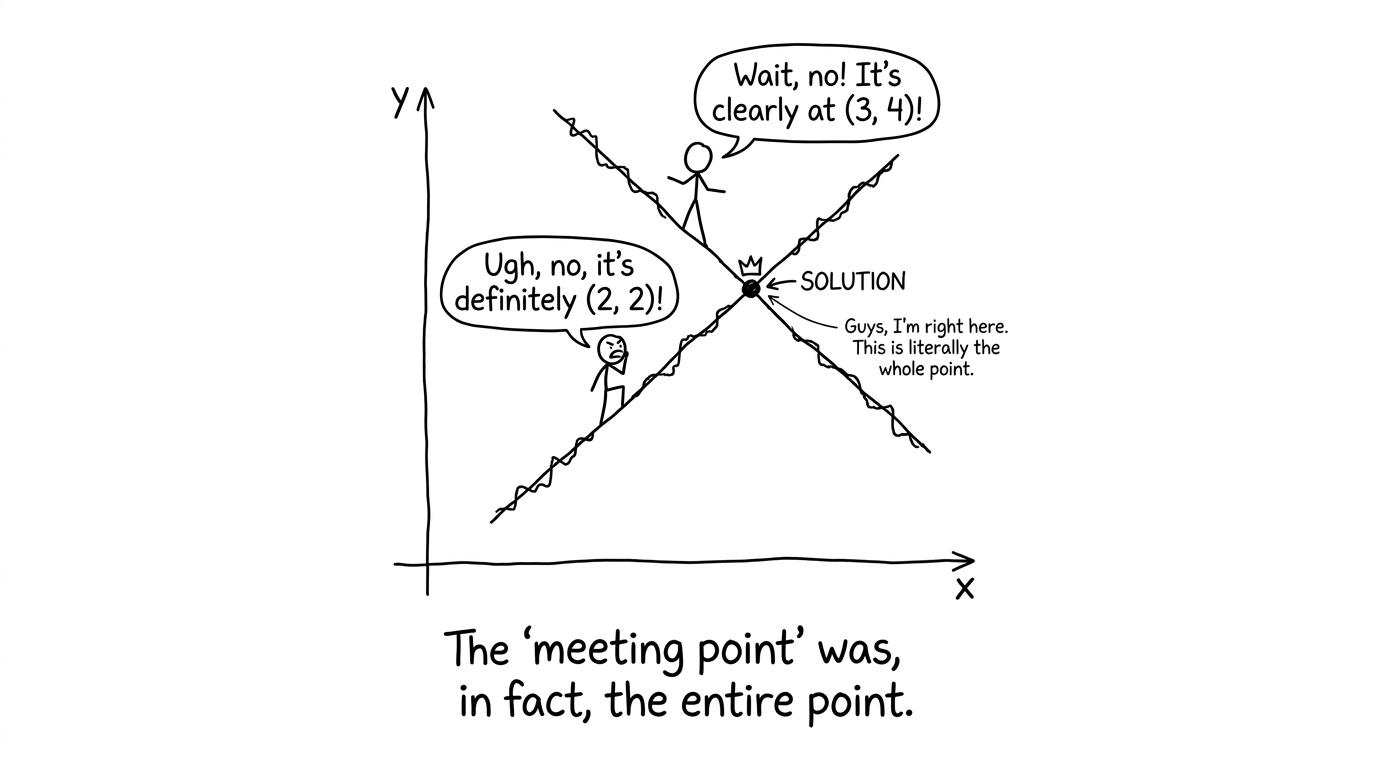 Two lines argue; intersection point wears a crown labelled solution
The elimination method (the GCSE favourite)
Elimination is usually the quickest way to score marks because it’s tidy and predictable. You make the coefficients of one variable match, then add or subtract to remove it.
Worked example: elimination with tidy coefficients
Solve:
4x+3y=18x−3y=7\begin{aligned} 4x + 3y &= 18 \\ x - 3y &= 7 \end{aligned}4x+3yx−3y=18=7Add the equations (because +3y+3y+3y and −3y-3y−3y will cancel):
(4x+3y)+(x−3y)=18+7(4x + 3y) + (x - 3y) = 18 + 7(4x+3y)+(x−3y)=18+7 5x=255x = 255x=25 x=5x = 5x=5Substitute into x−3y=7x - 3y = 7x−3y=7:
5−3y=75 - 3y = 75−3y=7 −3y=2-3y = 2−3y=2 y=−23y = -\frac{2}{3}y=−32Check in the first equation:
4(5)+3(−23)=20−2=18 ✓4(5) + 3\left(-\frac{2}{3}\right) = 20 - 2 = 18 \;\checkmark4(5)+3(−32)=20−2=18✓So the solution is x=5x = 5x=5, y=−23y = -\frac{2}{3}y=−32.
How to choose your multiplier quickly
Your aim is to make something like 3y3y3y and −3y-3y−3y, or 5x5x5x and 5x5x5x. Look for the smallest number you can multiply by to match coefficients.
If you see 2x2x2x and 3x3x3x, think 6x6x6x. Multiply one equation by 333 and the other by 222. In GCSE mark schemes, those setup lines often earn method marks, even before you get to the final values.
For elimination practice, build confidence with the Grade 7 simultaneous equations questions and then revisit the Grade 5 questions for speed.
The substitution method (when one equation is already “solved”)
Substitution shines when one equation is easy to rearrange, like y=2x+1y = 2x + 1y=2x+1 or x=7−3yx = 7 - 3yx=7−3y. The danger is brackets: most substitution errors are really bracket errors.
Worked example: substitution with brackets done properly
Solve:
y=2x+13x+2y=19\begin{aligned} y &= 2x + 1 \\ 3x + 2y &= 19 \end{aligned}y3x+2y=2x+1=19Substitute y=2x+1y = 2x + 1y=2x+1 into the second equation:
3x+2(2x+1)=193x + 2(2x + 1) = 193x+2(2x+1)=19Expand:
3x+4x+2=193x + 4x + 2 = 193x+4x+2=19 7x=177x = 177x=17 x=177x = \frac{17}{7}x=717Find yyy:
y=2(177)+1=347+77=417y = 2\left(\frac{17}{7}\right) + 1 = \frac{34}{7} + \frac{7}{7} = \frac{41}{7}y=2(717)+1=734+77=741Check quickly:
3(177)+2(417)=517+827=1337=19 ✓3\left(\frac{17}{7}\right) + 2\left(\frac{41}{7}\right)=\frac{51}{7}+\frac{82}{7}=\frac{133}{7}=19 \;\checkmark3(717)+2(741)=751+782=7133=19✓If substitution feels messy, it’s worth revisiting the underlying skill: Substitution (Maths Genie). That page is deceptively powerful for GCSE algebra accuracy.
Solving simultaneous equations graphically (the confidence method)
Graphical solutions are common in foundation tier GCSE, and they’re also a great sense-check at higher tier. You draw both lines, then read the intersection.
What examiners really want
- Two straight lines drawn accurately.
- A clearly marked intersection.
- Coordinates read correctly (often to the nearest integer or a sensible value from the grid).
For focused exam practice, use Solving Simultaneous Equations Graphically. The questions mirror what Edexcel, AQA, OCR and Eduqas tend to ask.
The step up: simultaneous equations with a quadratic (A Level link)
Higher tier GCSE sometimes includes one linear and one quadratic equation. A Level students will see this more often and in richer forms. The method is still “substitution/elimination”, but it creates a quadratic you then solve.
Worked example: linear and quadratic simultaneous equations
Solve:
y=x+1x2+y2=25\begin{aligned} y &= x + 1 \\ x^2 + y^2 &= 25 \end{aligned}yx2+y2=x+1=25Substitute y=x+1y = x + 1y=x+1 into x2+y2=25x^2 + y^2 = 25x2+y2=25:
x2+(x+1)2=25x^2 + (x+1)^2 = 25x2+(x+1)2=25Expand:
x2+(x2+2x+1)=25x^2 + (x^2 + 2x + 1) = 25x2+(x2+2x+1)=25 2x2+2x+1=252x^2 + 2x + 1 = 252x2+2x+1=25 2x2+2x−24=02x^2 + 2x - 24 = 02x2+2x−24=0Divide by 222:
x2+x−12=0x^2 + x - 12 = 0x2+x−12=0Factorise:
(x+4)(x−3)=0(x+4)(x-3)=0(x+4)(x−3)=0So x=−4x=-4x=−4 or x=3x=3x=3.
Find yyy using y=x+1y=x+1y=x+1:
- If x=−4x=-4x=−4, then y=−3y=-3y=−3.
- If x=3x=3x=3, then y=4y=4y=4.
So the solutions are (−4,−3)(-4,-3)(−4,−3) and (3,4)(3,4)(3,4).
For extension practice (great for aiming at grades 7-9 and for A Level bridging), use Simultaneous Equations with a Quadratic and the linked revision page Solving Simultaneous Equations (Quadratic).
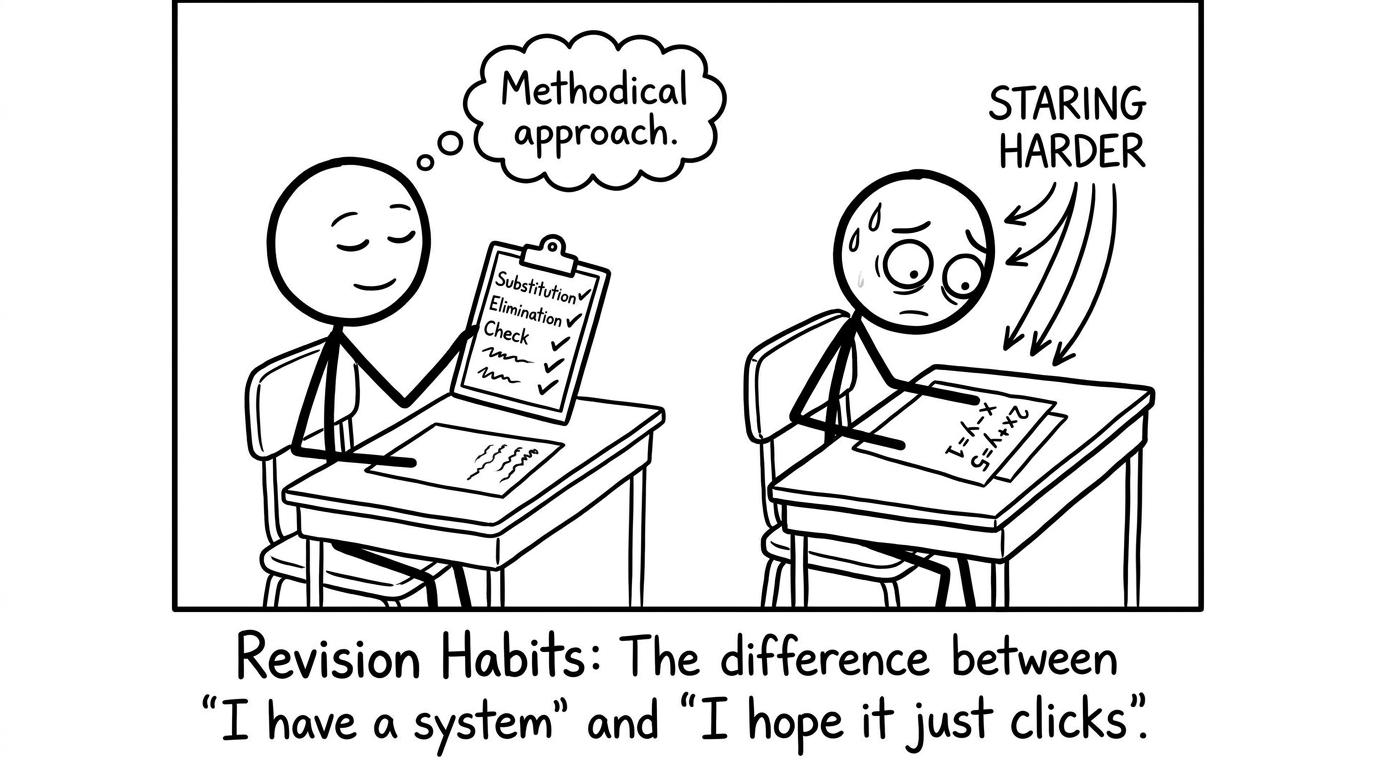 Exam hall: one student uses checklist, another tries staring harder
Common mistakes (and how to stop making them)
Forgetting to do the same thing to both sides
In elimination, if you multiply an equation by 222, you must multiply every term by 222. Students often scale only the first term. Keep your equations aligned vertically to reduce this.
Substitution without brackets
If you substitute y=2x−3y = 2x - 3y=2x−3 into 5y5y5y, you must write 5(2x−3)5(2x - 3)5(2x−3), not 10x−310x - 310x−3. Brackets are not optional at GCSE; they are the difference between method marks and lost marks.
Sign errors when subtracting
When eliminating, many students subtract but forget that every term in the second equation changes sign. A safe approach is to write the subtraction as adding the negative, or rewrite one equation first.
Not checking answers
Checking feels like extra work until the first time it saves you in a paper. Substitute your (x,y)(x,y)(x,y) back into both original equations. In GCSE mark schemes, correct checking can even help you spot a final arithmetic slip without redoing everything.
Rounding too early in graph questions
If you read the intersection roughly, then round each coordinate too early, your final coordinate can drift. Use the grid carefully, and if the question expects integers, make sure your drawn lines are accurate enough to justify them.
A revision routine that actually improves your GCSE marks
Improvement in simultaneous equations is less about doing “more”, and more about doing the right set repeatedly.
- Start with a short burst of topic practice: Simultaneous Equations (Grade 5).
- Move to the next difficulty: Simultaneous Equations (Grade 7).
- Add one graph set for confidence and accuracy: Simultaneous Equations Graphically.
- If you’re aiming high (or doing A Level), include one extension sheet weekly: Simultaneous with a Quadratic.
- Then test the skill in context using predicted papers: GCSE Predicted Papers.
That final step matters because simultaneous equations are rarely isolated in real papers. They show up after a rearrangement, inside a worded problem, or as part of a multi-step higher tier question.
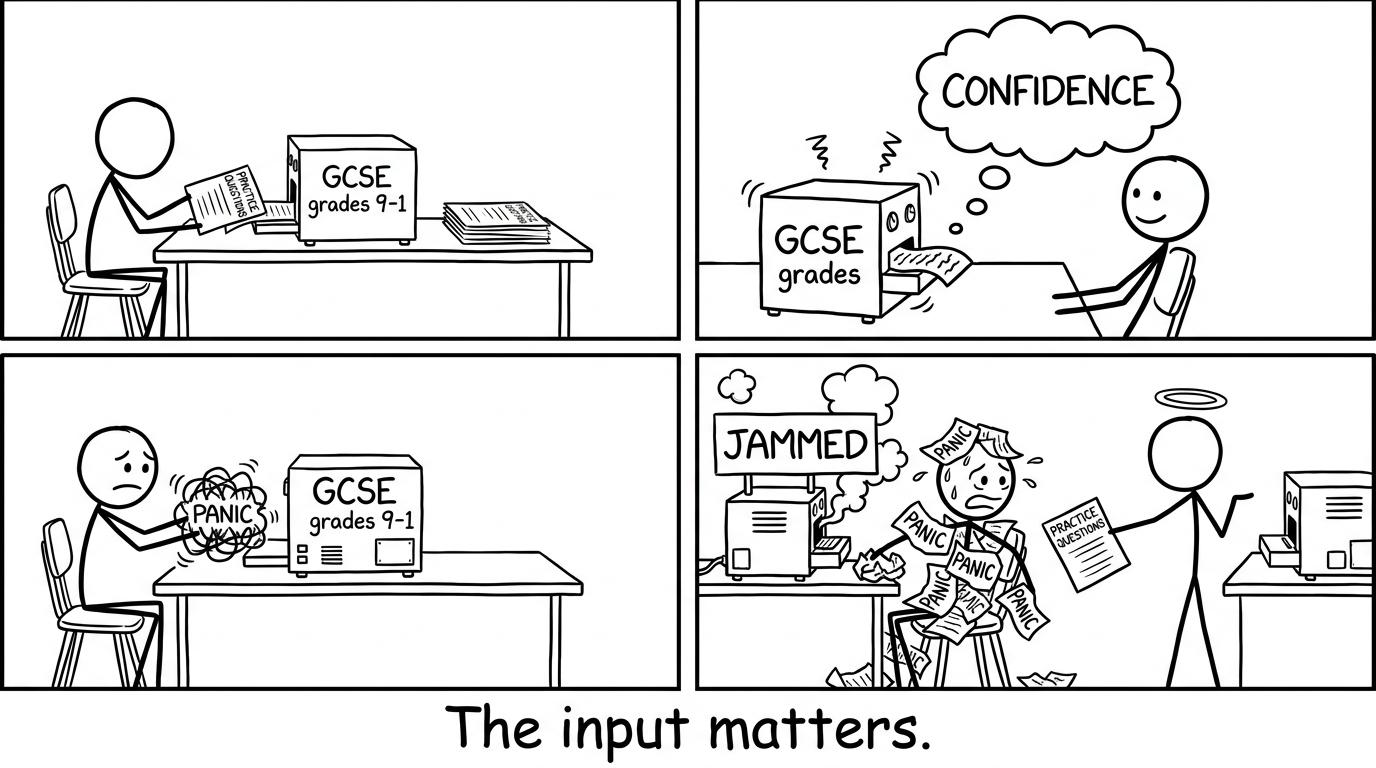 Machine labelled GCSE grades: practice questions in, confidence out; panic jams it
Closing: the quiet way to get good at simultaneous equations
Simultaneous equations don’t reward cleverness as much as they reward calm repetition. In GCSE maths, that’s a gift. You can become “good at them” without changing who you are, just by choosing the right method, writing the steps cleanly, and checking.
If you want that progress to be measurable, keep it simple: use Maths Genie’s revision lessons, practise with the exam questions, and then pressure-test the skill using past and predicted papers. Start with Simultaneous Equations (Grade 5), move up to Grade 7, add graphical practice, and finish with a timed run from the GCSE Predicted Papers.
That’s how you turn a topic that used to feel like tangled wires into one you can solve under pressure, and take reliable marks into your next GCSE paper.