GCSE ICT Coursework Teacher Help: What Is Allowed?
GCSE ICT coursework teacher help explained: what teachers may clarify, where feedback must stop, and how to avoid malpractice while protecting your marks.
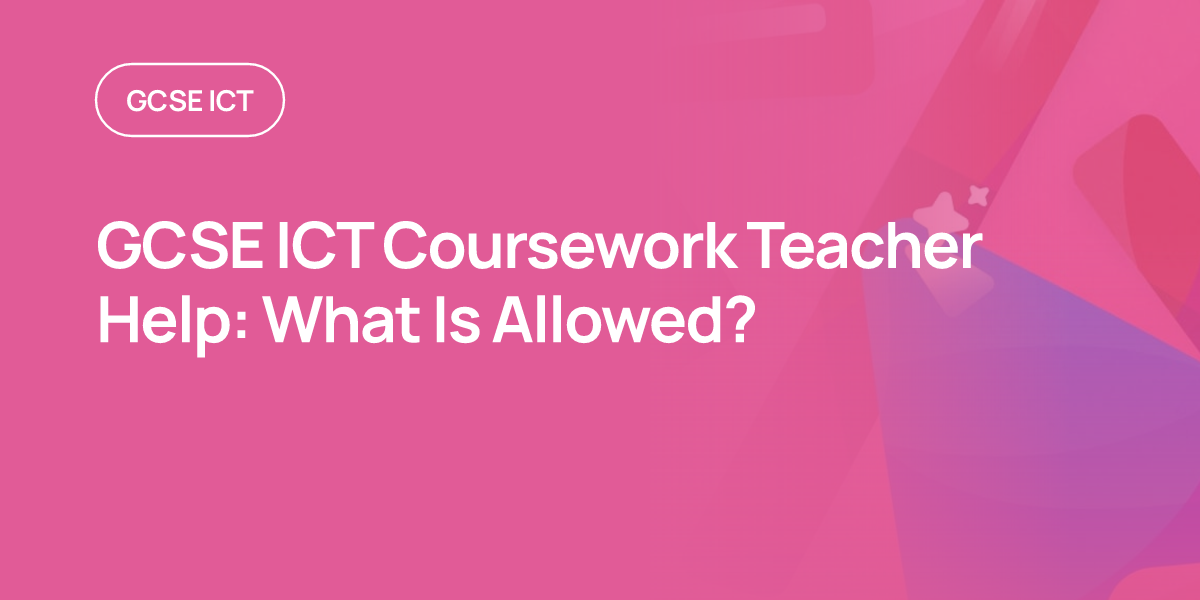
A teacher looks at your screen, pauses, and says, “I can help you understand the task, but I cannot tell you what to put.” It can feel frustratingly vague. Yet the rules on GCSE ICT coursework teacher help are built around a clear principle: your teacher may teach, clarify and supervise, but the assessed decisions and final work must remain yours.
There is no universal number of hints that suddenly turns support into malpractice. The boundary depends on your qualification's current specification, assessment instructions and the Joint Council for Qualifications, or JCQ, regulations used by the awarding body. Help becomes a serious problem when it gives you an unfair advantage, directs your assessed response or makes it impossible for the teacher to authenticate the work as your own.
One detail matters immediately: check what qualification you are actually taking. In England, many students who informally say “ICT” are taking Computer Science, a vocational digital qualification or an internal school course. GCSE ICT or digital qualifications may operate differently in Wales and Northern Ireland. A classroom project is not automatically formal coursework.
The short checklist
Before requesting help, ask yourself:
- Is this an assessed task or ordinary practice?
- Which awarding body and specification am I following?
- Is my teacher explaining a general skill or directing my particular answer?
- Will I make the final design, content and technical decisions independently?
- Have I acknowledged permitted sources, including any approved use of artificial intelligence?
- Could my teacher confidently authenticate the submitted work as mine?
If anything is unclear, ask your teacher or exams officer before continuing. A quick question now is safer than discovering a problem after submission.
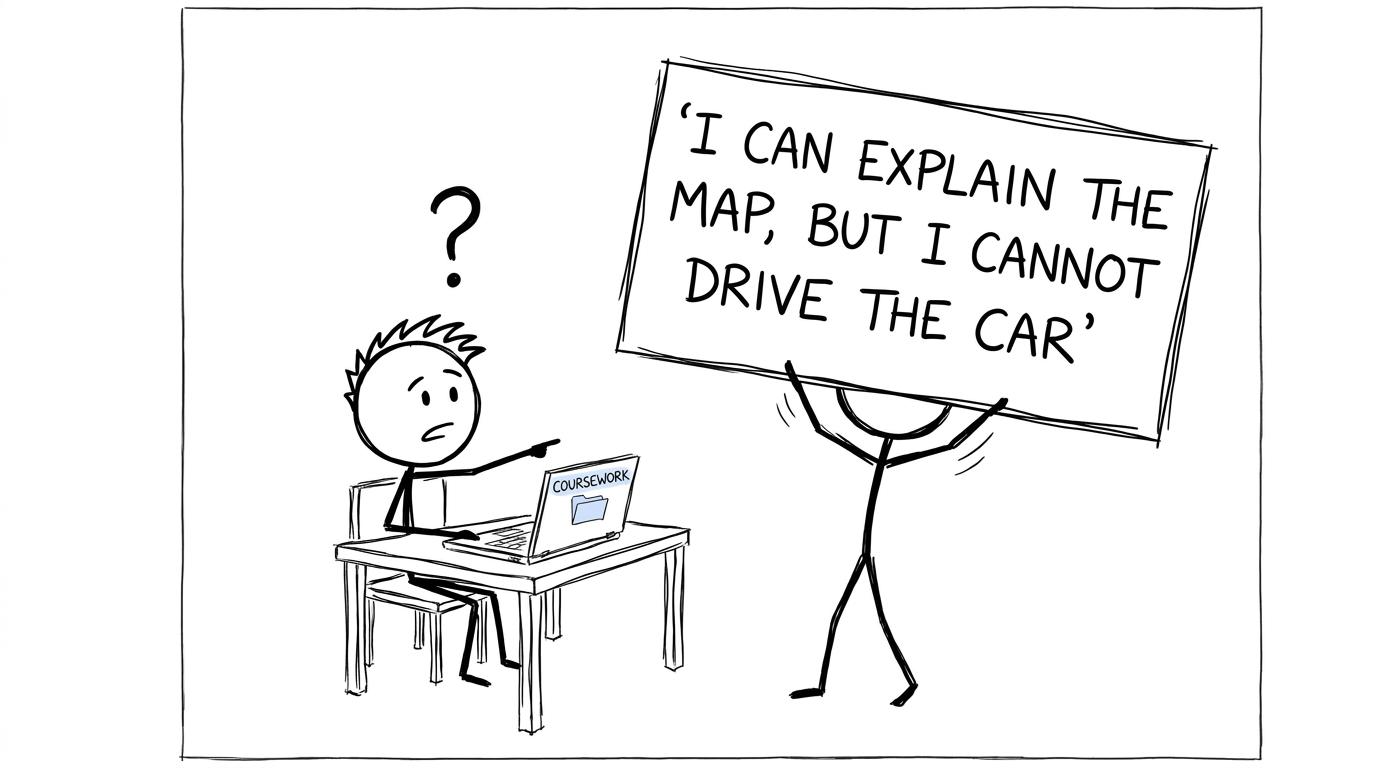 A teacher explains the boundary between guidance and doing the work
Why the exact qualification matters
“GCSE ICT coursework” is often used as a loose description rather than the official name of an assessment. That creates confusion because current qualifications do not all have the same structure.
AQA, Pearson Edexcel, OCR, WJEC, Eduqas and CCEA publish specification-specific requirements. Some courses are assessed mainly or entirely by examinations. Others contain non-examination assessment, controlled assessment or internally assessed units. Practical programming completed during a Computer Science course is not necessarily coursework contributing directly to the final grade.
Your first step should therefore be to find the qualification title, specification code and assessment component on your school documents. Then confirm:
- whether the task contributes to your final qualification;
- whether it is completed under formal supervision;
- what resources and collaboration are allowed;
- whether drafts can receive feedback;
- how sources and assistance must be recorded;
- when the work is considered finally submitted.
The current specification and assessment brief take priority over general advice online. JCQ also updates its regulations and guidance, so your school must follow the documents applying to your examination series.
Help your teacher can normally give
Teachers are allowed to teach you. Coursework rules are not designed to make them silent; they are designed to preserve the difference between learning a skill and receiving an assessed answer.
Subject to the specification, permitted support commonly includes:
Teaching skills before the assessment
Your teacher can normally teach the knowledge and techniques required by the course. This could include database concepts, spreadsheet skills, interface design principles, testing methods, programming constructs or ways to organise evidence.
They may demonstrate techniques through separate classroom material and practice activities. The crucial distinction is that the demonstration should not become a ready-made solution to your live assessed task.
Clarifying instructions and administration
A teacher can usually explain what an instruction means, remind the class about deadlines and identify the evidence that the assessment requires. They can also explain practical arrangements such as file naming, storage, supervision and submission.
Clarification should help you understand the question. It should not decide how you will answer it.
Giving general feedback where permitted
A teacher may sometimes identify broad issues, such as an incomplete section, unclear presentation or the need to check work against the published requirements. However, the amount and timing of feedback vary between specifications.
General feedback leaves the thinking with you. Detailed instructions such as which sentence to add, which formula to enter or which design to choose are much more likely to cross the line.
Supporting access arrangements
Approved access arrangements and reasonable adjustments are not improper assistance. They are formal measures intended to give eligible students appropriate access to an assessment without changing what is being assessed. These arrangements must be authorised and applied through the proper process.
Where useful support becomes excessive assistance
The safest test is authorship. If a teacher's intervention means that an important assessed choice is no longer genuinely yours, the support may be excessive.
| Usually legitimate support | Potentially excessive or prohibited support |
|---|---|
| Explaining a general database principle | Designing your assessed database structure for you |
| Clarifying an instruction in the task | Rewriting the instruction as a step-by-step solution |
| Reminding everyone to test their work | Giving you the exact tests, data and expected results |
| Pointing you towards the published criteria | Telling you precisely what to add to reach a higher band |
| Teaching a spreadsheet technique in a practice lesson | Entering or correcting the formula in your assessed file |
| Identifying that evidence is missing, where feedback is permitted | Creating the evidence or dictating its content |
| Explaining how references work | Supplying material that you submit without acknowledgement |
Repeated intervention matters too. A small comment can become inappropriate if a teacher continuously checks, corrects and improves the same work until it reaches a particular standard. Teachers must not act as an editor, developer or co-author of an assessed submission.
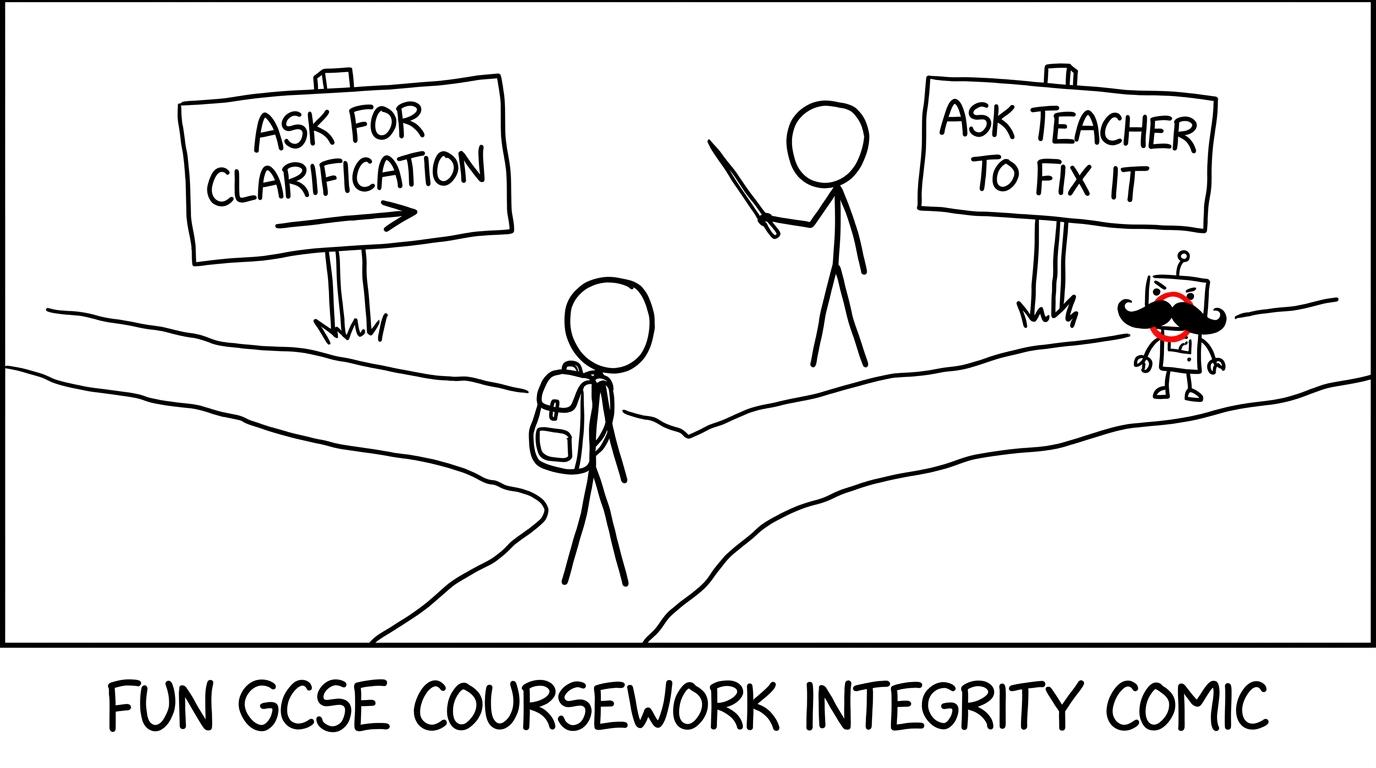 A student chooses between clarification and asking a teacher to fix the work
When does teacher help become malpractice?
Malpractice is not simply “getting help”. It arises when assessment regulations are breached in a way that could undermine the integrity of the qualification.
For centre staff, this can include providing assistance beyond what the specification allows, improperly influencing assessed work, failing to supervise under the required conditions or authenticating work that cannot reliably be confirmed as the candidate's own.
For a student, related concerns can include plagiarism, submitting another person's work, receiving undeclared assistance, sharing controlled materials or presenting AI-generated content as independent work when that use is not permitted or properly acknowledged.
Not every accidental question triggers a malpractice case. Context, the type of assessment, the assistance given and what happened afterwards all matter. Schools should record assistance where the rules require it and refer suspected breaches through their exams procedures. Possible consequences depend on the awarding body's investigation and can affect a task, component or qualification.
If you think too much help has already been given, do not try to hide it. Stop, preserve an honest account of what happened and speak privately to your teacher, head of department or exams officer. They can check the current rules and decide whether work must be redone, assistance recorded or another formal step taken.
A safer way to ask for help
Questions that focus on understanding are usually safer than questions that ask someone to improve the assessed product.
You might ask:
- “Can you clarify what this instruction is asking me to demonstrate?”
- “Which section of the specification covers this skill?”
- “Can I practise this technique on a separate file?”
- “Are we allowed feedback on a draft for this component?”
- “How should permitted sources or AI tools be acknowledged?”
Avoid requests such as “Tell me what to write”, “Fix my formula”, “Choose the best design” or “Check this until it reaches the top band”. Even if your intention is innocent, those requests invite someone else to make assessed decisions for you.
Using AI, online resources and help from home
The same authorship principle applies beyond the classroom. A parent, tutor, friend or online service should not complete, rewrite or technically repair formal coursework for you.
AI use requires particular caution. Whether a tool is allowed depends on the assessment, your centre's instructions and the current awarding-body and JCQ guidance. Generating text, code, analysis or designs and submitting them as your own can prevent authentic assessment. Simply changing a few words does not make externally produced material yours.
Before using any tool, ask what is permitted, what must be acknowledged and whether the assessment conditions allow internet access at all. Keep a record of sources and drafts where instructed. Never upload confidential assessment materials to a public tool.
Common mistakes that put coursework at risk
Assuming every digital project is formal coursework
A practice assignment may allow extensive feedback, while a controlled or non-examination assessment may impose strict limits. Confirm the status before making assumptions.
Asking for “just one correction”
Correcting a single project-specific formula, query, code block or design decision may reveal the answer being assessed. Ask to revisit the general technique using unrelated practice material instead.
Treating classmates as collaborators
Discussion may be allowed during teaching but not during an individual assessment. Sharing files, screenshots, code or detailed solutions can create authentication and plagiarism concerns for everyone involved.
Forgetting to acknowledge sources
Text, images, data, templates and generated material may require acknowledgement even when their use is permitted. A bibliography does not automatically make prohibited assistance acceptable, but missing acknowledgement creates an additional problem.
Waiting until submission to mention extra help
Once concerns emerge, early honesty gives your school more opportunity to follow the correct procedure. Concealing assistance can make authentication harder.
Protect your maths revision time as well
Coursework can expand to fill every available evening. The answer is not to seek prohibited shortcuts; it is to contain the task with a realistic plan. Separate authorised coursework sessions from examination revision, record deadlines and leave time for independent checking.
For GCSE maths, use the free MathsGenie GCSE revision lessons to identify topics by grade, then test your recall with MathsGenie mini tests. When examinations approach, move towards timed GCSE maths past papers and compare your work carefully with the available mark schemes and video solutions.
MathsGenie predicted papers can provide further exam-style practice, but they should complement rather than replace official past papers and complete specification coverage. The wider MathsGenie free revision platform brings these resources together without turning revision into another complicated project.
 Two revision strategies race towards the exam
Keep the work recognisably yours
The boundary around GCSE ICT coursework teacher help is easier to understand when you stop looking for a fixed number of permitted hints. Teachers may teach skills, clarify requirements, manage the assessment and provide only the feedback authorised by the specification. They must not make your assessed decisions or transform your draft into a higher-mark response.
Check the exact qualification, follow your centre's instructions and ask before using outside help. Then return to the habit that works in every subject: learn the method, practise it independently and submit only work you can honestly explain.
Once the coursework session ends, continue your exam preparation with MathsGenie's revision lessons, practice questions, mini tests, past papers, predicted papers, mark schemes and video solutions. Independent practice protects the integrity of your coursework, and builds the confidence you will need when the exam paper is entirely your own.