GCSE: How Many Marks Do You Need for a Grade 7?
GCSE grade 7 marks explained: how grade boundaries work, what to aim for on higher tier, and a revision plan using Maths Genie papers and tests.
If you’ve ever walked out of a GCSE maths paper thinking, “That felt… fine?” and then immediately panicked because you don’t know what “fine” means in marks, you’re not alone. A grade 7 sits in a strangely emotional place: high enough to feel like proof you can do hard maths, but close enough to the boundary that every dropped mark feels personal.
The truth is calmer than your group chat makes it sound. A grade 7 isn’t one magic number of marks. It’s a moving target that depends on your exam board, your tier, and the difficulty of that year’s papers. Once you understand that, you can stop chasing rumours and start collecting marks in a way you can control.
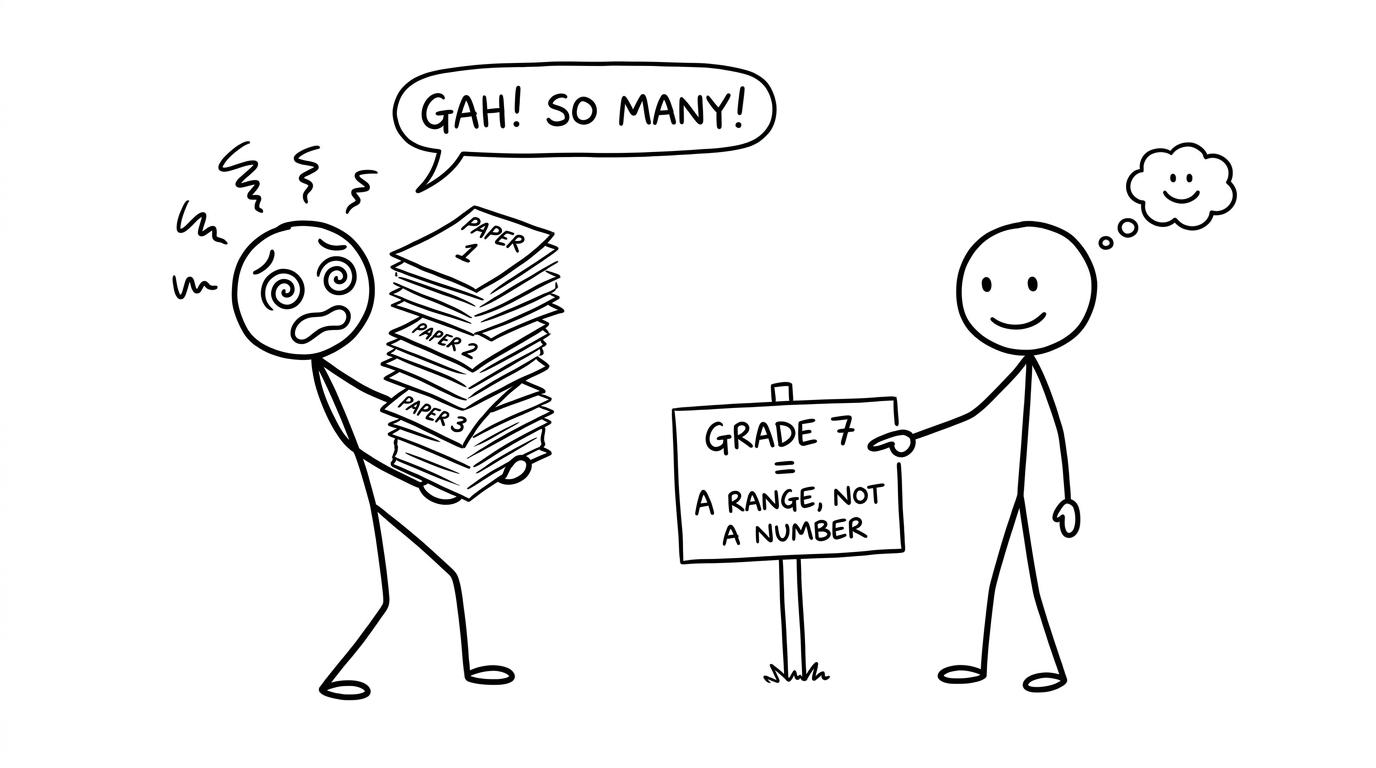 Stick figures holding three exam papers and a sign about grade ranges
The simple answer (and why it’s not a single number)
A GCSE maths grade is awarded using grade boundaries. These boundaries are set after the exams are sat, using evidence about how hard the papers were. So you can’t know the exact grade 7 boundary in advance.
But you can be smart about it.
- Most GCSE maths specs have 3 papers, usually worth 80 marks each, so the total is often 240240240 marks (AQA/Edexcel/OCR for GCSE Maths commonly use this structure).
- A grade 7 boundary is typically somewhere in the upper-middle of the total marks. The exact mark changes by exam series.
- Your best strategy is to aim for a buffer above typical boundaries so you’re not relying on a perfect day.
To see real examples across years, use Maths Genie’s grade boundary pages (they’re one of the fastest ways to ground your expectations in data rather than guesses):
What a grade 7 means in GCSE maths
A grade 7 is often described as “roughly an old A”. But that comparison is more emotional than mathematical. In practice, a grade 7 means you can:
- handle multi-step problem solving,
- use algebra fluently (including rearranging, simultaneous equations, quadratics),
- work confidently with geometry and trigonometry,
- show clear method to secure method marks even when the final answer slips.
This is why chasing the exact grade 7 mark boundary is less useful than becoming the kind of student who picks up the “quiet marks” reliably.
A practical checklist: how to aim for grade 7 marks
Here’s a revision checklist that fits how GCSE papers actually award marks.
Build your “bank of reliable marks”
You want topics where, under time pressure, you still score well. For many students aiming at grade 7, that includes:
- linear equations and inequalities
- percentages and ratio
- angles, bearings and transformations
- standard form and bounds
- algebraic manipulation
- trigonometry (including non-right-angled trig on higher tier)
A simple way to diagnose this is to use targeted practice rather than endless full papers:
Practise with full papers once a week
Full papers teach pacing and decision-making. They also reveal a key truth: a grade 7 is usually built from consistency, not heroics.
Use:
And if you’re short on time, 45-minute chunks can be more realistic than pretending you have a full uninterrupted afternoon:
How to estimate the marks you need for a grade 7 (worked methods)
You can’t predict the exact boundary, but you can estimate what to aim for using sensible buffers.
Worked example: using a percentage target
Suppose your GCSE maths total is 240240240 marks.
A common planning approach is to aim for around 70%70\%70% for a secure grade 7 performance (this is a planning figure, not a guarantee).
0.70×240=168 0.70 \times 240 = 168 0.70×240=168So you might set a working target of about 168168168 marks out of 240240240.
Now turn that into paper targets. With 3 papers, that’s:
1683=56 \frac{168}{3} = 56 3168=56So you aim for about 565656 marks per paper.
That’s useful because it changes revision from “be good at everything” into “find 565656 marks”. On a higher tier paper, 565656 marks is typically a mix of strong performance on the early and middle questions, plus a handful of later marks.
Worked example: building a buffer using your mock result
Say your mock total was 150150150 out of 240240240.
You decide you want a buffer of +20+20+20 marks to protect against a harder paper day and exam nerves:
150+20=170 150 + 20 = 170 150+20=170Your new target becomes 170170170 out of 240240240.
That is an improvement of:
170−150=20 170 - 150 = 20 170−150=20Across 3 papers, that’s about:
203≈6.67 \frac{20}{3} \approx 6.67 320≈6.67So roughly 777 extra marks per paper.
That’s not “learn the whole course again”. That’s “stop losing the 111-mark slips, secure method marks, and upgrade two or three topics that show up every year”.
Worked example: the ‘method marks’ mindset
On many GCSE mark schemes, you earn marks for a correct method even if your final answer is wrong.
Imagine a 3-mark algebra question where the intended method is:
- rearrange
- substitute
- simplify to the final answer
If you do the rearranging correctly and set up the substitution correctly but make an arithmetic slip at the end, you might still earn 222 out of 333.
That’s why your goal is not perfection; it’s visibility. Show working. Write the rearrangement. Put the substitution on the page.
To see how mark schemes reward method, practise alongside mark schemes and solutions:
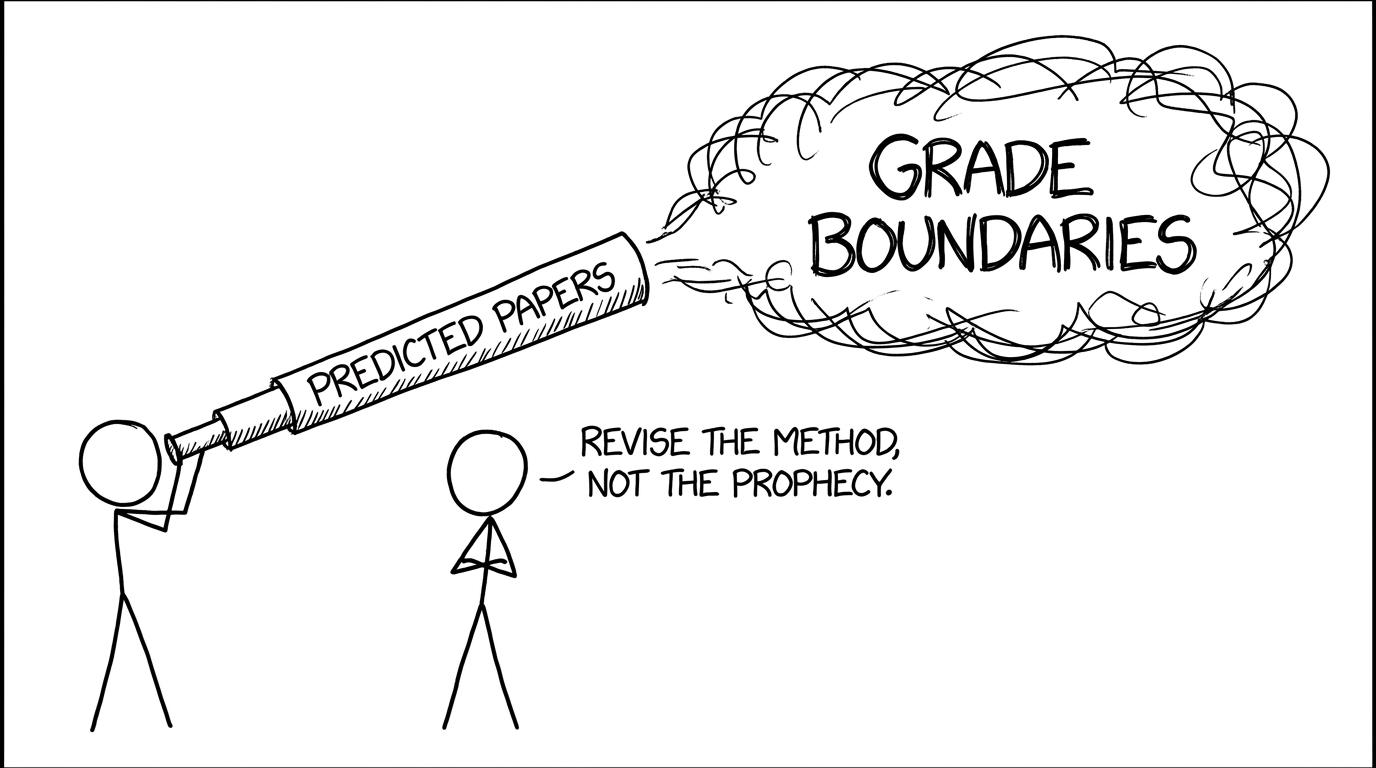 Stick figures using a telescope labelled Predicted Papers towards a cloud labelled Grade Boundaries
Higher tier vs foundation: can you get a grade 7?
This matters because it changes what “marks for grade 7” even means.
- On foundation tier, the highest available grade is 5.
- On higher tier, grades 4 to 9 are available.
So if you are aiming for a grade 7, you are implicitly aiming for higher tier GCSE maths.
That doesn’t mean you need to be brilliant at every hard topic. It means you need enough higher-tier fluency to access the questions that carry you beyond grade 6 performance. Maths Genie’s structure helps here: build foundations through earlier stages, then move into higher-only content when you’re ready.
Start from a clear pathway:
A revision rhythm that tends to produce grade 7 marks
Grade 7 often comes from what you do repeatedly, not what you do occasionally.
Use the “topic: paper: review” loop
- Topic practice (30-40 mins): pick one weak area and practise exam-style questions.
- Paper practice (45-90 mins): do a timed paper or half-paper.
- Review (20 mins): update an error log: what went wrong, what the correct method was, and what you’ll do next time.
If you want a summer-focused programme, this page can guide your topic choices:
And for focused exam readiness:
Common mistakes that stop students reaching a GCSE grade 7
These are the marks that leak quietly, and they add up.
Rounding too early
If you round an intermediate value too early, the final answer can drift. Keep exact values (or more decimals) until the end.
Not writing units or concluding statements
A surprising number of grade 7-level questions involve context. Marks can be lost for missing units or not stating what your number represents.
Dropping method marks by doing work in your head
Even if you can do it mentally, write the steps. It’s not about impressing anyone; it’s about making your marks “visible” to the examiner.
Misreading the command word
“Show that” questions require you to demonstrate a result. “Hence” means use what you just found. “Estimate” means rounding first.
Ignoring non-calculator skills
On Paper 1 (non-calculator for many boards), students often haemorrhage marks on arithmetic, standard form and exact values. Make sure you practise without a calculator regularly.
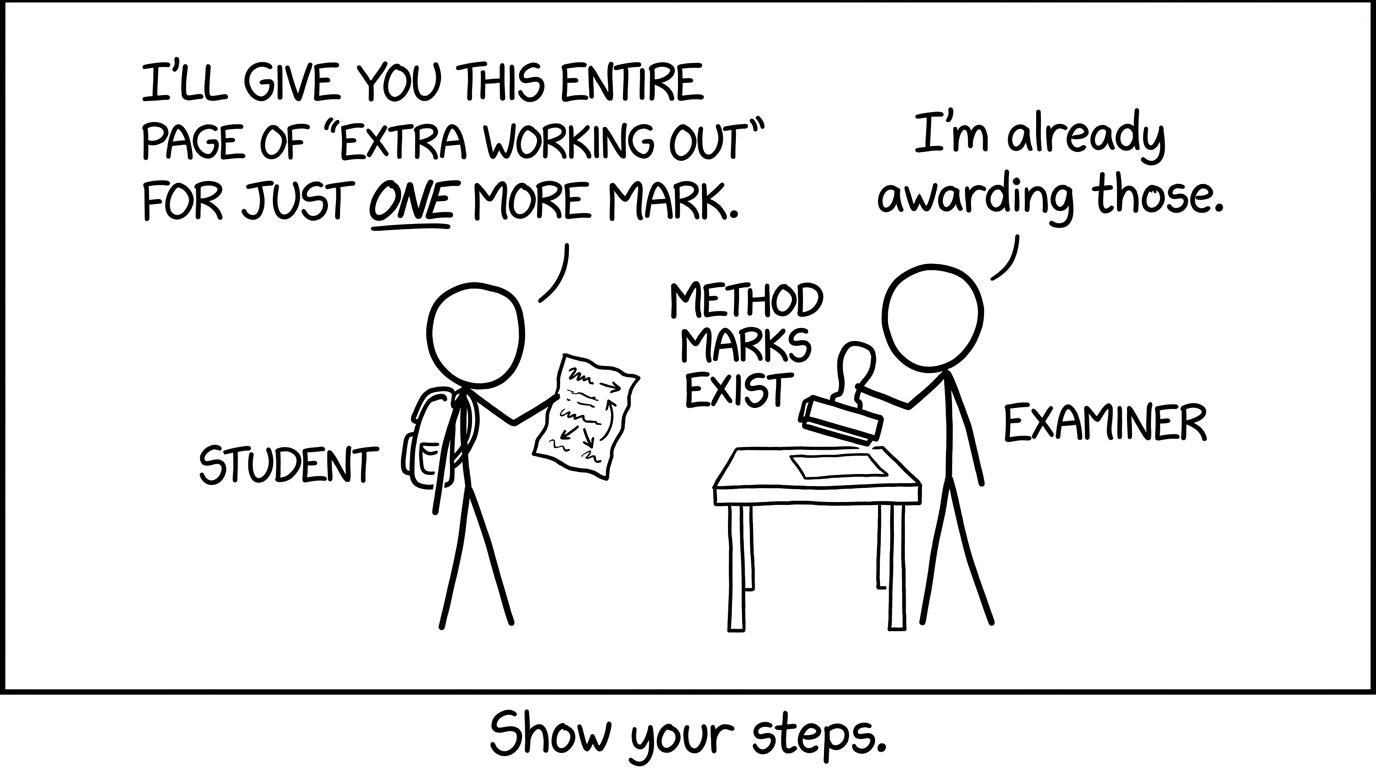 Stick figures bartering with an examiner; caption about method marks and showing steps
Bringing it together: stop chasing a number, start building a score
So, how many marks do you need for a grade 7? In GCSE maths, the honest answer is: it depends. But the useful answer is: you need enough marks that a moving boundary can’t catch you.
That’s a comforting kind of control. You don’t control grade boundaries. You control whether you show your method, whether you practise non-calculator skills, whether you keep an error log, and whether you turn “topics I sort of know” into “marks I reliably bank”.
If you want a clear next step, use Maths Genie as your routine, not your emergency plan:
- Work through the GCSE Scheme of Learning to plug gaps systematically.
- Use Target Tests (Grades 7-9) to sharpen exam readiness.
- Do weekly timed practice with papers and mark schemes via GCSE Resources (including predicted papers) and your board’s paper page like AQA GCSE Papers.
- When you’re unsure what “grade 7 marks” has looked like historically, check OCR GCSE Grade Boundaries to keep your expectations realistic.
Keep collecting marks. Quietly. Repeatedly. That’s how grade 7 happens.