

GCSE History Revision: Silence or Noise?
GCSE history revision silence or noise? See what research says about lyrics, instrumental music and quiet, then choose a revision setup that works for you.
Revision can look productive while very little is being remembered. The textbook is open, the playlist is running and an hour passes pleasantly. The harder question arrives tomorrow: what can you recall without the book?
For students wondering about GCSE history revision silence or noise, the evidence points to a practical default. Use silence for demanding reading, memorising facts, planning essays and completing exam questions. If silence makes concentration difficult, quiet instrumental music or steady, unobtrusive sound may be a workable alternative. Music with lyrics is the riskiest choice because words in a song can compete with the words you are trying to read, organise and remember.
That conclusion matters beyond History. If you are preparing for GCSE maths alongside content-heavy subjects, your best sound environment may change with the task. The aim is not to find one perfect playlist. It is to make each revision session easier to complete well.
The short answer
Use this checklist as your starting point:
- Choose silence for learning dates, reading sources, recalling explanations and writing timed answers.
- Avoid music with lyrics during language-heavy tasks.
- If quiet feels uncomfortable, try low-volume instrumental music with no vocals, adverts or sudden changes.
- Treat white noise, brown noise and nature sounds as optional ways to mask an unpredictable environment, not proven shortcuts to better memory.
- Complete some revision in exam-like silence, particularly timed papers.
- Compare conditions using recall or marks rather than judging only by how enjoyable the session felt.
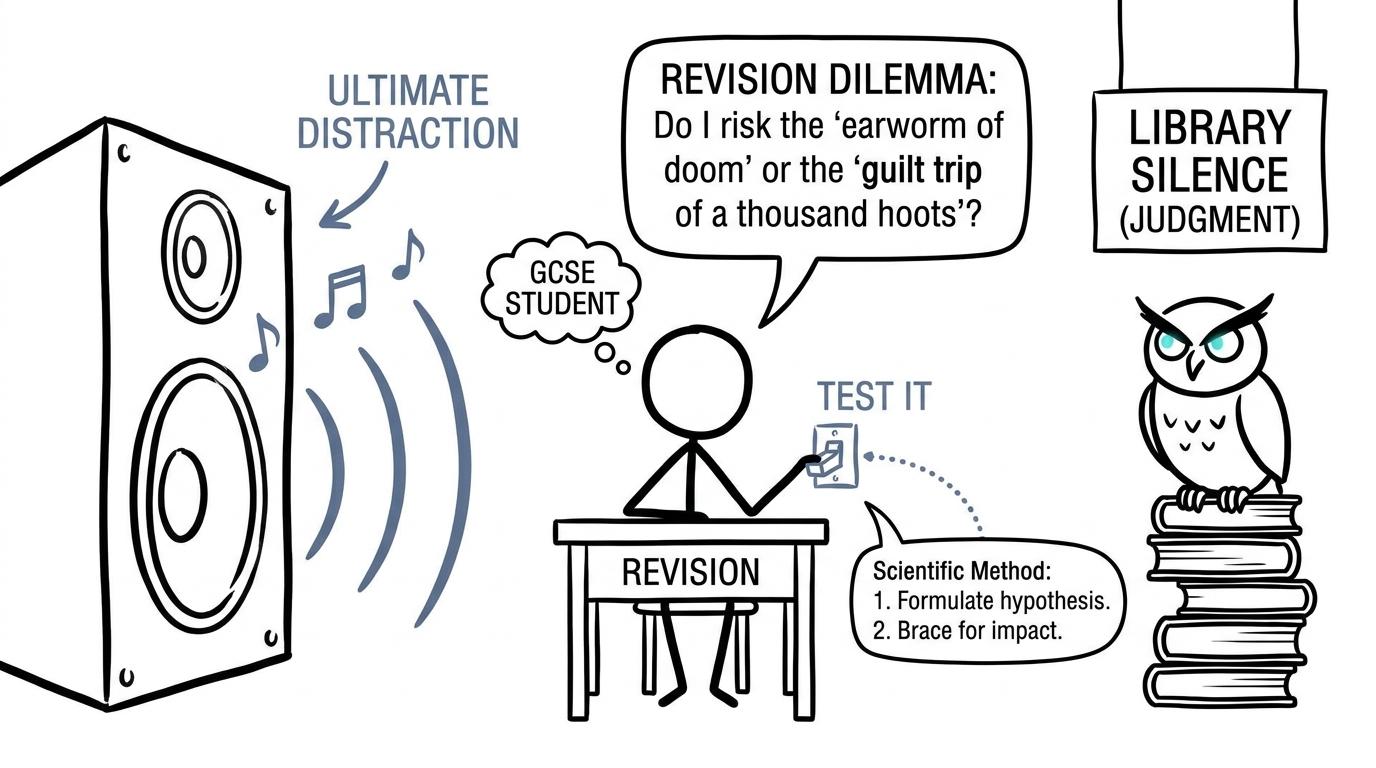 A student choosing between a giant speaker and a disapproving library owl
What the evidence actually says about silence and noise
There is no strong evidence that one sound condition improves every kind of learning for every student. Results depend on the task, the sound and the individual. However, several patterns are useful for GCSE revision.
A systematic review published in 2022 examined 95 articles covering 154 experiments across areas including memory, language, attention and problem-solving. Across most comparisons, background music did not produce a clear difference from silence. Where harmful effects appeared, however, music with lyrics was particularly likely to interfere with memory and language-related work. Instrumental music generally performed more like silence, although it was not a reliable learning boost.
A controlled study published in 2023 compared silence, instrumental lo-fi music and music with lyrics. The participants were university students rather than GCSE pupils, so the findings should not be treated as a direct GCSE trial. Nevertheless, they are relevant to the kinds of mental processes used in History. Music with lyrics reduced performance in verbal memory, visual memory and reading comprehension. Instrumental music did not reliably improve or damage performance compared with silence.
Research published in 2024 also found poorer reading comprehension with lyrical pop music than with no music. The effect varied with listening habits and the relationship between the language of the text and the lyrics. This reinforces an important point: personal preference can influence how distracting music feels, but liking a condition does not automatically mean that it improves learning.
Why History is especially vulnerable to lyrical distraction
History revision is intensely verbal. You may need to:
- read an interpretation carefully;
- distinguish causes from consequences;
- connect evidence to a judgement;
- remember names, dates and developments;
- organise an explanation into a coherent chain;
- select precise knowledge for an exam answer.
Lyrics add another stream of meaningful language. Even if you are not consciously singing along, the sound may still compete for attention. Research on auditory distraction also suggests that irrelevant speech and changing sounds can disrupt short-term recall. Quiet background speech from a television, podcast or nearby conversation may therefore be more intrusive than a continuous, neutral sound.
This does not mean every student will collapse the moment a song begins. It means lyrics create an avoidable risk during tasks that already demand verbal attention.
Silence is a strong default, not a moral rule
Silence has an advantage that is easy to overlook: it adds nothing for your attention to manage. When the work is difficult, simplicity helps.
Choose silence when you are:
- learning unfamiliar content;
- retrieving facts without notes;
- reading a dense textbook section;
- comparing historical interpretations;
- planning or writing an extended response;
- completing a timed practice paper.
Yet silence is not equally available to everyone. A shared room, traffic, conversations or household noise can make genuine quiet impossible. Some students also find that an entirely silent room makes ordinary sounds feel more noticeable.
In that situation, the useful comparison is not perfect silence versus music. It is unpredictable distraction versus controlled sound. Quiet instrumental audio, a fan or steady neutral noise may mask interruptions without introducing understandable speech. The evidence does not establish these sounds as memory enhancers, but they may make an imperfect revision environment more manageable.
The test is functional: does the sound reduce interruptions without drawing attention to itself?
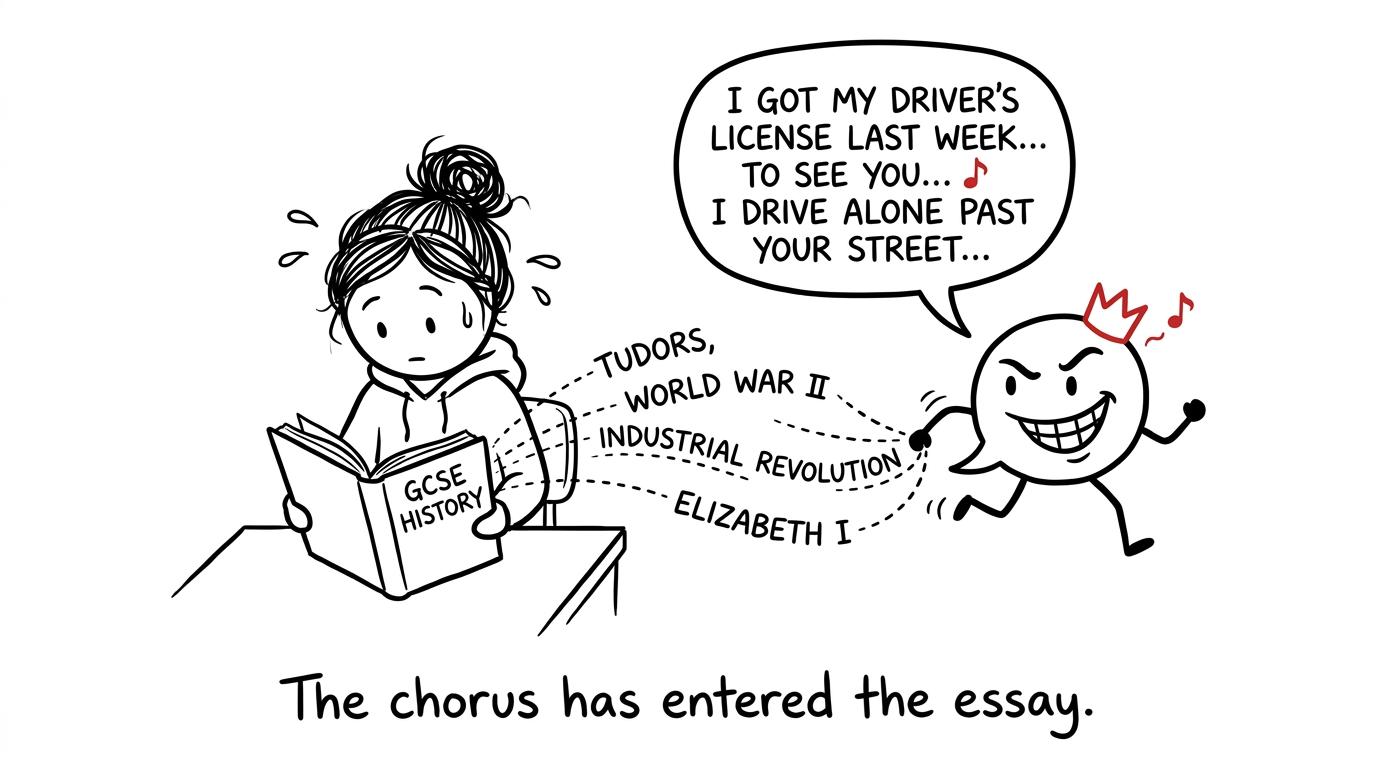 A mischievous song lyric stealing words from a History textbook
Match the sound to the revision task
The question is not simply whether noise is good or bad. Ask what your brain must do next.
Reading and learning new material
Begin in silence. New content already places demands on attention and working memory. If you need sound to settle into the session, choose something instrumental, familiar and quiet. Avoid changing tracks, searching for songs or adjusting the volume repeatedly.
Active recall and flashcards
Use silence where possible. Active recall works because you attempt to retrieve information rather than merely recognise it on a page. You want to discover what your memory can produce, not whether the music makes the activity feel smooth.
Write or say the answer before checking it. Record missing details, then test them again in a later session.
Essay planning and exam questions
Work in silence. AQA, Edexcel, OCR and Eduqas History papers require careful reading, relevant knowledge and controlled written reasoning, although question structures vary by specification. Music with lyrics can compete directly with those processes.
Timed practice should also resemble the working conditions of the examination. You will not have a playlist in the exam hall, so at least some practice needs to show that your concentration survives without one.
Simple organisation
Music is less concerning when the task has a low mental demand, such as arranging notes, filing worksheets or writing a revision timetable. Even then, be honest about when administration ends and learning begins.
For maths planning, the GCSE maths revision timetable guide can help you turn a broad intention into repeatable sessions. If exams are close, the GCSE one-month revision plan provides a more focused structure.
Test your own revision environment properly
Personal preference matters, but it should be tested against performance. A playlist can make time pass quickly while reducing the amount remembered. Comfort and learning are related, but they are not identical.
Try a small comparison across several sessions:
- Choose two History topics of similar difficulty.
- Revise one in silence and one with your proposed background sound.
- Keep the duration and revision method similar.
- Put the notes away when the session ends.
- Test factual recall and explanation quality later that day or the following day.
- Repeat the comparison before drawing a conclusion.
Measure useful outcomes: correct facts recalled, links explained, questions completed and marks awarded using your teacher's guidance or the relevant mark scheme. Also note interruptions and whether you kept changing tracks.
Do not compare a difficult unfamiliar topic in silence with an easy familiar topic accompanied by music. That tells you more about topic difficulty than sound.
Maths students can run the same test with short question sets. Start at the GCSE maths revision hub, choose comparable practice and mark both attempts. Edexcel students can also use GCSE maths mini tests for compact, timed checks.
Build a sound routine for GCSE revision
A sensible routine removes repeated decisions. You could use music while setting up, then switch to silence for the work itself. Alternatively, use quiet instrumental sound for an initial revision lesson before removing it for recall and exam questions.
A strong session might follow this pattern:
- Set one precise objective.
- Remove notifications and unrelated tabs.
- Learn or review the content in silence or with unobtrusive instrumental sound.
- Close the notes and retrieve the key ideas in silence.
- Complete an exam-style task.
- Mark it and identify the next action.
For maths, MathsGenie's free revision lessons and practice questions make this cycle straightforward. Topic work can be followed by paper practice using the guidance in when to start GCSE past papers. Edexcel students can then use the guide to using past papers properly to turn lost marks into targeted revision.
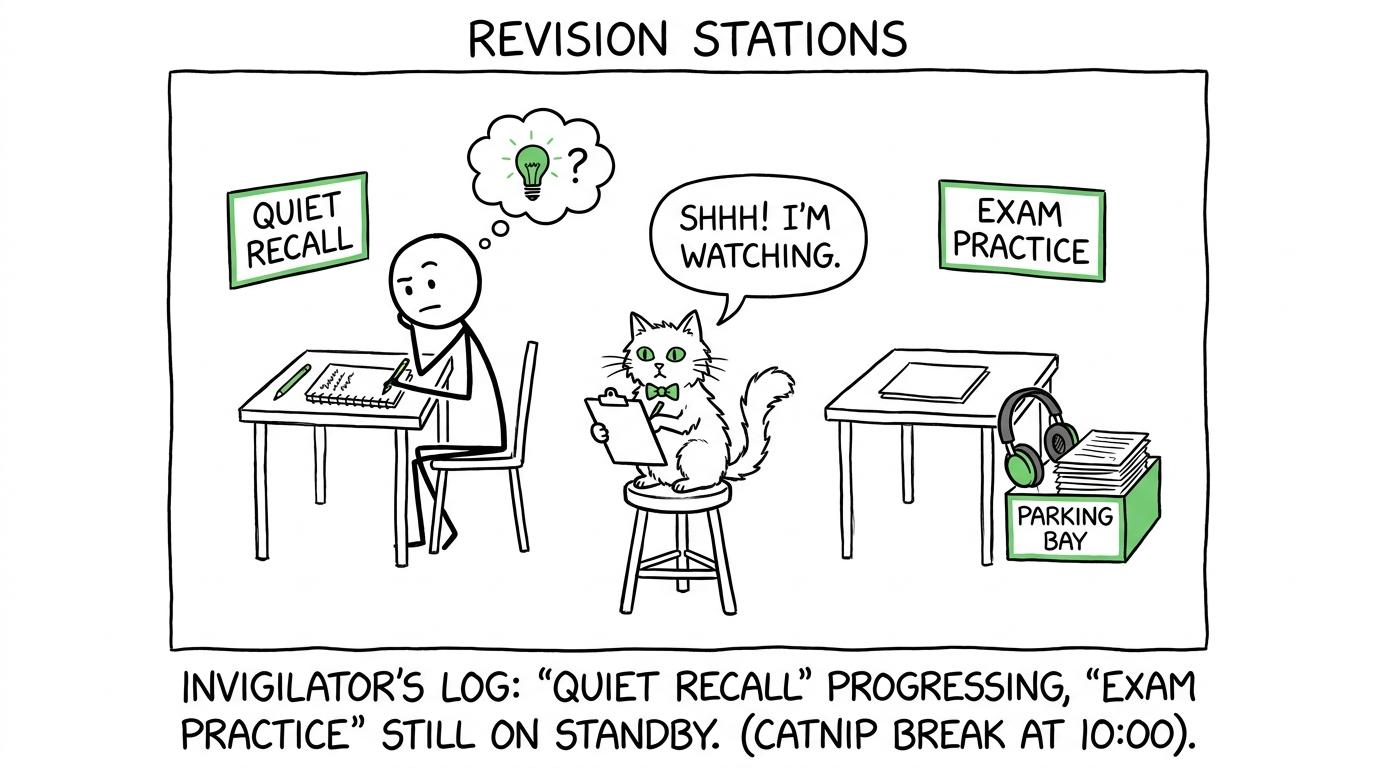 A cat invigilator watches while headphones wait in a parking bay
Common mistakes when choosing revision sound
Keeping lyrics because they feel motivating
Motivation matters, but use lyric-heavy music before the session or during a break. Feeling energised does not remove the possibility of verbal interference during reading and recall.
Assuming instrumental music improves memory
Instrumental music is generally less risky than lyrical music, but research does not show a universal advantage over silence. Treat it as an environmental preference, not a revision technique.
Playing audio too loudly
Background sound should remain in the background. If you notice musical changes, anticipate favourite sections or cannot hear your own spoken recall clearly, reduce the volume or turn it off.
Using podcasts or television as harmless noise
Speech contains meaning. A podcast, video or television programme can compete with History reading and essay planning even when it is not the main focus.
Never practising in exam conditions
Comfortable revision is not enough. Complete timed work in silence, without pausing or checking notes. The GCSE maths exam-week checklist can help you make these final sessions calm and realistic.
Changing the sound instead of changing the method
If little is sticking, the playlist may not be the main problem. Rereading remains passive whether the room is silent or noisy. Retrieval practice, exam questions, marking and revisiting errors are more important than finding a supposedly perfect soundtrack.
Choose the environment that makes learning visible
For most language-heavy GCSE History revision, silence is the safest starting point. Quiet instrumental or steady neutral sound can be a practical compromise when silence is unavailable or uncomfortable. Music with lyrics should usually be saved for breaks, travel or low-demand organisation.
Then look beyond the atmosphere. The real measure of revision is what you can retrieve, explain and apply after the notes are closed.
Use the same principle for maths. Visit the MathsGenie GCSE revision hub, choose a revision lesson, practise the skill and check your work with solutions or a mark scheme. Build towards mini tests, past papers and predicted papers, using video solutions when a method remains unclear. Put the headphones aside for timed papers and let your marks show you what to revise next.










