

GCSE History Remark Appeal: Is It Worth It?
GCSE history remark appeal guide explaining reviews of marking, costs, deadlines, risks and when challenging your result may be worthwhile now.

Results day can reduce two years of work to one small line on a screen. If your GCSE History grade is lower than expected, especially by only a few marks, requesting a remark can feel like the obvious response.
But a GCSE history remark appeal is not an automatic second chance at a higher grade. What students call a “remark” is normally a formal review of marking. The reviewer checks whether the mark scheme was applied correctly; they do not simply mark the paper again in the hope of finding extra credit. Your mark can rise, stay unchanged or fall.
The short answer is that a review may be worthwhile when you are close to the next grade boundary and a teacher finds credible evidence of a marking error. It is less compelling when the request is based only on disappointment or a result being lower than a predicted grade.
Your results-day checklist
Before paying a fee or signing a consent form:
- Ask your school for your marks for every History paper or component.
- Check the official grade boundary for your exam board and specification.
- Calculate how many additional marks you need overall.
- Ask whether your school can obtain the script for a History teacher to inspect.
- Discuss whether there appears to be a genuine marking error.
- Check the exam board's current deadline and fee with the exams officer.
- Understand that the reviewed mark may decrease.
- Tell your sixth form or college promptly if the grade affects your place.
Act quickly, but do not confuse speed with panic. Post-results deadlines are set for each exam series, and schools often use earlier internal deadlines so that they have time to secure consent and submit requests.
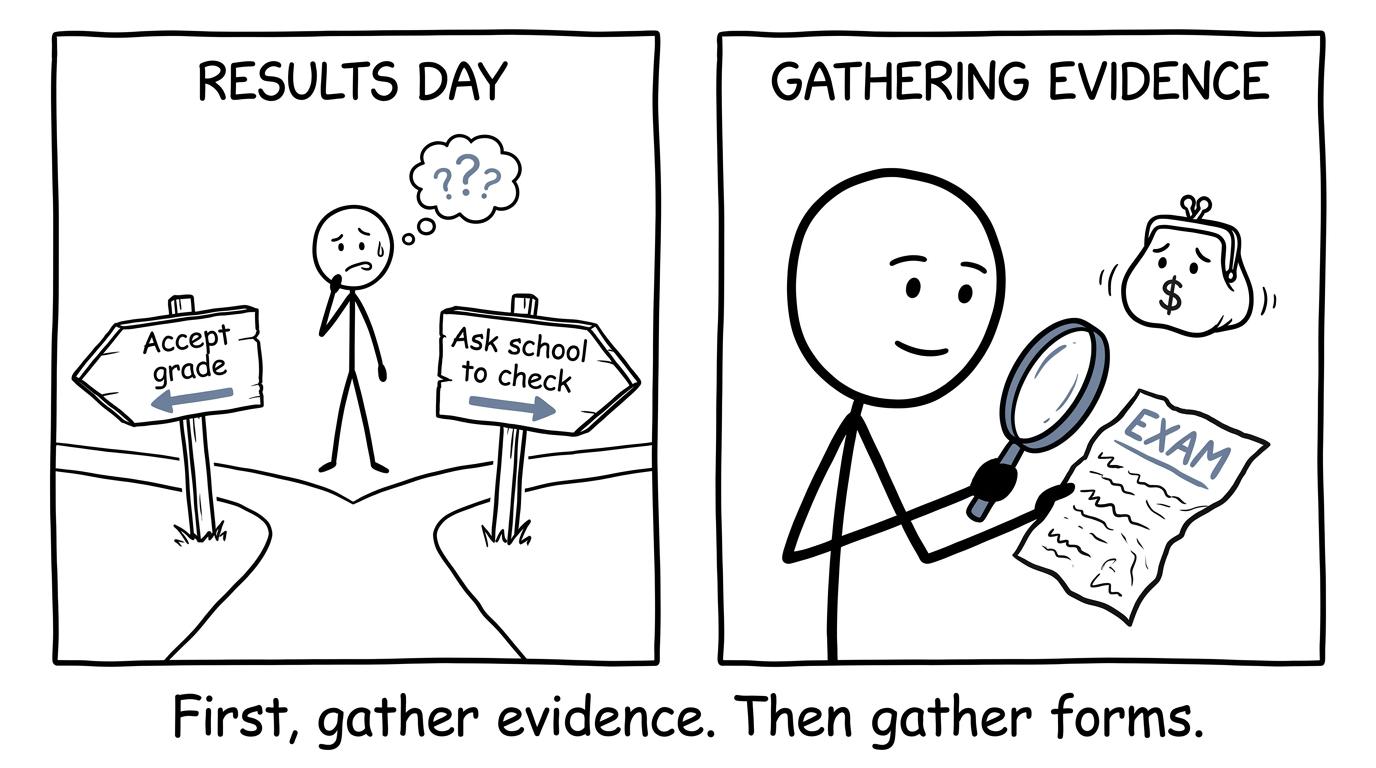 A student choosing between accepting a grade and asking the school to check
How a GCSE History remark actually works
For GCSE qualifications regulated through the usual JCQ post-results system, requests are normally submitted by your school or college. An internal candidate does not usually contact Edexcel, AQA, OCR or Eduqas directly. Private candidates should speak to the centre through which they entered the examination.
Start by checking the result
You need the total qualification mark, the marks awarded for individual papers and the relevant grade boundary. The useful calculation is:
marks needed=next grade boundary−current total mark\text{marks needed} = \text{next grade boundary} - \text{current total mark}marks needed=next grade boundary−current total markBeing one mark below a boundary does not prove that the marking is wrong. It simply tells you how small a successful change would need to be. Predicted grades, mock results and teacher expectations are helpful context, but they are not evidence that an examiner made an error.
History normally has several examined components, depending on the board and specification. A request is made for a particular paper or component, so identify where a plausible change could affect the overall total rather than requesting every paper automatically.
Ask to see the script where possible
An exam script can help your teacher judge whether a review has a realistic basis. Exam boards provide access-to-scripts services, although arrangements and deadlines differ. Your exams officer can explain what is available for the current series.
A History teacher might look for:
- an answer or page that appears not to have been marked;
- a mark that seems inconsistent with the published mark scheme;
- incorrect addition or transfer of marks;
- evidence that part of an extended response was overlooked;
- an annotation or mark that suggests the response was misread.
This professional review is valuable because History marking involves academic judgement. Another teacher believing that an answer “deserved more” does not necessarily establish a marking error.
Choose the correct post-results service
A clerical re-check checks administrative matters such as whether all parts were marked, whether marks were totalled correctly and whether the final mark was recorded accurately. It does not reconsider the quality of an essay.
A review of marking includes the clerical checks and considers whether the original examiner applied the mark scheme correctly. It is not a completely fresh re-mark. The reviewer corrects identified marking errors while recognising that legitimate academic judgement can exist within mark schemes.
Your school must obtain your written consent before requesting a review because the mark can go down as well as up. The reviewed outcome replaces the original result, even if it is lower.
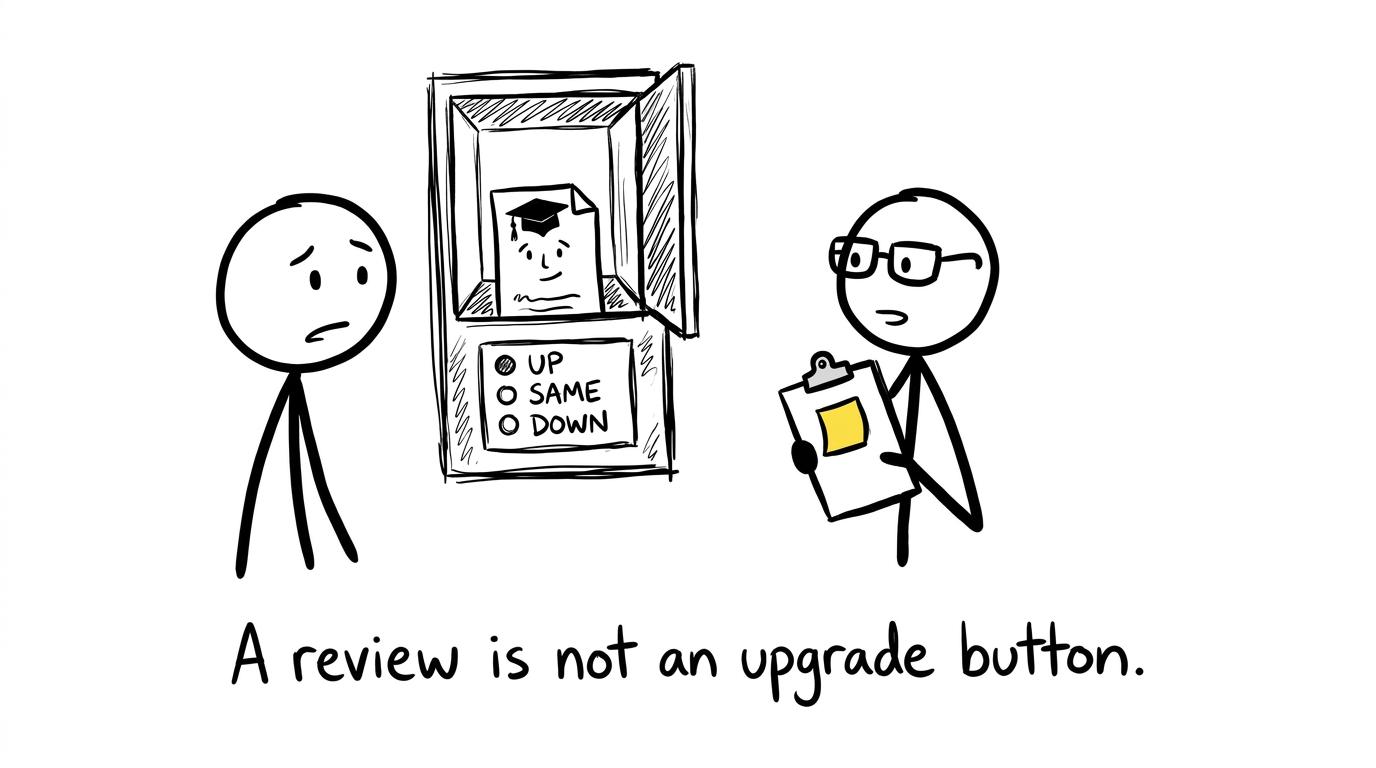 An exam paper in a lift with up, same and down buttons
When is a GCSE History remark appeal worth it?
A request is strongest when several pieces of evidence point in the same direction.
You are close to a meaningful grade boundary
If a small mark increase would change the final grade, the possible benefit is clear. This can matter when a sixth form, college course or apprenticeship has a specific entry requirement.
Distance from the boundary is only one factor. A student who needs one additional mark but has no questionable marking may have a weaker case than a student who needs several marks and whose teacher has identified a substantial omission.
A specialist teacher identifies a likely error
The most useful evidence is not “this result feels wrong”. It is a teacher locating a particular response where the mark scheme appears to have been applied incorrectly.
Extended History answers can involve judgement about knowledge, analysis, explanation and evaluation. A review is more promising when the concern is specific enough to explain to the exams officer, rather than being a general disagreement with the level awarded.
The changed grade would affect your next step
Consider what the result changes in practice. If the higher grade would secure a place, meet an entry condition or correct an inaccurate certificate, there is a concrete reason to proceed.
Contact the sixth form or college before assuming that a review is essential. It may hold your place while an outcome is pending or decide that your overall results already satisfy its requirements. Only the institution can confirm its own admissions decision.
You accept the financial and academic risk
Exam boards charge per reviewed component, with fees and payment policies varying by board and series. Your school may pass the fee on to you. Some boards do not charge in certain circumstances when the overall qualification grade changes, but you should never assume this applies: ask the exams officer for the current written policy.
You must also accept the possibility that marks could decrease. A lower mark may or may not lower the overall grade, depending on the total and the boundaries.
When a review is unlikely to be worthwhile
Think carefully before proceeding when:
- you are many marks from the next boundary;
- no teacher has inspected the script or found a credible concern;
- the argument relies entirely on a mock or predicted grade;
- the desired grade would not affect your next step;
- you are requesting every paper without identifying which component is questionable;
- you are unwilling to accept that the mark could fall.
There is no special rule that awards an extra mark because a student narrowly missed a boundary. Grade boundaries classify the marks already awarded; they do not alter how close answers are treated.
What happens after the review?
The school receives an outcome confirming whether the component mark has changed. If the total crosses a boundary, the qualification grade changes accordingly. If the mark changes but remains within the same boundary range, the grade stays the same.
Keep your sixth form or college informed if admission depends on the result. Do not wait silently for the certificate to be updated.
If you and your school still believe the exam board has failed to correct a marking or procedural error, the next step may be an appeal. An appeal is not simply another opportunity to ask for a more generous mark.
How the appeals process differs from a remark
A formal appeal normally follows completion of the relevant post-results service. It considers whether the exam board followed its procedures correctly or whether a marking error remains uncorrected. The centre submits it to the awarding organisation and must meet the applicable deadline.
The process can include an initial appeal stage and, where grounds remain, a later appeal hearing. Exact forms, fees and time limits vary, so your exams officer should consult the current rules for your board and exam series.
If your school decides not to support a review or appeal, ask for its internal appeals procedure. Centres are expected to have a process through which candidates can challenge certain post-results decisions. This does not guarantee that the school will submit the case, but it gives you a formal route for asking it to reconsider.
Common mistakes to avoid
Calling every request an appeal
A clerical re-check, review of marking and appeal are different stages. Use the correct term when speaking to your exams officer so that you receive the right form and information.
Treating a predicted grade as proof
A predicted grade is an informed estimate, not a contractual result. The decision should focus on the marked script, the mark scheme and the distance from the official boundary.
Looking only at the overall grade
Obtain the component marks. History papers can produce quite different results, and only one may contain a credible issue.
Missing the school's deadline
The published exam-board deadline may not be your school's deadline. Centres need time to review scripts, collect consent and process payment. Contact the exams officer as soon as possible.
Forgetting that marks can fall
Signing the consent form is not a formality. A review can leave the mark unchanged or reduce it, and the revised mark becomes the official one.
Turn results-day uncertainty into a revision plan
A History review cannot improve your next maths examination. Deliberate revision can.
Begin with the free GCSE Maths revision lessons, then select topics at the right level. Students rebuilding core skills can use the grade 444 revision resources, while those targeting stronger higher-tier performance can progress through the grade 555 topics, grade 666 topics and grade 777 topics.
Once individual skills are secure, use GCSE Maths past papers to practise choosing methods under exam conditions. Closer to the examination, GCSE predicted papers can add structured practice, but they should complement revision lessons and past papers rather than replace them.
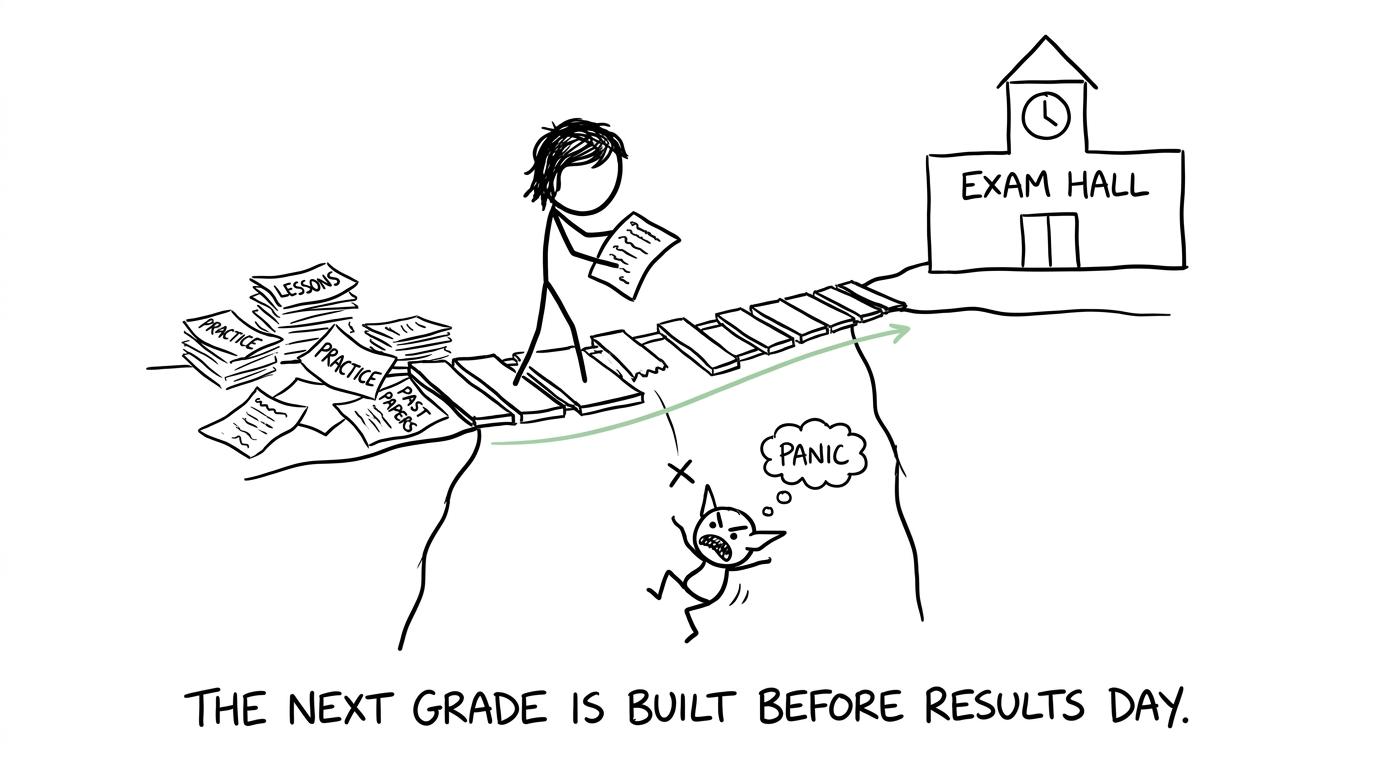 A student building a revision bridge while panic cannot cross
Make the decision from evidence, not hope
A GCSE History review is genuinely worth considering when the grade matters, you are within realistic reach of the next boundary and a teacher can identify a potential marking error. It is not a reliable gamble based solely on being disappointed.
Ask for your component marks, explore access to the script, speak to a History teacher and confirm the current fee and deadline with your exams officer. Then make a calm decision with full knowledge that the mark can move in either direction.
For the exams still ahead, put that same evidence-led approach into action with MathsGenie. Work through the free revision lessons, practise targeted questions, complete mini tests, mark past papers honestly and use video solutions to understand errors. A review may correct a mistake in one completed paper; consistent practice changes what you can do in every paper that follows.











