GCSE History February Half-Term Revision Plan
GCSE history February half term revision made manageable: create a focused plan, practise exam skills and keep maths moving without burning out this week.
February half-term can feel like the moment when GCSE revision suddenly becomes real. History folders look enormous, maths topics are still moving forward, and every subject seems to want the same seven days.
A good GCSE history February half term revision plan does not attempt to finish the entire course. It identifies the knowledge and exam skills that most need attention, gives them several focused sessions, and leaves room for maths, other subjects and rest. The aim is not to make half-term your only revision window. It is to leave the week with a clearer map for the months ahead.
For maths, keep a separate routine running through the week using the GCSE Maths revision hub. MathsGenie does not provide GCSE History lessons, but its free maths revision lessons, practice questions and papers can stop one subject quietly displacing another.
Your half-term revision checklist
Before building a detailed timetable, make these decisions:
- Confirm your History exam board and the exact topics taught by your school.
- Use the current specification rather than a generic online topic list.
- Choose two weak content areas and two weak question types.
- Plan short retrieval, question practice and marking sessions.
- Keep at least three maths sessions in the week.
- Leave one lighter day and some unscheduled catch-up time.
- Finish with a plan for what you will revisit after half-term.
That is enough structure to create momentum without turning the break into a seven-day mock examination.
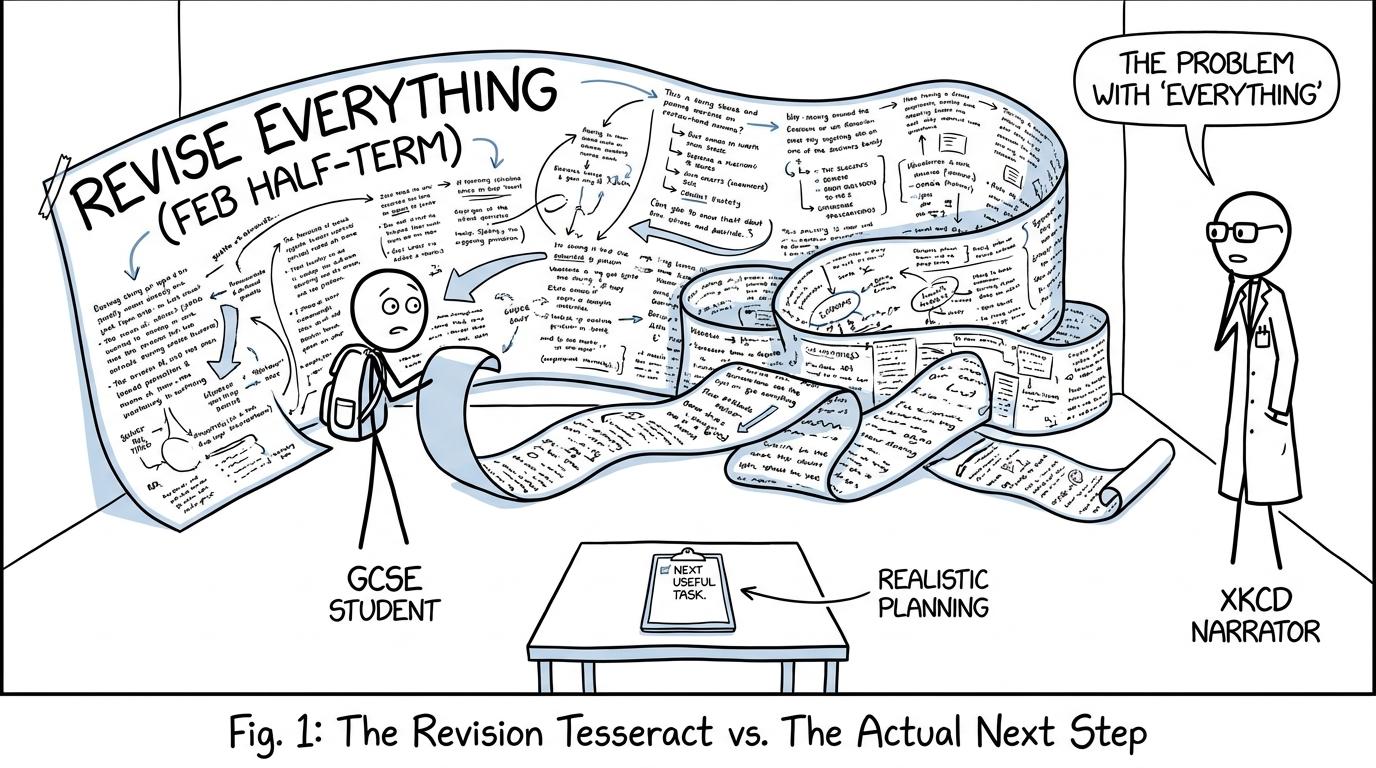 A student choosing a sensible revision checklist over an enormous plan to revise everything
Start with your specification, not your biggest textbook
GCSE History courses differ considerably. AQA, Edexcel, OCR and Eduqas offer different combinations of thematic studies, period studies, depth studies and historic environments. Paper structures and question wording also vary. Edexcel has introduced specification and assessment changes across recent examination series, including content changes for first assessment in summer 2026, so students should check the current version provided by their school or exam board.
Write down four things before revising:
- your exam board;
- the papers or components you will sit;
- the options your class has studied;
- the command words and question types used on each paper.
Then turn the specification into a simple traffic-light list. Use green for material you can recall and apply, amber for uncertain areas, and red for content you cannot yet explain. Be honest. A neat green spreadsheet is less useful than an untidy red list that tells you what to do next.
The national assessment objectives also provide a useful guide. Across GCSE History specifications, approximately 35%35\%35% of the assessment relates to knowledge and understanding, 35%35\%35% to explanation and analysis, 15%15\%15% to sources and 15%15\%15% to interpretations. Exact question arrangements vary by board, but the broader lesson is clear: memorising facts alone is not sufficient. You must also use knowledge to analyse causation, consequence, change, continuity, significance, similarity and difference.
Choose a narrow half-term target
The danger of a free week is confusing available time with unlimited capacity. A realistic target might be:
- repair two weak History topics;
- practise three important question types;
- complete one timed section rather than several full papers;
- maintain three short maths sessions;
- prepare the next four weeks of revision.
Choose priorities using evidence. Look at recent assessments, teacher feedback and questions you found difficult. Replace broad labels such as “Germany” or “medicine” with precise targets such as “reasons for the consolidation of Nazi control” or “factors affecting medical progress in the nineteenth century”. Precision makes the first task easier to begin.
Use the same principle for maths. A short diagnostic activity from the GCSE Maths mini tests can reveal whether your next session should address percentages, algebra or geometry. If you need a wider map, the GCSE maths topics by board and tier guide helps you check that your Foundation or Higher revision remains balanced.
A focused seven-day half-term plan
The plan below is a framework, not a test of discipline. Move sessions around family plans, work, sport and genuine rest. Most days contain two History blocks and no more than one maths block.
| Day | History focus | Maths and balance |
|---|---|---|
| Saturday | Audit the specification and organise resources | Complete a short maths diagnostic |
| Sunday | Retrieve one weak topic and check missing knowledge | Rest or catch up |
| Monday | Rebuild weak topic one; practise one relevant question type | One focused MathsGenie topic session |
| Tuesday | Rebuild weak topic two; create a chronology or factor map | Free evening |
| Wednesday | Sources or interpretations practice for your board | Short maths mini test and corrections |
| Thursday | Timed History question set; mark and improve it | Rest after the timed work |
| Friday | Mixed retrieval and next-month planning | One maths paper section or targeted practice |
Use a repeatable History session
A focused block can last about 454545 to 606060 minutes:
- Recall: spend 101010 minutes writing what you know without notes.
- Repair: use class materials to correct gaps for 151515 minutes.
- Apply: answer or plan an exam-style question for 202020 minutes.
- Review: use the mark scheme or teacher guidance for 101010 minutes.
The order matters. Retrieval shows what is actually available in memory. Repair fills specific gaps. Application turns knowledge into something an examiner can reward. Review gives the next session a purpose.
Avoid spending the whole block copying notes. Attractive notes can support revision, but they do not prove that you can retrieve knowledge or construct a judgement under time pressure.
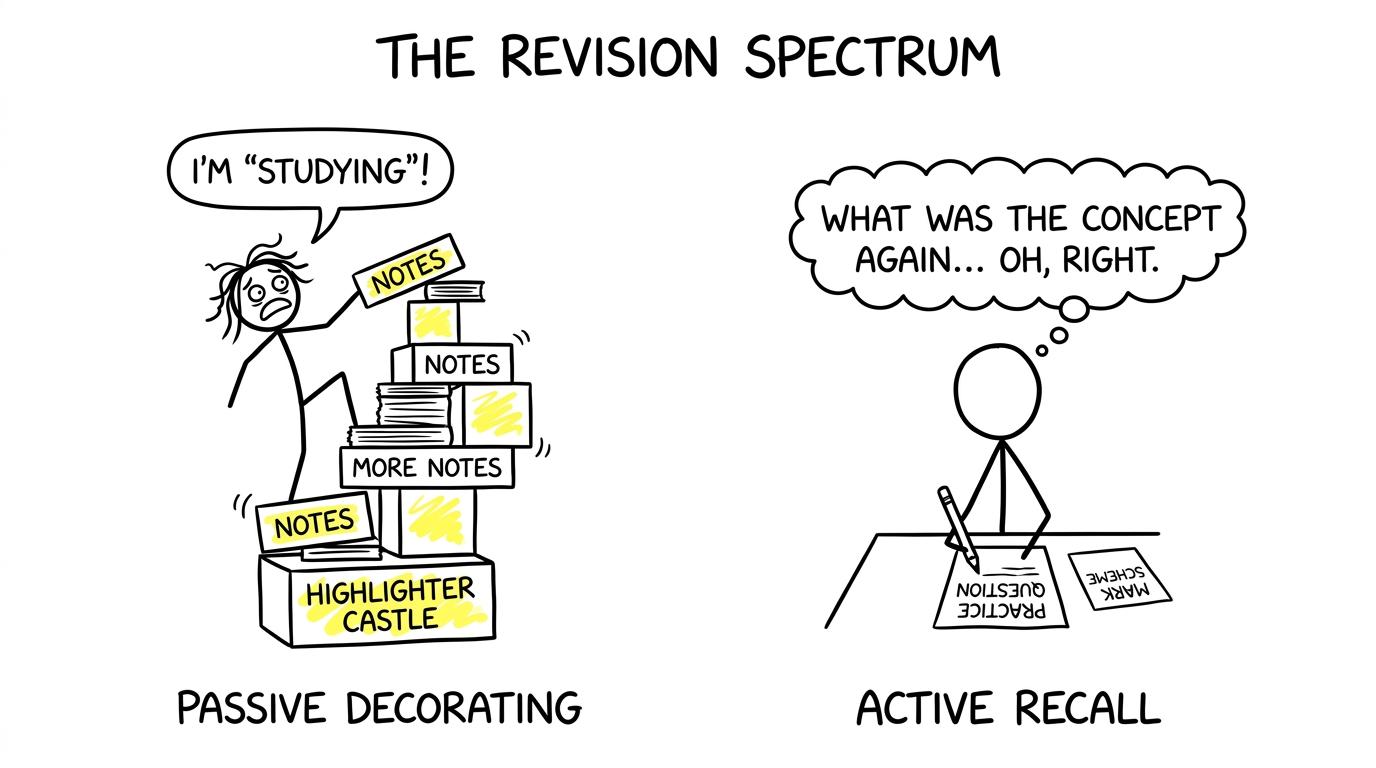 One student builds a highlighter castle while another calmly answers and marks a practice question
Revise historical knowledge so that you can use it
A useful History memory is connected, not merely large. For each selected topic, organise knowledge around the demands of the specification.
Build chronology before detail
Create a short sequence of pivotal events. Do not add every date you have encountered. Choose dates that help you explain development, turning points or cause and consequence.
Once the sequence is secure, ask:
- What changed between these points?
- What remained similar?
- Which factor had the greatest influence?
- Were the effects immediate or long term?
- How did political, economic, social or religious factors interact?
This prevents facts from becoming isolated flashcards with no analytical purpose.
Retrieve relationships, not just definitions
When testing yourself, use prompts such as “Why did this happen?”, “What evidence challenges this view?” and “How was this different from the earlier period?” These prompts practise the thinking represented by the assessment objectives.
You can also sort evidence under possible arguments. If a question asks about significance, for example, your revision should include the scale, duration and wider consequences of an event rather than a list of details alone.
Practise the question types your board actually uses
Do not borrow an answer structure from another exam board without checking it. AQA, Edexcel, OCR and Eduqas can use different command words, mark totals and expectations. Your teacher, current specification, sample assessment materials, past papers and official mark schemes should determine your approach.
During half-term, choose a small set of recurring skills:
- selecting precise evidence;
- explaining cause or consequence;
- analysing change and continuity;
- evaluating a source in its historical context;
- comparing interpretations;
- reaching a supported judgement.
Start by planning answers if writing several complete responses would be unrealistic. A useful plan identifies the argument, relevant evidence, links between paragraphs and the basis of the final judgement. Later in the week, complete at least one response or paper section under timed conditions.
When marking, avoid asking only, “What mark did I get?” Ask which part of the response prevented the next level: insufficient knowledge, weak explanation, limited source analysis, an unsupported judgement or poor timing. Turn the answer into one specific action for your next attempt.
Keep maths moving without dividing every day equally
Balance does not mean giving every subject the same number of minutes. It means preventing an urgent-looking subject from consuming all available attention.
Three well-chosen maths sessions can protect progress during a History-focused week:
- Diagnostic session: use a mini test or mixed questions to expose weak topics.
- Repair session: watch a revision lesson, complete practice questions and check the solutions.
- Exam session: attempt part of a paper under timed conditions and review every lost mark.
The GCSE past papers collection includes papers organised by exam board. Edexcel students can use the dedicated Edexcel GCSE Maths past papers, while students looking for a better feedback routine can follow the guide to using GCSE past papers properly.
Half-term is usually better suited to diagnosis and repair than a relentless series of complete papers. GCSE predicted papers are particularly useful later, once you have repaired topic gaps and want further unseen practice. They should complement, not replace, official past papers.
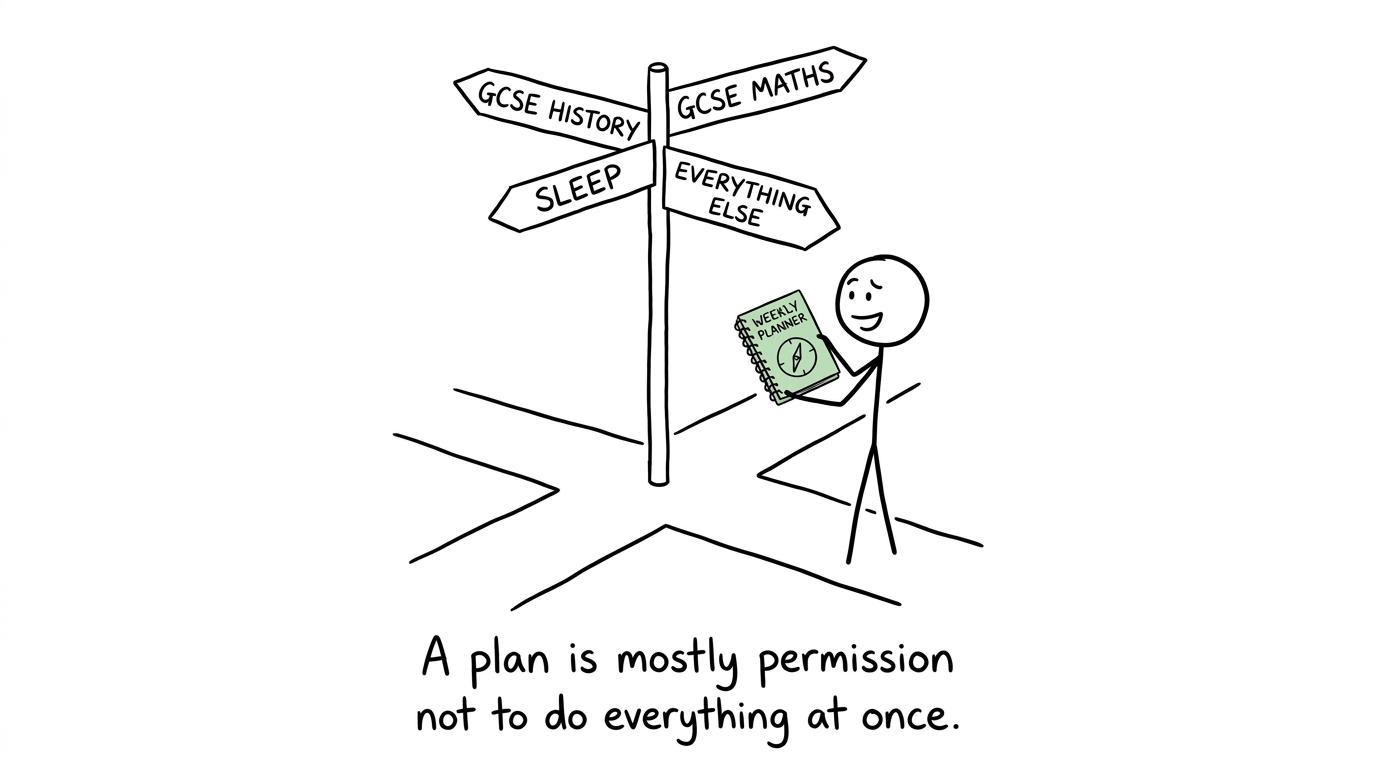 A student uses a weekly planner as a compass between History, Maths, sleep and everything else
Common mistakes during February half-term revision
Trying to complete the whole History course
This encourages shallow coverage and creates the impression that revision is finished. Repair a few important weaknesses now, then schedule the remaining topics across the following weeks.
Revising content without exam application
Knowing a page of facts is not the same as answering a question. Every substantial content session should end with retrieval, a question plan or a written response.
Using the wrong paper or specification
Generic resources may cover a different board, option or assessment model. Confirm your specification and the topics selected by your school before investing time.
Reading mark schemes before attempting questions
Mark schemes are valuable feedback, but seeing them too early removes the act of retrieval. Attempt the task first, mark it second, then improve the answer.
Letting History replace maths for the entire week
Maths skills become secure through repeated practice. A few short sessions are more protective than promising to “catch up later”. The GCSE maths revision timetable guide can help you build a routine that continues after half-term.
Treating rest as wasted time
A plan with no breaks is fragile. Stop at a sensible time, keep some evenings free and protect sleep. The purpose of a timetable is to reduce decisions, not to make every free hour feel guilty.
Finish half-term with a bridge to the next month
On the final day, spend 202020 minutes reviewing the week. Record what became more secure, what still needs work and which question type should be revisited first. Put those actions into the next four weeks before school routines become busy again.
Your February plan has worked if you finish with better evidence about your weaknesses and a process you can repeat. It has not failed because some topics remain untouched. GCSE revision is built through return visits.
For maths, make MathsGenie your free revision base. Choose your board and tier in the GCSE Maths revision area, rebuild individual skills with revision lessons and practice questions, and then test them using mini tests, past papers, predicted papers, mark schemes and video solutions. Keep History focused, keep maths moving, and let half-term become the beginning of a calmer revision cycle rather than its entire story.