GCSE History Exam Day Kit: Simple Checklist
GCSE history exam day kit checklist: pack black pens, a clear pencil case and label-free water, while leaving phones, watches and notes outside.
The night before a History paper, it is surprisingly easy to prepare for the wrong problem. You reread one more page on Elizabethan England, worry about a date you might have forgotten, then realise your only black pen is nearly empty.
A GCSE history exam day kit is reassuringly small: at least two working black ink pens in a clear pencil case, plus a clear, label-free bottle of water if your centre allows it. Keep your timetable and any centre-required identification ready for arrival, but do not take revision notes, a phone, earbuds or any type of watch into the exam room.
The goal is not to pack for every imaginable emergency. It is to remove small, avoidable distractions so that your attention can stay on interpreting sources, selecting evidence and building clear arguments.
Your GCSE History exam kit at a glance
Prepare this simple checklist the night before:
- At least two working black ink or black ballpoint pens
- A completely clear pencil case
- A pencil, eraser, ruler and sharpener, if your paper or school advises them
- A clear water bottle with the label removed, if permitted by your centre
- Your exam timetable, checked for the correct date, start time and room
- Your candidate card or identification, but only if your school requires it
- Any approved access-arrangement equipment organised through your school
- A practical plan for storing your phone, watch and other prohibited items
Check your school’s candidate handbook as well as the instructions for your particular paper. Exam boards including Edexcel, AQA, OCR and Eduqas follow common JCQ rules, but centres can have their own arrival, identification and storage procedures.
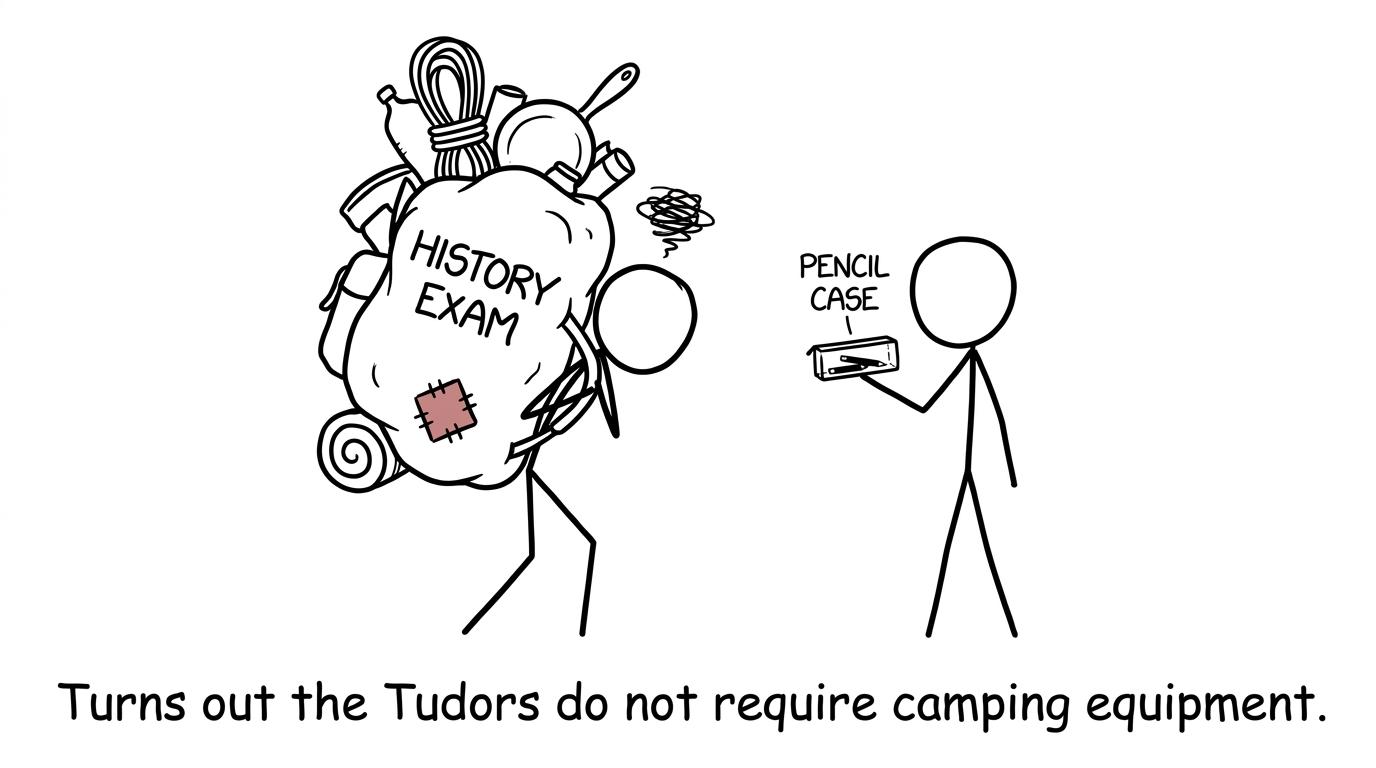 A student discovers that a History exam does not require expedition equipment
What you actually need inside the exam room
Two or more reliable black pens
Current JCQ written-exam guidance says candidates must write clearly in black ink. The practical checklist for candidates recommends bringing at least two black ink pens, with blue pens not accepted.
History involves sustained writing, so one spare is the minimum sensible backup. Test every pen on ordinary paper the night before. A pen that works after frantic scribbling is not the same as a pen that writes comfortably through several extended responses.
Choose pens you already use confidently. Exam day is not the moment to discover that a new pen smudges, scratches the page or makes your hand tense. Avoid erasable and gel pens for answers. Correcting pens, fluid and tape are also prohibited under JCQ written-exam rules.
A transparent pencil case
Any pencil case taken into the exam room must be see-through. A clear case also makes your own check easier: pens, pencil, eraser and ruler are visible, with no folded notes or forgotten scraps of paper hiding underneath.
Do not assume that a metal maths tin or an opaque pouch will be accepted. Transfer only the permitted equipment you need into a transparent case. Your school may provide stationery, but unless it has explicitly told you this, preparing your own compliant kit is safer.
A pencil, ruler and eraser
Your History answers should be written in black ink, not pencil. However, a pencil and ruler may be useful where a paper requires a simple annotation or where the front-page instructions permit their use. Pack them only as basic backup equipment rather than as substitutes for your pens.
A small, transparent sharpener is sensible if you bring a pencil. Avoid bulky containers, tins or equipment carrying printed notes. Always follow the instructions on the question paper if they differ from your normal routine.
A clear bottle of water
JCQ’s candidate preparation checklist permits a clear water bottle without a label. Your centre may give more detailed instructions, so check them beforehand.
Prepare the bottle at home: remove the label completely, check that it does not leak and fill it with plain water. Place it beside your pencil case so it cannot be forgotten in the morning. Water is optional, but having it ready prevents a small decision becoming another source of stress.
What should stay outside the exam room
A good kit is partly about what you pack. More importantly, it is about what you deliberately remove.
Phones, watches and smart devices
Do not take a mobile phone, smartwatch, analogue watch, digital watch, earbuds, headphones, smart glasses, tablet or similar device into the exam room. Current JCQ rules list phones, watches and smart devices as unauthorised items. Possession can be treated as breaking the rules even when the item is switched off and you never intended to use it.
Follow your centre’s collection or storage procedure. If you need a phone for travelling, decide the night before where it will go. Do not rely on remembering at the exam-room door, when your attention is already divided.
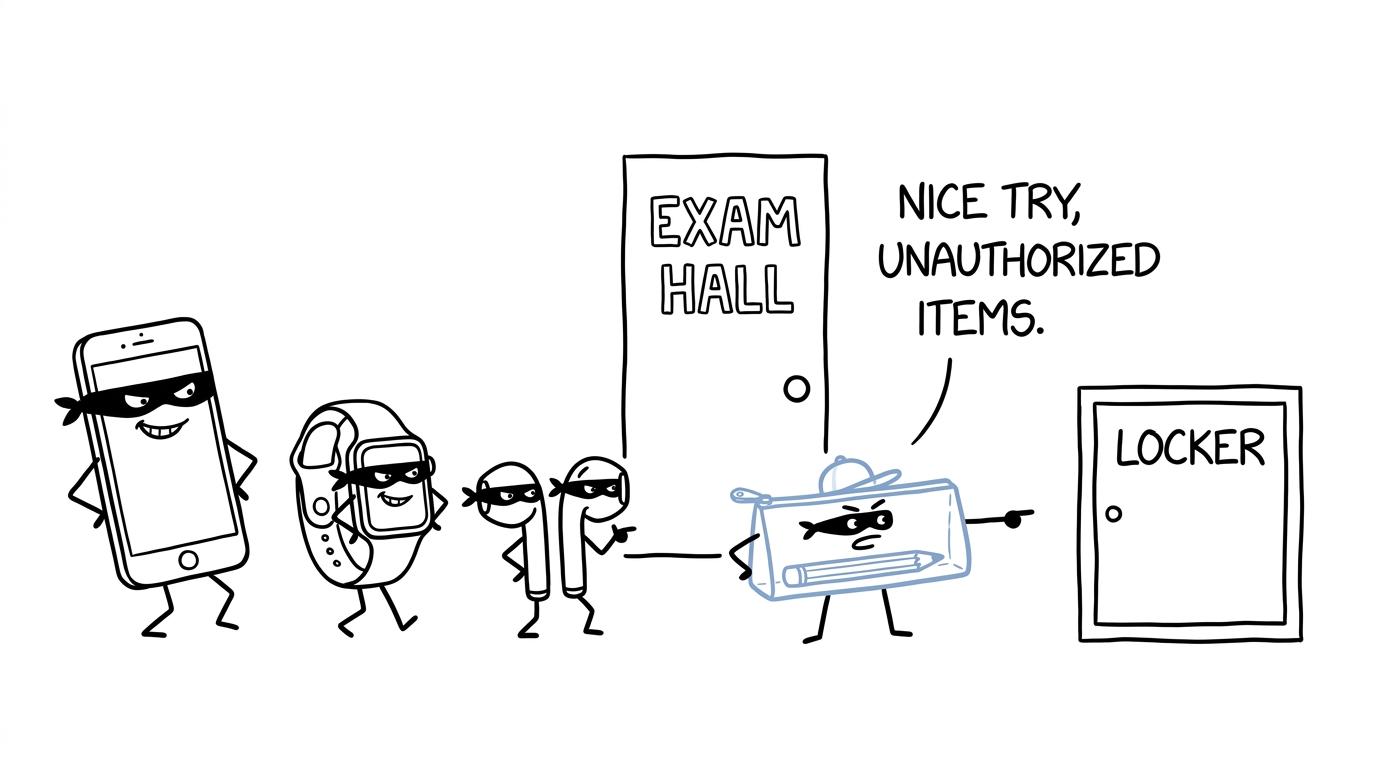 Unauthorised electronic items are turned away from the exam hall
Revision notes and textbooks
Your timeline, flashcards and model paragraphs belong outside the exam room. Check blazer pockets, trouser pockets and the compartments of your pencil case. A forgotten note is still unauthorised material.
There is also a useful psychological boundary here. Notes help before the paper; once you enter, your job changes from collecting knowledge to using what you know. Leave the folder in the place specified by your school rather than carrying it towards your desk.
Highlighters and correction products
Under current JCQ guidance, highlighters must not be used in answers. They may be used to highlight material in a question paper or supplied resource material, but bringing one creates little benefit unless you have practised using it appropriately.
Do not bring correcting fluid, correcting tape, erasable pens or gel pens for your answers. If you make an error, cross it out neatly and continue. A clear correction is usually faster and less distracting than trying to make the page look untouched.
A calculator and maths equipment set
A standard written GCSE History paper does not normally require a calculator, protractor or pair of compasses. The definitive instruction is always on the front of your paper and in information from your centre.
This is where switching between subjects can cause confusion. Your GCSE maths revision hub may lead you towards calculator practice and geometry equipment, but History requires a simpler desk. Keep separate subject checklists so the kit for one paper does not automatically become the kit for every paper.
The night-before routine
Preparation works best when it is boring. The calmer the routine, the less attention it demands.
Check the exam, not just the subject
Confirm the date, arrival time, room and exact History component. Depending on your specification, papers may cover different period studies, thematic studies, wider-world depth studies or historic environments. Do not rely on remembering what a friend said.
Check information issued directly by your school or exams officer. If there is a difference between a general online checklist and your centre’s instructions, ask your exams officer before the examination.
Lay everything out in one place
Put the clear pencil case and water bottle beside the bag you will take. Add your candidate card if required. Set out suitable clothing according to your school’s rules and check your travel arrangements.
Then inspect every pocket of the clothing and bag you plan to use. Remove notes, earbuds and other electronics now. Morning decisions are expensive because they arrive when time and attention are limited.
Stop heavy revision at a sensible point
Packing should mark the end of the evening, not the beginning of another long revision session. A brief check of your plan or key themes may be useful, but starting a full paper late at night is unlikely to make your kit feel calmer.
Maths students can use the same principle during exam season. The GCSE maths exam week checklist provides a calm routine for preparing equipment, protecting sleep and completing focused revision rather than attempting everything at once.
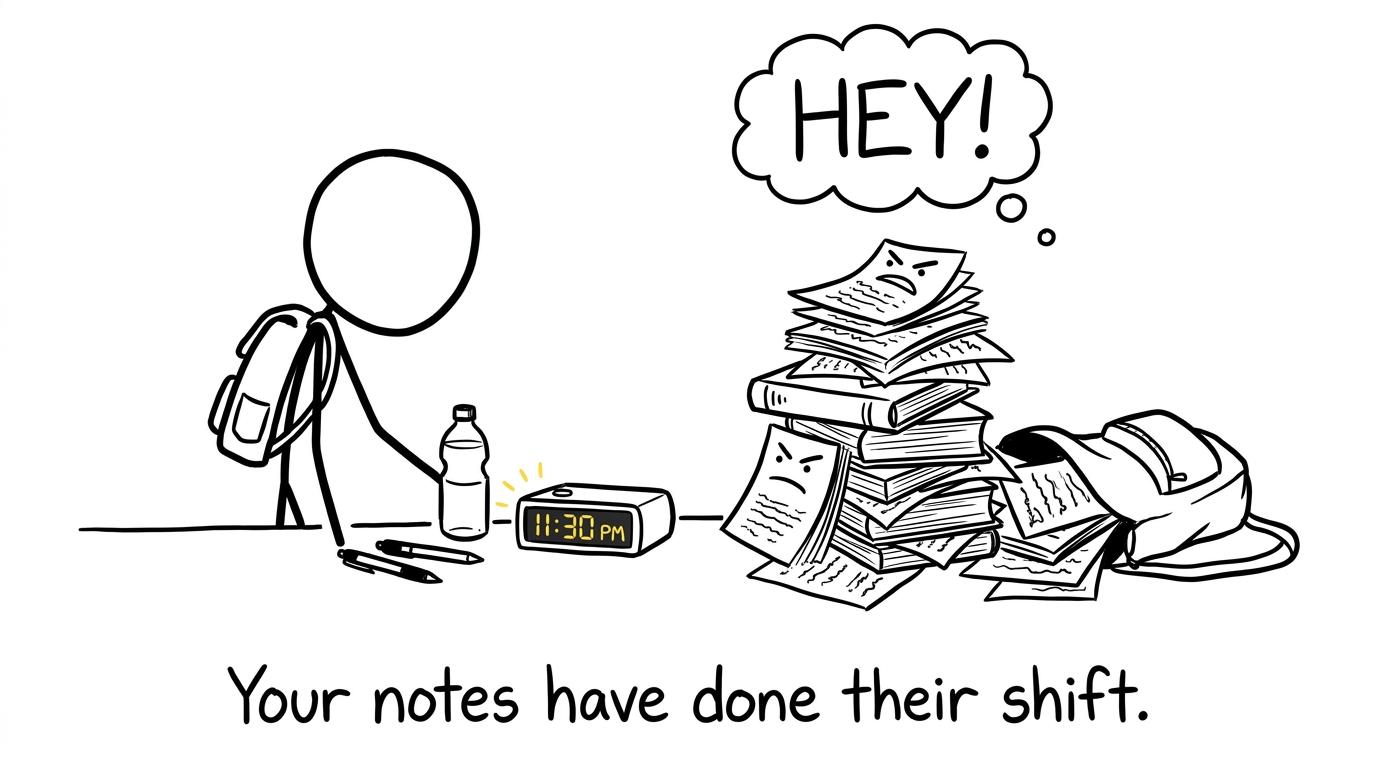 Revision notes discover that their shift ends before bedtime
What to do on the morning of the exam
Eat and drink something familiar. Leave enough travel time for ordinary delays, then arrive at the time specified by your centre. Last-minute rushing creates problems that no extra flashcard can solve.
Before entering the exam room:
- Use your centre’s system to store or hand in your phone and other devices
- Remove every type of watch
- Check your pockets for notes or electronic items
- Make sure your pens are inside the clear pencil case
- Listen carefully to the invigilator
- Ask immediately if you are uncertain about an item or instruction
Once formal exam conditions begin, do not communicate with other candidates. If you need help, feel unwell or require additional paper, raise your hand and wait for an invigilator.
Preparing for History while revising for maths
The physical kit for History is simple, but the habit behind it helps across the GCSE grades 9-1 exam season: separate preparation from performance.
For maths, equipment is only one layer. You also need the correct board, tier and paper type. MathsGenie’s Edexcel GCSE Maths past papers and AQA GCSE Maths past papers help you rehearse using realistic paper instructions and mark schemes.
When full papers feel too large, use GCSE predicted papers and revision resources or follow the past-paper revision method. Edexcel students can also use the current GCSE Maths predicted papers with worked and video solutions where available.
The subject changes, but the useful pattern remains: know what paper you are sitting, practise under suitable conditions, mark honestly, fix weak areas and prepare the right equipment before bedtime.
Common GCSE History exam kit mistakes
Packing only one pen
A single pen can run out, leak or stop writing. Bring at least two tested black pens, preferably ones you have already used for extended writing.
Bringing an opaque pencil case
A familiar pencil case may still breach exam-room rules. Transfer your permitted stationery into a completely transparent case.
Treating a switched-off phone as safe
The important issue is possession, not whether the device is switched on. Use the storage procedure set by your centre.
Forgetting that every watch is prohibited
The restriction is not limited to smartwatches. Current JCQ rules include analogue and digital watches too.
Leaving notes in a pocket
Flashcards and folded notes can remain hidden after revision. Empty every pocket the night before and check again before entering.
Assuming every GCSE paper needs the same equipment
History normally needs far less equipment than maths. Read the front-page instructions and maintain separate kits or checklists for different subjects.
A calm kit creates room to think
The best GCSE history exam day kit is not impressive. It is dependable: tested black pens, a clear pencil case, optional label-free water and a confirmed plan for the morning. Everything unauthorised stays safely outside.
Pack once, check once, then let the decision go. Your remaining attention belongs to the paper.
For your maths exams, turn that same calm preparation into useful practice with MathsGenie. Begin at the free GCSE Maths revision hub, then combine revision lessons and practice questions with past papers, predicted papers, mark schemes, mini tests and video solutions. Prepare the kit the night before, and prepare the methods in the weeks before it.