

GCSE History 5 to 8: How to Raise Your Grade
GCSE History 5 to 8 guidance: improve recall, explanation, source analysis, judgement and exam timing with a focused, practical revision plan.
A grade 5 student often knows far more history than their mark suggests. The problem is usually not a complete lack of knowledge. It is that useful evidence remains trapped in notes, explanations stop too early, or conclusions repeat an argument instead of judging it.
Moving from GCSE History 5 to 8 therefore requires more than learning another stack of facts. You need precise knowledge, but you must also select it, connect it to the question and use it to sustain an argument. In short: revise like a historian and practise like an exam candidate.
This guide explains what tends to separate the two grade bands and the practical changes that can close the gap. Requirements differ between Edexcel, AQA, OCR and Eduqas, so always match the advice to your specification, teacher guidance and current exam-board materials.
The grade 5 to grade 8 checklist
A student working towards grade 8 will usually need to:
- recall accurate, specific evidence without relying on notes;
- address the exact issue, period and command word in the question;
- explain why evidence matters rather than leaving it unexplored;
- analyse causation, consequence, change, continuity, similarity and significance;
- evaluate sources using content, provenance and contextual knowledge;
- compare interpretations by examining their arguments and supporting evidence;
- maintain a clear line of reasoning across longer answers;
- make supported judgements based on explicit criteria;
- complete questions under realistic time pressure;
- use mark schemes and feedback to diagnose recurring weaknesses.
The aim is not perfect prose. It is controlled historical thinking.
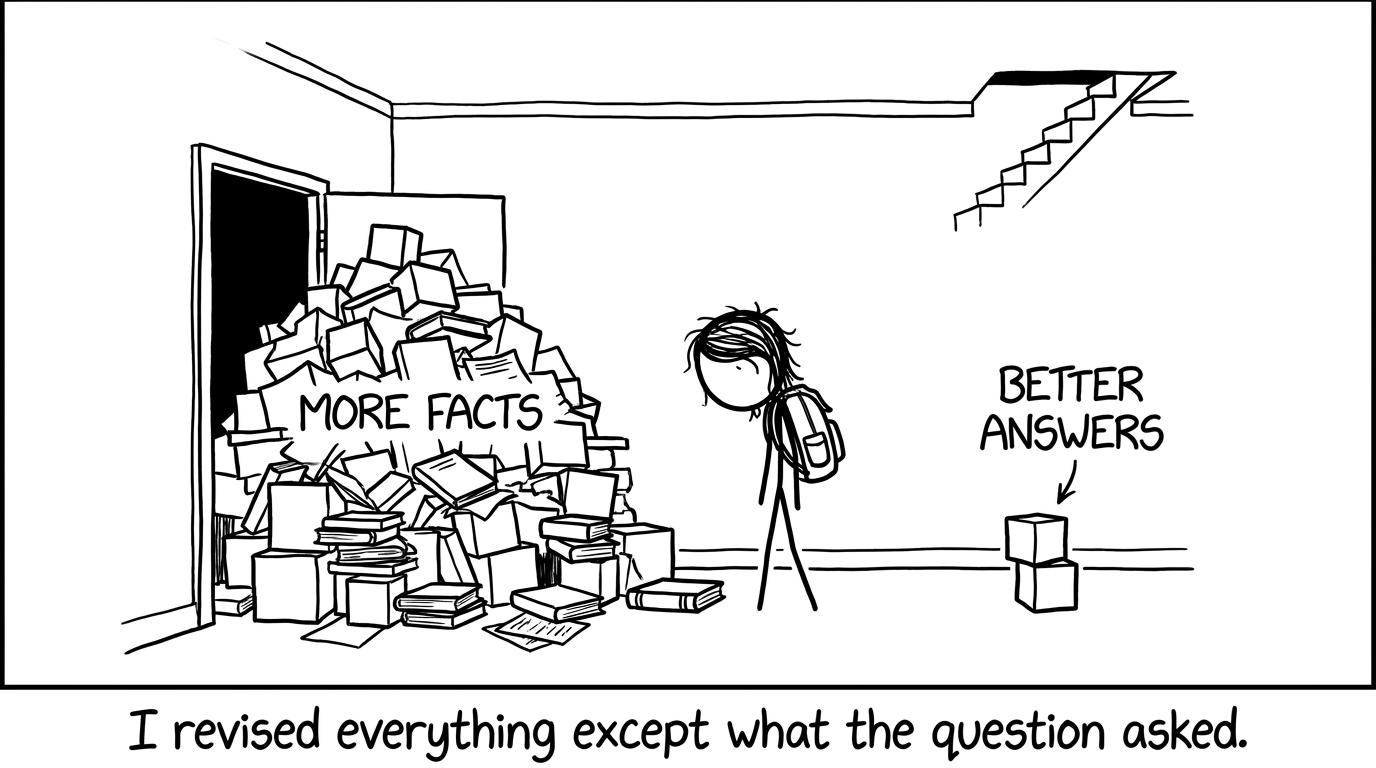 A student discovers that better answers beat a larger pile of disconnected facts
What separates a grade 5 from a grade 8 in GCSE History?
There is no universal raw mark that always produces a grade 8. Grade boundaries can change between exam series and specifications, reflecting the demands of each paper. Nor does an examiner assign a GCSE grade to an individual paragraph. Answers are marked against question-specific criteria, often through levels of response, before marks across the qualification are combined.
Even so, higher-level responses share recognisable qualities.
| Feature | Typical grade 5 tendency | Direction towards grade 8 |
|---|---|---|
| Knowledge | Generally relevant but sometimes broad | Precise, securely selected and consistently relevant |
| Explanation | States or describes an effect | Develops how and why the evidence supports the argument |
| Analysis | Identifies factors or differences | Connects factors and applies second-order concepts accurately |
| Sources | Comments on content or provenance separately | Evaluates usefulness in context for the particular enquiry |
| Interpretations | Describes what interpretations say | Analyses differences and tests claims against knowledge |
| Judgement | Gives an opinion, often at the end | Establishes criteria and weighs arguments throughout |
| Exam control | Produces uneven detail or runs out of time | Allocates effort in proportion to marks and completes the paper |
A grade 5 answer can contain correct information. A grade 8 answer makes that information work.
Turn factual knowledge into usable evidence
History revision can feel productive long before it becomes effective. Reading a textbook again creates familiarity: names look recognisable and events seem obvious. In the exam, however, the page is gone. Recognition is not the same as recall.
Build knowledge around the questions historians ask:
- What happened? Establish the event accurately.
- When did it happen? Place it in the correct chronology.
- Why did it happen? Identify and connect causes.
- What changed? Compare conditions before and after.
- Who was affected? Add range and precision.
- Why was it significant? Consider scale, duration and importance.
Use closed-book retrieval before checking notes. Timelines, flashcards, blank-page recall and short knowledge quizzes can all help, provided that checking and correction follow. A useful card should prompt an explanation or relationship, not merely an isolated date.
Organise topic knowledge into small evidence banks for likely themes such as leadership, government, conflict, religion, society or the economy. Each bank should contain carefully chosen details that can support several arguments. This reduces overload while improving flexibility.
Build analysis one connection at a time
Grade 5 responses often reach a correct idea and stop. They identify that an event caused change, for example, but do not trace the chain between cause and outcome.
A developed analytical paragraph usually performs several jobs:
- advances a claim that answers the question;
- supplies specific historical evidence;
- explains the mechanism linking evidence to the claim;
- relates the point to the wording of the question;
- considers importance, interaction or limitation where relevant.
This is not a demand for a rigid paragraph acronym. Structures can help during practice, but an examiner rewards reasoning rather than labels. After writing a paragraph, ask: Have I shown how this happened, why it mattered and how it answers this question?
Strong analysis also distinguishes between second-order concepts. A question about significance is not simply a causation question with a different heading. Significance may involve the scale, depth, duration or subsequent influence of an event. Change and continuity require comparison across time, while causation demands explanation of relationships between contributing factors.
Make judgement a process, not a final sentence
Many students save their judgement for the conclusion. By then, most of the answer has become a sequence of separate points.
Instead, establish a criterion for judgement early. Depending on the question, you might weigh factors through:
- scale of impact;
- duration of impact;
- breadth of people affected;
- directness of the relationship;
- importance compared with another factor;
- short-term and long-term consequences.
Then use that criterion throughout the answer. A conclusion should synthesise the argument, not reveal a new opinion. It should explain why one interpretation or factor is more convincing while recognising relevant limitations.
This is one of the clearest grade-band changes: the student stops treating evaluation as an extra sentence and starts using it to control the whole response.
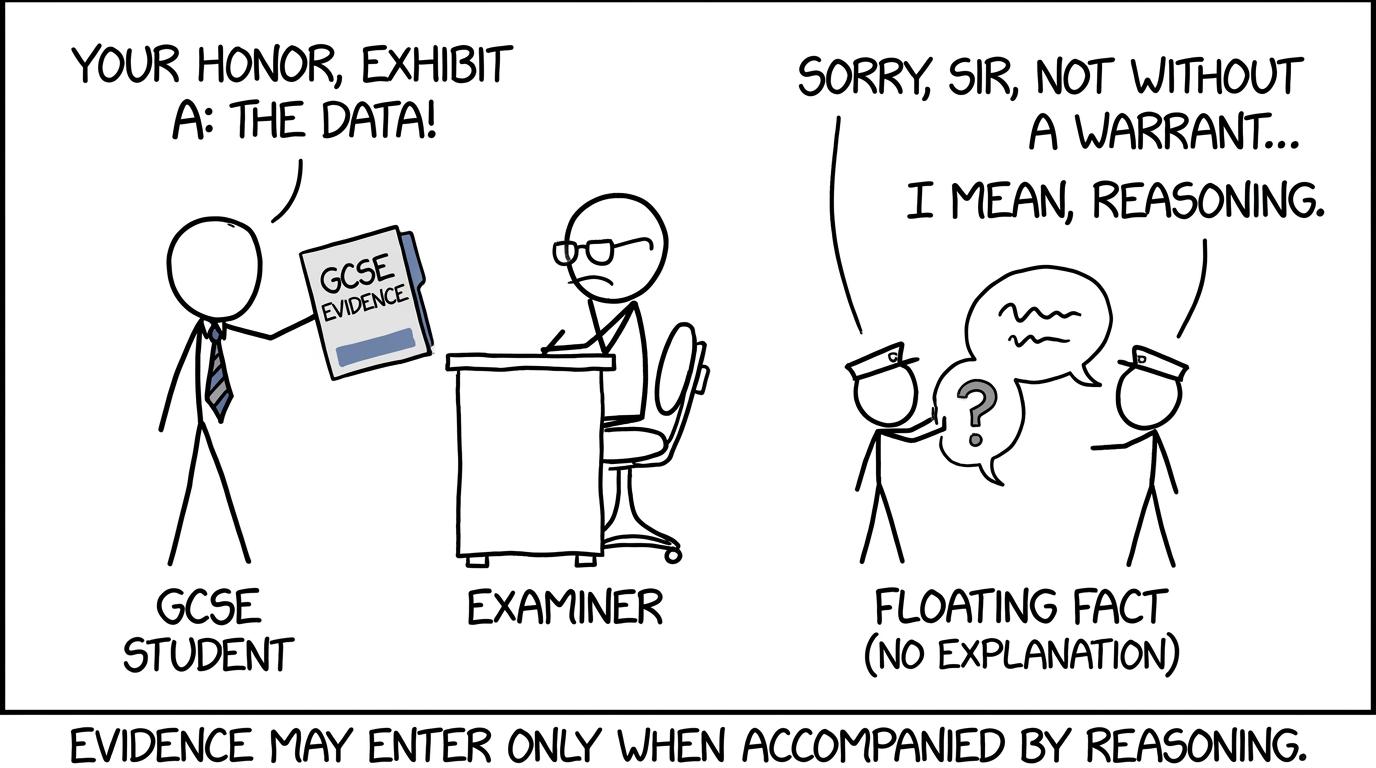 Historical evidence is admitted only when accompanied by reasoning
Improve source and interpretation questions
GCSE History specifications assess knowledge and understanding, second-order historical concepts, sources and interpretations. The precise question formats differ by exam board, so memorising a generic answer template can be risky.
Evaluate sources for the stated enquiry
A source is not automatically useful because it is contemporary, and it is not automatically unreliable because its author had a purpose. Begin with the question being investigated.
Consider:
- what the source says or shows;
- what can reasonably be inferred from it;
- whether contextual knowledge supports or challenges its content;
- who produced it, when and for what audience or purpose;
- how those features affect its value for this particular enquiry;
- what the source cannot establish by itself.
Avoid declaring a source “biased” and moving on. A partisan source may be highly valuable as evidence of attitudes, priorities or propaganda, even if it is less dependable as a literal account of events.
Analyse interpretations as arguments
Interpretations are constructed accounts of the past. Compare their main claims, emphasis and supporting reasoning rather than searching only for different words.
Relevant contextual knowledge allows you to test how convincing an interpretation is. Select evidence that bears directly on its claim, then explain whether that evidence supports, qualifies or challenges it. Do not criticise an interpretation merely because it was created later: historians necessarily write from a later position.
Practise exam performance, not just history content
The knowledge gap between grade 5 and grade 8 may be smaller than the performance gap. Knowing material at home and retrieving it under timed conditions are different skills.
Use a simple practice cycle:
- choose one question type;
- plan or answer it without notes;
- mark it using the current mark scheme and teacher guidance;
- identify one precise weakness;
- rewrite only the weak element;
- attempt another question of the same type later.
Your target should be observable. “Improve essays” is vague. “Use specific evidence and explain its importance in every analytical paragraph” can be checked.
Timing should reflect the guidance for your paper and the marks available. Check the front of official papers and your exam board's instructions rather than relying on one timing formula for every specification. Practise complete papers occasionally, but use shorter drills to repair individual weaknesses efficiently.
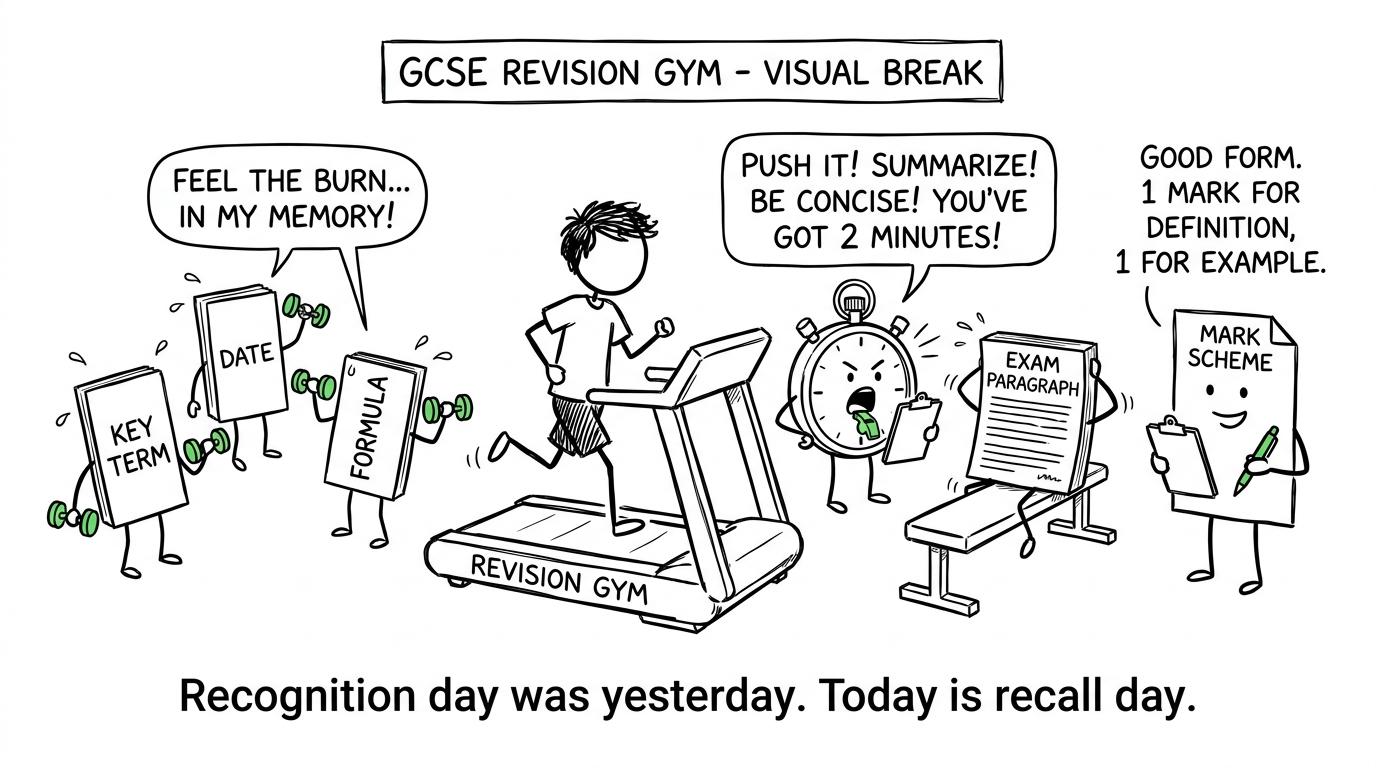 Flashcards, a stopwatch and a mark scheme train in a revision gym
Use MathsGenie to strengthen the wider revision system
MathsGenie is a maths resource rather than a GCSE History course, so your historical content should come from your teacher, specification and official exam-board resources. Its revision structure can still model habits that work across subjects: focused lessons, deliberate practice, checking with mark schemes and revisiting weak areas.
If maths is also part of your GCSE revision programme, use the GCSE Maths revision topics to identify specific gaps rather than revising everything equally. Then combine GCSE Maths past papers with mark schemes and video solutions to see where marks are being lost.
The MathsGenie revision planner can help you protect regular revision time, while GCSE predicted papers provide further maths exam practice. Students moving beyond GCSE can also explore the A Level Maths revision resources.
Apply the same loop to History: diagnose, practise, check, correct and revisit. The resource changes. The learning discipline does not.
Common mistakes that hold students near grade 5
Revising by rereading
Rereading can support initial understanding, but it does not reliably test retrieval. Close the book and reproduce the argument, timeline or evidence bank before checking accuracy.
Writing everything remembered
Relevant selection earns more than an information dump. Pause before writing and identify the exact period, factor and concept demanded by the question.
Treating evidence as explanation
A date, policy or event does not explain itself. Follow evidence with the historical relationship it demonstrates and its importance to the argument.
Using generic source comments
Statements such as “the author was there” or “the source is biased” are incomplete. Tie provenance and content to usefulness for the stated enquiry.
Making unsupported judgements
Words such as “most important” need criteria. Explain what importance means in this question and compare factors on that basis.
Ignoring specification differences
Edexcel, AQA, OCR and Eduqas do not use identical papers or question wording. Practise questions, mark schemes and examiner guidance produced for your own specification.
From more revision to better revision
The move from grade 5 to grade 8 is rarely one dramatic leap. It is a collection of smaller changes: recalling rather than rereading, selecting rather than dumping, explaining rather than asserting, and judging rather than adding an opinion at the end.
Choose one weak question type this week. Complete it without notes, check it carefully and record the one change your next answer must demonstrate. That feedback loop is how a grade band begins to move.
For your maths exams, start with MathsGenie's free GCSE revision lessons, then use practice questions, mini tests, past papers, predicted papers, mark schemes and video solutions to turn weaknesses into a clear revision plan. Progress becomes less mysterious when every practice session has a purpose.











