

GCSE Grade Change and Your Sixth Form Place
GCSE grade change and sixth form place guidance: see how a successful review affects your offer, what evidence to send admissions and when to act.

Results day can turn on a single grade. You may hold a sixth form offer, miss its conditions, request a review and then discover that your result has risen. So, can a GCSE grade change affect your sixth form place?
The short answer is yes. If the revised grade now meets the conditions of your offer, contact the sixth form immediately and ask it to reconsider or confirm your place. The change may not reach admissions automatically, and acceptance is not guaranteed if places have already been allocated. Your offer terms, the sixth form's admissions policy, course capacity and timing all matter.
Your results-day checklist
- Attend enrolment even if you have missed a required grade.
- Tell admissions that a review of marking is being considered or is already under way.
- Ask whether your place or preferred subjects can remain open temporarily.
- Request the decision and any deadline in writing.
- Send the official revised result as soon as your school receives it.
- Keep your original offer, emails and review outcome together.
- Maintain a realistic alternative while the decision is pending.
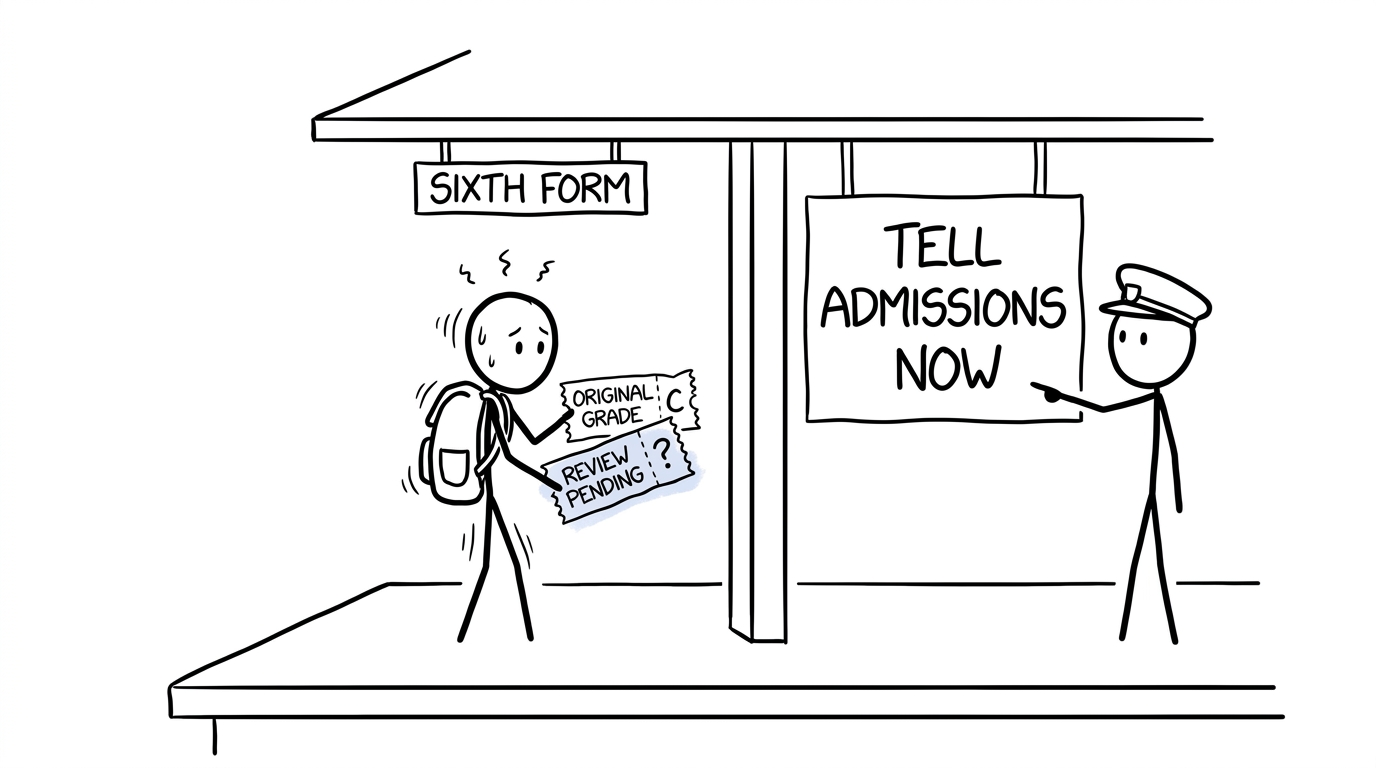 A student tells sixth-form admissions that a result review is pending
How a GCSE remark affects a sixth form offer
Students often say “remark”, but the official service is usually called a review of marking. The exam board checks whether the original mark scheme was applied correctly and corrects identified errors. It is not simply a fresh attempt to find extra marks.
Most students must request the service through their school or college, which normally needs their written consent. A review can leave the mark unchanged or move it up or down. Even when the mark changes, the overall qualification grade may remain the same.
This distinction matters because a sixth form usually considers your certified grade, not merely a small increase in raw marks. If your result changes from grade 555 to grade 666, and grade 666 was the stated entry requirement, you now have important new evidence. But you still need to place that evidence in front of the admissions team.
Scenario: your place was already confirmed
Suppose the sixth form accepted you on results day, perhaps on your original course or an agreed alternative. A later successful review raising your grade would not normally create a reason to remove that confirmed place.
It may, however, let you request a subject change. For example, a higher maths grade could make you eligible for A Level Maths under that sixth form's published subject requirements. Ask quickly: eligibility and timetable capacity are separate questions, and meeting the grade does not create an empty seat in a full class.
If you are preparing for that next step, MathsGenie's free GCSE Maths revision hub brings together lessons, question banks and papers for foundation and higher tier.
Scenario: you missed the condition and your place is pending
This is the moment when communication matters most. Tell admissions that a review is pending and ask three direct questions:
- Will you hold my institutional or course place until the outcome?
- What evidence do you need from my school?
- What is the final date for reconsideration?
Do not assume the exam board will contact the sixth form for you. Your school receives the outcome, while the admissions decision belongs to the sixth form.
Priority GCSE review arrangements are not identical across Edexcel, AQA, OCR and Eduqas, so ask your exams officer what is available for your qualification and deadline. Ordinary reviews also take time. That is why informing the sixth form before the outcome can be as important as sending the outcome afterwards.
Scenario: the sixth form has already refused the place
A successful grade change gives you grounds to request prompt reconsideration if the original refusal resulted from that grade. Send:
- your original conditional offer;
- the official review outcome;
- confirmation of the revised grade;
- a concise request for reconsideration.
There is no universal rule that automatically restores every place. If the course is full or the offer included other unmet conditions, the sixth form may not reverse its decision. Ask for its reasoning in writing and check the admissions or appeals process that applies to that institution.
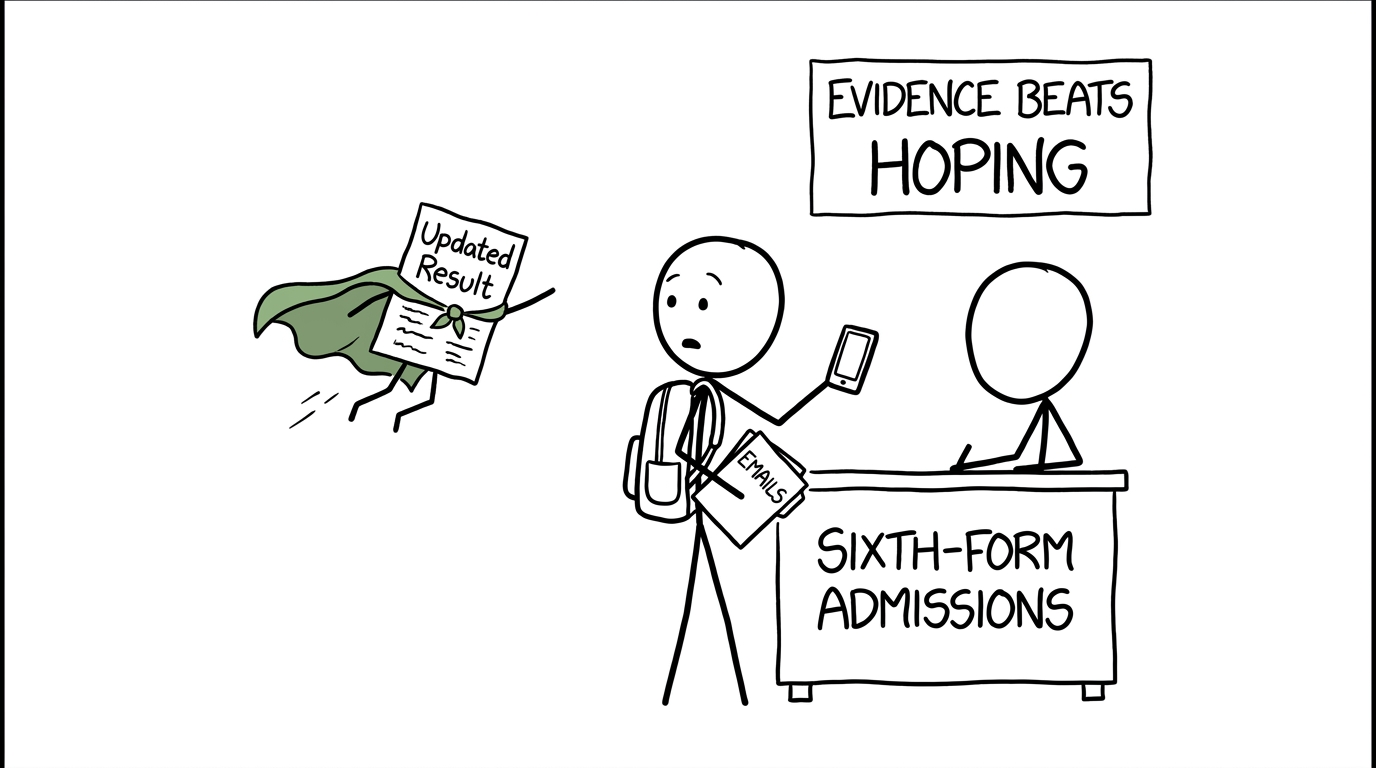 An updated result arrives at the admissions desk with supporting evidence
What to do while the review is pending
Uncertainty invites students to pause everything. A better approach is to protect both possible futures.
Accept or investigate any suitable alternative offered to you, while being honest that a review is pending. Meanwhile, keep your maths active. Choose the correct exam-board resources, such as Edexcel GCSE Maths revision, AQA GCSE Maths revision or OCR GCSE Maths papers.
If a resit becomes necessary, begin with GCSE results and resit next steps. A short routine using revision lessons, practice questions and mark schemes is more useful than waiting anxiously for an email.
Common mistakes to avoid
Waiting for systems to update automatically
Send the revised result yourself and ask for confirmation that it has been added to your application.
Confusing extra marks with a higher grade
Admissions normally works from the final qualification grade. Check whether the review actually changed that grade.
Contacting only the exam board
Your school manages the review in most cases; your sixth form manages the offer. Keep both informed.
Giving up your alternative too early
Until the preferred sixth form confirms your place in writing, keep a workable backup.
Treating predicted papers as predictions of your result
GCSE predicted papers are revision tools, not guarantees. Combine them with past papers, careful marking and targeted repair of weak topics.
Turn uncertainty into a clear next step
A successful review can rescue an offer or reopen a subject choice, but the revised grade cannot speak for itself. Contact admissions quickly, provide official evidence and get the answer in writing.
Then return your attention to what you can control. Use MathsGenie's GCSE revision resources for lessons, mini tests, practice questions, past papers, predicted papers, mark schemes and video solutions. For results-day options, start with the GCSE results and remark next-step guidance, then ask your school and sixth form for the rules and deadlines applying to your exact offer.











