

GCSE German Topics Breakdown: Where to Revise
GCSE German topics breakdown covering themes, paper weightings and a practical revision-time plan for AQA, Edexcel and Eduqas students.
Revision becomes difficult when everything looks equally urgent. One vocabulary list leads to another, grammar notes multiply, and the speaking exam quietly gets closer. A useful GCSE German topics breakdown should therefore do more than name the themes. It should tell you where marks come from and help you decide what deserves your next hour.
The short answer is that listening, speaking, reading and writing each contribute 25%25\%25% of the qualification under the revised GCSE German specifications used for first assessment in 2026. Individual themes do not have guaranteed percentages. Your safest strategy is to cover every theme while spending extra time on the vocabulary, grammar and skills that diagnostic practice shows are weakest.
Your GCSE German revision checklist
Before building a timetable, establish these facts:
- Confirm whether your exam board is AQA, Pearson Edexcel or Eduqas. OCR no longer offers a current GCSE German qualification.
- Check whether you are entered for foundation or higher tier.
- Download the current specification and vocabulary list through your school or exam board.
- Treat listening, speaking, reading and writing as equally important papers.
- Test yourself before deciding which areas need the most time.
- Keep a record of vocabulary gaps, grammar errors and exam-technique mistakes.
- Revisit weak material rather than repeatedly revising comfortable topics.
This is the same principle behind MathsGenie's guide to finding your weakest GCSE topics: evidence should shape the plan.
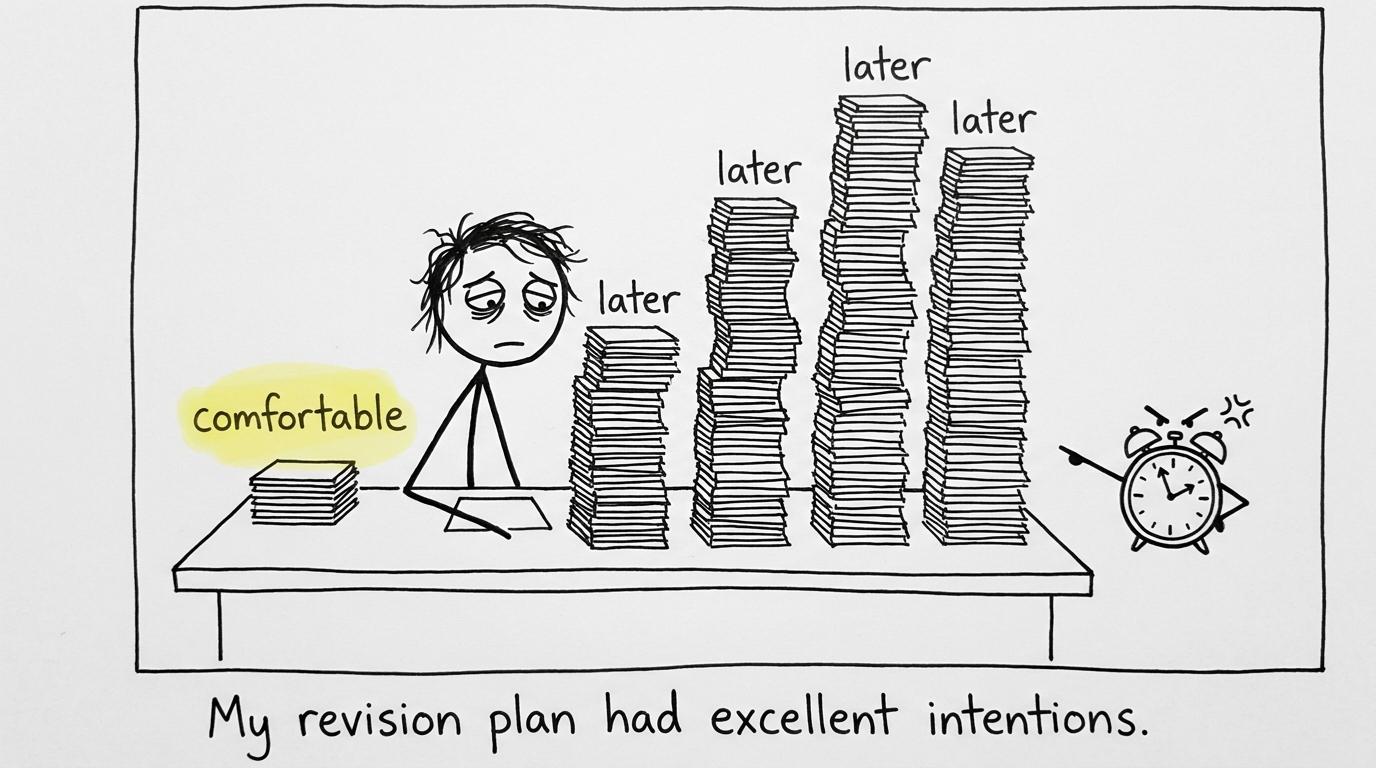 A student faces a revision plan with several neglected German topic piles
How much does each GCSE German area count?
For the revised GCSE, the four assessment components have equal weight. Although exact paper order, timings and task formats vary between boards, the overall balance is clear.
| Assessment area | Qualification weighting | What you need to practise |
|---|---|---|
| Listening | 25%25\%25% | Comprehension, sound recognition, detail, inference and dictation |
| Speaking | 25%25\%25% | Reading aloud, role play, describing or discussing a stimulus, conversation and spontaneous responses |
| Reading | 25%25\%25% | Comprehension, inference, vocabulary recognition and translation into English |
| Writing | 25%25\%25% | Communicating information, accurate grammar, varied language and translation into German |
The revised assessment objectives used by AQA, Edexcel and Eduqas distribute marks across mixed language skills:
- 35%35\%35% for understanding and responding to spoken language
- 45%45\%45% for understanding and responding to written language
- 20%20\%20% for accurate application of prescribed grammar and vocabulary
These figures overlap the four papers. For example, speaking involves understanding prompts as well as producing spoken German. The important lesson is that vocabulary and grammar are not separate corners of the course. They support almost everything you do.
GCSE German topics by exam board
The broad subject matter is similar across specifications, but the labels and groupings differ. Use the list for your board rather than relying on an old revision guide.
AQA GCSE German topics
AQA organises its current specification into three themes, each containing three topics.
People and lifestyle covers:
- identity and relationships with others
- healthy living and lifestyle
- education and work
Popular culture covers:
- free-time activities
- customs, festivals and celebrations
- celebrity culture
Communication and the world around us covers:
- travel and tourism, including places of interest
- media and technology
- the environment and where people live
These themes can appear across all four papers. AQA also makes clear that an assessment task may combine language from different contexts, so memorising nine isolated topic scripts is not enough.
Pearson Edexcel GCSE German topics
Edexcel uses six thematic contexts:
- my personal world
- lifestyle and wellbeing
- my neighbourhood
- media and technology
- studying and my future
- travel and tourism
Within these contexts, students encounter areas such as family, relationships, equality, food and drink, physical and mental wellbeing, school, employment opportunities, transport, the natural world, social media, music, television, film and accommodation.
The contexts are broad because real communication rarely stays inside one chapter. A discussion about future plans might involve education, travel, relationships and technology within the same response.
Eduqas GCSE German topics
The revised Eduqas specification groups language under five broad themes:
- identity
- everyday life
- my future
- exploring
- global matters
These can include relationships, education, health, entertainment, social media, aspirations, travel, customs, German-speaking cultures, the environment, inequality and citizenship. Eduqas states that themes help categorise content but are not necessarily identified explicitly in assessment texts.
That matters. You must learn to recognise familiar German even when a question does not arrive with a neat topic heading.
Do some German topics carry more marks?
No official specification gives a permanent percentage to topics such as school, holidays or the environment. A theme that appeared heavily in one paper is not guaranteed to disappear from the next, and a predicted topic list cannot replace full coverage.
If you have no diagnostic evidence yet, divide thematic revision broadly evenly. That would mean about 13\frac{1}{3}31 of theme-focused time for each AQA theme, 16\frac{1}{6}61 for each Edexcel context or 15\frac{1}{5}51 for each Eduqas theme. These are planning fractions, not official exam weightings.
Once you complete practice tasks, change the balance. A student who understands travel vocabulary but cannot discuss future plans should not continue splitting time equally simply because the timetable says so. Revision should respond to what the evidence reveals.
MathsGenie's article on when to start using GCSE past papers explains the wider principle: papers are most valuable when there is still time to act on what they expose.
A practical way to divide your revision time
For an initial week, the following split gives you broad coverage while recognising that vocabulary and grammar feed every paper.
| Revision activity | Suggested share of time |
|---|---|
| Thematic vocabulary and retrieval | 30%30\%30% |
| Grammar and sentence building | 20%20\%20% |
| Listening and dictation | 15%15\%15% |
| Speaking and pronunciation | 15%15\%15% |
| Reading and translation into English | 10%10\%10% |
| Writing and translation into German | 10%10\%10% |
This is not an exam-board weighting. It is a starting allocation. After a week, adjust it using your results.
Prioritise vocabulary you can use
Knowing that you have seen a word is different from being able to retrieve it in conversation. Test both directions: German to English for recognition, then English to German for production. Include nouns with gender, verbs in useful forms and adjectives that help you express and justify opinions.
Organise vocabulary by function as well as theme. Language for giving opinions, explaining reasons, comparing experiences, referring to different times and asking questions can travel across almost every topic.
Give grammar a permanent place
Grammar accounts directly for 20%20\%20% of the revised assessment objectives and also affects whether your meaning is clear. Prioritise the structures named in your specification, including verb position, tense formation, cases, adjective endings, pronouns, modal verbs and subordinate clauses at the level required for your tier.
Do not wait until you have “finished vocabulary” before revising grammar. The two should be practised together in short, accurate sentences.
Keep all four skills active
Reading notes can feel productive because it is calm. Exams demand retrieval under pressure. Each week should therefore include German that you hear, say, read and write.
A repeatable short routine works well: retrieve vocabulary, complete one skill task, check it, record the cause of each error and retest it later. MathsGenie's 20-minute GCSE revision routine was written for maths, but its cycle of recall, practice, marking and correction transfers neatly to language revision.
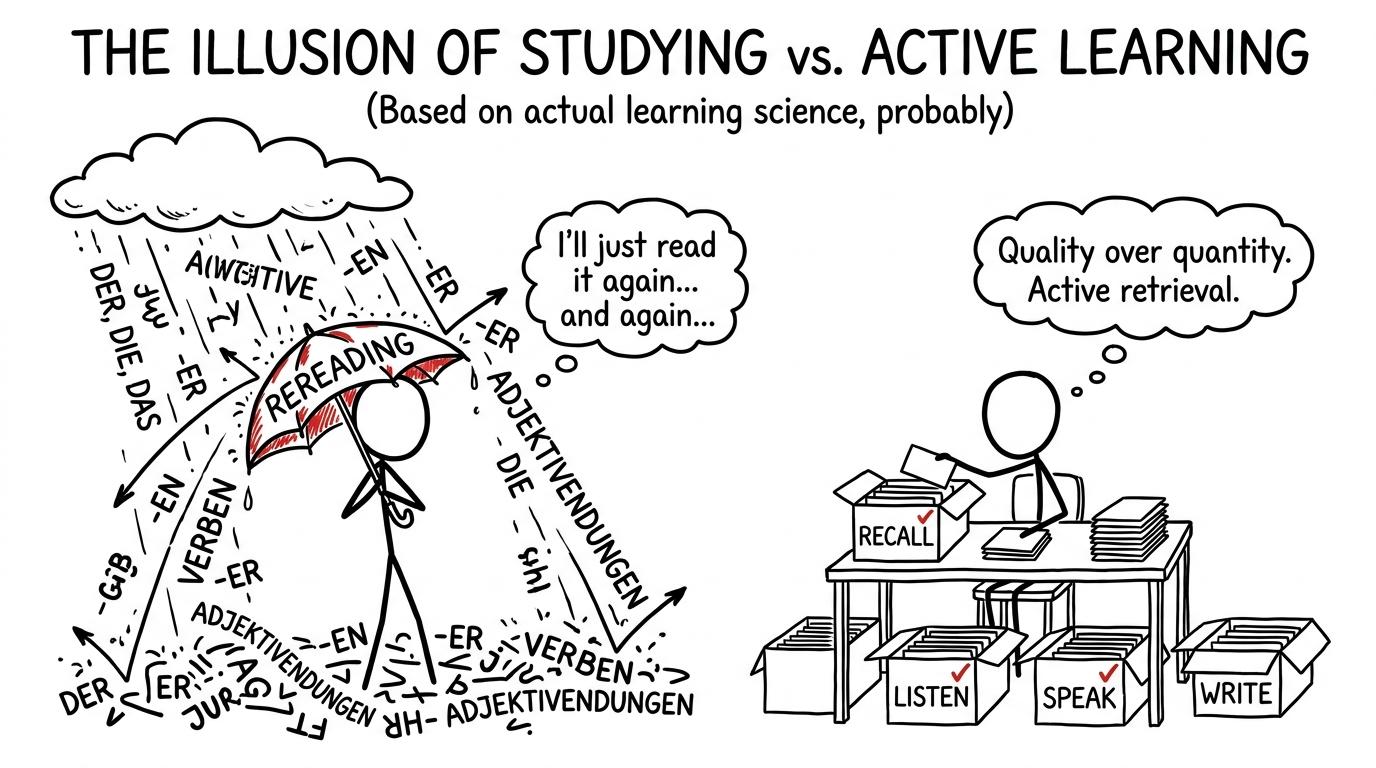 German vocabulary falls around one student while another sorts active practice into skills
How to find your real priorities
Complete one short task in each skill using current materials for your board and tier. Mark reading, listening and writing with the relevant mark scheme. For speaking, use your teacher's feedback and the published assessment criteria.
Classify every weakness under one of these headings:
- Vocabulary: the key word was unknown or could not be recalled.
- Grammar: the intended meaning was clear in your mind but inaccurately formed.
- Comprehension: you knew the words but missed a negative, tense, opinion or change of speaker.
- Production: you understood the material but could not respond independently.
- Technique: you misread instructions, omitted a required detail or used time poorly.
Your next revision sessions should address the most repeated causes, not merely the lowest total score. This diagnostic approach also sits at the centre of MathsGenie's GCSE maths revision timetable, where marking and focused repair turn activity into progress.
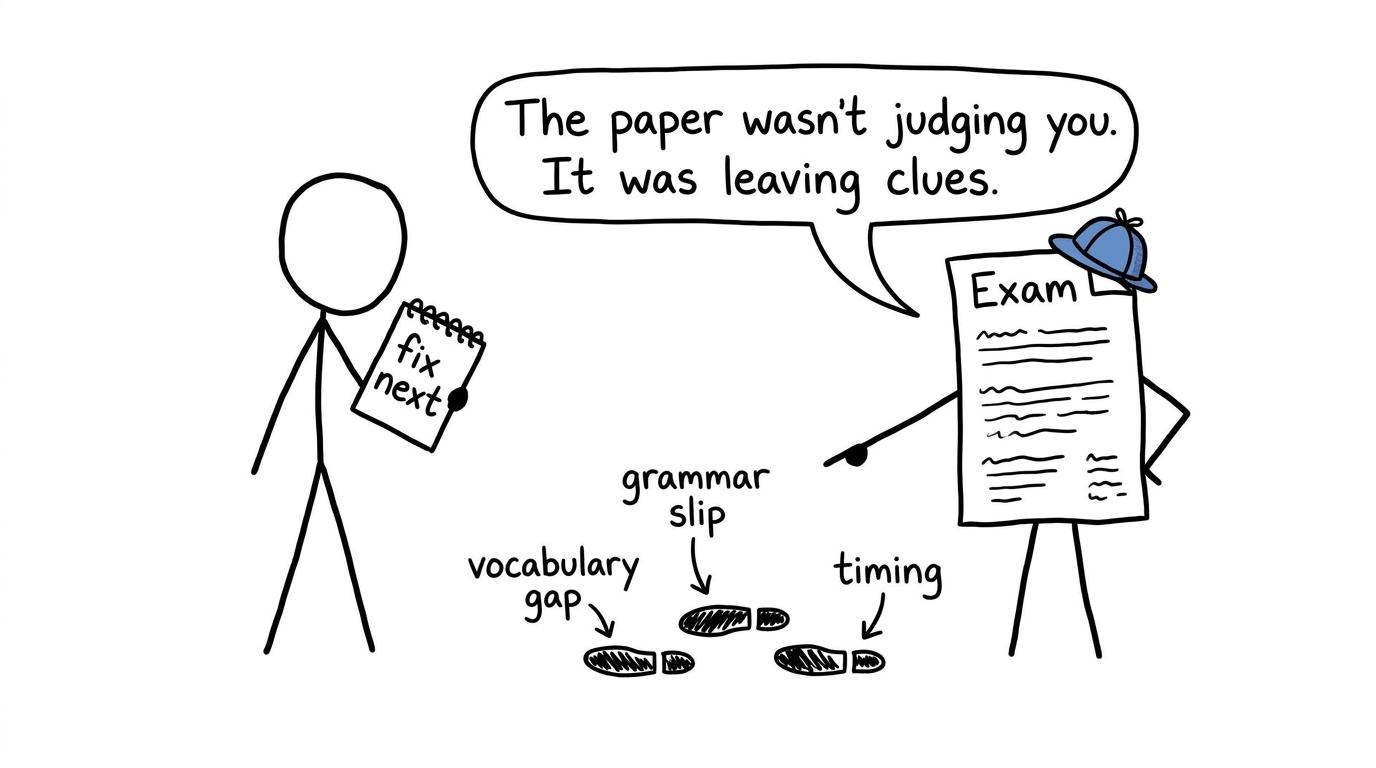 A mock paper dressed as a detective leaves clues about revision weaknesses
Common GCSE German revision mistakes
Guessing which themes will appear
Themes are contexts, not predictable mark allocations. Cover the complete specification and use predictions only as optional practice, never as permission to abandon a topic.
Spending all your time making notes
Neat notes can support learning, but they do not prove that you can retrieve language. Close the book and listen, speak, read or write from memory.
Learning a perfect script
Prepared material can provide useful phrases, but a memorised answer may not fit the question. Speaking and writing tasks reward relevant communication. Practise adapting language to unfamiliar prompts.
Ignoring listening until late
Listening improves through repeated exposure to speech, pronunciation patterns and different voices. Short, regular practice is more manageable than trying to repair the whole skill just before the examination.
Marking without repairing
A score is a measurement, not a revision plan. Record why each mark was lost, practise the smallest skill that would correct it and revisit it without notes.
MathsGenie's guide to using past papers properly applies the same idea: a paper is not finished until its mistakes have produced targeted action.
Build a balanced GCSE revision system
The most useful conclusion from this GCSE German topics breakdown is not that one theme deserves all your attention. It is that the four papers each carry 25%25\%25%, while vocabulary and grammar connect them all. Cover every topic, diagnose your weaker areas and then let those weaknesses alter your timetable.
Keep the wider exam season balanced too. MathsGenie remains your free home for GCSE maths revision, with topic lessons, practice questions, mini tests, past papers, mark schemes and video solutions. When exams approach, use Edexcel GCSE maths predicted papers as fresh timed practice rather than a substitute for full revision.
Choose one German theme to test today. Then choose one maths topic through MathsGenie. Practise, mark, repair and retest. A sensible revision plan is rarely dramatic. It simply makes the next hour easier to spend well.










