Is a GCSE German Revision Bootcamp Worth It?
GCSE German revision bootcamp costs can be substantial. Learn what courses offer, when they are worthwhile and how to judge value before booking.
Revision courses are often bought at a moment of anxiety. The speaking assessment is getting closer, German word order still feels slippery, and a polished course page promises confidence by Friday.
So, is a GCSE German revision bootcamp worth paying for? Sometimes. A well-matched course can provide expert feedback, realistic speaking practice and a structure that is difficult to create alone. But it is rarely worth the cost when it simply delivers broad teaching to a student with specific gaps, or when it consumes time needed for maths and other GCSE subjects.
The right question is not whether bootcamps work in general. It is whether this particular course solves your particular problem better than the alternatives.
The quick bootcamp value checklist
Before booking, check whether the course:
- matches your exam board, specification and foundation or higher tier
- covers listening, speaking, reading and writing rather than promising vague “exam preparation”
- includes individual feedback on spoken and written German
- uses tasks that reflect the specification you will actually sit
- has a group small enough for meaningful participation
- provides a clear timetable, tutor credentials and cancellation terms
- leaves enough time for maths and your other GCSE subjects
- addresses weaknesses already identified by your teacher or mock assessments
If several of these details are missing, pause before paying. Urgency is useful in an exam room, but expensive when shopping.
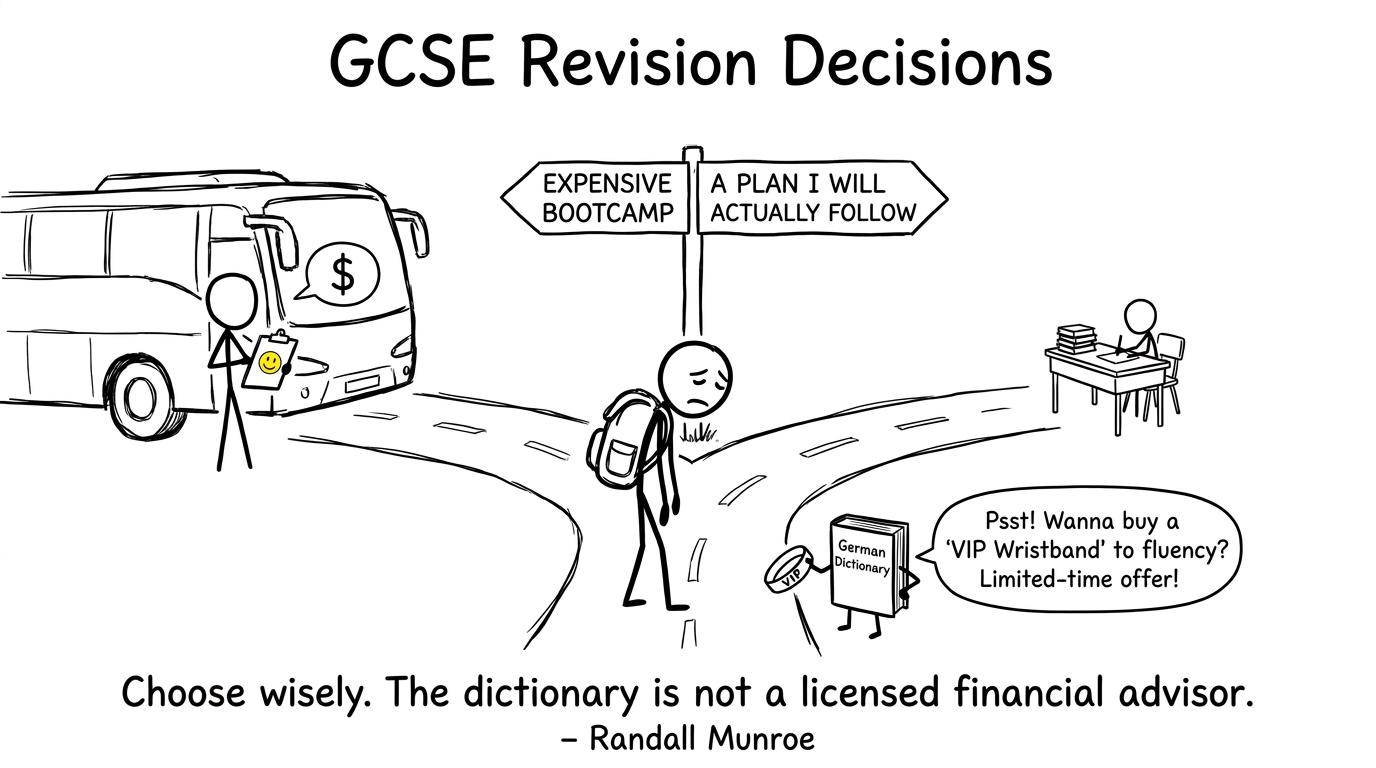 A student choosing between an expensive bootcamp and a realistic revision plan
What GCSE German revision bootcamps actually offer
A bootcamp is usually a short, intensive course delivered during Easter, half-term or the summer holidays. Formats range from live online classes to classroom programmes and one-to-one tuition. Some last a day; others spread several sessions across one or two weeks.
Current course listings show considerable variation in price, group size and contact time. That makes the headline fee a poor measure of value. Compare the total guided teaching time, level of personal feedback, included resources and number of students instead.
The strongest courses usually combine several of the following.
Specification-focused teaching
For students sitting the reformed GCSE German qualifications first assessed in summer 2026, course material should reflect the current specification rather than recycled tasks from an older qualification.
The reformed GCSE assesses listening, speaking, reading and writing. Ofqual’s requirements retain tiered assessment, with students entered for the same tier across the qualification, while speaking contributes 25%25\%25% of the overall marks. Defined vocabulary, grammar, sound-symbol relationships, dictation and reading aloud are also important features of the revised content.
Exact paper structures and tasks vary between boards such as AQA, Pearson Edexcel and Eduqas. A provider should therefore ask for your board and tier before teaching you a supposedly universal exam technique.
Speaking practice
Speaking is one of the clearest reasons to consider a paid course. Independent revision can strengthen vocabulary, but it cannot recreate a responsive conversation or provide reliable feedback on pronunciation.
A useful bootcamp may include:
- reading aloud with pronunciation feedback
- role-play practice
- responses to visual stimuli
- unprepared follow-up questions
- guidance on extending answers naturally
- correction of recurring grammatical errors
Ask how much time each student will actually speak. A three-hour group session may sound substantial, but its value falls quickly if most of it is spent listening to other students.
Writing correction
Good feedback is specific. It should identify patterns such as inaccurate verb placement, confused cases, weak tense control or answers that fail to address the task.
“Add more detail” is encouragement, not diagnosis. A valuable course explains what needs to change and then gives the student an opportunity to apply that correction in another response.
Listening, reading and translation practice
Bootcamps may also provide timed listening exercises, reading strategies, dictation, translation tasks and vocabulary retrieval. These can be useful when the provider explains why an answer was missed rather than merely revealing the correct response.
The distinction matters. Completing more tasks can create the sensation of progress. Analysing errors is what makes the next task easier.
Structure and accountability
Some students know what to revise but struggle to begin. A fixed course removes several decisions: when to work, what to cover and who will check it.
That structure has genuine value. Yet it only lasts if the student leaves with a repeatable routine. A bootcamp should create the next stage of revision, not become a dramatic substitute for it.
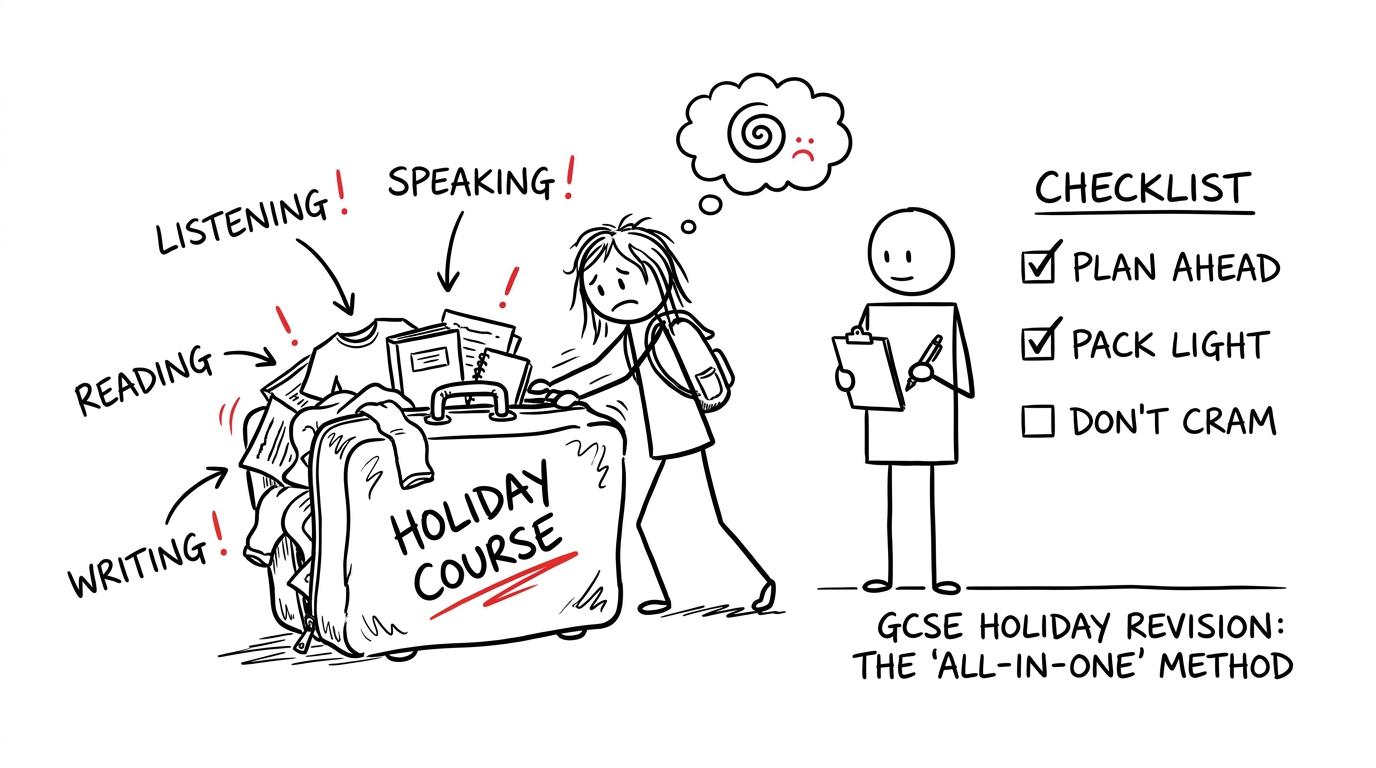 A student trying to pack every German skill into one holiday course
When a bootcamp is genuinely worth paying for
A course is most likely to justify its cost in a few specific situations.
You need feedback that independent revision cannot provide
Pronunciation, spontaneous speaking and extended writing are difficult to assess accurately alone. If your teacher has identified these as your main weaknesses, access to a skilled German tutor may be more valuable than another revision book.
The course should include direct feedback to you, not only general advice delivered to a large class.
Your knowledge is reasonable but exam performance is inconsistent
A student may understand German in lessons yet struggle with timing, task instructions or producing language under pressure. A board-aligned course can help connect knowledge to the assessment format.
This is different from needing to learn large parts of the course from the beginning. A short bootcamp can sharpen existing knowledge, but it cannot responsibly compress two years of language learning into a weekend.
The group and tutor are a close match
Small groups can balance affordability with interaction. They also let students hear different answers and notice common errors. One-to-one tuition may be better when gaps are highly individual or speaking confidence is very low.
Look beyond labels such as “expert” or “exam specialist”. Ask about experience with your current specification, how feedback is delivered and whether the tutor regularly teaches students at your tier.
You will use the follow-up material
Recordings, vocabulary lists and practice tasks add value only when they are used. Before booking, decide when follow-up practice will happen. Without that plan, included resources often become an expensive folder that is opened once.
When the cost is probably not justified
A bootcamp is less likely to be worthwhile when the problem is mainly lack of regular practice. If a student has not been learning vocabulary, completing classwork or revisiting corrections, buying more instruction may simply add another source of unfinished tasks.
Be cautious when:
- the provider cannot name the specification being taught
- the course promises a particular grade or dramatic improvement
- group size is unclear
- there is no individual speaking or writing feedback
- most sessions consist of lectures or generic revision tips
- the course clashes with essential maths, English or science preparation
- the student is already exhausted
Holiday time is limited. Every course has an opportunity cost as well as a fee.
For a student preparing for GCSE maths, losing several productive days may matter. Use the GCSE Maths revision hub to identify what would be displaced. If you are still repairing major foundation or higher tier gaps, an intensive German course needs to fit around that work rather than erase it.
How to judge the real cost
Do not compare courses using the booking price alone. A simple measure is:
Cost per guided hour=Total course costLive teaching hours\text{Cost per guided hour}=\frac{\text{Total course cost}}{\text{Live teaching hours}}Cost per guided hour=Live teaching hoursTotal course costThen judge what each guided hour contains. Individual correction is generally more valuable than passive listening, while a well-run small group may offer better value than a larger course with little participation.
Also consider:
- travel, accommodation or equipment costs
- whether missed sessions are recorded
- access to materials after the course
- refund and rescheduling rules
- preparation expected before each class
- time taken from other subjects
Price and value are not the same. The cheapest course can waste a holiday; the most expensive can solve the wrong problem beautifully.
Protecting your GCSE maths revision
The target audience for a German bootcamp may be taking eight or nine GCSEs, not one. Revision therefore needs a portfolio mindset: time should go where it is most likely to protect or gain marks.
Before giving an entire holiday block to German, diagnose your maths position. The GCSE Maths topics by board and tier guide can help you check the scope of foundation and higher content. Then use the GCSE maths self-assessment resources to identify vulnerable areas.
A sensible holiday balance might include:
- the German course sessions and their assigned follow-up
- short vocabulary retrieval on non-course days
- protected maths topic practice
- one timed maths section or mini test
- rest and catch-up time
Maths revision does not always require long sessions. The 20-minute GCSE maths revision routine is useful when a course occupies much of the day. For a fuller structure, adapt the GCSE one-month maths revision plan.
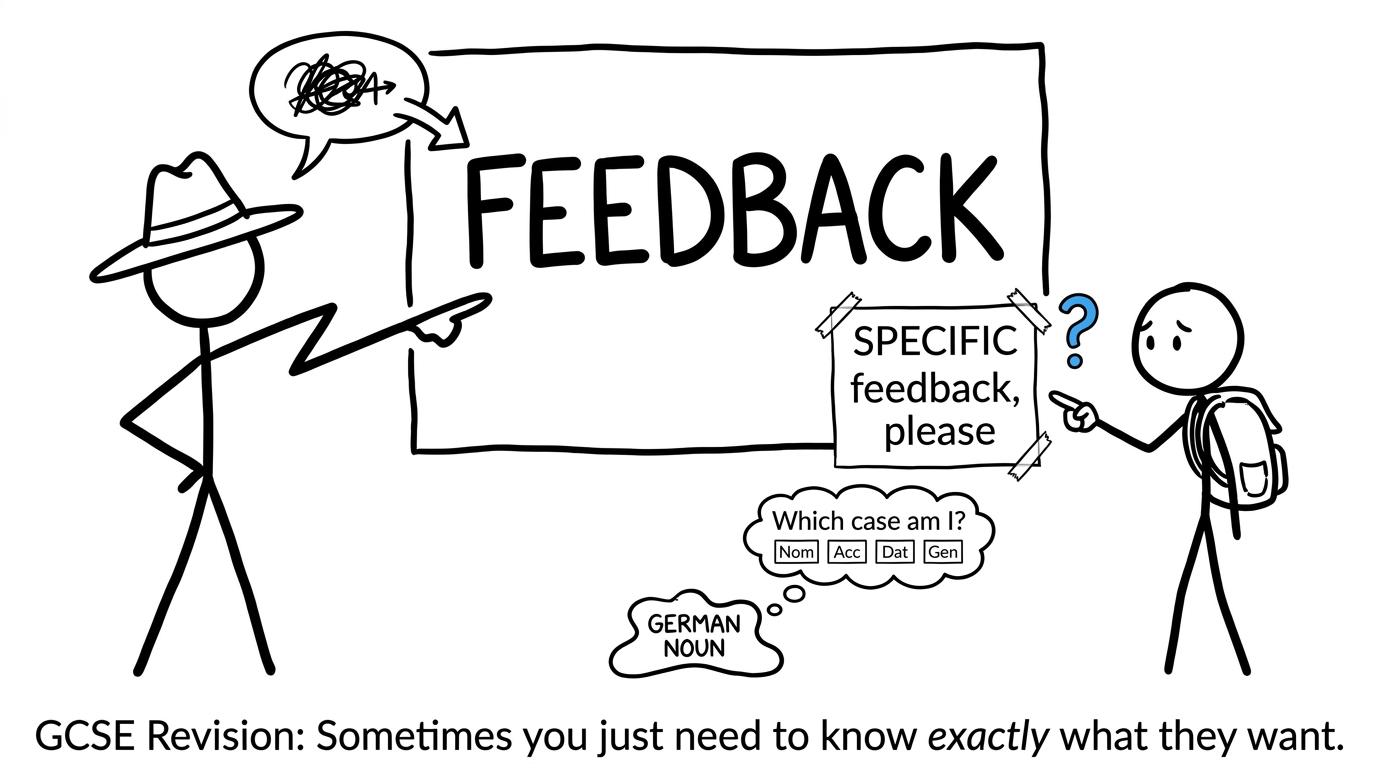 A student requesting specific feedback from an enthusiastic instructor
Questions to ask before booking
A reputable provider should be able to answer these clearly:
- Which exam boards and specification versions do you cover?
- Is the course separated by foundation and higher tier?
- What is the maximum group size?
- How much individual speaking time is included?
- Will written work be marked personally?
- Are sample assessment materials or current-style tasks used?
- What qualifications and recent GCSE experience does the tutor have?
- Are recordings, worksheets and follow-up tasks included?
- What happens if a session is missed or cancelled?
Send the provider a concise description of your weaknesses. If their answer remains generic, the teaching may be generic too.
Common mistakes when choosing a holiday course
Buying before diagnosing
A mock result alone does not reveal what went wrong. Separate vocabulary gaps, grammar errors, weak pronunciation, timing and misunderstood task instructions. Then buy help only if it addresses the dominant problem.
Assuming intensity guarantees progress
Several consecutive hours can produce fatigue rather than durable learning. Look for retrieval, active participation, feedback and later revisiting, not merely a packed timetable.
Choosing by testimonials alone
Testimonials cannot show whether the course matches your board, tier or needs. Clear curriculum information and feedback arrangements are more useful evidence.
Ignoring the rest of the revision timetable
A German course that causes you to abandon maths for a week may create a new problem. Keep at least a small maths routine alive. The GCSE maths revision timetable guide explains how to combine focused topic sessions with timed practice.
Treating the course as the finish line
A bootcamp is a concentrated intervention, not the whole revision process. The days afterwards should contain short retrieval, corrected writing, speaking practice and repeated work on the errors discovered.
The final verdict
A GCSE German revision bootcamp is worth the cost when it supplies something scarce: expert individual feedback, realistic speaking interaction, current specification knowledge or a structure the student will genuinely follow. It is poor value when it offers generic content, oversized groups or motivation without diagnosis.
Before paying, identify the precise problem, compare guided hours and feedback, check the current specification, and protect time for your other GCSEs.
For maths, that protection is easier with one reliable home base. Start at MathsGenie and use free revision lessons and practice questions to repair weak topics, mini tests to maintain recall, and guidance on using GCSE past papers properly to build exam stamina. Nearer the exams, add Edexcel predicted papers, mark schemes and video solutions.
A paid course should make your revision plan better. It should never replace the plan.