GCSE German Grade 5 Meaning: A Clear Guide
GCSE German grade 5 meaning explained: understand the ability it represents, how it compares with old grades and what it means for your next steps.
A result can look precise while leaving you with a surprisingly vague question: what can I actually do with it? If you are searching for the GCSE German grade 5 meaning, the short answer is that grade 5 is a solid result showing a reasonable, functional command of GCSE-level German. You can generally understand and communicate key information across familiar contexts, although mistakes and gaps will remain.
It is above grade 4, which aligns with the bottom of the old grade C, but it is not officially identical to one old letter grade. Grades 4, 5 and 6 collectively cover the region previously occupied by grades C and B. Grade 5 is also commonly described as a strong pass, while grade 4 is called a standard pass in school performance measures.
That is the headline. The more useful story is what sits underneath it.
GCSE German grade 5 meaning at a glance
Here is the practical picture:
- Grade 5 is a credible pass and sits in the middle of the grades 9-1 scale.
- It indicates developing competence across listening, speaking, reading and writing.
- You should be able to communicate about familiar GCSE themes using more than isolated words and memorised phrases.
- Errors are expected, especially with unfamiliar language, longer passages and complex grammar.
- Grade 5 does not correspond exactly to an old C or B.
- It may satisfy some sixth-form, college or course requirements, but each provider sets its own entry criteria.
- It is not a percentage fixed permanently across every year or exam board.
Most importantly, a grade describes performance in a particular set of assessments. It is not a permanent label for your intelligence, confidence or potential.
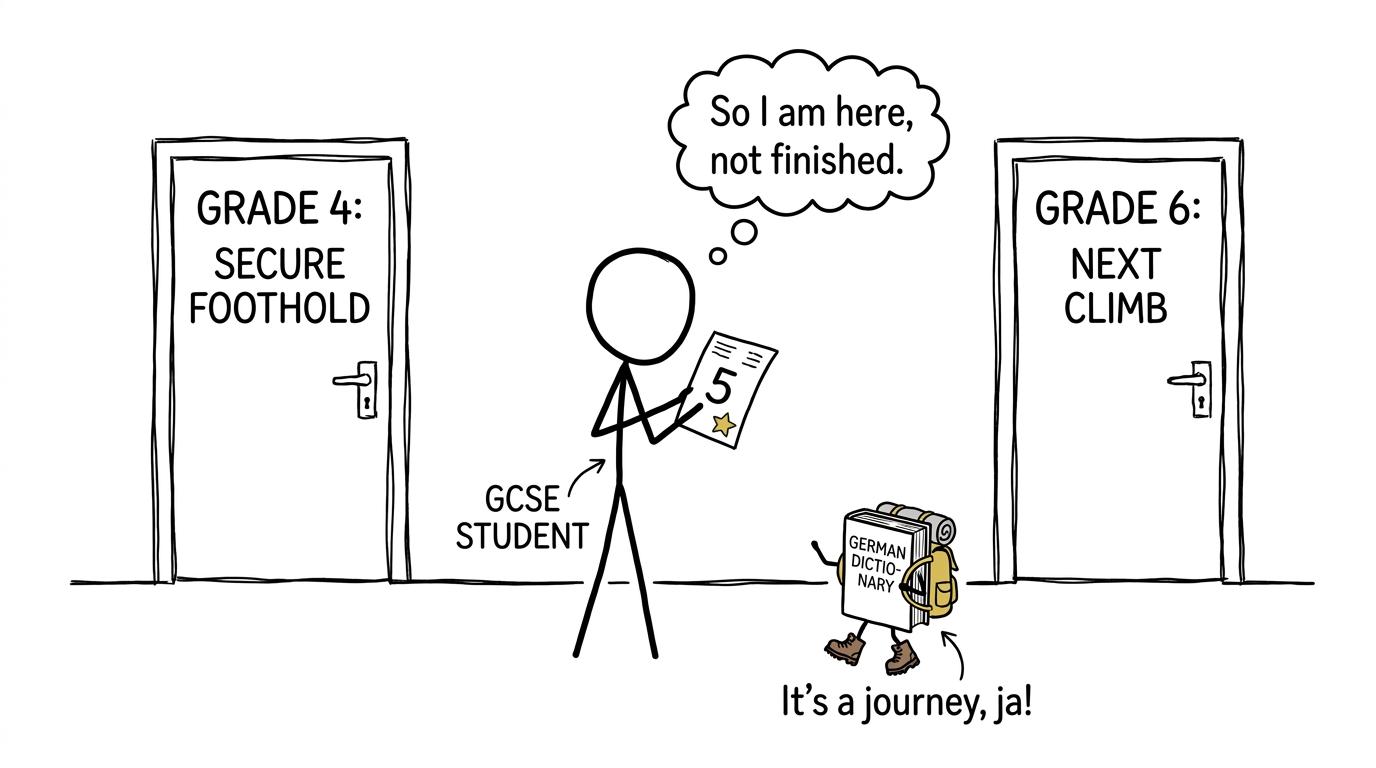 A student treats grade 5 as a milestone rather than a final identity
What ability does a grade 5 in German represent?
GCSE German assesses several kinds of language use. Although exact paper structures depend on the specification and exam board, the qualification is built around listening, speaking, reading and writing.
A grade 5 therefore represents an overall result rather than one narrow skill. Two students can earn the same grade with different profiles: one might speak confidently but lose marks in reading, while another might write accurately but find spontaneous conversation difficult.
Listening and reading
At around this level, you would normally be expected to understand the main message and identify relevant details in language based on familiar GCSE contexts. These may include personal identity, school, free time, travel, relationships, future plans and the wider world, depending on your specification.
You may also be able to:
- distinguish facts from opinions;
- recognise references to different time frames;
- use context to interpret some unfamiliar vocabulary;
- extract key information from short and longer passages;
- understand clear speech delivered in standard German.
A grade 5 does not imply that every word feels easy. Language comprehension often works through reconstruction: you recognise enough vocabulary, grammar and context to build the intended meaning without translating every sentence word for word.
Speaking and writing
In productive skills, grade 5 performance generally means you can communicate relevant information and opinions with reasonable clarity. You are likely to use familiar vocabulary, link ideas and refer to more than one time frame, though accuracy may be uneven.
Typical strengths might include:
- giving and explaining opinions;
- describing experiences and intentions;
- responding to familiar questions;
- producing connected speech or writing rather than isolated sentences;
- using a developing range of vocabulary and grammatical structures.
There may still be errors in word order, adjective endings, verb forms, cases or pronunciation. The key distinction is whether those mistakes regularly prevent communication. At grade 5, meaning should usually remain understandable even when the German is not flawless.
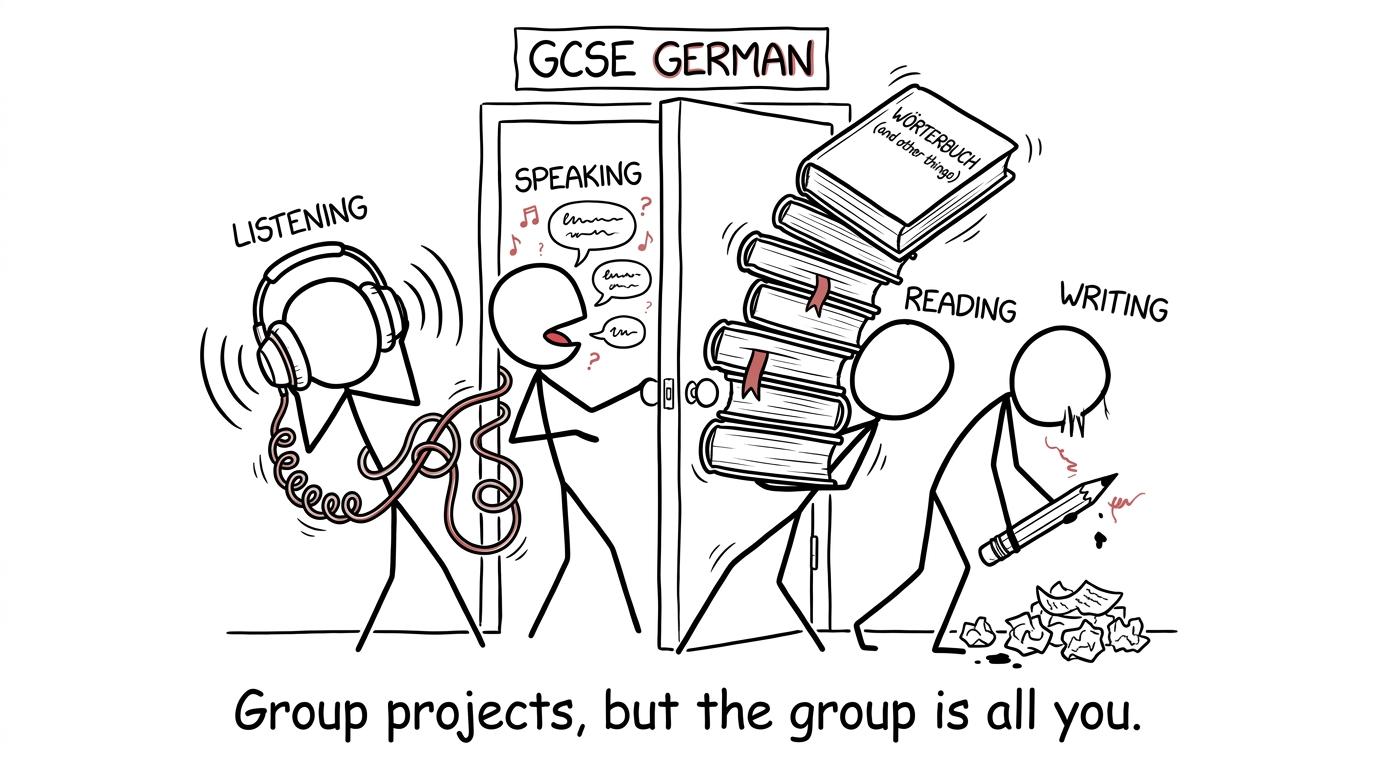 Listening, speaking, reading and writing arrive as one rather demanding group project
Is a grade 5 a strong pass in GCSE German?
Yes, grade 5 is commonly called a strong pass in England. Grade 4 is commonly described as a standard pass.
These labels can be useful, but they should not be treated as universal admissions rules. A sixth form might require grade 4 in one subject, grade 5 in another, or a higher result for continuing that subject at A Level. Employers, colleges and training providers can also set their own criteria.
If an application matters, read its current entry requirements rather than assuming that the phrase “strong pass” guarantees acceptance. The grade is nationally recognised; the decision about whether it meets a particular requirement belongs to the institution.
How grade 5 compares with the old letter grades
The safest comparison is not “grade 5 equals C” or “grade 5 equals B”. Neither statement is officially precise.
When GCSEs in England moved from letters to grades 9-1, comparable points were maintained at certain boundaries:
- the bottom of grade 7 aligns with the bottom of the old grade A;
- the bottom of grade 4 aligns with the bottom of the old grade C;
- the bottom of grade 1 aligns with the bottom of the old grade G.
Between those anchor points, the mapping is deliberately broader. Grades 4, 5 and 6 together provide more differentiation across the area previously covered by grades C and B. It is therefore reasonable to describe grade 5 as lying between the old C and B region, but not as a direct replacement for either letter.
This matters because an apparently simple conversion can create false certainty. The new scale was designed to divide performance more finely. Grade 5 has its own boundaries and should be read as a result within the current system.
For students also interpreting their maths result, the same grading principle applies. MathsGenie has a separate guide to the meaning of grade 5 in GCSE Maths.
Does grade 5 mean the same on Foundation and Higher tier?
A grade 5 is the same qualification grade whichever eligible tier produced it. It is usually available at the top of Foundation tier and within the lower part of Higher tier, subject to the rules of your exam board and specification.
However, the experience of reaching it can differ. Foundation papers are designed around a lower grade range, while Higher papers include more demanding language and access to the top grades. Students must normally take the required components at the same tier.
Tier decisions should be made with your teacher. They involve more than your target grade: your consistency, confidence with harder material and risk of falling below the available Higher-tier range all matter.
The same principle is familiar in maths. Students should practise material for the paper they will actually sit, which is why the GCSE Maths revision hub separates revision by exam board and tier.
Why there is no permanent grade 5 percentage
A grade boundary is the minimum mark required for a grade in a particular assessment series. It is not permanently fixed at one percentage.
Boundaries can vary because papers are not identical in difficulty from year to year. Awarding processes are intended to keep the standard of the grade comparable even when the raw mark needed changes. Your exam board publishes official boundaries after results are awarded.
This means that statements such as “grade 5 is always a particular percentage” should be treated cautiously. Do not build revision around a guessed boundary. Build enough knowledge and exam reliability to create a margin above the result you need.
That advice transfers directly to maths. Use official-style questions, mark accurately and diagnose where marks disappear. MathsGenie explains this process in its guide to using Edexcel GCSE Maths past papers properly, with the actual papers available in the Edexcel GCSE Maths past paper collection.
What grade 5 does not tell you
A single grade cannot reveal whether you are stronger in speaking than listening. It cannot show how close your mark was to grade 6, and it does not certify effortless fluency in everyday German outside the GCSE contexts you studied.
It should not automatically be converted into a level from another framework either. GCSE grades and external language proficiency frameworks assess performance for different purposes, so a one-line conversion can be misleading unless an institution provides an official policy.
Nor does grade 5 predict every future result. A student can improve with deliberate practice, just as a student can forget material after months without using it. The grade records what your assessed work demonstrated at that time.
Using the result to plan the rest of your revision
German and maths require different knowledge, but strong revision in both subjects follows a similar rhythm: retrieve, practise, check and return.
For German, that might mean vocabulary recall, listening practice, short spoken responses and corrections based on a mark scheme. For maths, it means learning a method, completing exam questions and reattempting errors without notes.
A manageable weekly plan is more useful than an ambitious timetable that lasts three days. MathsGenie’s GCSE maths revision timetable shows how to balance focused topic sessions with timed practice. If exams are close, the one-month GCSE revision plan offers a shorter structure.
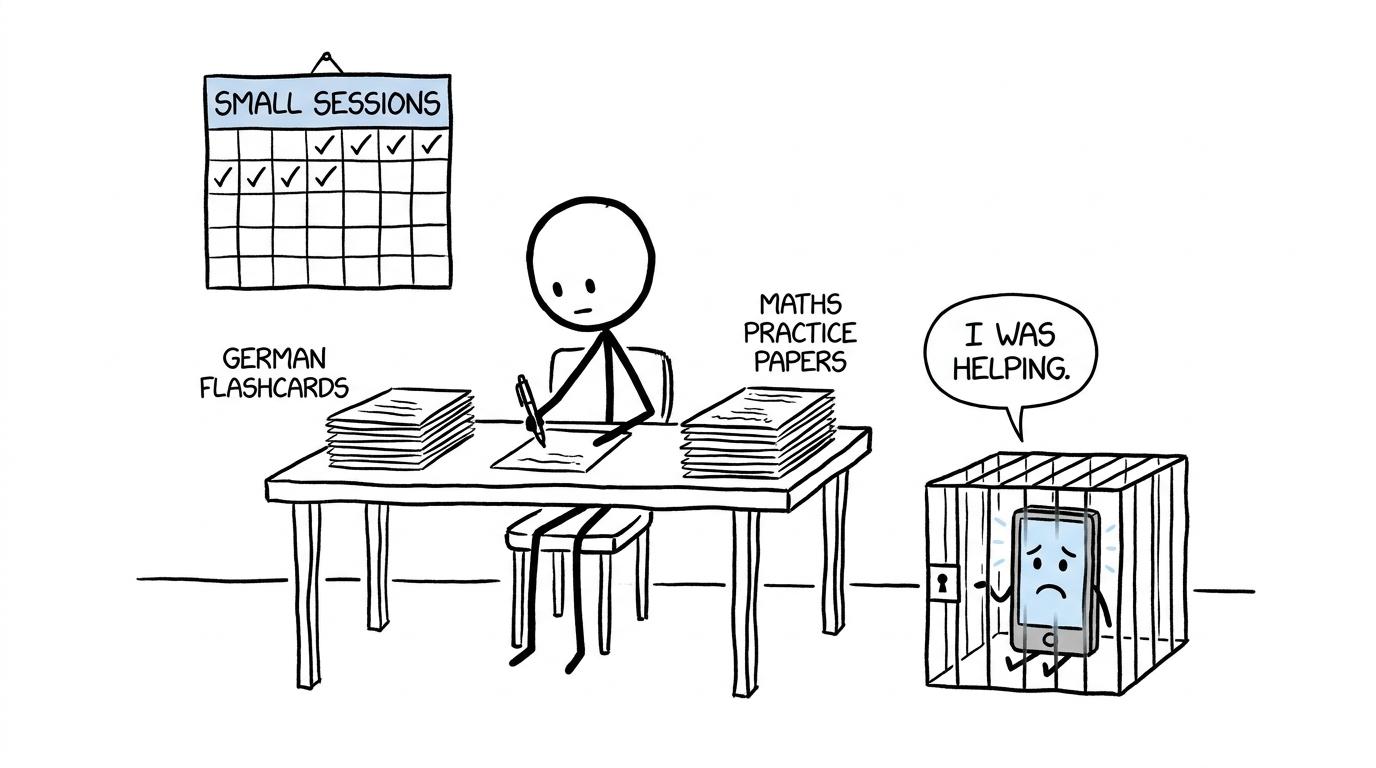 A student balances German and maths revision while the distracting phone serves time
A simple approach is to:
- identify one weak skill in each subject;
- complete a short, focused revision session;
- check your work against reliable criteria or a mark scheme;
- record the precise error;
- revisit that error after a short gap;
- add timed papers once individual skills are becoming dependable.
If your maths grade also feels stuck, use the focused advice in GCSE Maths revision at a pass grade. The goal is not to revise everything at once. It is to make the next weak area less weak.
Common mistakes when interpreting a German grade 5
Treating grade 5 as exactly the old grade C
The scales overlap, but they do not convert grade by grade. Grade 4 aligns with the bottom of the old C, while grades 4-6 collectively span the old C/B region.
Assuming it proves complete fluency
Grade 5 shows useful GCSE-level competence. It does not mean you will understand every native speaker, discuss every topic spontaneously or write without grammatical errors.
Believing every skill must have been at grade 5
Your final grade combines performance across assessed skills. Stronger results in one component can sit alongside weaker results in another.
Using an unofficial percentage as a target
Grade boundaries can change between series and boards. Use your exam board’s published boundary for the relevant paper after results, and aim for a sensible safety margin during revision.
Comparing the number without checking requirements
A grade can be a strong personal achievement while still falling below a particular course requirement. Always check the current criteria for the sixth form, college or apprenticeship you are considering.
Turn one grade into a useful next step
A grade 5 in GCSE German means you have built a sound platform: you can understand and communicate meaningful German across familiar contexts, even though accuracy, range and independence can still improve. It is a strong pass, not a direct old-letter equivalent and not the end of the story.
The best response to any GCSE result is specific action. Keep practising German where your assessment profile is weakest, then protect your maths preparation with the same disciplined cycle. Start at the free MathsGenie GCSE Maths revision hub, choose your board and tier, and use revision lessons, practice questions, mini tests, past papers, predicted papers, mark schemes and video solutions to turn uncertainty into a clear plan.