

GCSE Geography: Revise Every Day or Rest?
GCSE geography revise every day or rest? See why spaced recall, sleep and planned breaks beat cramming, then build a practical weekly revision routine.
The evening starts with good intentions. Then you remember the case studies, fieldwork methods, map skills, maths practice and every other subject waiting for attention. When students ask, “GCSE geography: revise every day or rest?”, the useful answer is simple: you do not need a demanding geography session every day. Frequent, spaced revision is better than occasional cramming, but planned rest days and sufficient sleep should be part of the schedule.
A brief recall activity on most days can help, especially near an exam. That is different from forcing yourself through a full session seven days a week. The aim is not to build the longest revision streak. It is to remember and apply more when the paper is in front of you.
The short answer: revise frequently, not relentlessly
For most students, a good pattern is geography revision on 444 to 666 days each week, with at least one genuine rest day. The right frequency depends on how close the exams are, how secure your knowledge is and how geography fits beside maths, English and science.
Use this checklist:
- Spread geography across several short sessions rather than one weekly marathon.
- Retrieve information from memory instead of repeatedly reading notes.
- Revisit topics after a gap so that recall takes some effort.
- Include case studies, processes, fieldwork, geographical skills and exam questions.
- Protect sleep rather than extending revision late into the night.
- Keep at least one lighter day or full rest day each week.
- Adjust the plan using evidence from marked questions, not guilt.
The word that matters is frequently. Daily revision can work when sessions are short and purposeful, but it is not automatically better than a balanced schedule.
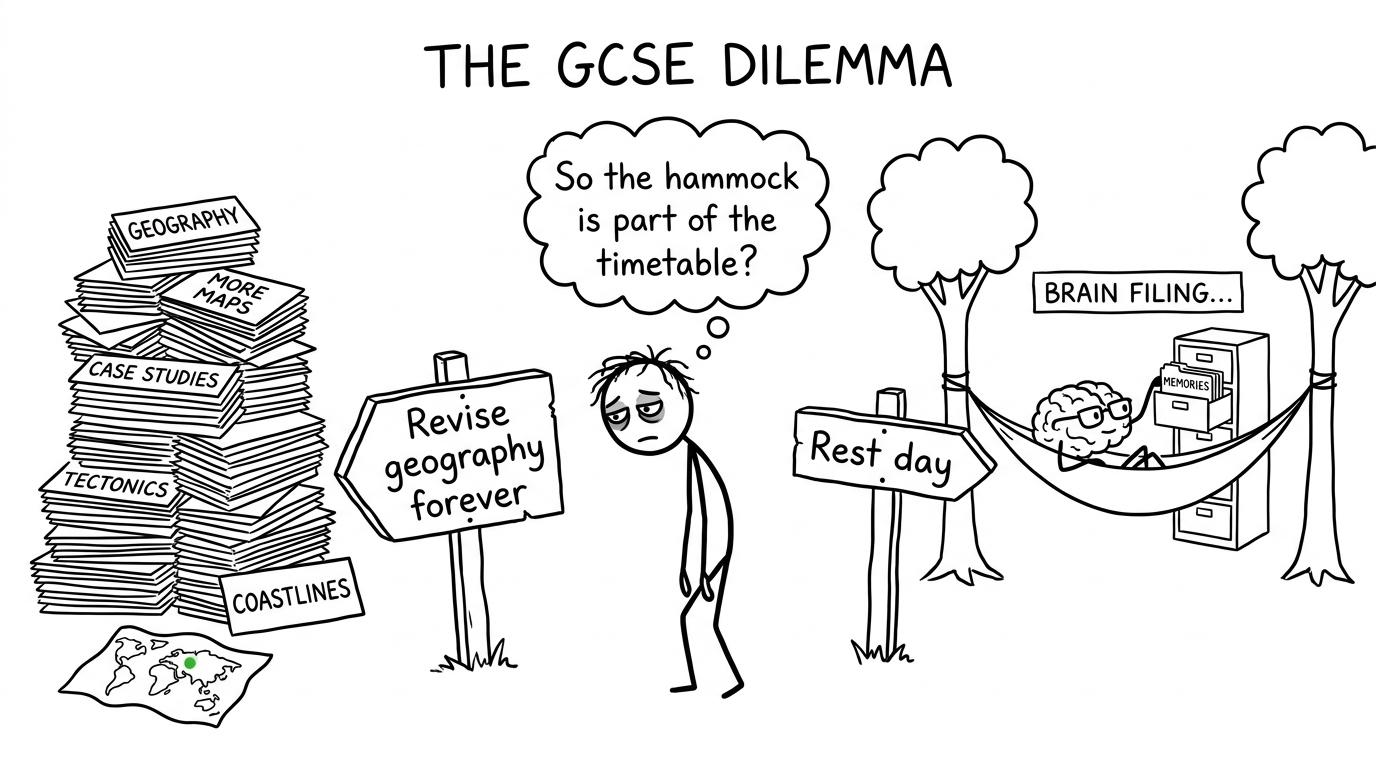 A student discovers that rest belongs in a revision timetable
Why spacing improves retention
Memory is not a filing cabinet that stays perfectly organised once information goes in. Some forgetting happens between sessions. That can feel frustrating, but it also creates the conditions for useful retrieval.
Research on learning consistently supports spacing: revisiting material across separate sessions generally produces better long-term retention than concentrating the same practice into one block. Retrieval practice also tends to be more effective than passive rereading. In practical terms, trying to recall the causes and effects of a hazard before checking your notes does more for memory than simply looking at the page again.
The gap is important because successful recall becomes less automatic. Your brain has to reconstruct the idea. Each successful return can make that knowledge easier to access later.
This suggests a sensible geography cycle:
- learn or review a small section;
- close the notes and retrieve its key ideas;
- apply the knowledge to a question, map, photograph or data set;
- check accuracy;
- return to it after a gap.
A rest day can sit inside that gap. Rest does not erase learning, and revising continuously does not guarantee retention.
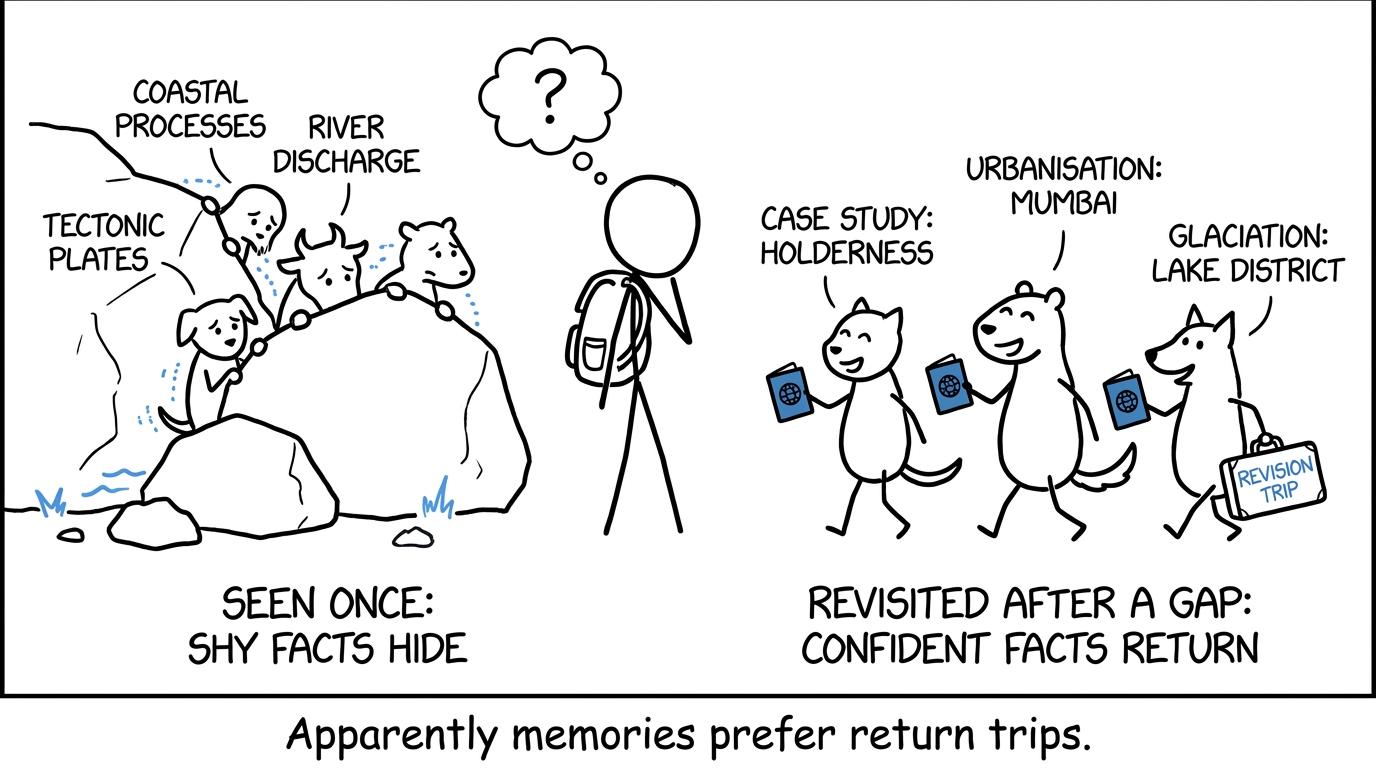 Case-study facts return confidently after spaced revision
Why rest days help without becoming lost days
A rest day is not a memory technique by itself. Its value comes from protecting attention, motivation and sleep while separating revision sessions. To gain the spacing benefit, you still need to retrieve the material when you return.
Rest days also make a timetable more resilient. A schedule requiring perfect performance every day tends to collapse as soon as schoolwork, illness or an unexpected commitment intervenes. A plan with breathing room can absorb ordinary life.
There are two useful versions of rest:
A complete rest day
Do no formal revision. Exercise, see friends, spend time outdoors or do something unrelated to exams. This is particularly valuable if you are tired, irritable or reading without processing what you see.
A light recall day
Spend 555 to 101010 minutes recalling case-study facts or reviewing previous mistakes, then stop. This can maintain a routine without turning the day into another demanding session.
Neither version should involve staying awake late to compensate. NHS guidance says most teenagers need around 888 to 101010 hours of sleep, and sleep supports concentration and learning. An all-night cram exchanges tomorrow’s attention for a few extra hours of low-quality revision tonight.
A practical weekly GCSE geography schedule
There is no scientifically perfect timetable for every student. The following is a flexible starting point rather than a rule.
| Stage of revision | Suggested geography pattern | Main purpose |
|---|---|---|
| More than 888 weeks away | 333 or 444 sessions each week | Build knowledge and revisit older topics |
| Around 444 to 888 weeks away | 444 or 555 sessions each week | Combine retrieval with exam questions |
| Final 222 to 333 weeks | 555 or 666 shorter sessions each week | Strengthen weak areas and practise under time pressure |
| Day before the paper | One short review, then stop | Refresh priorities without sacrificing sleep |
A single session might last 252525 to 454545 minutes. It should have a defined outcome such as recalling one case study, reviewing a physical process, checking fieldwork vocabulary or answering an extended-response question.
Your exact content must come from your own specification. AQA, Edexcel, OCR and Eduqas organise GCSE Geography differently. Check your exam board rather than assuming that a revision list found elsewhere matches your course. Geography papers may assess factual knowledge alongside interpretation, evaluation, fieldwork understanding, maps, graphs, photographs and numerical data.
What to do during each session
The quality of a session matters more than whether it preserves an unbroken daily streak.
Begin with retrieval
Before opening a book, write or say what you remember. You could reconstruct a case study under headings such as location, causes, effects, responses and evaluation. For geographical processes, recall the sequence and explain why each stage happens.
Then check your account. Correct omissions immediately so that retrieval does not become repeated guessing.
Alternate knowledge and application
Knowing facts is necessary, but geography exams also require you to use them. Mix recall with:
- map, graph and photograph interpretation;
- fieldwork methods and evaluation;
- unfamiliar data and resource questions;
- command words such as describe, explain, assess and evaluate;
- timed extended responses;
- self-marking with an official mark scheme where available.
Record what failed
After marking, write down the precise problem. “Rivers” is too broad. “I could name the process but not explain how it changes the channel” gives you a useful next action.
This is also an effective approach to maths. The free GCSE Maths revision hub brings revision lessons, practice questions and papers together, while Edexcel GCSE Maths mini tests make short retrieval sessions easier to schedule.
Balancing geography with maths revision
The danger is not usually one subject. It is every subject quietly claiming every evening.
Start by giving each subject a realistic share of the week. Maths needs repeated problem-solving, while geography combines factual retrieval with interpretation and written application. Rotate them rather than attempting a full session for every subject every day.
The GCSE maths revision timetable guide explains how to build a schedule around weak topics, timed practice and rest. If you are unsure which maths areas need attention, use the GCSE maths topics by exam board and tier to check the relevant Foundation or Higher content.
Unlike GCSE Maths, GCSE Geography does not use Foundation and Higher tiers. You still need to confirm your geography specification because content and assessment arrangements vary by board.
A balanced week might include short geography retrieval on some days, focused maths questions on others and one session where each subject is tested under exam conditions. MathsGenie’s guide to using GCSE past papers properly shows the wider principle: attempt, mark, diagnose and repair. That loop is more valuable than merely counting hours.
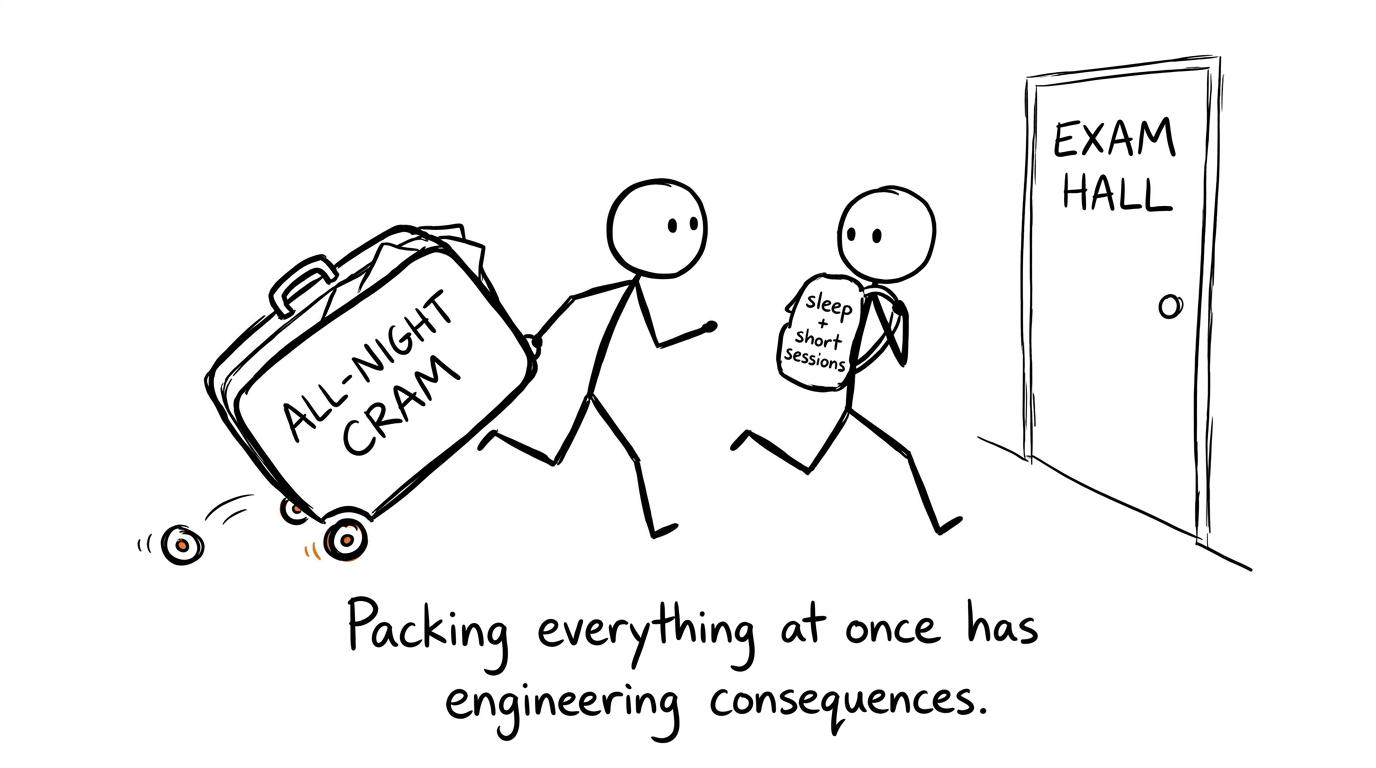 A small revision backpack overtakes an overloaded cram suitcase
When daily geography revision makes sense
Daily contact can be useful during the final run-up, provided it remains sustainable. It works best when:
- sessions are short;
- each day has a specific purpose;
- topics are mixed rather than repeated mechanically;
- active recall and questions replace highlighting;
- you still sleep properly;
- at least one day is noticeably lighter.
It may also help if geography is currently your weakest subject or if a mock has exposed serious gaps. If you are behind across several subjects, do not respond by removing every break. Use a triage system: identify the topics most likely to improve with focused work, then follow a manageable plan. The MathsGenie GCSE catch-up guide offers a useful framework for diagnosing gaps and repairing them in priority order.
Common mistakes when planning revision and rest
Treating rest as something you must earn
Rest is part of a sustainable plan, not a reward available only after perfect revision. Put it in the timetable before the week begins.
Revising daily but only rereading
Familiar pages create a feeling of fluency. That feeling can disappear when the notes are closed. Test yourself before checking the source.
Leaving too long between every session
Spacing is not neglect. If weeks pass before you revisit a weak topic, you may have to learn much of it again. Use shorter gaps initially, then extend them as recall improves.
Sacrificing sleep for one more chapter
Late-night revision can reduce concentration the following day. Set a stopping time and keep it, particularly before an exam.
Using the same schedule throughout revision
Early revision should build knowledge. Later revision should include more timed application and paper practice. The guide to when to start GCSE past papers explains how exam practice can develop in stages.
Confusing activity with progress
Hours, flashcard totals and revision streaks measure activity. Marked answers and improved recall measure learning. On low-motivation days, a short attempt-mark-fix cycle is enough; the GCSE revision guide for low motivation shows how to make that cycle manageable.
Build a rhythm you can repeat
The best answer to the GCSE geography revise every day or rest question is not an extreme. Revise often enough to create repeated retrieval, but include enough rest to remain attentive and consistent. A calm schedule followed for several weeks will usually serve you better than a heroic schedule abandoned after several days.
Plan one week now. Choose your geography topics from the correct specification, include active recall and exam questions, and protect at least one rest day. Then organise maths around the same evidence-led cycle.
Use MathsGenie as your free maths revision base: start with revision lessons and practice questions, check progress through mini tests, and build towards past papers and predicted papers. Mark every attempt with the available mark schemes and use video solutions to understand the methods you missed. Revision works when each return is a little more informed than the last.










