GCSE Geography Remark Appeal: Is It Worth It?
GCSE geography remark appeal guide: understand reviews, 2026 deadlines, likely fees, grade risks and when requesting one may genuinely be worthwhile for you.
Results day can turn one mark into the most important mark in the world. If your GCSE Geography result is below the grade you expected, particularly when you are close to a boundary, a GCSE geography remark appeal may be worth considering. But closeness alone is not proof of an error.
The official first step is normally a review of marking, not an appeal and not a complete re-mark from scratch. Your school asks the exam board to check whether the mark scheme was applied correctly. Your mark can rise, remain unchanged or fall. An appeal only becomes possible after that review has finished, and it needs proper grounds.
The sensible approach is to obtain the evidence, discuss the script with a Geography teacher and consider what a changed grade would actually affect before paying a fee.
Your results-day checklist
Before requesting anything:
- Contact your Geography teacher or exams officer promptly.
- Confirm your exam board, paper marks and overall grade.
- Compare your total with the official grade boundary for your specification.
- Ask whether your marked scripts can be accessed first.
- Let a teacher look for specific marking or clerical concerns.
- Check your school's internal deadline and fee.
- Decide whether to request a clerical re-check or review of marking.
- Understand that the mark and grade can go down.
- Give written consent only when you understand the risk.
- Consider an appeal only after receiving the review outcome.
For a wider overview of the terminology, read MathsGenie's GCSE remark request guide.
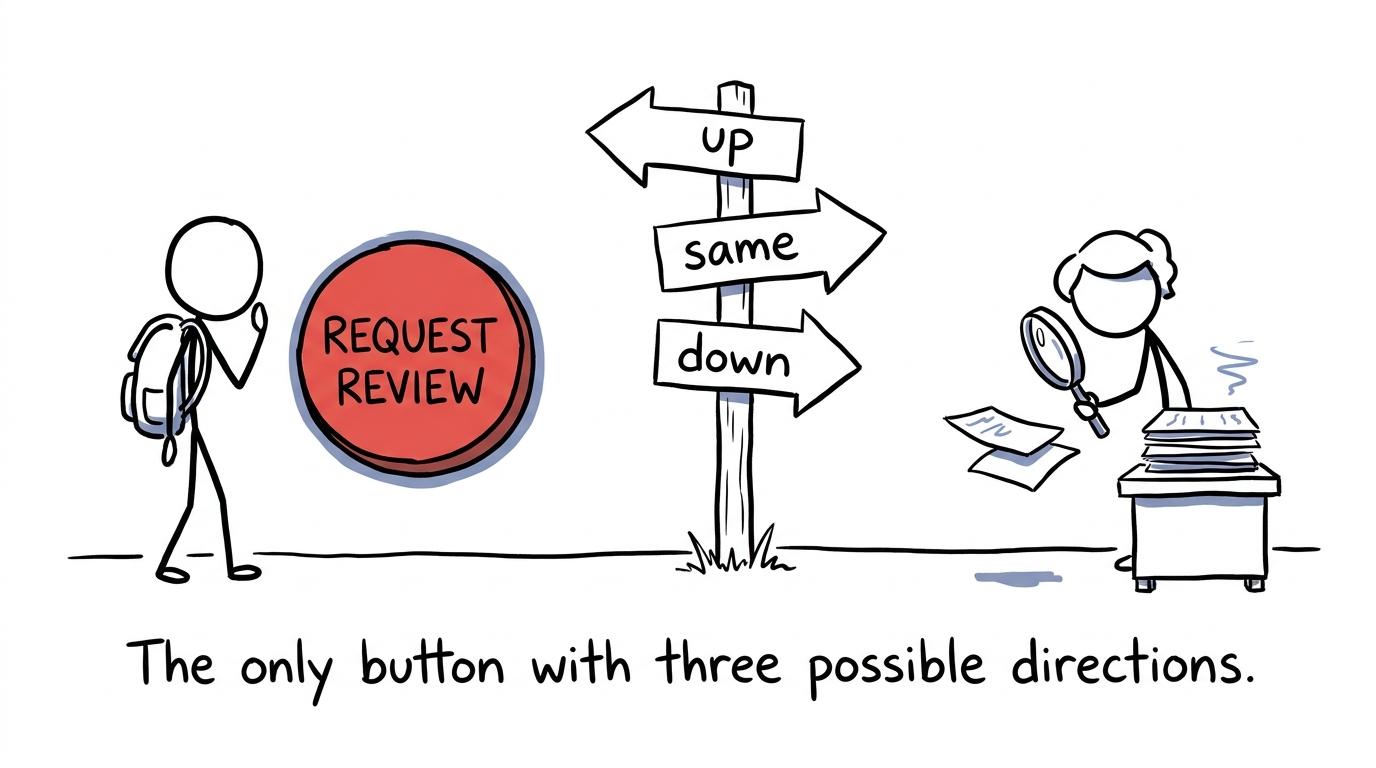 A student facing a review button with three possible directions
What a GCSE Geography remark really means
Students often ask for a "remark", but the regulated service is called a review of marking. A reviewer checks the original marking to establish whether the agreed mark scheme was applied correctly. They must correct identified marking errors, but the process is not simply a second examiner replacing every reasonable judgement with their own.
That distinction matters in Geography. Some questions have clear, tightly defined answers. Others involve levels-based marking, where the examiner judges the quality of explanation, use of evidence and development of an argument. Two teachers might prefer different wording without the original mark necessarily being wrong.
A review is therefore strongest when your teacher can identify something specific, such as:
- a response or page that appears not to have been marked;
- a mark that appears inconsistent with the published mark scheme;
- a total that may have been calculated or recorded incorrectly;
- credit apparently missing from a clearly valid point;
- an extended answer that may have been placed in an unreasonable level.
It is weaker when the only argument is that your mock grade was higher or that you were close to the next boundary. Mock examinations, teacher predictions and final examinations are different assessments.
The post-results process from script to appeal
Accessing the marked script
Ask whether your centre can obtain a copy of the relevant marked paper before requesting a review. The major boards provide access-to-script arrangements, and electronic copies used to support review decisions are generally available without an exam-board charge for the June 2026 series.
A script is useful because it changes the conversation from I deserved more marks to this particular response may have been assessed incorrectly. Ask a Geography teacher who understands the specification and current mark scheme to inspect it. They can compare the answer with the indicative content, level descriptors and examiner annotations.
Permission is required before a centre accesses a candidate's script. Your school may also have an earlier request date than the board's published deadline.
Choosing the right service
A clerical re-check checks administrative processes such as whether all parts were marked and whether marks were totalled and recorded correctly. It does not reconsider the quality of the answers.
A review of marking includes the relevant clerical checks and examines whether the mark scheme was applied correctly. For most concerns about the assessment of written Geography answers, this is the relevant service.
Your school or college submits the request. Internal candidates and their parents cannot normally send it directly to the board. Private candidates may usually approach the awarding organisation directly or work through the centre that entered them.
Giving consent and receiving the outcome
Your centre must obtain your written consent after results have been published. This is necessary because a review can produce three outcomes:
- the mark increases;
- the mark remains unchanged;
- the mark decreases.
There is no grade protection for an individual review of marking. If a reduced mark crosses a boundary, your subject grade can fall too.
For the June 2026 series, GCSE results are released to candidates on 20 August 2026. The JCQ deadline for awarding bodies to receive standard review-of-results requests is 24 September 2026, and a standard review should normally be completed within 20 calendar days. Treat your school's earlier internal deadline as the date that matters to you.
When a GCSE geography remark appeal is worth considering
A review becomes more reasonable when several signals point in the same direction.
The script contains a credible concern
The strongest reason is evidence. If an experienced teacher identifies an answer that appears to meet a higher level descriptor, a valid point receiving no credit or an apparently unmarked section, there is a reason for the board to investigate.
This still cannot guarantee a change. It does, however, replace guesswork with an informed professional judgement.
A grade change has a meaningful consequence
Ask what the higher grade would change. It may affect entry to a sixth form, college course or future application. A review may also matter personally, but it helps to separate disappointment from consequence.
If your place depends on the result, tell the school and admissions provider immediately. Do not assume that every board offers a GCSE priority review. For 2026, the standard priority service is principally for Level 3 qualifications; Pearson Edexcel has separately listed a GCSE priority option. Availability and deadlines must be confirmed with your exams officer.
You are close enough for a realistic change
Being one or two marks below a boundary makes a grade change mathematically possible, but does not show that the marking was wrong. Being farther away does not make a review impossible either, although a larger increase generally requires stronger evidence across one or more papers.
Look at the paper-level evidence rather than the boundary alone. If the likely correction is on one component, reviewing that paper may be more sensible than paying to review every paper.
You accept the financial and grade risk
Review fees are normally charged per paper or component. Published June 2026 standard fees include approximately $ £\pounds£ 44.85$ for AQA,
\pounds$ 67.75$ for OCR and\pounds45 4545 for WJEC/Eduqas. Pearson's previously published GCSE fee was
\pounds$ 50$ per component, but its displayed schedule ended before August 2026 results, so Edexcel candidates should confirm the current charge with their centre. Schools may cover the fee, pass it on or add an administration charge. Exam-board review fees are generally not charged or are refunded when the overall certification grade changes. Check the exact arrangement before submitting payment. MathsGenie's [GCSE remark cost guide](https://mathsgenie.co.uk/blog/gcse-remark-cost-2026) explains the per-paper issue in more detail. 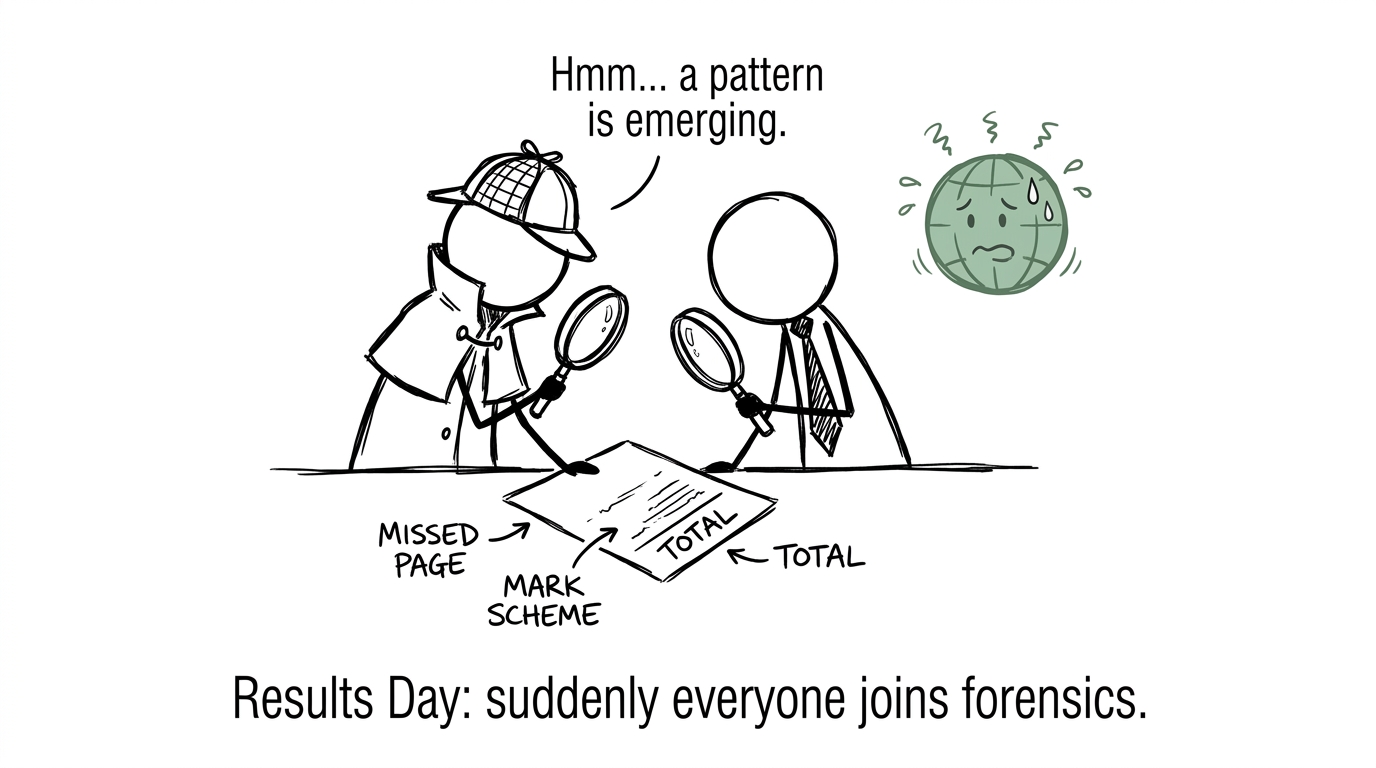 ## When it is probably not worth the fee A request is less compelling when: - nobody has inspected the script; - the only evidence is a predicted grade; - your teacher believes the marking is reasonable; - the possible grade change would not affect your next step; - you would need an unusually large movement with no identifiable errors; - you are unwilling to accept that the mark could fall; - the fee would cause difficulty and the evidence is weak. There is no shame in deciding against a review. A result can feel unfair simply because it is painful. The purpose of the process is to correct errors, not to provide another attempt at the examination. ## How an appeal differs from a review of marking An appeal is not the next paid attempt to obtain a better grade. It challenges the outcome of the review because the awarding body may have made an error or failed to apply its procedures consistently, properly or fairly. You cannot normally appeal until the relevant clerical re-check or review of marking has been completed. For an internal candidate, the head of centre submits the appeal. A private candidate may submit directly. The centre must state clear grounds. Simply disagreeing with the result is unlikely to be enough. Useful grounds could relate to an uncorrected marking error, an unreasonable exercise of academic judgement or a procedural failure in the review. The process generally has two stages: - **Stage One:** a preliminary appeal considered by someone not previously involved in the case. - **Stage Two:** an appeal hearing involving a panel with at least one independent member. A Stage One appeal must normally be submitted within 30 calendar days of the review outcome. A request for a Stage Two hearing must normally be made within 14 calendar days of the preliminary appeal outcome. Fees vary by board and stage, and are normally refunded or waived if the appeal is upheld. After the awarding body's final appeal stage, a centre may ask Ofqual's Exam Procedures Review Service to consider whether the board followed the required procedures. Ofqual does not simply re-mark the paper or decide what grade it prefers. ## Common mistakes to avoid ### Treating "close to the boundary" as proof A boundary tells you how many additional marks are required. It does not reveal whether any marking error occurred. Start with the script. ### Missing the school's deadline The national deadline is the board's deadline, not necessarily yours. A school needs time to obtain consent, collect payment and submit the correct component codes. ### Reviewing every paper automatically Fees are usually per component. Ask which script contains the strongest evidence and whether that paper alone offers a realistic route to the required total. ### Confusing an appeal with another review An appeal requires grounds connected to the review decision or procedure. It is not an unlimited sequence of fresh marking opinions. ### Forgetting that marks can fall Read the consent statement carefully. A lower mark can produce a lower subject grade, even if that outcome seems unlikely. ### Letting one result stop all revision Post-results decisions matter, but they should not consume every useful week. If maths remains part of your next step, return to what you can control. Use the [GCSE Maths revision hub](https://mathsgenie.co.uk/gcse/maths/edexcel) for lessons and topic questions, then build exam confidence with [GCSE predicted papers](https://mathsgenie.co.uk/gcse/predicted-papers).  ## Make the decision, then move forward A GCSE Geography review is genuinely worth considering when a teacher has found credible evidence, the required mark movement is realistic and the resulting grade would matter. An appeal is appropriate only when there are defensible grounds after the review outcome. Neither process is a gamble to take simply because a boundary is close. Ask for the script. Check the evidence. Confirm the fee and deadline. Then make one calm decision. After that, focus on the examinations still ahead. MathsGenie gives you free revision lessons, practice questions, mini tests, mark schemes and video solutions. You can learn how to use [GCSE past papers effectively](https://mathsgenie.co.uk/blog/gcse-when-should-you-start-past-papers), follow a structured [one-month GCSE Maths revision plan](https://mathsgenie.co.uk/blog/gcse-one-month-revision-plan-maths) or prepare for another attempt with the [GCSE Maths resit results-day plan](https://mathsgenie.co.uk/blog/gcse-maths-resit-results-day-revision-plan). A review deals with a paper already written. Good revision changes the next one.