GCSE Geography Last-Minute Revision Plan
GCSE geography last minute revision plan: use three calm days for case studies, fieldwork, map skills, timed questions and proper rest before the exam.
The exam is three days away. Your notes feel enormous, the case studies blur together, and every untouched topic suddenly looks urgent. The instinct is to revise everything at once. Resist it.
A useful GCSE geography last minute revision plan is not an attempt to relearn the entire course. It is a controlled rescue operation: confirm what your paper covers, identify where marks are most recoverable, practise producing answers, and protect enough sleep to think clearly.
Over the next three days, you will move through three stages: triage, repair and rehearsal. This works whether you take AQA, Edexcel, OCR or Eduqas, although you must use the specification and paper structure for your own exam board.
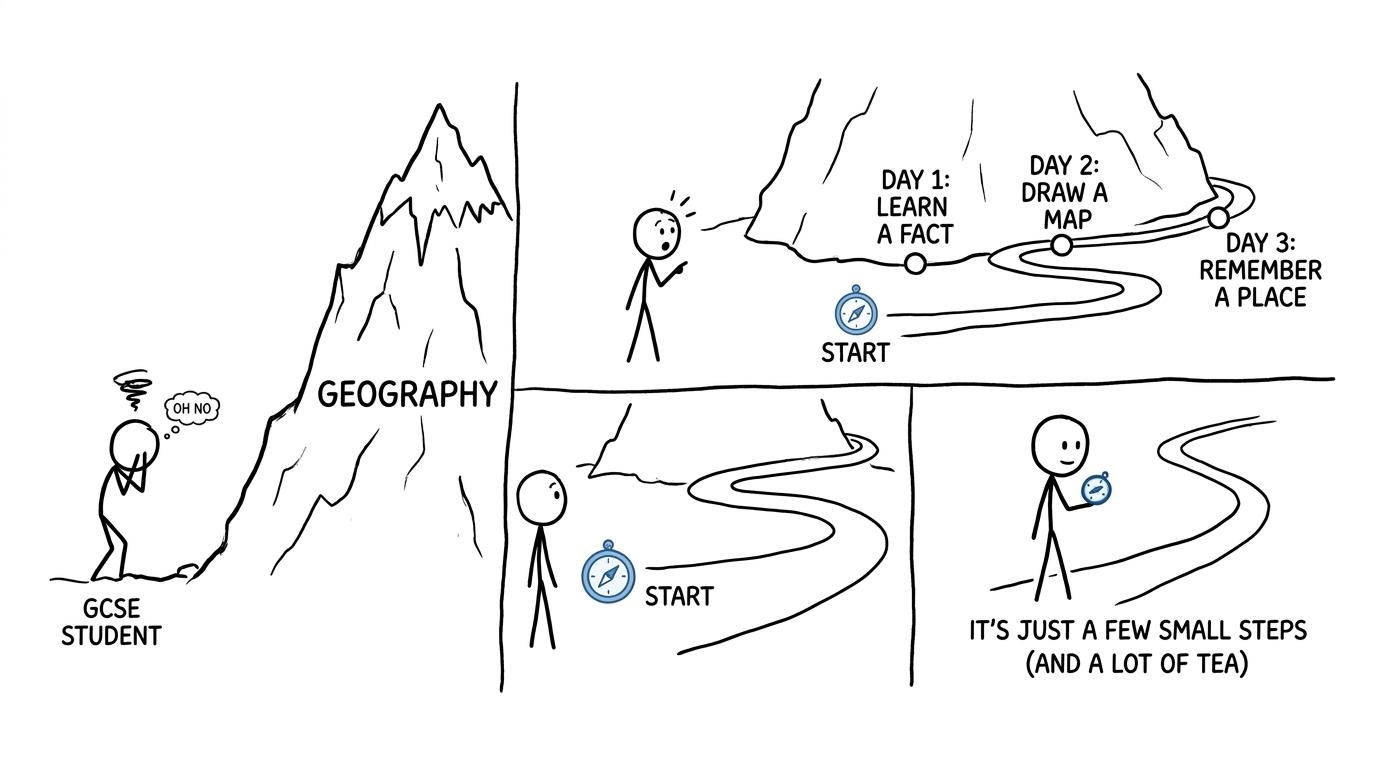 A calm three-step route around the GCSE Geography mountain
Your three-day geography revision checklist
| Day | Main purpose | What you should produce |
|---|---|---|
| Day one | Diagnose and organise | A priority list, condensed case studies and a fieldwork summary |
| Day two | Repair weak areas | Completed skills practice and improved exam answers |
| Day three | Rehearse the exam | A timed section, a short mistake list and a calm final review |
Before beginning, collect your specification checklist, class case studies, fieldwork notes, calculator, ruler and several past-paper questions. Check which paper you are sitting. Do not assume every topic belongs in the next exam.
If you follow AQA, the AQA GCSE Geography revision hub brings the course content, questions and paper resources together. The wider principle applies to every board: revise the content you will actually be assessed on, not whichever chapter happens to be open.
Day one: stop the panic by reducing the problem
Panic treats the course as one giant object. Planning breaks it into decisions.
Spend the first 202020 minutes checking your exam board, paper and specification topics. Create three columns:
- Secure: you could answer a question without notes.
- Fragile: you recognise the topic but lack detail or confidence.
- Missing: you cannot explain the process, place or example.
Do not devote equal time to all three. Secure topics need short retrieval. Fragile topics usually offer the fastest gains because some understanding is already present. Missing topics need selective repair, not an afternoon of copying the textbook.
Build case studies that can answer questions
A case study is useful only if you can deploy it. For each named place or event required by your course, reduce your notes to:
- location and geographical context;
- relevant causes or processes;
- social, economic and environmental effects;
- immediate and longer-term responses;
- management, success or limitations;
- a small number of precise facts you understand.
Use your own course examples. Different schools may teach different valid case studies, so replacing your teacher's examples at the last moment creates unnecessary confusion.
Close your notes and retrieve each case study aloud or on blank paper. Then check what was missing. Retrieval reveals gaps; rereading often disguises them.
Reconstruct your fieldwork enquiries
Fieldwork is not an optional extra. Official GCSE Geography requirements include geographical enquiry, data collection, presentation, analysis, conclusions and critical evaluation. The exact assessment structure varies by board, so use your specification.
For each enquiry, know:
- the question or hypothesis and location;
- the geographical idea being investigated;
- primary and secondary data used;
- sampling and data-collection methods;
- risks and how they were managed;
- patterns, anomalies and conclusions;
- limitations and realistic improvements.
AQA students can use the GCSE Geography fieldwork revision guide to review the enquiry sequence. Avoid memorising a generic paragraph about reliability. An improvement earns its place when it addresses a specific weakness, such as collecting data at more sites, repeating measurements at different times or using a larger sample.
Finish day one with a short closed-book recall session. Stop at a sensible time. The aim is to make tomorrow's work obvious, not to exhaust yourself tonight.
Day two: turn knowledge into marks
Knowing that you have read a topic is not the same as being able to answer a question on it. Day two therefore follows a tighter loop:
Recall, attempt, mark, correct, retry.
Choose two fragile content areas and one skills area. For each content area, spend roughly 252525 minutes retrieving and repairing knowledge, followed by 202020 minutes answering questions. Use mark schemes to identify missing geographical reasoning, evidence or judgement.
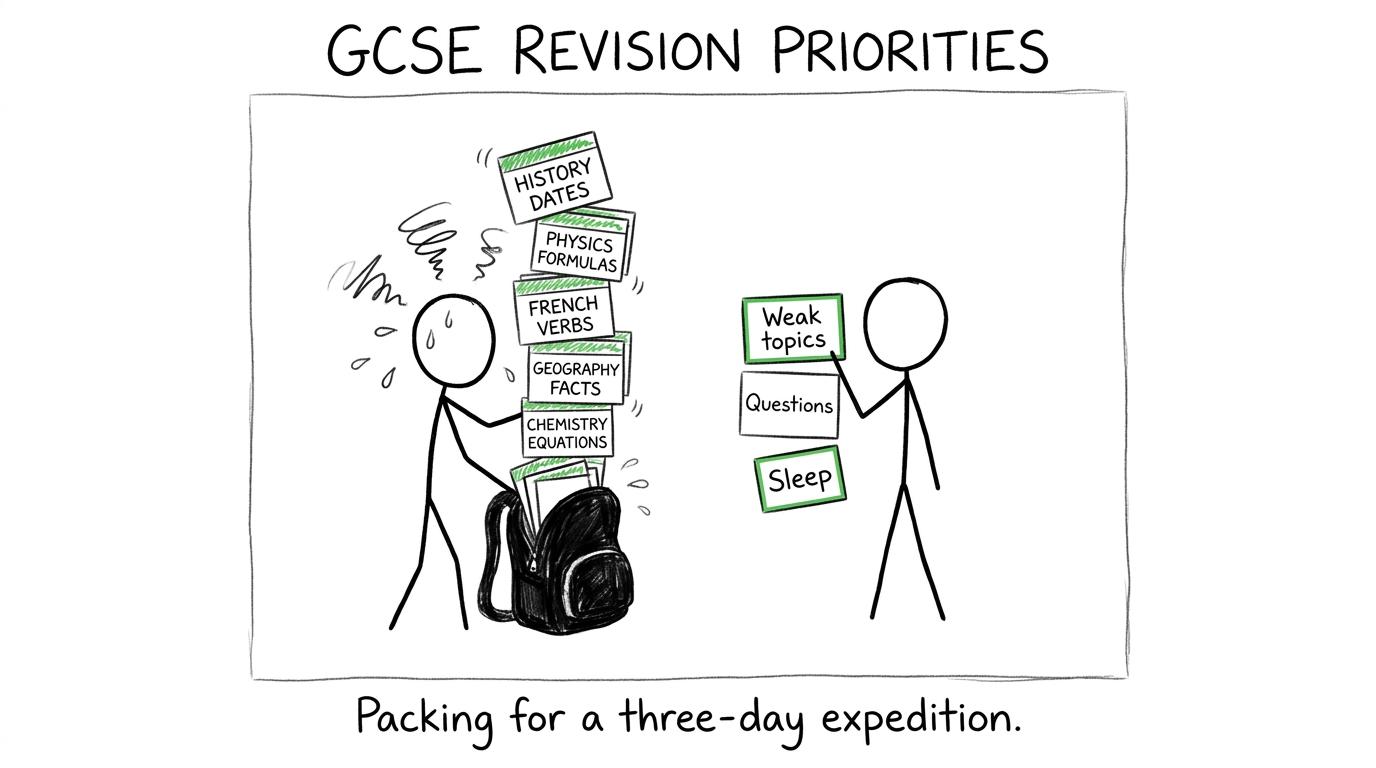 A student packs only the revision essentials for a three-day expedition
Prioritise maps, graphs and numerical skills
Geographical skills can appear within physical geography, human geography and fieldwork questions. The national subject content includes work with maps, graphical information, data and geographical enquiry. These are often recoverable marks because the resource provides evidence in front of you.
Practise checking:
- titles, keys, axes, units and scales;
- four-figure and six-figure grid references where required;
- distance, direction, relief and contour patterns;
- trends, comparisons and anomalies in graphs;
- whether data shows correlation rather than proof of causation;
- whether a source is representative, current and reliable.
The cartographic skills revision guide supports map interpretation, while the graphical skills revision guide covers choosing and reading geographical displays. You can then test application with cartographic exam-style questions.
Refresh the calculations listed by your board. Common geographical data skills may include the mean,
Mean=sum of the valuesnumber of values,\text{Mean}=\frac{\text{sum of the values}}{\text{number of values}},Mean=number of valuessum of the values,the range,
Range=highest value−lowest value,\text{Range}=\text{highest value}-\text{lowest value},Range=highest value−lowest value,and percentage change,
Percentage change=new value−original valueoriginal value×100.\text{Percentage change}=\frac{\text{new value}-\text{original value}}{\text{original value}}\times 100.Percentage change=original valuenew value−original value×100.The statistical skills revision guide connects averages, spread, percentage change and relationships to geographical interpretation. This is also where your maths revision becomes useful: ratio, scale, percentages and graphs do not stop being mathematical merely because they appear beside a river or population map.
Practise command words deliberately
Before answering, circle the command word and identify the task.
- Describe: give the pattern, characteristic or change, supported by evidence.
- Explain: develop reasons using connected geographical processes.
- Compare: give linked similarities or differences, not two unrelated descriptions.
- Assess or evaluate: consider evidence or competing arguments before reaching a judgement.
- Justify: select a position and defend it with relevant evidence.
For extended responses, plan briefly. Build a few developed arguments rather than unloading every remembered fact. If a source is supplied, use it precisely and combine it with your own geographical understanding.
AQA Paper 333 candidates should also review their official pre-release material in the way directed by their school. The issue evaluation revision guide explains how to compare stakeholders, impacts and options without forcing a memorised answer onto the question.
Day three: rehearse, correct and then stop
The final day is not for rebuilding your entire understanding of coasts, cities and climate. It is for making your existing knowledge accessible under pressure.
Complete a timed section from the correct board and paper. A section is usually more useful than an exhausting sequence of full papers because it leaves time for feedback. Work without notes, follow the timing guidance for that paper and attempt every question.
Mark it carefully. For each lost mark, label the cause:
- missing knowledge;
- weak case-study evidence;
- misread command word;
- poor use of the resource;
- calculation, scale or graph error;
- incomplete explanation;
- timing.
Choose the three patterns most likely to recur. Repair those only. The AQA GCSE Geography revision guides are useful when a marked answer exposes a specific content gap.
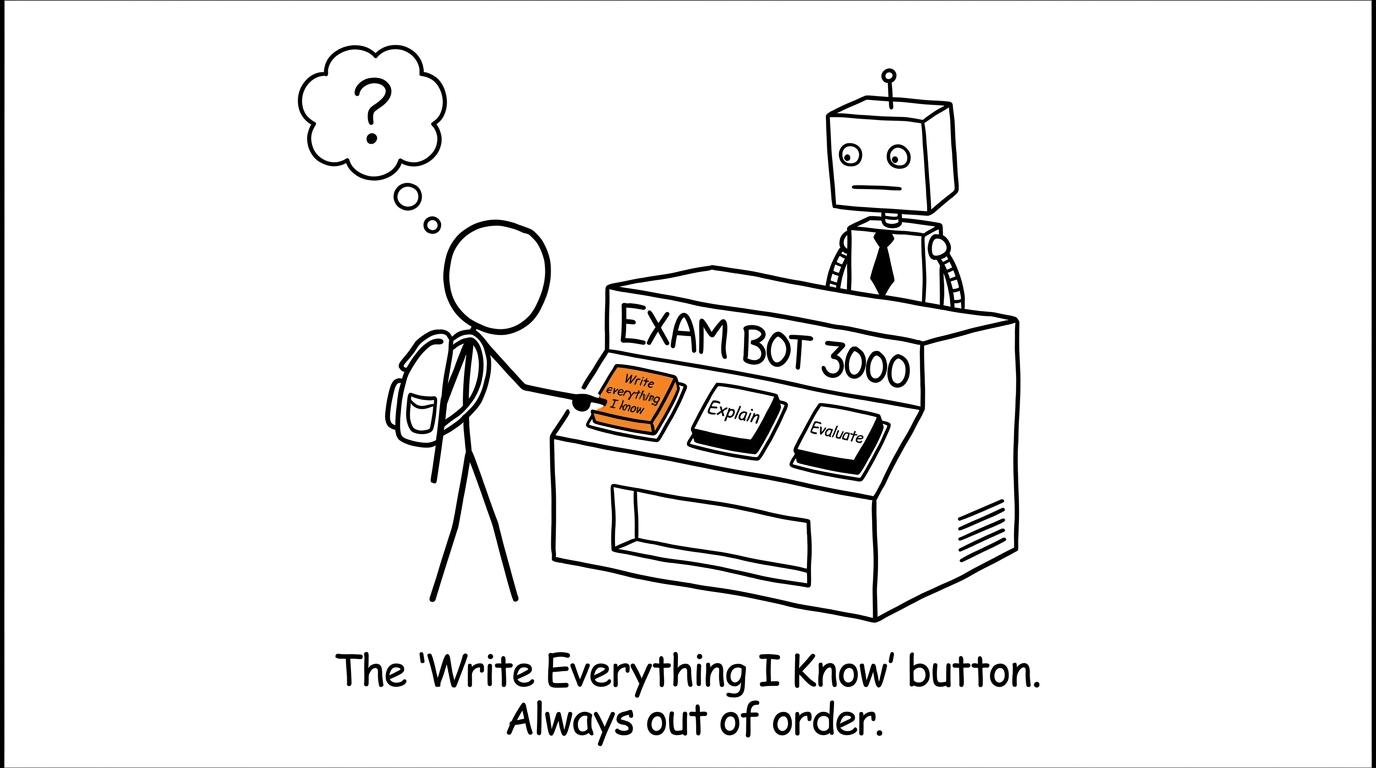 An exam-technique vending machine rewards evidence and evaluation
Prepare for the exam room
End academic revision early enough to prepare practically:
- check the start time and location;
- pack black pens, pencils, a ruler, eraser and approved calculator;
- confirm whether you need any other permitted equipment;
- set an alarm and arrange transport;
- review one short sheet of case studies, fieldwork and personal mistakes;
- sleep rather than beginning another large topic.
In the exam, read the whole question, including any source title, date, key and units. Match your answer to the marks available. If you become stuck, write what you can justify from the source, leave space and return later.
Common last-minute revision mistakes
Trying to cover everything equally
The course is too broad for equal treatment in three days. Use the specification and your diagnostic list to prioritise fragile, examinable material.
Making beautiful new notes
Presentation can feel productive while protecting you from recall. Create only summaries that you will test immediately.
Memorising disconnected statistics
A precise figure helps only when it supports the question. Remember what the evidence demonstrates, not merely the digits.
Ignoring fieldwork and skills
Students often retreat into familiar case studies. Yet maps, data, sources and fieldwork are central parts of GCSE Geography across specifications. Give them a defined session.
Completing questions without reviewing them
Practice without feedback rehearses the same weaknesses. The correction is the valuable part: identify why the mark was lost and improve the answer.
Sacrificing sleep for one more chapter
Revision must survive contact with the exam. A tired brain that has seen everything may perform less effectively than a rested brain with clear priorities.
A calm finish is still productive
Three days cannot make revision perfect. They can make it purposeful.
Begin with the paper you are actually sitting. Reduce the course to priorities, retrieve your case studies and fieldwork, practise geographical skills, answer timed questions and learn from the mark scheme. Then stop. Calm is not the absence of urgency; it is urgency given a sensible order.
Use MathsGenie as your free revision base: choose the relevant revision lessons, strengthen transferable maths skills with practice questions, and use past papers, predicted papers, mini tests, mark schemes and video solutions where available. Start with one honest diagnostic task now. The next three days will feel smaller as soon as the first useful action is complete.