

GCSE Geography Exam-Day Kit: Simple Checklist
GCSE geography exam day kit: pack the right pens, pencil, ruler, calculator and clear water bottle, and avoid prohibited items with this checklist.
The night before an exam is a bad time to discover that your only black pen has stopped working. It is also when an ordinary calculator can suddenly feel like an ancient machine whose battery may or may not survive the morning.
A reliable GCSE geography exam day kit is simple: at least two black pens, an HB pencil, a rubber, a sharpener, a ruler, an approved calculator and a clear pencil case. Add a label-free clear water bottle if your school permits one. Then check your timetable, paper instructions and school guidance because equipment requirements can vary between exam boards and individual papers.
This guide gives you a calm, practical checklist based on current examination rules. Pack it the night before and the morning becomes much easier.
Your GCSE geography exam day kit checklist
Put these items together in one clear pencil case:
- At least two working black ballpoint pens
- An HB pencil
- A rubber
- A pencil sharpener
- A ruler marked in centimetres and millimetres
- An approved calculator with a working battery
- Coloured pencils, if your teacher or paper instructions indicate that they may be useful for diagrams, maps or charts
- A clear, label-free water bottle, if permitted by your centre
Outside the pencil case, have these ready:
- Your school identification or candidate card, if your centre requires it
- The correct school uniform or clothing required by your centre
- Any approved medication, following your school’s arrangements
- Your journey plan and the time you need to leave
Do not pack revision notes, a phone, earbuds, smart glasses, a tablet or any type of watch for use in the exam room. Current Joint Council for Qualifications rules treat possession of unauthorised material as a breach even when a student does not intend to use it.
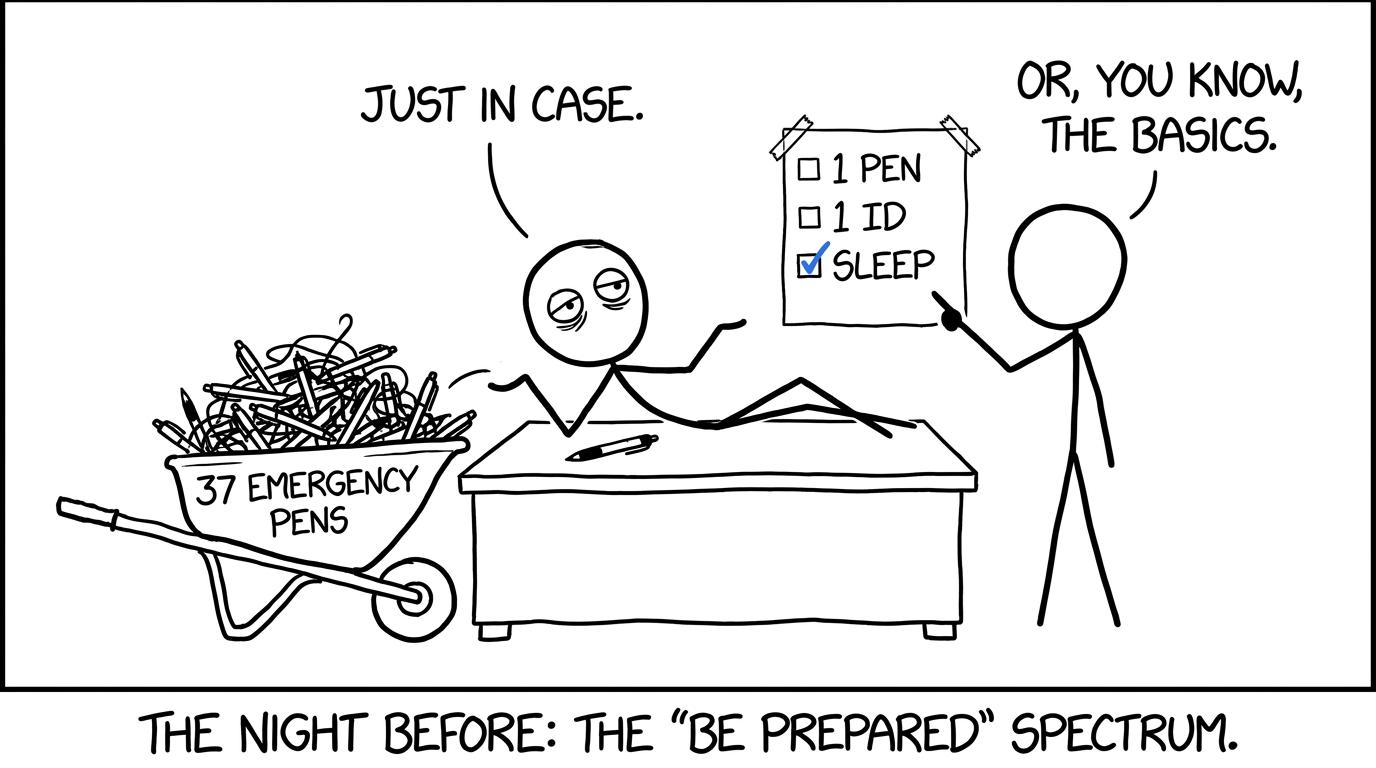 A student discovers that sensible exam packing needs fewer emergency pens than expected
The essential writing equipment
Bring at least two black pens
You must write clearly in black ink unless the front of the question paper says otherwise. Black ballpoint pens are the safest choice. Gel pens, erasable pens and correction fluid should stay at home because current examination instructions prohibit their use in answers.
Test every pen on scrap paper before packing it. One pen is equipment; a second pen is insurance. Keep both in a see-through pencil case so an invigilator can inspect the contents easily.
Highlighters may generally be used to highlight words in a question or supplied resource, but not within your written answers. They are optional rather than essential. If you take one, follow the instructions given by your centre and the invigilator.
Pack a pencil, rubber and sharpener
An HB pencil is useful for graphs, diagrams and map work. A sharp pencil gives you greater control when plotting information or drawing a precise line against a scale.
A rubber lets you correct pencil work cleanly, while a small sharpener prevents the familiar problem of trying to draw an accurate graph with a blunt pencil. These are modest objects, but exam-day preparation is mostly about removing modest problems before they consume attention.
Use a transparent pencil case
Any pencil case taken into the examination room must be see-through under current JCQ instructions. Avoid notes, formulae, labels or unofficial information inside it. The purpose is not to create an elaborate stationery collection. It is to keep permitted equipment visible and uncomplicated.
The geography tools that matter
A clear ruler
A ruler is commonly required or useful in GCSE Geography. You may need it to read a scale, measure a map feature, complete a graph or draw a line accurately. Pearson’s current materials information, for example, specifies a calculator and ruler for several Edexcel GCSE Geography papers. OCR also permits a ruler and calculator for relevant Geography A questions.
Choose a ruler with legible centimetre and millimetre markings. Check that its edge is not chipped and that the markings have not rubbed away.
Geographical calculations may involve relationships such as:
actual distance=map distance×scale factor\text{actual distance}=\text{map distance}\times\text{scale factor}actual distance=map distance×scale factorThe exam may assess the method, but your equipment allows you to carry it out accurately.
An approved calculator
Pack a familiar scientific calculator unless your school or paper instructions explicitly say it is unnecessary. Calculators are permitted in many GCSE Geography examinations and support quantitative skills such as percentages, averages, ratios, data interpretation and scale calculations.
Current JCQ rules say that a permitted calculator must not provide access to stored text, formulae, communication facilities, the internet or symbolic algebra and calculus features during the examination. A phone calculator is never an acceptable substitute. If your calculator has an examination mode, make sure you understand how it works before exam day.
The night before:
- Switch the calculator on and test several keys
- Check the battery or charge, as appropriate
- Clear stored information that is not permitted
- Remove any cover carrying printed instructions or formulae
- Make sure you know how to enter fractions, brackets and percentages
Maths and geography meet more often than students expect. If calculations are a weak area, use the free MathsGenie GCSE maths revision resources to refresh percentages, averages, ratio and graphs before the exam. Keep the final evening light, though. Packing should support revision, not become another revision session.
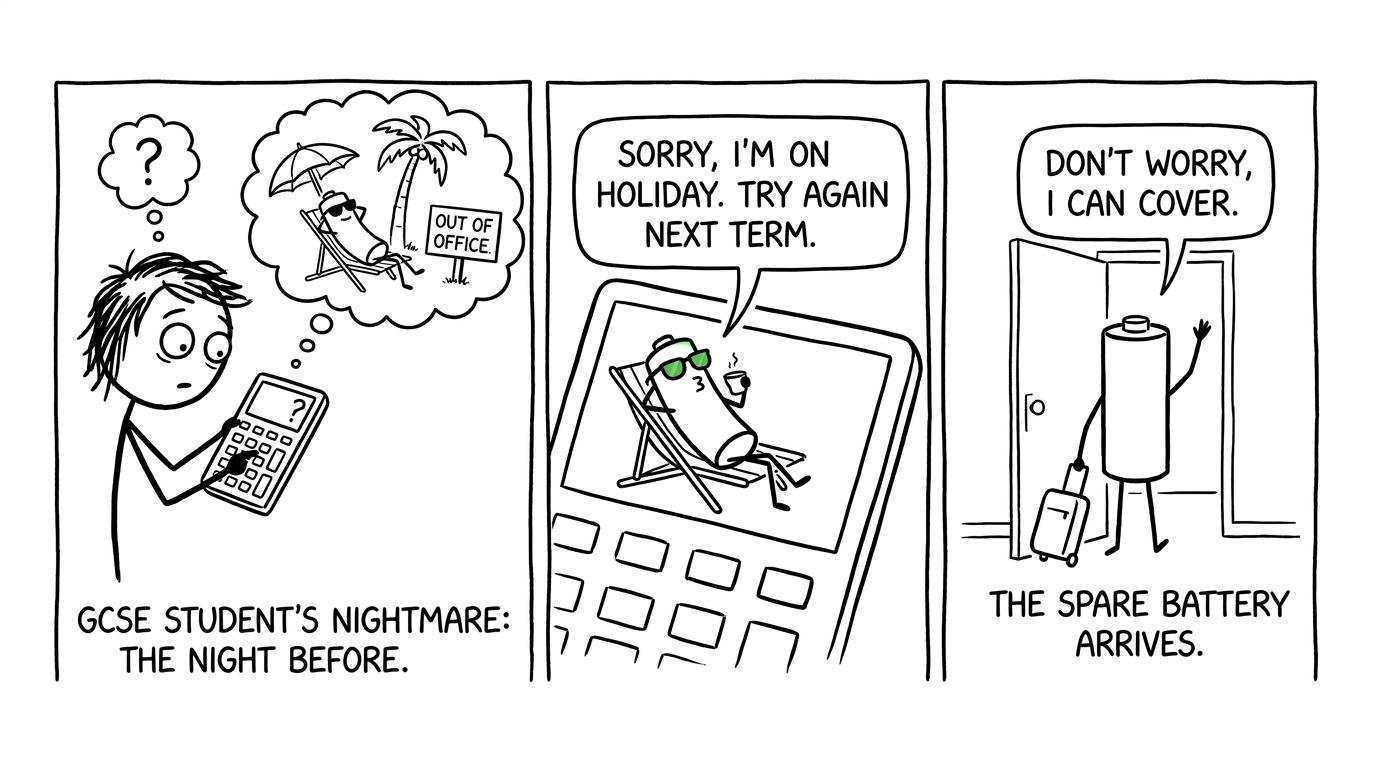 A calculator battery chooses an inconvenient moment to take a holiday
Do you need a protractor or string?
Requirements differ between specifications and papers. A protractor is not a universal GCSE Geography requirement, so check the front-page instructions, your teacher’s guidance and information from your exams officer.
Some OCR Geography A papers may allow a piece of string for measuring curved distances, but OCR describes this as optional and explains that candidates can still measure without it. Do not assume that an unusual item is allowed simply because it appeared in a practice lesson. Your centre’s instructions come first.
What to prepare outside the pencil case
Check the exact paper
Write down or photograph your timetable before putting your phone away. Confirm:
- The date and morning or afternoon session
- Your arrival time
- The examination room
- Your seat or candidate details, if supplied
- The exam board and paper
- Any equipment instructions from your school
- Who to contact if an emergency delays you
AQA, Edexcel, OCR and Eduqas papers do not necessarily request identical materials. Even papers from the same specification can differ. The definitive information for your sitting is the guidance from your centre together with the instructions printed on the question paper.
Prepare permitted water
If your school allows water, use a clear bottle without a label. Avoid coloured or opaque bottles. Ask your exams officer beforehand if you are uncertain rather than testing the rule at the examination-room door.
Food is not normally part of an exam kit unless your centre has approved it for a medical reason. Eat beforehand and follow your school’s arrangements for medication or other access needs.
Protect approved access arrangements
If you have an agreed access arrangement, check the details with your special educational needs coordinator or exams officer before the examination. This may concern supervised rest breaks, extra time, a word processor, coloured overlays or another approved arrangement.
Do not attempt to create your own substitute on the morning. If the arrangement you expect is missing, tell the invigilator immediately.
What must stay out of the exam room
Leave these items in the place directed by your centre:
- Mobile phones
- Analogue, digital and smart watches
- Earphones and earbuds
- Smart glasses and other communication devices
- Revision cards, notes and textbooks
- Calculator instructions or prepared programs
- Correction fluid, correction tape and erasable pens
- Pencil cases that are not transparent
Switching a phone off is not the same as making it permitted. Follow your school’s collection or storage process before entering the room.
Once inside, listen to the invigilator. Do not open the paper or begin writing until instructed. If you receive the wrong paper, cannot read a printed page or think a required resource is missing, raise your hand rather than trying to resolve the problem yourself.
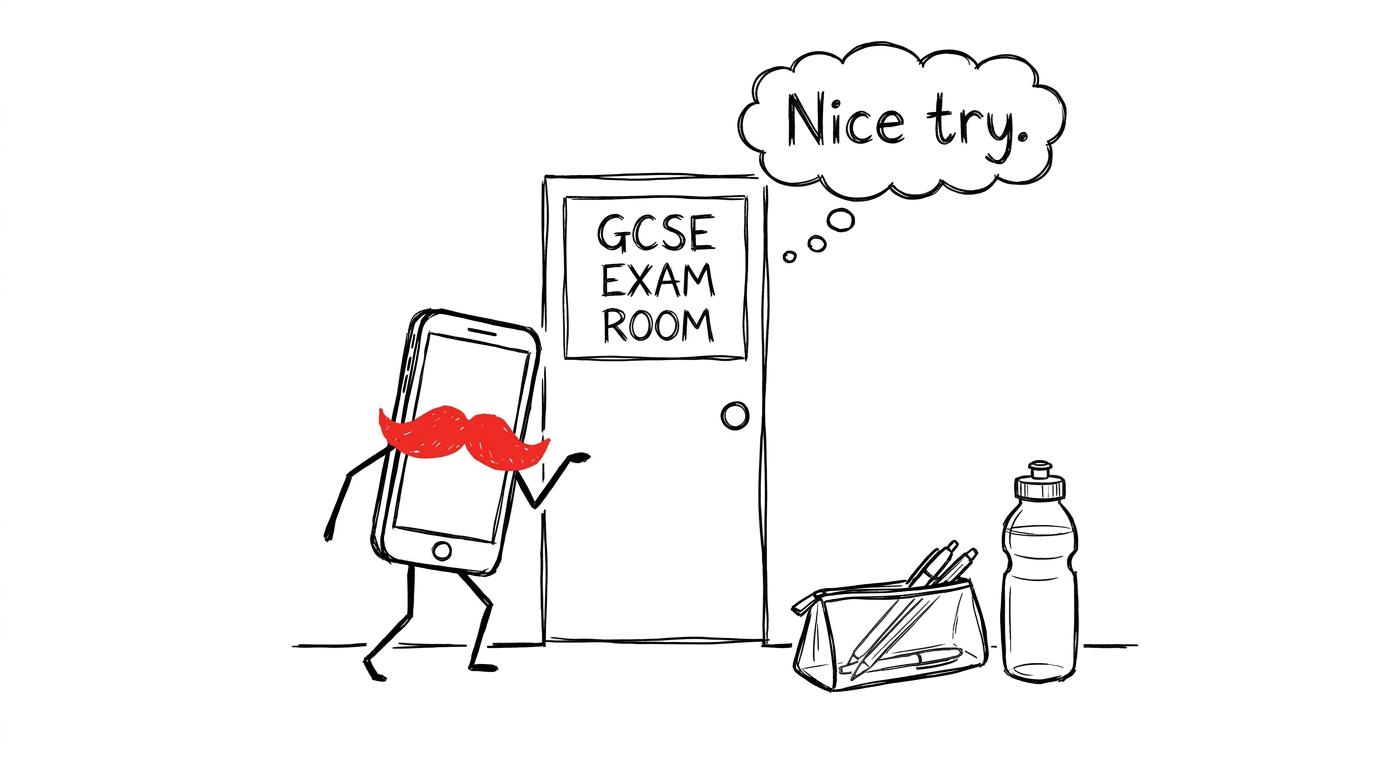 A disguised mobile phone makes an unsuccessful attempt to enter the exam room
A calm night-before routine
Packing works best as the final step of a short routine, not as something done while leaving the house.
First, finish revision at a sensible time. If you are also preparing for GCSE Maths, the GCSE maths revision timetable guide explains how to balance topic practice with timed work. Avoid beginning a full paper late in the evening simply because anxiety says you should do more.
Next, place every item on a desk. Test the pens and calculator, inspect the ruler and put the stationery into a clear pencil case. Check your timetable and set an alarm. Put your bag, clothing and travel essentials together.
Finally, stop. Preparation has a point of diminishing returns. A student who keeps rearranging pens at midnight is not becoming more prepared.
For future maths exams, a timed paper is a useful rehearsal because it tests both knowledge and equipment. Read how to use GCSE past papers properly, then choose a suitable paper and practise with the calculator, ruler and stationery you intend to take. Nearer the exam, Edexcel GCSE Maths predicted papers can provide fresh timed practice.
Common GCSE exam-kit mistakes
Packing only one pen
Pens fail, leak and run out. Two tested black ballpoint pens should be your minimum.
Assuming every geography paper needs identical equipment
Equipment can vary by exam board and paper. Check your own centre’s instructions rather than copying a friend whose specification may be different.
Bringing a calculator without checking it
A calculator is useful only if it works and complies with examination rules. Test it, check the battery and remove prohibited stored material or printed covers.
Leaving a watch on
Current JCQ written-exam rules prohibit all watches, not only smart watches. Remove yours before entering and store it as your centre directs.
Taking notes in by accident
Empty pockets and inspect the pencil case before leaving home. Possession of unauthorised material can lead to sanctions even if it is never used.
Using unsuitable pens
Do not write answers with blue ink, gel pens or erasable pens. Use black ballpoint pen, reserving pencil or permitted colour for diagrams, maps and charts where appropriate.
Pack once, then focus on the paper
A good GCSE geography exam day kit is deliberately uninteresting. It works because nothing in it asks for attention. Your pens write, your ruler is readable, your calculator switches on and your prohibited devices are safely outside the room.
Use this checklist the night before, then follow the specific guidance from your school, exams officer and question paper. When geography is finished and maths becomes the next priority, return to MathsGenie. The free revision lessons, practice questions, past papers, predicted papers, mini tests, mark schemes and video solutions give you a clear route from uncertainty to useful practice. The GCSE resit and exam preparation guide also explains how to diagnose weaknesses and plan the next step.
Pack the kit. Check the timetable. Then let your attention go where it earns marks: onto the question in front of you.










