GCSE Geography Exam Cost: Private Candidate Guide
GCSE geography exam cost private candidate guide: compare fees, fieldwork charges and late-entry risks, then find an approved UK exam centre near you.
The exam-board fee can look surprisingly small. Then the exam centre adds administration, invigilation and, potentially, fieldwork support. That is why two candidates sitting the same qualification can receive very different quotes.
For anyone comparing GCSE geography exam cost private candidate options, the practical answer is to budget roughly £200\text{£}200£200 to £300\text{£}300£300 for a standard, on-time entry at a private exam centre. Some centres advertise less, while specialist arrangements, fieldwork support, access arrangements, late booking and travel can push the real cost higher.
You cannot normally book directly with AQA, Pearson Edexcel, OCR or Eduqas. An approved school, college or independent exam centre must enter you. Geography also has fieldwork requirements, so finding a centre willing to accept the exact specification matters just as much as comparing prices.
Private candidate cost checklist
Before paying, confirm all of the following:
- the total fee, including the awarding-body entry and centre administration charges
- the exam board and exact specification code
- whether every written paper is included
- how the centre will verify your required fieldwork
- whether access arrangements cost extra
- the centre's own booking deadline and late-fee policy
- what identification and previous candidate details are required
- where and when each paper will be sat
- the cancellation and refund terms
A sensible initial budget is £200\text{£}200£200 to £300\text{£}300£300, but only a written quotation from your chosen centre tells you the amount you will actually pay.
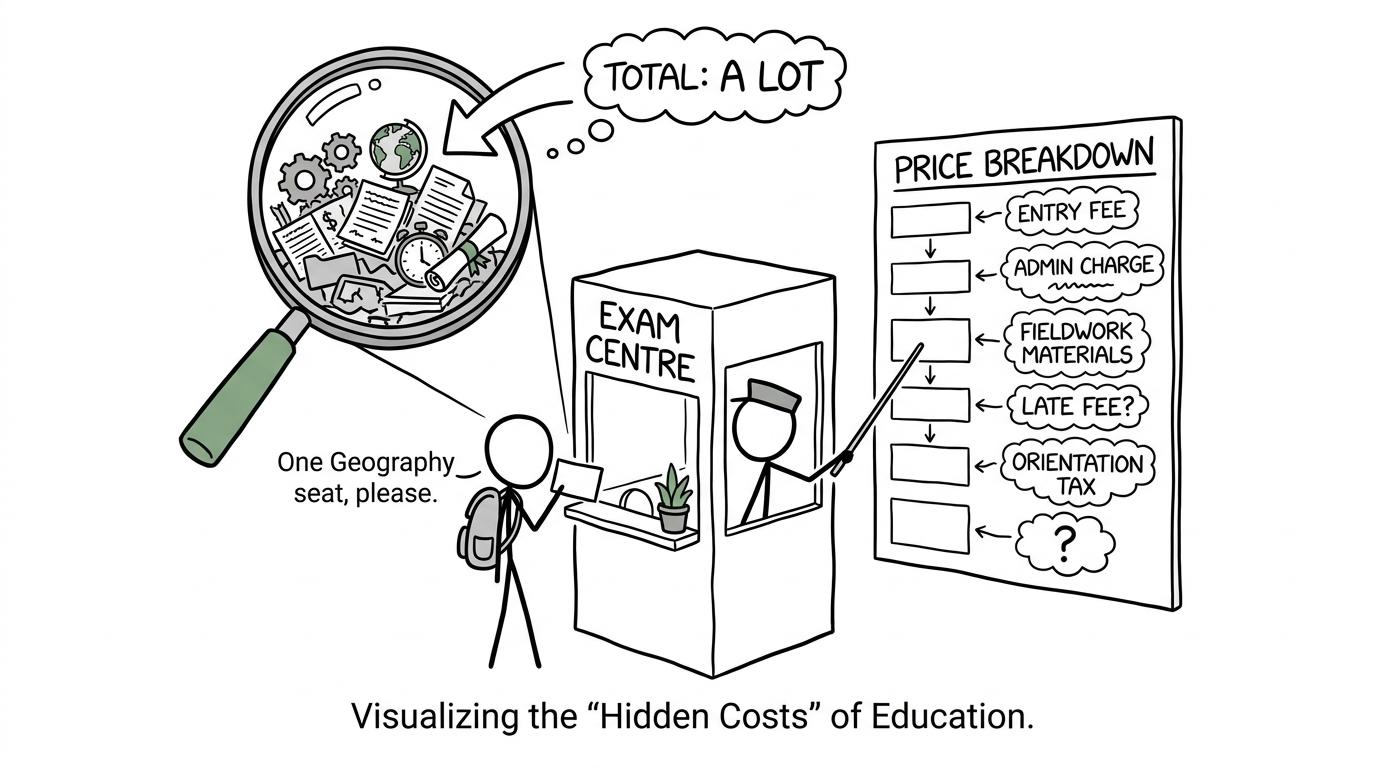 A private candidate investigates an exam centre's menu of charges
How much does private GCSE Geography cost?
There is no single national private-candidate price. The awarding body charges the approved centre an entry fee, and the centre decides what to charge you for administering and hosting the exams.
For context, published fees for the 2025/26 academic year listed Pearson Edexcel GCSE Geography A and B at £55\text{£}55£55, while OCR listed both Geography A and Geography B at £55\text{£}55£55. These are awarding-body fees to centres, not guaranteed prices for individual private candidates.
Published private-centre prices reviewed for the summer 2026 series placed Geography entries at approximately £190\text{£}190£190 to £290\text{£}290£290 before certain optional or exceptional charges. Other centres listed an AQA Geography entry at £260\text{£}260£260. This supports a realistic planning range of around £200\text{£}200£200 to £300\text{£}300£300 for an ordinary on-time booking.
These figures are a guide rather than a quotation. Fees change between exam series, and not every centre has published its summer 2027 prices at the time of writing in August 2026.
| Part of the cost | What it may cover |
|---|---|
| Awarding-body entry fee | Registration for the complete GCSE qualification |
| Centre administration | Processing the entry, candidate records and results |
| Accommodation and invigilation | The exam room, staff and secure handling of papers |
| Fieldwork administration | Checking evidence and completing required declarations |
| Access arrangements | Evidence review, separate rooms, readers, scribes or other approved support |
| Late-entry charge | Extra fees after the awarding body or centre deadline |
| Travel | Reaching the centre for every paper and any required appointment |
A useful way to think about the total is:
T=B+A+F+L+RT = B + A + F + L + RT=B+A+F+L+Rwhere BBB is the board entry fee, AAA is centre administration, FFF is any fieldwork-related charge, LLL is any late fee and RRR represents travel or other personal costs. A centre advertising one headline price may not include every term in this total.
Why the centre charges more than the exam board
The difference is not simply a mark-up on an exam paper. A centre must verify your identity, create or retrieve candidate records, make the correct entry, store confidential materials, provide suitable rooms and invigilators, return scripts securely and manage results.
It may also need to answer questions about fieldwork evidence or process an access-arrangement application. A candidate requiring a separate room or dedicated support can create costs that are not present in a standard entry.
This explains why the £55\text{£}55£55 board fee does not mean you can expect to sit the qualification for £55\text{£}55£55. The board fee is one layer. The centre provides the place, people and administration that make the entry possible.
Geography fieldwork can affect availability and price
GCSE Geography is not merely a collection of written papers. Fieldwork is examined, and centres have responsibilities connected with confirming that candidates have completed the required activity.
For AQA GCSE Geography specification 8035, private candidates must complete fieldwork outside school grounds on two separate occasions. The head of the entering centre must sign a statement confirming that this has been completed. The centre may use evidence supplied by the candidate and ask questions about the enquiries, or it may arrange for a teacher to supervise the fieldwork.
Other boards also set fieldwork and centre-declaration requirements, although the details differ by specification and exam series. This has two important consequences:
- a centre that accepts private candidates generally may still refuse GCSE Geography
- a centre may accept the subject only if it can verify suitable fieldwork evidence
Ask about this before paying for a course or preparing an independent fieldwork investigation. Do not assume that an exam-only fee includes a field trip, supervision or authentication.
Maths plays a quiet but important role here. Geography papers can assess data handling, percentage change, sampling, graphs and map calculations. MathsGenie's free AQA GCSE Geography statistical skills resources cover the numerical techniques used to interpret geographical evidence. The cartographic skills revision guide can also help with scale, direction, relief and map interpretation.
Where to book GCSE Geography as a private candidate
Begin with the Joint Council for Qualifications private-candidate centre search. It allows you to search approved centres by location, qualification type and awarding body. The list is a starting point, not a guarantee: JCQ advises candidates to confirm details directly because availability and centre policies can change.
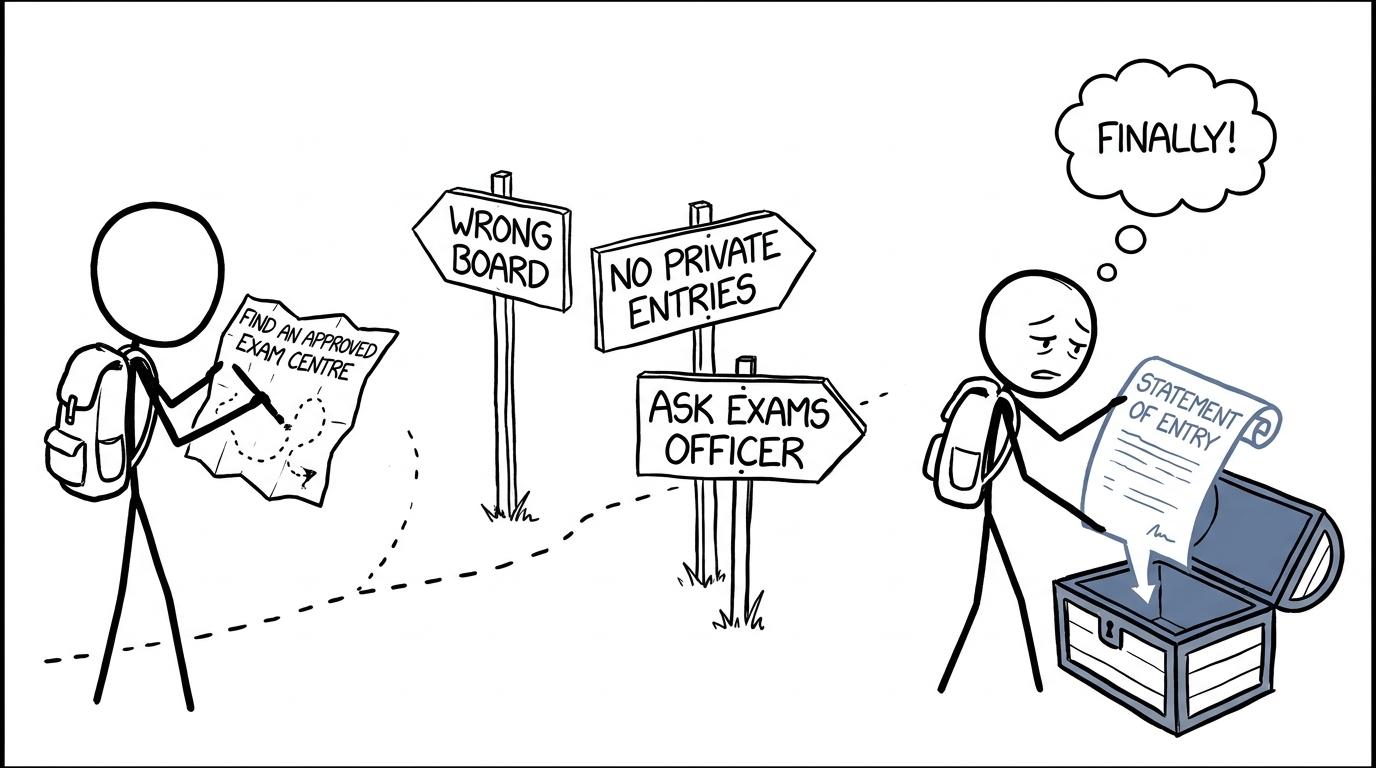 A candidate navigates the search for an approved exam centre
Choose the specification first
Decide whether you are taking AQA, Pearson Edexcel, OCR or Eduqas and record the exact specification. Examples include AQA 8035, Edexcel Geography A 1GA0 and Edexcel Geography B 1GB0.
Geography does not have foundation and higher tiers, but boards can offer different specifications. Edexcel Geography A and Geography B are separate qualifications, for example, and their papers cannot be mixed.
Contact several centres
Search by postcode, then contact several suitable centres rather than relying on the first listing. Ask the exams officer:
- Do you accept private candidates for this exact specification?
- What is the full on-time fee?
- Are all papers and invigilation included?
- How will you approve or verify my fieldwork?
- What is your internal entry deadline?
- What happens if the board changes a timetable date?
- Can you process my access arrangements if required?
Local schools and colleges not shown in the search may also choose to accept private candidates, so a polite enquiry can still be worthwhile.
Register and check the statement of entry
The centre will normally request personal details, identification and information about previous entries, including your Unique Candidate Identifier if you already have one. It then submits the entry to the awarding body.
When you receive your statement of entry, check your name, date of birth, subject, board, specification and components. A small unchecked error can become a large problem when papers arrive.
Book early to avoid avoidable charges
Awarding bodies set entry deadlines, but centres commonly impose earlier internal deadlines so their exams officers have time to complete the work. Once the standard window closes, late or very late entry fees may apply. Capacity can also disappear even while a late entry remains technically possible.
For the June 2026 series, AQA and Pearson's standard entry deadline was 21 February 2026. Those dates should not be reused for a later series: ask the centre for its current deadline and book well before it.
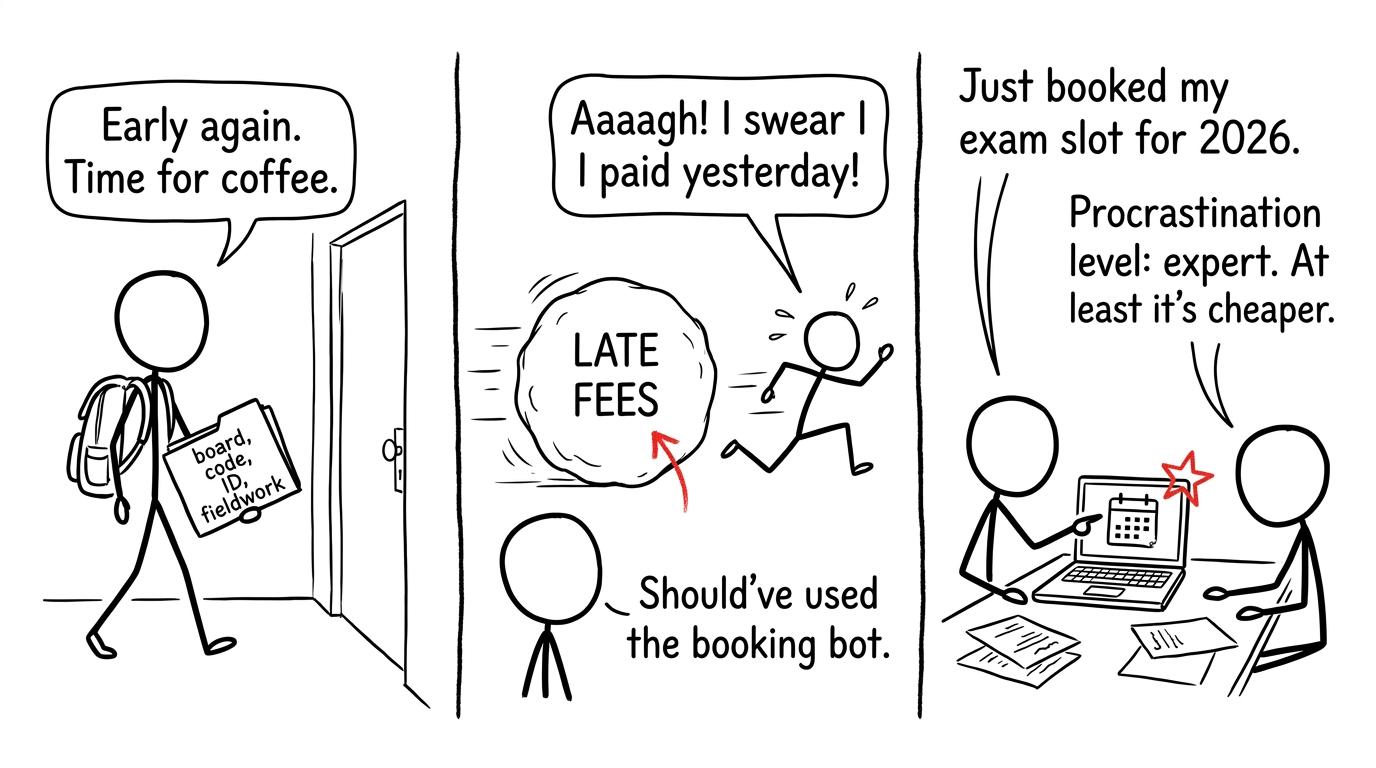 An organised candidate stays ahead of a rolling late-fee snowball
Early contact is particularly important if you need extra time, a reader, a scribe, a word processor or another access arrangement. The centre must consider evidence and follow JCQ rules; it cannot necessarily add support shortly before the exam.
Use maths revision to strengthen Geography marks
Paying for the seat only gets you into the room. Geography still rewards confident numerical reasoning.
Revise percentage change using:
Percentage change=new value−original valueoriginal value×100\text{Percentage change} = \frac{\text{new value}-\text{original value}}{\text{original value}} \times 100Percentage change=original valuenew value−original value×100MathsGenie's percentage change revision resources build the same calculation skill used when interpreting changing populations, rainfall, economic data or land use. The scatter graphs revision guide supports correlation, lines of best fit and cautious prediction.
If maths is one of your private GCSE entries too, use the AQA GCSE Maths revision hub or select the page matching your own board. Follow topic revision with Edexcel GCSE Maths predicted papers, rather than treating papers as a substitute for learning weaker skills.
Common mistakes private candidates make
Comparing headline prices instead of total prices
One centre may include administration and invigilation while another lists them separately. Ask for one written total and a list of possible additions.
Booking the wrong specification
“GCSE Geography” is not enough information. Confirm the board, specification title and code before making payment.
Assuming any private centre offers Geography
A centre may offer written subjects but decline Geography because it cannot meet the fieldwork requirements. Obtain written confirmation first.
Leaving fieldwork until after booking
Fieldwork is not optional background knowledge. Ask what evidence the centre needs, who approves it and when the declaration must be completed.
Waiting for the awarding-body deadline
Your centre's deadline may be earlier. Late entries can cost considerably more, and a centre can refuse them when rooms are full.
Forgetting travel across several papers
GCSE Geography normally involves multiple written papers. Check the provisional timetable and calculate the cost and practicality of reaching the centre each time.
Turn the booking into a revision plan
Private entry feels uncertain because there is no school office quietly completing the forms in the background. The solution is not to worry about every possibility. It is to make the important decisions early: board, specification, centre, fieldwork, total fee and deadline.
Once the statement of entry is correct, attention can return to what earns marks. Build a manageable schedule with the GCSE one-month maths revision plan, using it as a model for short topic sessions, retrieval and timed practice.
MathsGenie gives you a free place to continue: revision lessons to rebuild understanding, practice questions and mini tests to make methods reliable, and past papers, predicted papers, mark schemes and video solutions to develop exam technique. Start with MathsGenie's free GCSE and A Level revision resources, confirm your exam arrangements early, and make every paid exam entry count.