

GCSE Geography Cram Guide: A 1-Week Plan
GCSE geography cram guide 1 week: follow a focused seven-day plan for case studies, fieldwork, skills and exam questions with less panic now.
There is a particular kind of panic that arrives when the exam is close and the revision folder is still mostly untouched. Geography makes that feeling worse because the course appears enormous: physical processes, human geography, case studies, fieldwork, maps, data and extended answers.
This GCSE geography cram guide 1 week plan gives you a direct response. Spend the next seven days identifying what your exam board assesses, retrieving essential knowledge, practising geographical skills and answering real exam questions. You cannot relearn two years perfectly in a week. You can, however, become considerably better prepared than you are today.
The aim is not to read everything. It is to turn limited time into usable knowledge and better exam decisions.
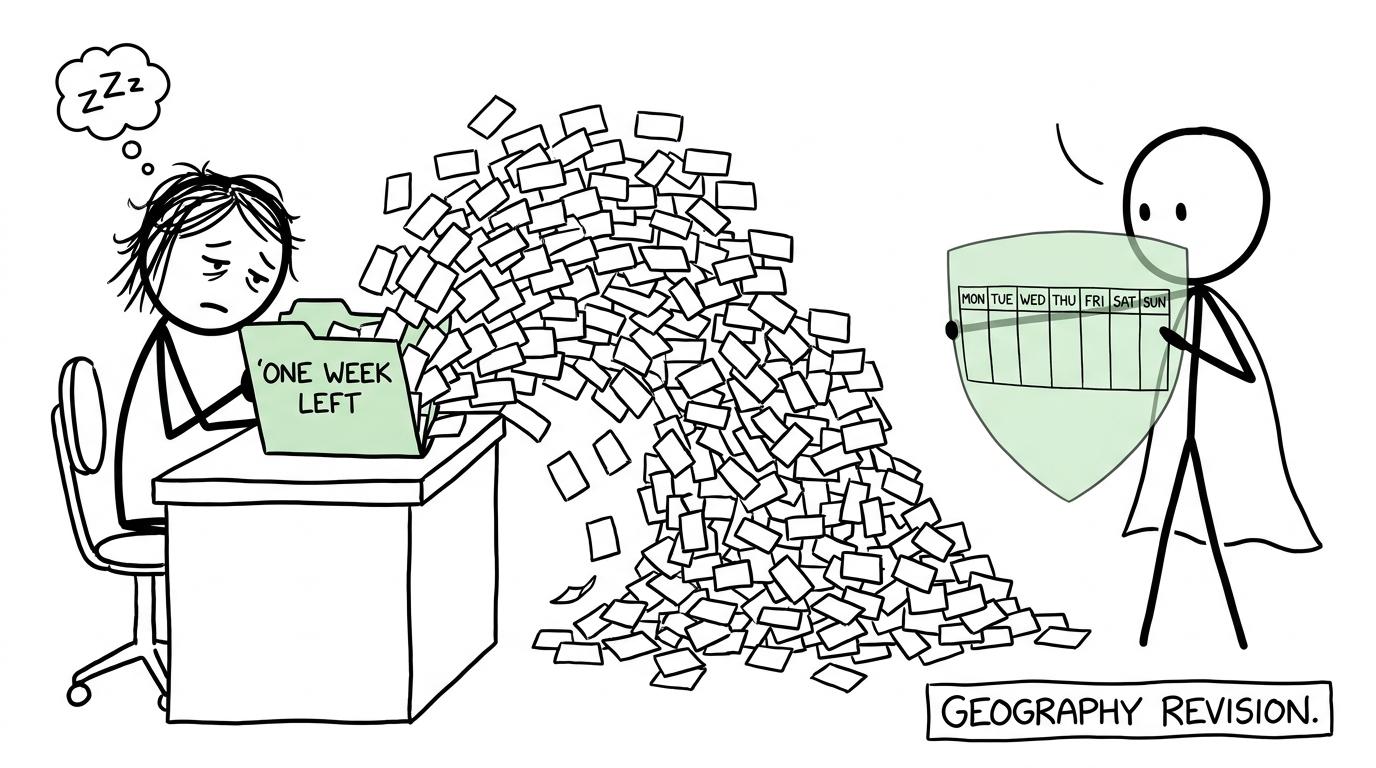 A student uses a seven-day plan to defend against an avalanche of revision cards
Your one-week geography revision checklist
Before the detailed plan, gather the following:
- Your correct specification for AQA, Edexcel, OCR or Eduqas
- A list of the topics taught by your school
- Your named case studies and fieldwork enquiries
- Past papers and official mark schemes
- A notebook or document for recording mistakes
- A calculator, ruler and basic writing equipment
- Seven realistic revision slots of around 909090 to 150150150 minutes
Check the front of a recent school assessment if you do not know your exam board or specification. Do not assume that a friend's topic list is right for you. Exam boards divide content and papers differently, and Pearson has introduced timing changes for some Edexcel Geography examinations in 202620262026. Your teacher and current official exam information should be your final reference.
A useful daily structure is:
- 252525 minutes of closed-book recall
- 353535 minutes repairing gaps with notes
- 404040 minutes answering exam questions
- 202020 minutes marking and recording corrections
- A short break between blocks
If you have less time, preserve the order but shorten the blocks. Retrieval, questions and review matter more than creating attractive notes.
Why this plan prioritises application
Across GCSE Geography specifications, Ofqual's assessment objectives allocate approximately 15%15\%15% to knowledge, 25%25\%25% to geographical understanding, 35%35\%35% to applying knowledge through interpretation, analysis, evaluation and judgement, and 25%25\%25% to geographical skills.
That balance explains why rereading a textbook is not enough. Knowledge matters, but the larger task is using it. You must interpret unfamiliar resources, connect causes and consequences, assess evidence and justify conclusions.
This is familiar territory for students who use MathsGenie's GCSE Maths revision hub: learning becomes useful when it is followed by questions, marking and correction. The subject changes, but the productive loop does not.
Day one: map the course and diagnose gaps
Start by turning the specification into a traffic-light checklist. Mark each required topic:
- Green if you can explain it without notes
- Amber if you recognise it but cannot produce a secure answer
- Red if you barely remember it
Include physical geography, human geography, geographical skills, fieldwork and any issue-evaluation or pre-release material required for your paper. For AQA, for example, geographical skills can be assessed across all three written papers rather than appearing only in a separate skills section.
Next, attempt selected questions from a past paper for 303030 to 404040 minutes. Do not revise first. This is a diagnosis, not a performance. Mark it and classify every lost mark as one of four things: missing knowledge, weak explanation, misunderstood command word or inaccurate skill.
Students preparing for several subjects can borrow the same diagnostic approach described in MathsGenie's guide to starting GCSE past papers. A paper is valuable because it shows you what to do next.
End the session by selecting the three weakest high-priority areas for the week.
Day two: secure physical geography
Focus on the physical topics named in your specification. These may include natural hazards, ecosystems, weather and climate, rivers, coasts or glacial landscapes, depending on your board and options.
For each major process, retrieve four things:
- What happens
- Why it happens
- The sequence or mechanism involved
- Its effects on people and environments
Then connect processes to landforms, hazards or management. A list of isolated definitions will not prepare you for questions asking you to explain relationships.
Condense each physical case study onto one side of paper. Record its location, relevant causes, primary and secondary effects, immediate and long-term responses, and evidence supporting an evaluation. Use only statistics that you can recall accurately and explain. One reliable piece of evidence is worth more than five uncertain figures.
Finish with short and extended physical-geography questions. Mark them immediately and rewrite only the weakest paragraph.
Day three: secure human geography
Use the same method for urban change, development, economic change, resource management or other human topics on your specification.
Human geography answers often become vague because students rely on general statements such as “this creates jobs” or “quality of life improves”. Push each idea one step further. Which jobs? For whom? How might income, access to services, housing or environmental quality change?
Build compact case-study sheets around:
- Location and context
- The issue or opportunity
- Specific causes
- Social, economic and environmental effects
- Management strategies
- Evidence of success and limitations
Do not replace your school's named examples with random internet case studies at the last minute. Your existing examples are more likely to match what you were taught and what the specification requires.
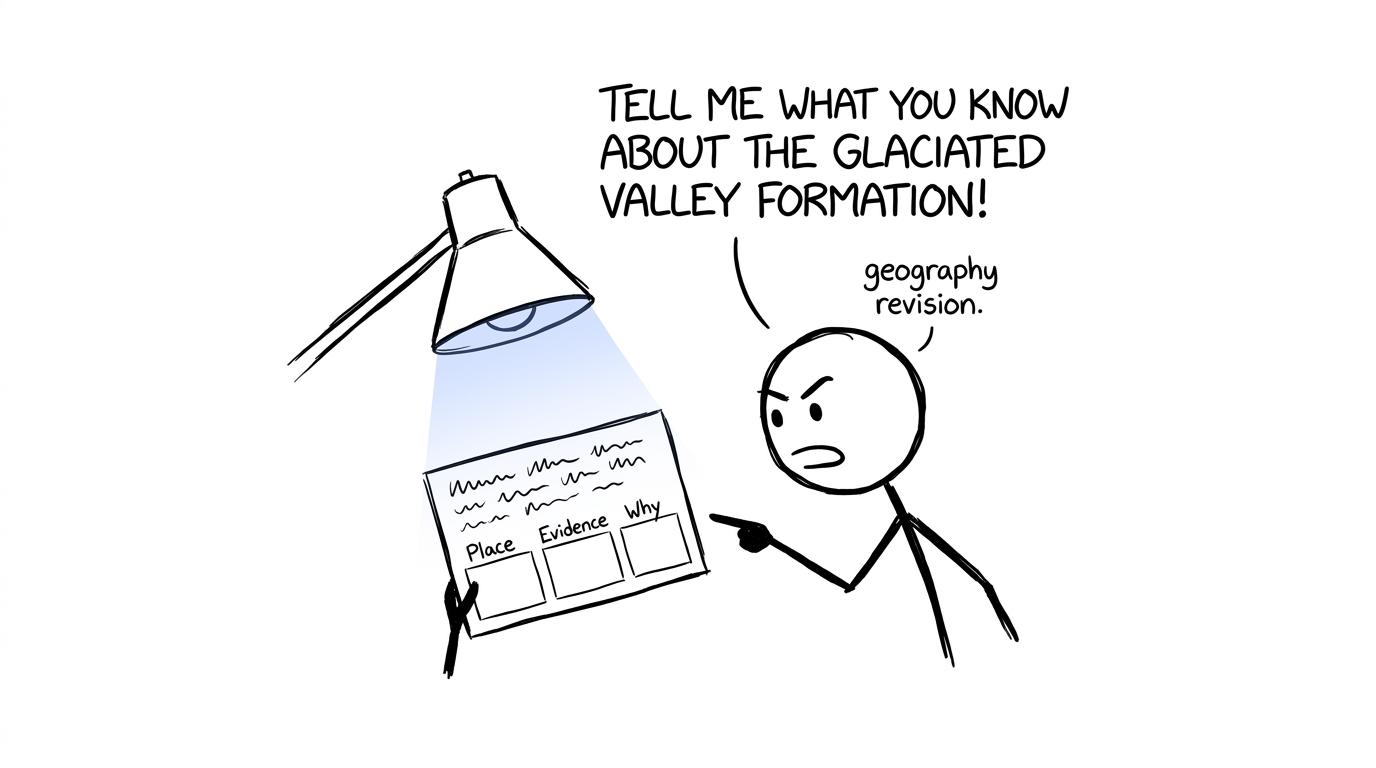 A student questions a suspiciously vague geography case-study card
Day four: rebuild case studies through retrieval
Today is about memory under pressure. Put your notes away and write every case-study name you need. Under each one, retrieve the location, process or issue, key effects, responses and a small number of precise facts.
Now check your notes in a different colour. The gaps you expose are your real revision list.
A strong case-study paragraph usually contains a relevant claim, named evidence and an explanation linking that evidence to the question. Avoid dropping a memorised fact into an answer without explaining its significance.
Use flashcards carefully. Questions such as “What happened?” encourage shallow recall. Better prompts include:
- Why was this location vulnerable?
- Which response was most effective, and why?
- How did effects differ between groups or places?
- What evidence supports this judgement?
Return to the same cards later that day and again on day six. A case study should become easier to reconstruct, not merely easier to recognise.
Day five: fieldwork, maps and numerical skills
Fieldwork is not just remembering where you went. You need to understand the enquiry process: question or hypothesis, sampling, data collection, presentation, analysis, conclusion and evaluation.
For each investigation, retrieve:
- The enquiry question and geographical setting
- The primary and secondary data used
- The sampling strategy
- Risks and ethical considerations
- Patterns, anomalies and conclusions
- Limitations and realistic improvements
An improvement must address a weakness. “Collect more data” is incomplete; explain where, when or how the additional data would make the evidence more representative or reliable.
Geographical skills may include grid references, scale, direction, contour patterns, photographs, graphs, averages, percentages, rates of change and interpretation of statistical relationships. Useful calculations include:
percentage change=new value−original valueoriginal value×100\text{percentage change}=\frac{\text{new value}-\text{original value}}{\text{original value}}\times 100percentage change=original valuenew value−original value×100and
mean=sum of valuesnumber of values.\text{mean}=\frac{\text{sum of values}}{\text{number of values}}.mean=number of valuessum of values.Always attach units where appropriate and interpret the result in its geographical context. If data handling is a weakness, MathsGenie's GCSE Statistics revision resources can reinforce charts, averages, sampling, correlation and data interpretation. The GCSE Maths self-assessment sheet can also help identify supporting skills such as percentages, ratio and estimation.
Day six: practise complete exam sections
Complete a substantial timed section from the correct exam board. Use the resources and instructions provided with the paper, including any relevant map extract or pre-release material.
Before writing, underline the command word and identify the geographical content required. A question asking you to describe needs accurate patterns or characteristics. Explain requires linked reasoning. Assess and evaluate require evidence, consideration of different sides or factors, and a supported judgement.
For longer answers, plan briefly before starting. A compact structure is:
- Make a clear argument
- Support it with geographical knowledge or resource evidence
- Explain why the evidence matters
- Consider another factor or limitation
- Reach a judgement that answers the precise question
Mark the section honestly. Read the level descriptors for extended responses rather than looking only for individual words. Then record the three errors most likely to recur.
The same review principle appears in MathsGenie's guide to using past papers properly: a paper is not finished until its mistakes have produced targeted action.
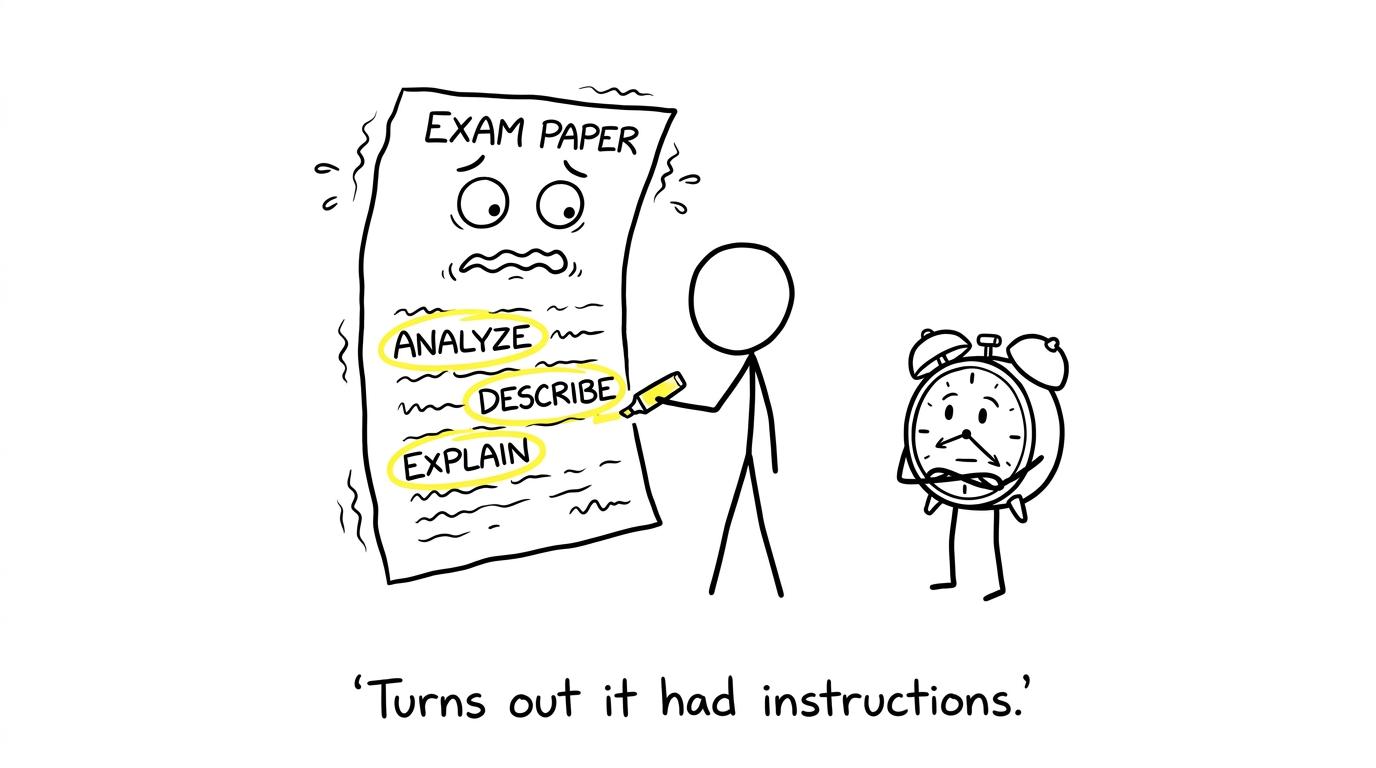 A student discovers that the exam paper monster came with instructions
Day seven: consolidate without exhausting yourself
Do not spend the final day attempting to relearn the entire course. Begin with closed-book retrieval of your weakest physical topic, weakest human topic, case studies and fieldwork enquiries.
Next, answer a small mixed set of questions. Review your mistake log and write a final page containing only information you still forget: easily confused processes, named evidence, command-word reminders and fieldwork limitations.
Check the time, equipment and rules for your actual paper. If your exam includes pre-release material, use the version supplied for your examination series and follow your teacher's guidance.
Stop at a sensible time. MathsGenie's night-before GCSE plan is written for maths, but its central lesson transfers well: fewer well-chosen tasks are better than frantic, unfocused hours.
Common mistakes during a one-week geography cram
Spending hours making notes
Notes feel safe because they remove the risk of being wrong. Unfortunately, the exam requires recall and application. Keep note-making brief, then close the book and answer something.
Revising topics that already feel comfortable
Confidence is pleasant but not always useful. Use your diagnostic paper and traffic-light list to direct time towards genuine weaknesses.
Memorising case studies without links
A place name and several statistics do not create an explanation. Practise connecting evidence to causes, effects, management and judgement.
Ignoring skills and fieldwork
Official assessment requirements include substantial application and skills. Maps, unfamiliar data and fieldwork evaluation deserve planned revision rather than whatever time remains.
Completing questions without marking them
Unmarked practice can repeat the same error. Use the mark scheme, identify the cause and reattempt the weak part later.
Treating predictions as certainty
No predicted topic list can guarantee what will appear. The safer approach is specification coverage followed by prioritised practice. MathsGenie's discussion of predicted topics and sensible prioritisation explains why predictions should guide practice, not replace the course.
Make the next seven days count
A week is not much time, but it is enough time to create order. Diagnose first. Repair the largest gaps. Retrieve case studies. Revisit fieldwork. Practise skills. Then sit and review exam questions.
Geography may be the immediate problem, but exam season rarely contains only one subject. Use MathsGenie's free GCSE Maths revision resources to apply the same disciplined cycle to maths: revision lessons, practice questions, mini tests, past papers, predicted papers, mark schemes and video solutions.
Start today's session now. Open the correct specification, make the checklist and let the first honest diagnostic decide what happens next.










