GCSE Geography 6 to 9: The Grade 9 Strategy
GCSE geography 6 to 9: improve analysis, case-study evidence, fieldwork evaluation and exam technique to turn secure answers into top marks.
A grade 6 answer often knows the geography. A grade 9 answer uses it.
That difference can feel frustrating. You may remember case studies, recognise processes and write several paragraphs, yet still see phrases such as “develop this point” or “use the resource” beside your work. The route from GCSE geography 6 to 9 is not simply learning more facts. It is learning to select evidence, apply it to unfamiliar contexts, analyse relationships and reach convincing judgements.
In practical terms, your priorities are:
- secure the specification knowledge you genuinely need;
- turn explanations into linked chains of reasoning;
- use resources and case studies as evidence, not decoration;
- evaluate fieldwork methods and conclusions precisely;
- become fluent with maps, graphs and numerical data;
- use mark schemes and timed papers to diagnose lost marks.
The climb is demanding, but it is not mysterious. Each extra grade tends to come from making your thinking more visible.
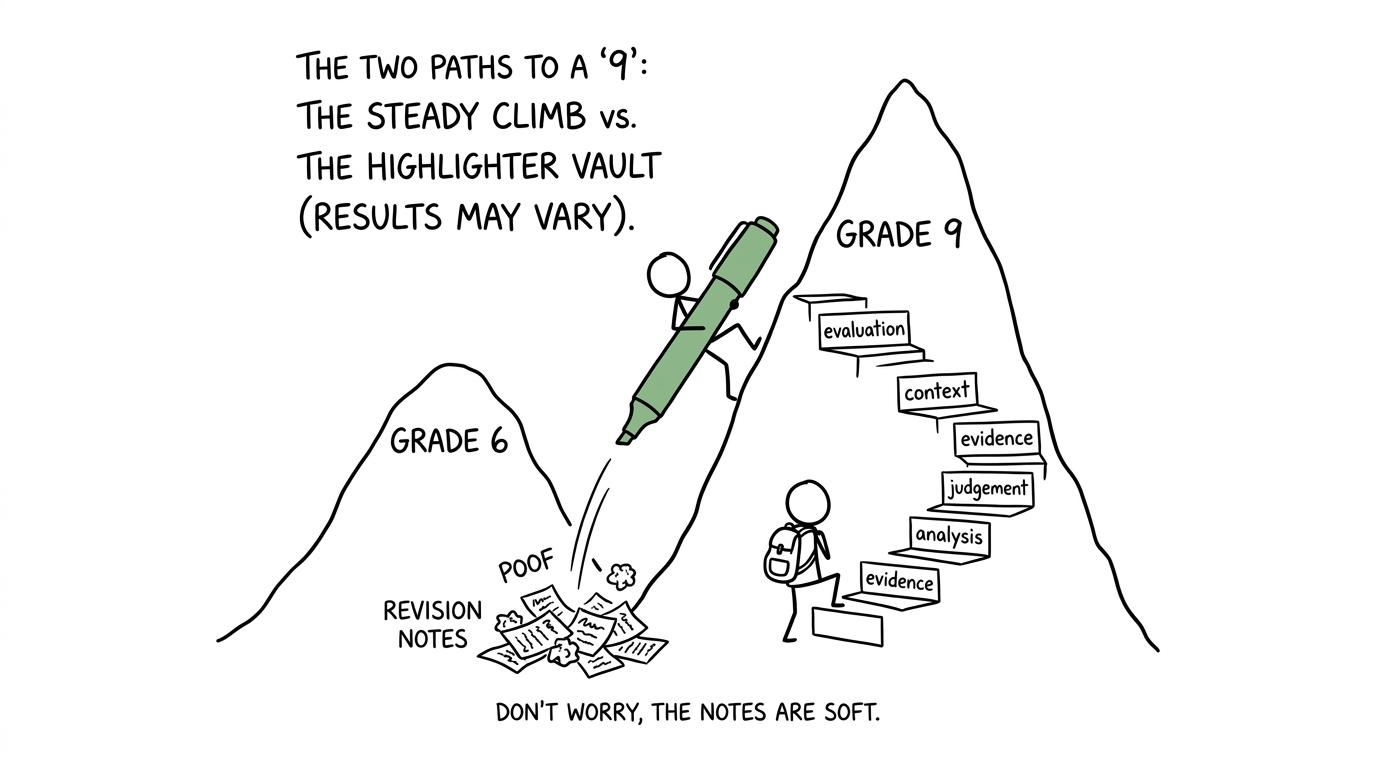 A student discovers that the route from grade 6 to grade 9 is a staircase of evidence, analysis and judgement
What separates a grade 6 from a grade 9 in GCSE Geography?
There is no official checklist describing grades 6 and 9 separately. Ofqual publishes broad Geography descriptors at grades 5 and 8, while actual grades depend on total performance and boundaries set after each examination series. A grade cannot be guaranteed by using a particular paragraph structure or collecting a fixed number of case-study facts.
However, the official descriptors reveal the direction of travel. Around grade 5, students generally show mostly accurate knowledge, clear understanding, coherent arguments and accurate use of a range of skills. At grade 8, performance is expected to include comprehensive and relevant knowledge, perceptive understanding of complex relationships, sustained arguments, well-evidenced conclusions and effective evaluation of geographical skills.
A useful comparison is:
| Secure grade 6 performance | Performance moving towards grade 9 |
|---|---|
| Accurate knowledge of the main content | Selective, detailed knowledge chosen for the exact question |
| Clear explanation of a process | Developed reasoning linking causes, processes, effects and scale |
| A relevant case-study reference | Place-specific evidence integrated into the argument |
| Some use of the supplied resource | Precise analysis of patterns, contrasts, anomalies and limitations |
| A supported conclusion | A comparative judgement based on stated criteria |
| General evaluation of fieldwork | Specific evaluation of validity, reliability, accuracy and sampling |
| Correct calculations most of the time | Accurate calculations followed by geographical interpretation |
The important word is selective. Grade 9 answers are not necessarily the longest. They are economical with irrelevant knowledge and generous with reasoning.
Build revision around the assessment objectives
Across GCSE Geography specifications, the four assessment objectives are set nationally. They carry the following overall weightings:
| Assessment objective | What it rewards | Weighting |
|---|---|---|
| AO1 | Knowledge of places, processes, environments and scales | 15%15\%15% |
| AO2 | Understanding of concepts and interrelationships | 25%25\%25% |
| AO3 | Application, interpretation, analysis, evaluation and judgement | 35%35\%35% |
| AO4 | Geographical skills, techniques and communication | 25%25\%25% |
This matters because pure recall is only one part of the examination. AO3 has the largest weighting. A student who spends every revision session memorising notes may strengthen AO1 while neglecting the analysis and application that separate the highest responses.
Begin with the specification for your board: AQA, Edexcel, OCR or Eduqas, because content choices and paper structures differ. AQA students can organise topics through the free AQA GCSE Geography revision hub, which includes lessons, questions and paper practice.
Then divide your mistakes by assessment objective:
- AO1 gap: you did not know the process, place or terminology.
- AO2 gap: you knew separate facts but did not connect them.
- AO3 gap: you did not apply knowledge to the resource or make a judgement.
- AO4 gap: you misread data, selected the wrong technique or communicated poorly.
This creates a better revision target than writing “revise rivers” in a planner. “Explain how geology influences river landscapes” is specific enough to act on.
Change how you learn case studies
Case-study revision often becomes a collection contest: more dates, more statistics, more place names. The result is a crowded memory and an answer that reads like a suitcase being emptied onto the page.
Instead, organise each required example around five elements:
- location and context;
- relevant geographical processes;
- social, economic and environmental effects;
- immediate and longer-term responses;
- evidence that supports a judgement.
For every fact, ask: What claim could this prove? If it cannot support an explanation, comparison or evaluation, it has limited exam value.
Practise retrieving case studies from memory, but vary the question. One day, explain impacts. On another, assess management or compare effects at different scales. This turns static knowledge into flexible knowledge, the form needed for AO2 and AO3.
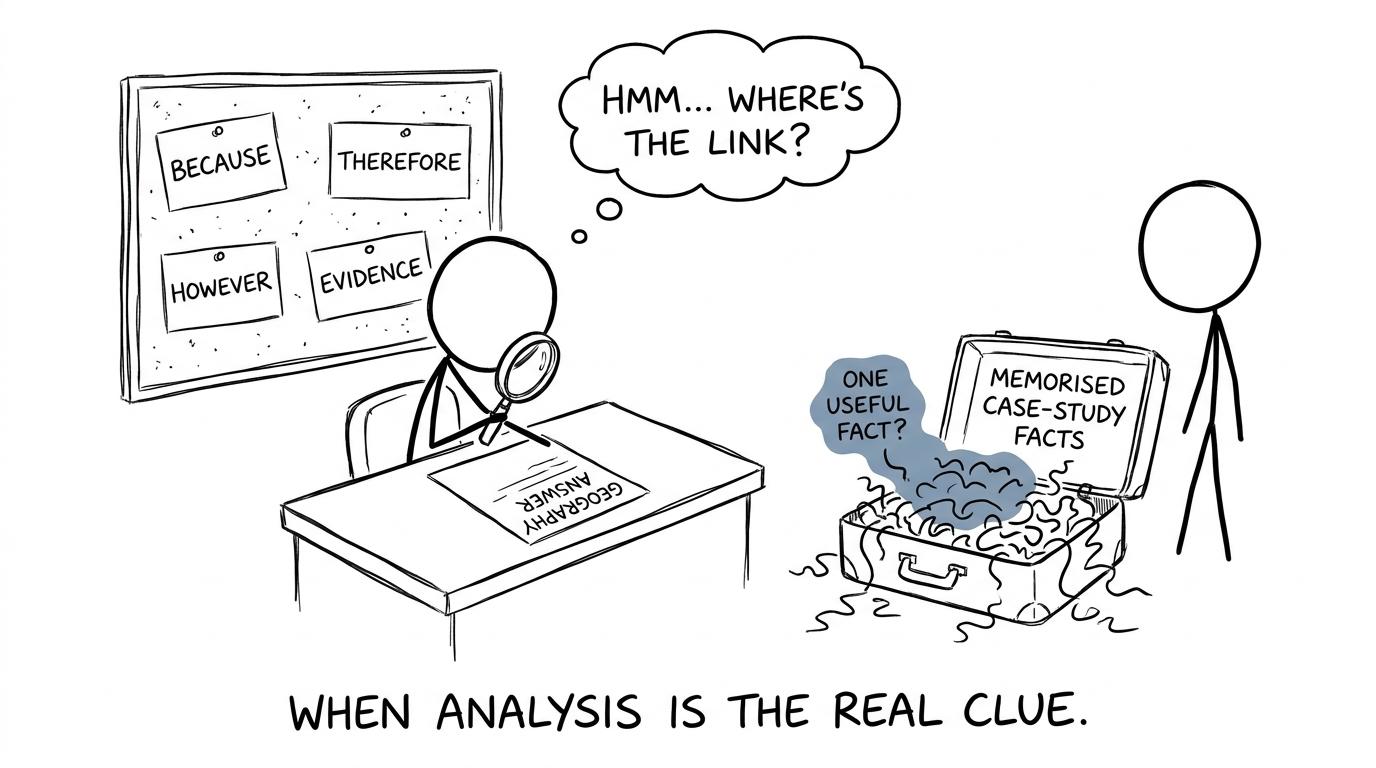 An examiner detective follows clues while an overloaded suitcase of case-study facts attracts suspicion
Develop analysis instead of adding more description
Description identifies what is happening. Analysis examines patterns and relationships. Explanation gives geographical reasons. Evaluation considers significance, success, limitations or competing evidence.
A high-level paragraph usually needs a chain rather than an isolated statement:
claim →\rightarrow→ evidence →\rightarrow→ geographical reasoning →\rightarrow→ link to the question.
The reasoning is where many grade 6 answers stop too early. If you write that urban growth increases flood risk, continue by showing how surfaces, drainage, infiltration and discharge are connected. Where appropriate, consider scale, time or the way one factor depends on another.
For extended responses, decide what your judgement means before writing. Possible criteria include:
- greatest number of people affected;
- severity or duration of impact;
- economic cost;
- environmental sustainability;
- effectiveness for different stakeholders;
- short-term success compared with long-term resilience.
A conclusion becomes convincing when it weighs factors using criteria. Merely repeating the introduction is not evaluation.
Command words also matter, but their precise interpretation and mark tariff can differ by board. Use your own specification, mark schemes and examiner materials rather than assuming that every “assess” question has an identical structure.
Treat resources as evidence, not illustrations
Maps, photographs, graphs and data tables are part of the question. Strong answers extract precise evidence and then interpret it.
When faced with a resource, look for:
- overall pattern or trend;
- highest and lowest values;
- contrasts between places or periods;
- rate or scale of change;
- clusters and anomalies;
- whether the evidence supports the claim;
- limitations such as date, scale, source or sample size.
Avoid writing that a value “went up a lot” when the resource lets you quantify the change. Where percentage change is needed, use:
Percentage change=new value−original valueoriginal value×100\text{Percentage change}=\frac{\text{new value}-\text{original value}}{\text{original value}}\times 100Percentage change=original valuenew value−original value×100A numerical answer is not the end. State what it means geographically and keep the units and context. The free GCSE Geography statistical skills guide covers averages, spread, percentage change and relationships. You can also strengthen general interpretation through scatter graph revision and percentage practice.
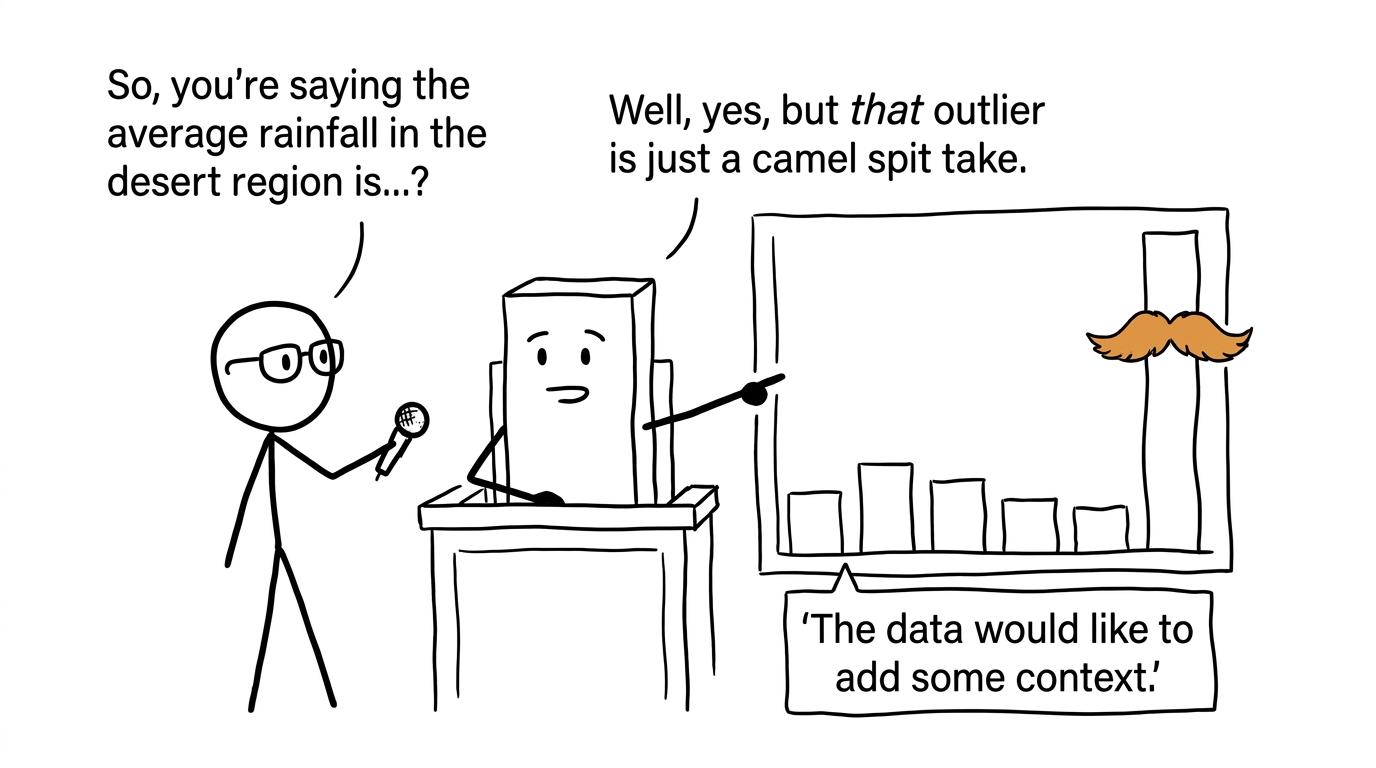 A bar chart gives evidence while a suspicious anomaly attempts to avoid attention
Make fieldwork evaluation specific
Fieldwork is not revised effectively by memorising a diary of what happened. You need to understand the enquiry process: question, method, sampling, presentation, analysis, conclusion and evaluation.
Use precise evaluative language:
- accuracy: closeness to the true value;
- reliability: whether repetition would produce similar results;
- validity: whether the method measured what the enquiry intended;
- representativeness: whether the sample reflects the wider area or population;
- bias: whether the method systematically favoured one result.
“Collect more data” is too vague. Explain what should be repeated, where, when and why that change would improve the investigation. A larger sample may improve representativeness, but it does not automatically remove a biased method.
Revise both your own enquiries and unfamiliar fieldwork scenarios. The AQA fieldwork revision guide helps connect methods with patterns, conclusions and limitations. The guide to qualitative and quantitative geographical data is useful for selecting presentation methods and evaluating sources.
Use an exam-practice loop that changes your next attempt
Completing papers is not the same as learning from them. Use this cycle:
- answer one question under realistic timing;
- mark it strictly with the correct board's mark scheme;
- identify the missing assessment objective;
- rewrite only the weak section;
- answer a related question several days later without notes.
Keep a mistake log with four columns: topic, question type, reason for lost marks and repair action. Patterns soon emerge. Perhaps your knowledge is secure but conclusions remain unsupported. Perhaps calculations are correct but you do not interpret them.
Do not chase a fixed grade boundary during revision. Boundaries vary by board and examination series. Track raw marks, the kinds of questions you miss and whether corrected skills survive when the context changes.
MathsGenie's GCSE Statistics revision hub can support graph and data fluency, while the Edexcel GCSE Statistics resources offer further questions, worksheets and papers. Use these selectively for overlapping skills rather than replacing your Geography specification.
Common mistakes that hold students at grade 6
Memorising model answers
A memorised response may not fit the location, resource or command word. Learn adaptable arguments and evidence instead.
Fact dumping
Named places and statistics earn little when their relevance is unexplained. Attach every detail to a claim.
Ignoring the resource
If a question supplies evidence, use it precisely. Quote values, identify spatial patterns and discuss anomalies where relevant.
Writing a one-sided evaluation
Evaluation does not mean adding “however” once. Compare factors, recognise limits and decide which matters most using clear criteria.
Giving generic fieldwork improvements
“Use better equipment” or “ask more people” does not explain how validity or reliability would improve.
Leaving skills until the end
Maps, graphs, statistics and fieldwork techniques are assessed across the course. Practise them weekly, not only before the fieldwork paper.
Measuring revision by time
Two hours of highlighting can feel productive without changing performance. Measure completed retrieval, corrected questions and fewer repeated errors.
Your next step towards grade 9
The move from grade 6 to grade 9 is less like discovering a secret and more like sharpening a tool. Knowledge becomes selective. Explanation becomes connected. Evidence becomes purposeful. Conclusions become earned.
Start with one marked paper and identify the assessment objective costing you the most marks. Use MathsGenie's free revision lessons and guides to repair that weakness, then complete targeted practice questions. Once your responses improve, test them with past papers, predicted papers, mini tests, mark schemes and available solutions.
Return to the AQA GCSE Geography revision hub or choose the correct exam-board resources from MathsGenie. Plan the next question, not the distant grade. Enough well-chosen improvements will take care of the distance.