GCSE Geography 4 to 7: A Practical Revision Plan
GCSE geography 4 to 7 guidance: improve case studies, geographical skills, extended answers and exam technique with a focused revision plan.
Moving from a grade 444 to a grade 777 in GCSE Geography is not mainly about memorising three times as many facts. It is about doing more with the knowledge you already have. A student working around grade 444 may recall a process or case study but struggle to apply it precisely. A grade 777 response usually selects relevant evidence, develops connected explanations, interprets unfamiliar resources and reaches justified conclusions.
That is the central idea behind a GCSE geography 4 to 7 revision plan: strengthen knowledge, but spend even more time learning how to use it.
Grade boundaries vary between exam boards and examination series, so there is no permanent number of marks that guarantees a grade 777. Instead, focus on the qualities rewarded across Edexcel, AQA, OCR and Eduqas specifications: accurate knowledge, application, geographical reasoning, fieldwork understanding and confident use of data.
Your grade 444 to grade 777 checklist
A useful improvement plan should help you:
- identify weak specification areas rather than revising every topic equally
- replace vague case-study knowledge with precise, relevant evidence
- follow command words accurately
- develop explanations through connected chains of reasoning
- use figures, maps, photographs and graphs as evidence
- evaluate different sides before reaching a supported judgement
- improve geographical maths and data skills
- complete timed questions and act on the mark scheme
The shift happens gradually. One better paragraph will not transform an entire paper, but repeated improvements across many questions can move your performance into a different grade band.
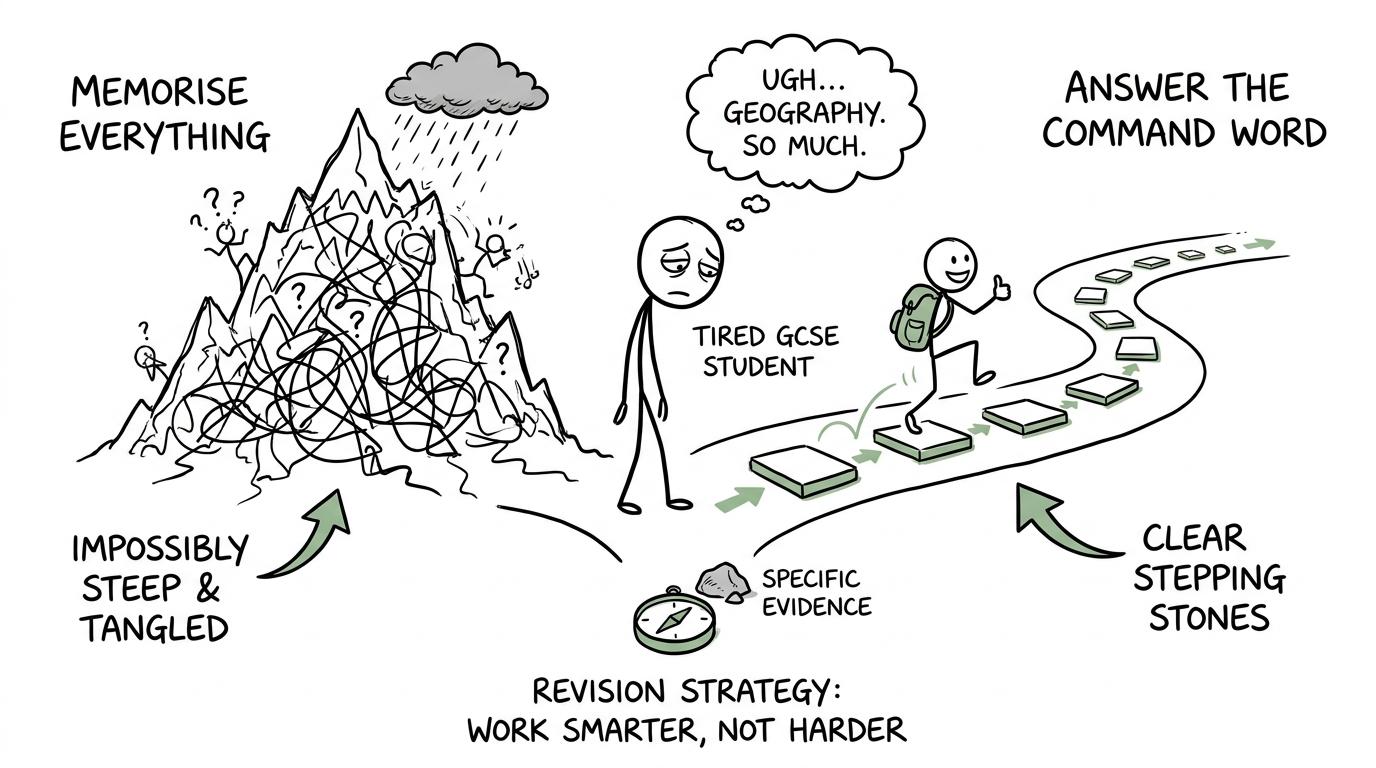 A student choosing between memorising everything and answering the command word
What separates a grade 444 from a grade 777?
Grade descriptors are not a mechanical checklist, and your final grade depends on your total mark across the assessed papers. Still, the following comparison captures the practical differences students often need to address.
| A response around grade 444 | A response aiming towards grade 777 |
|---|---|
| Recalls some accurate knowledge | Selects accurate knowledge that directly answers the question |
| Identifies a cause or effect | Explains linked causes, effects and relationships |
| Names a case study | Uses specific case-study evidence for a clear purpose |
| Describes obvious features of a resource | Uses data and patterns to support analysis |
| Gives one side of an argument | Considers competing evidence and reaches a justified conclusion |
| Attempts geographical calculations | Selects methods confidently and checks whether answers are sensible |
| Writes everything remembered | Plans, selects and prioritises relevant material |
The important word is selection. Strong answers are not simply longer. They contain a higher proportion of material that earns marks.
Turn remembered facts into geographical reasoning
Knowledge remains essential. You cannot explain coastal retreat, urban change or uneven development without understanding the relevant processes. But GCSE Geography also assesses whether you can apply that knowledge to places, resources and questions.
Suppose you know that hard engineering can reduce flood risk. That is recall. To move towards grade 777, you also need to explain how a particular strategy changes water movement, who benefits, what disadvantages may follow and why its suitability depends on the location.
Build revision notes around relationships rather than isolated definitions:
- cause →\rightarrow→ process →\rightarrow→ consequence
- strategy →\rightarrow→ immediate effect →\rightarrow→ wider implication
- evidence →\rightarrow→ interpretation →\rightarrow→ conclusion
This structure encourages the connected reasoning that higher-level questions require. Test yourself without notes, then check for missing links. Reading a highlighted page can feel productive while revealing very little about what you can retrieve independently.
Make case studies precise and usable
A common grade 444 habit is learning a case-study name followed by a long, unfocused list. The problem is not necessarily weak memory. It is that the facts have not been organised around likely questions.
For each required example in your exam board's specification, create a compact case-study sheet containing:
- location and geographical context
- causes or processes
- social, economic and environmental effects
- immediate and long-term responses where relevant
- named strategies or management approaches
- a small number of secure statistics
- evidence of success, limitation or conflict
Only learn figures you understand and can use accurately. A statistic earns no special credit merely because it contains a number. Its value comes from supporting a point or comparison.
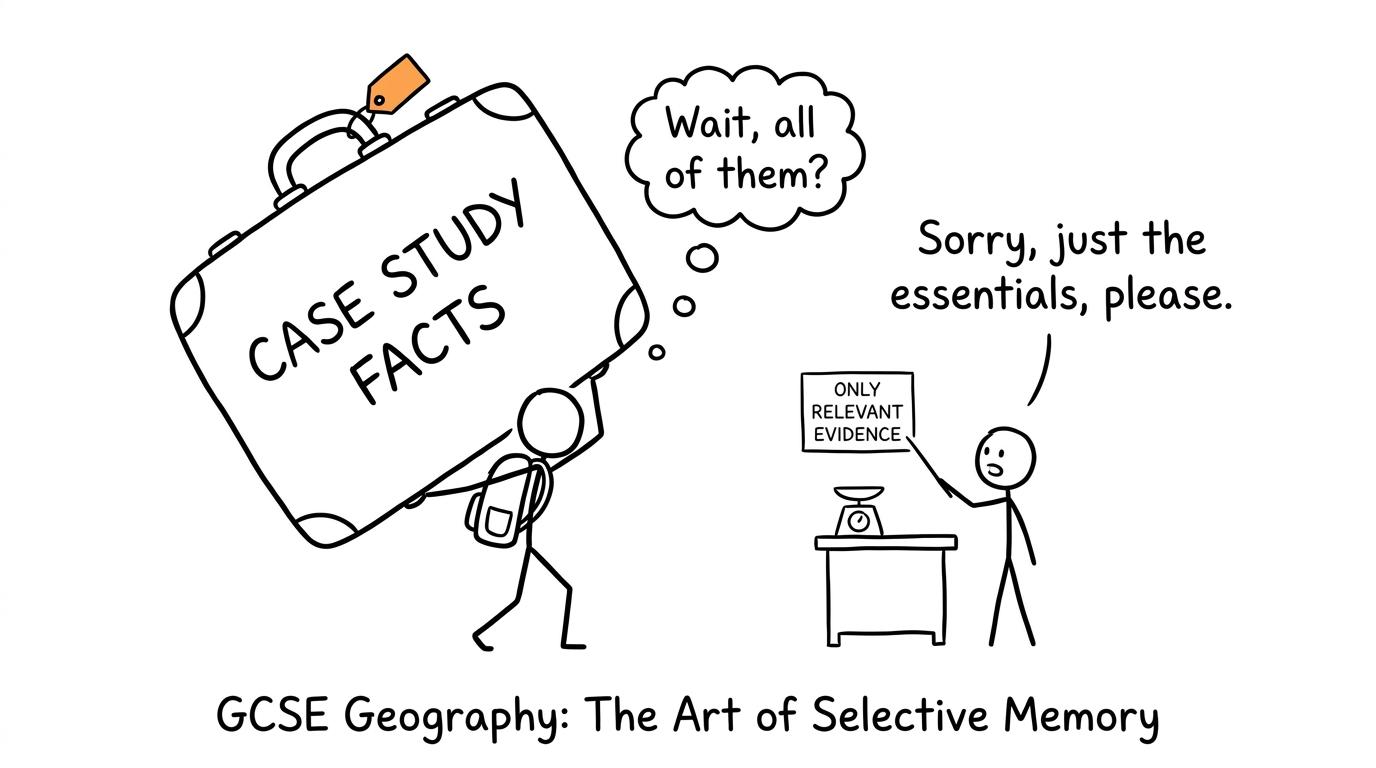 A student discovering that the exam only wants relevant case-study evidence
Treat command words as instructions
Many lost marks begin before the student starts writing. The question asks for an assessment, but the response gives a description. Or it asks students to use a figure, yet the figure is barely mentioned.
Although exact wording and mark schemes vary by exam board, these distinctions are useful:
- Describe: state what can be observed, including patterns, locations or changes.
- Explain: give reasons and show how or why something happens.
- Analyse: examine information closely and identify meaningful relationships.
- Compare: identify relevant similarities and differences.
- Assess or evaluate: consider evidence or viewpoints and make a supported judgement.
- To what extent: weigh how far a statement is valid, including its limitations.
Underline the command word, topic, location and resource instruction. If the question says to use a figure, quote or paraphrase specific evidence from it. If it asks for a judgement, make one and support it.
Build stronger extended answers
Longer answers often expose the difference between knowing geography and communicating geographical thinking. A reliable paragraph contains a clear point, relevant evidence and a developed explanation. It should then connect back to the question.
For an evaluative response, organise your thinking before writing:
- What is the strongest argument supporting the statement?
- What evidence supports that argument?
- What alternative factor or limitation matters?
- Does the answer change according to place, scale, time or stakeholder?
- What is your final judgement, and why is it stronger?
Avoid treating the conclusion as a summary of everything already written. A useful conclusion decides. It may identify the most important factor, explain the conditions affecting success or distinguish short-term effects from long-term outcomes.
Practise planning some responses without writing the full answer. This builds selection skills efficiently. However, full timed responses are still necessary because planning knowledge does not automatically create fluent exam writing.
Improve the maths behind geography
Geography papers can require calculations, graph interpretation, map skills and analysis of fieldwork data. These are valuable marks, particularly for students who already revise GCSE Maths.
Skills may include:
- calculating percentages and percentage change
- using ratios, scales and units
- finding the mean, median, mode and range
- interpreting scatter graphs and lines of best fit
- reading tables, maps and statistical diagrams
- describing trends, distributions and anomalies
- considering whether data supports a conclusion
The percentage-change relationship is:
percentage change=new value−original valueoriginal value×100\text{percentage change} = \frac{\text{new value} - \text{original value}}{\text{original value}} \times 100percentage change=original valuenew value−original value×100Do not rely on remembering the formula alone. Check whether a result represents an increase or decrease, include appropriate units and consider whether the answer is reasonable.
MathsGenie's free GCSE Maths revision lessons can strengthen the numerical foundations used in geography. In particular, revise percentages and percentage change, averages and range, ratio skills and scatter graphs.
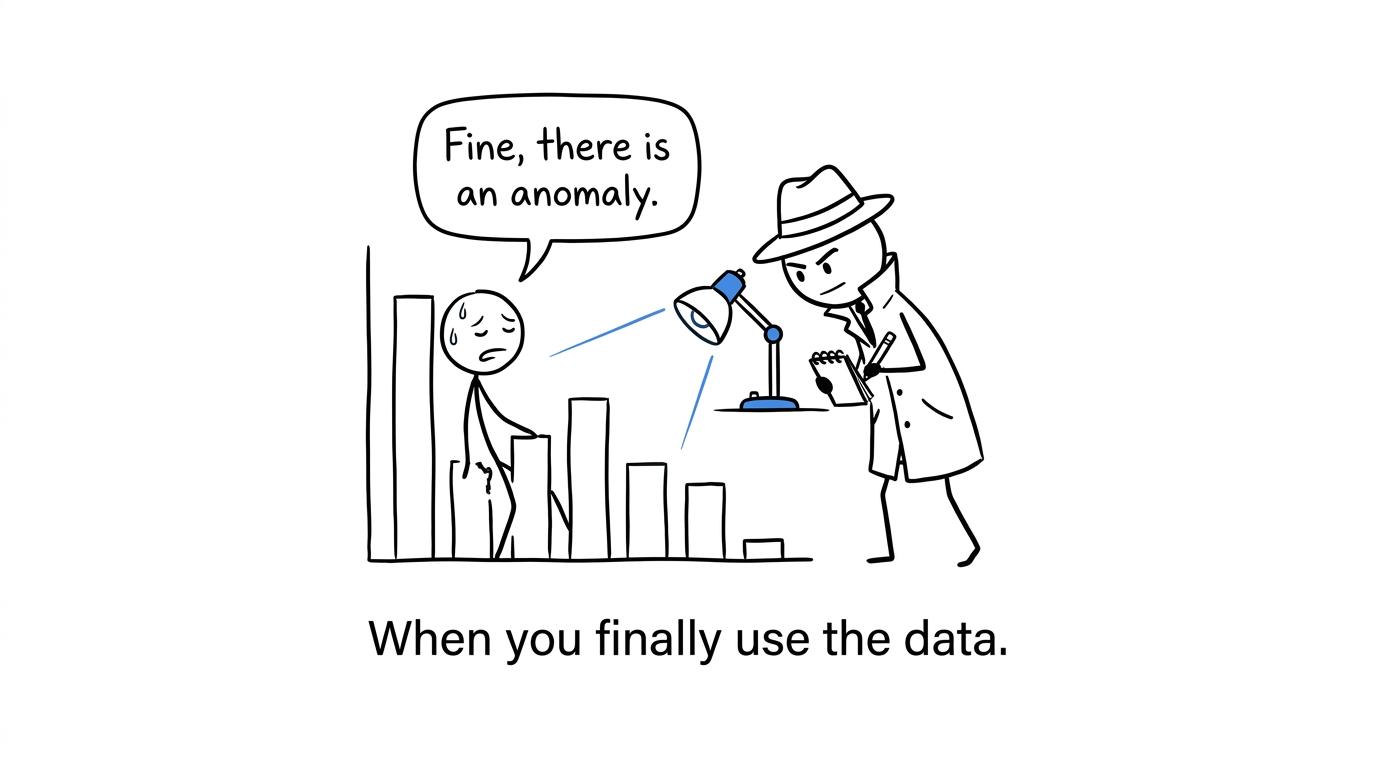 A student questioning a suspicious graph until it reveals an anomaly
Use resources instead of merely mentioning them
When a paper provides a photograph, map, graph or table, it is giving you evidence. Grade 777 candidates tend to integrate that evidence into their reasoning rather than writing a general answer beside it.
For numerical resources, look for:
- the overall trend
- the highest and lowest values
- significant contrasts
- clusters or spatial patterns
- anomalies
- changes over time
- evidence that supports or challenges the claim
Be precise. Replace phrases such as “it goes up a lot” with a quantified comparison where the resource allows it. Do not claim causation from a graph that only shows an association. A relationship between two variables does not by itself prove that one caused the other.
Turn fieldwork into a source of marks
Fieldwork questions test more than your memory of a day outside school. You should understand the enquiry process: question or hypothesis, method, sampling, data presentation, analysis, conclusion and evaluation.
Revise why each method was chosen. Know how sample size, timing, location, equipment and human judgement may affect reliability. When suggesting an improvement, connect it to the weakness. “Collect more data” is vague; identifying how a larger or more representative sample would improve confidence is much stronger.
You should also be ready to apply fieldwork understanding to an unfamiliar investigation. This is another reason to learn the logic of the enquiry rather than memorising a script.
A revision routine that moves performance upwards
Start by using your specification and recent assessments to classify topics as secure, developing or weak. Then follow a repeatable cycle:
Retrieve
Answer short questions from memory. Draw processes, define terms and list case-study evidence without looking at notes.
Apply
Complete questions using unfamiliar maps, figures and contexts. This trains you to transfer knowledge rather than recognise it on a page.
Mark
Use the mark scheme and examiner guidance supplied with the paper. Identify whether lost marks came from knowledge, application, data use, development or timing.
Repair
Rewrite weak sections or add the missing reasoning. Record recurring errors in a short log and revisit them later.
Maths practice can follow the same cycle. Use GCSE past papers to develop accuracy under time pressure, then compare your work with mark schemes and video solutions. Near the examination period, GCSE predicted papers can provide additional practice, but they should complement rather than replace official past papers.
Common mistakes that keep students near grade 444
Revising content without answering questions
Knowledge feels familiar when you reread it. Only retrieval and exam practice reveal whether you can use it independently.
Using vague evidence
Phrases such as “many people”, “a large amount” and “very successful” need support. Use accurate place detail or resource data when it is relevant.
Writing a pre-learned answer
A polished paragraph earns limited credit if it answers a different question. Adapt everything to the command word and context provided.
Listing rather than developing
Several brief points may be weaker than fewer well-developed ideas. Explain the chain linking each cause, process and consequence.
Ignoring units and scales
A correct method can still produce an unclear answer if the unit is missing or the map scale is misread. Check units before and after every calculation.
Giving an unsupported judgement
“Overall, I agree” is not enough. State what matters most and justify that decision using the evidence considered.
From grade 444 to grade 777: make the next answer better
The distance between grades can look like one enormous leap. In practice, it is built from smaller changes: one case study used more selectively, one graph interpreted with evidence, one explanation extended and one conclusion properly justified.
Begin with your next answer, not your imagined final grade. Diagnose what it lacks, correct it and repeat the process. For the numerical skills that support both subjects, make MathsGenie your free revision base. Work through the GCSE revision resources, practise with topic questions and mini tests, and use past papers and mark schemes to turn knowledge into exam performance. Consistent, specific practice is what makes a higher grade increasingly realistic.