

GCSE Further Maths Examiner Reports Explained
GCSE further maths examiner reports reveal recurring lost marks. Learn what examiners flag and turn their comments into a focused revision plan.
An examiner report can feel like a document written for teachers, about students, long after the exam has finished. Yet it contains something unusually valuable: a record of where real candidates lost marks and what stronger answers did differently.
That is the practical value of GCSE further maths examiner reports. They repeatedly draw attention to insecure algebra, incomplete reasoning, imprecise notation, weak interpretation and answers that stop one step too soon. Read properly, they are not historical commentary. They are instructions for smarter revision.
There is one important qualification point. What schools call “GCSE Further Maths” may officially be a Level 2 qualification, such as AQA Level 2 Certificate in Further Mathematics, rather than a GCSE. Other schools may offer a different additional maths qualification. Always read the report for your precise exam board, specification and paper.
What to look for in an examiner report
A useful first reading should answer five questions:
- Which topics caused widespread difficulty?
- What errors appeared repeatedly?
- Did students lose marks through knowledge, accuracy or communication?
- Which command words were misunderstood?
- What distinguished complete answers from almost-correct ones?
Examiner reports complement mark schemes rather than replace them. A mark scheme tells you what earned marks on a particular question. The report explains how candidates approached it, where those approaches broke down and what examiners accepted.
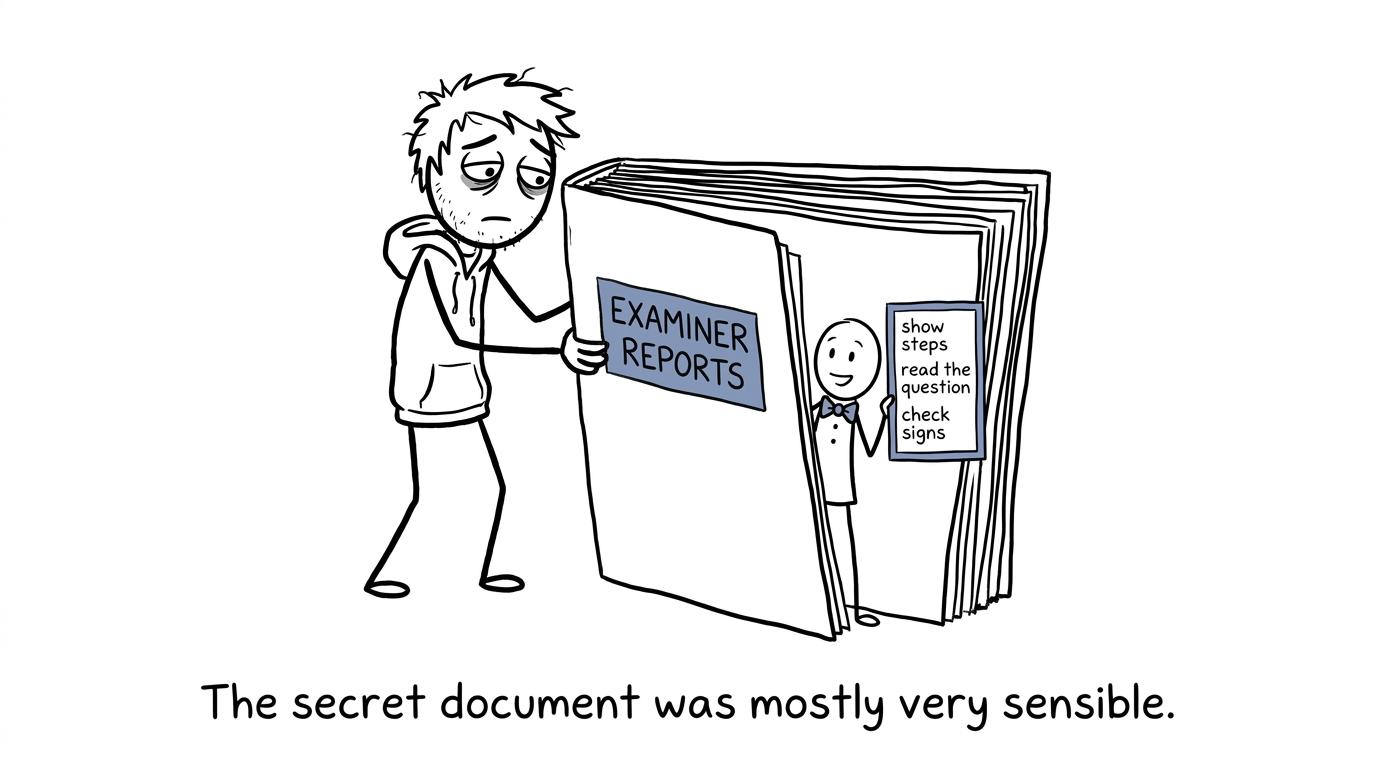 A student discovers that the secret examiner document contains a sensible checklist
What GCSE Further Maths examiner reports repeatedly flag
The precise comments change with each paper, but the same broad weaknesses often return. That repetition matters. If an issue survives several exam series, it is probably a revision priority rather than an isolated difficult question.
Algebra that is understood but not controlled
Further maths questions often depend on several connected algebraic steps. A candidate may know the right method but lose control of a negative sign, a bracket or a denominator.
Typical danger areas include:
- expanding expressions containing negative terms;
- factorising fully rather than partially;
- solving equations without preserving equivalence;
- manipulating indices and surds accurately;
- cancelling terms in algebraic fractions when cancellation is not valid;
- confusing an identity with an equation.
For example, cancellation applies to factors, not separate terms. In an expression such as
x(x+3)x,\frac{x(x+3)}{x},xx(x+3),there is a common factor of xxx, subject to x≠0x \ne 0x=0. In
x+3x,\frac{x+3}{x},xx+3,there is no common factor of xxx across the whole numerator. That distinction is elementary in appearance but important in advanced algebra.
If symbolic accuracy is a weakness, revisit algebraic fractions revision alongside mixed exam questions. Further maths tends to expose small algebra gaps because later methods assume those skills are already secure.
Correct methods with too little evidence
Examiners can only award method marks for work they can see. A correct unsupported answer may earn all the marks on a short-answer question, but it can be risky where the question asks candidates to show, prove, derive or justify a result.
A chain such as
A⇒B⇒CA \Rightarrow B \Rightarrow CA⇒B⇒Cneeds enough intermediate reasoning for each implication to be credible. Writing extra lines is not the goal. Showing the decisive mathematical steps is.
This matters particularly in algebraic proof, geometric reasoning and questions where a given result must be established. MathsGenie’s proof revision resources can help you practise the difference between evidence and assertion.
Function notation that is treated casually
Functions introduce a language as well as a technique. Reports commonly distinguish between candidates who understand that language and those who merely substitute numbers into familiar-looking expressions.
Frequent sources of confusion include:
- reading f−1(x)f^{-1}(x)f−1(x) as 1f(x)\frac{1}{f(x)}f(x)1;
- applying composite functions in the wrong order;
- failing to state restrictions when finding an inverse;
- mixing up an input, an output and the function itself;
- solving f(x)=g(x)f(x)=g(x)f(x)=g(x) inaccurately after forming the correct equation.
The notation fg(x)fg(x)fg(x), where used for composition, means one function is applied and then the other. It does not mean ordinary multiplication. Secure the notation through functions revision and practice, then check whether you can explain each symbol without relying on a memorised routine.
Conclusions that do not answer the question
A student can perform substantial correct work and still fail to finish. This often happens when a calculation produces possible values but the context, interval or condition requires one value to be selected.
Watch for instructions such as:
- hence state;
- give all possible values;
- determine whether;
- show that the result is a minimum;
- interpret your answer;
- give an exact value.
The last line should answer the original question, not simply repeat the final calculator display. If a question asks for an exact value, a decimal approximation is not an adequate substitute for a form involving x\sqrt{x}x, π\piπ or a fraction.
Geometry and vectors without sufficient reasoning
Diagrams can make a question appear more obvious than it is. Examiners do not award marks because a result looks true from the picture. Angles, ratios and vector relationships must follow from valid facts.
Common weaknesses include assuming a diagram is drawn to scale, quoting a theorem without connecting it to the relevant points, and writing vector expressions without a clear direction. A vector from AAA to BBB is not interchangeable with the vector from BBB to AAA:
BA→=−AB→.\overrightarrow{BA}=-\overrightarrow{AB}.BA=−AB.Use vector revision questions and circle theorems revision to practise concise chains of reasoning rather than visual guesswork.
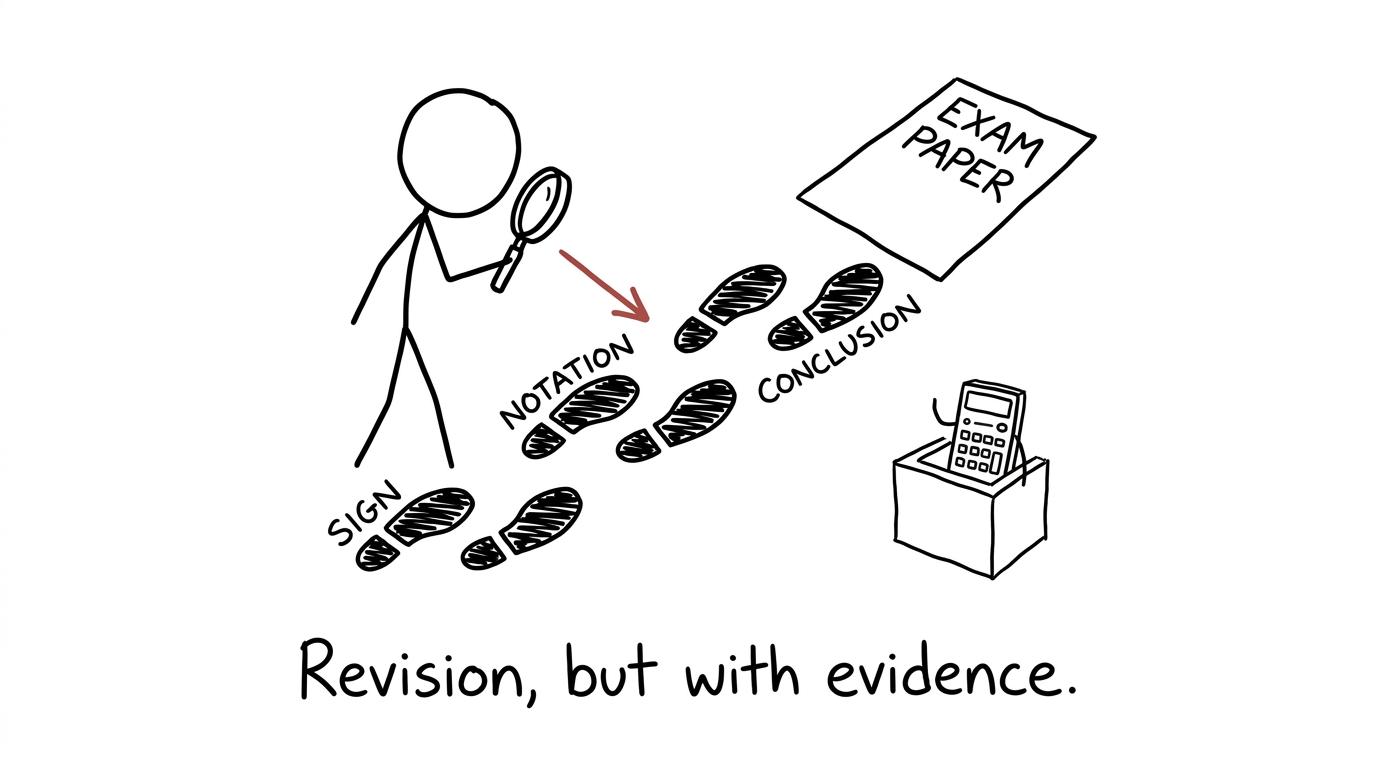 A revision detective follows clues about signs, notation and conclusions
Calculus procedures without interpretation
Where differentiation appears in a Level 2 further maths specification, reports may reveal a familiar divide: candidates can differentiate a standard expression but are less secure when interpreting the derivative.
Revision should connect the notation to its meaning:
dydx\frac{dy}{dx}dxdyrepresents the gradient function, while a stationary point satisfies
dydx=0.\frac{dy}{dx}=0.dxdy=0.Finding a stationary point may not complete the question. You could also need its coordinates, its nature or a geometrical interpretation. The examiner is looking for a mathematical conclusion, not just a successful procedure.
Premature rounding and unchecked calculator output
A calculator can produce a number without confirming that the number is sensible. Reports often draw attention to premature rounding, incorrect calculator entry and answers with unsuitable accuracy.
Keep exact values or additional decimal places during intermediate stages. Round only at the end unless the question instructs otherwise. Then perform a quick reasonableness check: consider the sign, approximate size, relevant interval and units.
How to turn reports into a revision plan
Reading examiner comments is useful. Converting them into behaviour is better.
Build an error log by cause
Do not record only the topic. Classify why the mark was lost:
| Error category | Revision response |
|---|---|
| Knowledge gap | Relearn the relevant method from a revision lesson |
| Algebra slip | Practise short accuracy drills and check each transformation |
| Misread command | Underline the required conclusion before starting |
| Missing evidence | Compare your working with the mark scheme |
| Weak interpretation | Add a final sentence answering the original question |
| Timing issue | Complete a similar question under timed conditions |
This stops every mistake being labelled “careless”. Carelessness is not a useful diagnosis. A missed negative sign, a misunderstood inverse and an unfinished proof require different remedies.
Use a report beside the relevant paper
The most productive sequence is:
- attempt the paper under realistic conditions;
- mark it carefully;
- read the examiner report for that examination series;
- locate comments relating to questions you attempted;
- redo those questions without copying the mark scheme;
- return several days later and try a similar question.
MathsGenie’s GCSE maths past papers provide useful practice for the core higher-tier skills that further maths assumes. Use the report to decide what to notice, and the mark scheme to decide whether your response earned the marks.
Convert vague comments into actions
An examiner comment such as “candidates found algebraic manipulation challenging” is too broad to revise directly. Translate it into observable tasks:
- I will write every stage when rearranging a multi-step equation.
- I will check whether cancellation involves factors.
- I will test solutions in the original equation where practical.
- I will preserve exact values until the final line.
- I will state restrictions when they affect the answer.
The smaller the action, the easier it is to repeat. Improvement usually comes from closing specific gaps, not promising to “do more maths”.
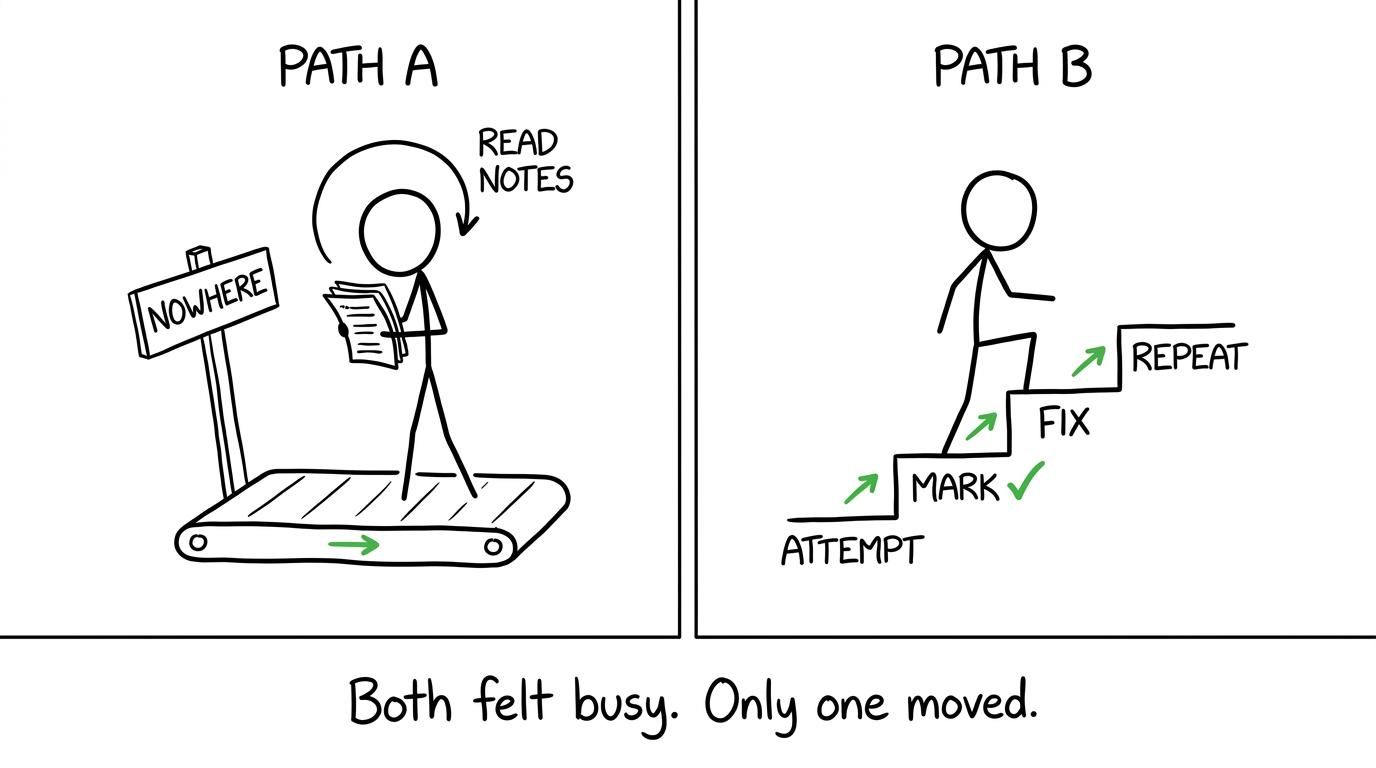 One student reads notes on a treadmill while another climbs the attempt, mark, fix and repeat steps
Common mistakes when using examiner reports
Reading reports instead of answering questions
Reports reveal patterns, but they do not create fluency. Most revision time should still involve attempting questions, checking methods and correcting errors.
Treating every comment as equally relevant
Start with the report for your own qualification and specification. AQA, OCR, Eduqas and Pearson qualifications are not interchangeable, and topic coverage or assessment arrangements may differ. Follow the current information provided by your school and exam board.
Memorising the previous paper
An examiner report describes one completed series. The next paper will use different questions. Extract transferable lessons such as “justify every step in a proof” rather than predicting that a particular question will return.
Looking only at difficult topics
Many lost marks come from familiar skills used inside unfamiliar problems. Keep strengthening the core material through the MathsGenie GCSE revision programme, especially higher-tier algebra, graphs, trigonometry and geometry.
Ignoring presentation
Clear presentation is not decoration. It makes signs, substitutions and logical steps easier to check. It also gives the examiner visible evidence for method marks when a final answer is wrong.
Make examiner insight part of your routine
Examiner reports rarely reveal a secret shortcut. Their value is quieter than that. They show that marks are often lost at the boundary between knowing a method and executing it carefully: between reaching a value and interpreting it, or between seeing why something is true and proving it.
Use those patterns to guide the next stage of your revision. Revisit weak skills through MathsGenie’s free revision lessons, attempt targeted practice questions, and then move to past papers and predicted papers. Check each attempt against the mark scheme and video solutions where available. Mini tests can expose whether a correction has lasted rather than merely felt familiar.
Start with one report and one paper. Find three repeated weaknesses. Turn each into a specific revision action. That is how examiner commentary stops being something written after an exam and becomes something that can improve your performance before the next one.










