GCSE French Year 10 Revision Head Start: Does It Help?
GCSE French Year 10 revision head start: discover whether early practice improves recall, protects maths time and avoids burnout with a realistic plan.
Starting revision early sounds sensible until you imagine spending the next two years permanently surrounded by flashcards. That is the fear behind many Year 10 revision plans: will beginning now make Year 11 easier, or simply make you tired earlier?
A GCSE French Year 10 revision head start genuinely can help, but only when it means short, active and sustainable practice. It should not mean completing full papers every weekend or turning every evening into an exam countdown. The real advantage is having time to space out vocabulary, pronunciation and grammar while protecting enough attention for GCSE maths and your other subjects.
The distinction matters. Early revision works when it reduces future pressure. If it merely brings Year 11 pressure into Year 10, it has missed the point.
The short answer: early French revision is worth it
Starting in Year 10 gives you more opportunities to retrieve and reuse French before the exam. Evidence reviewed by the Education Endowment Foundation supports spaced learning across different days and lessons, while retrieval practice can help make previously learned knowledge easier to access.
That makes an early start particularly suitable for a language. French depends on knowledge that becomes more useful when it can be recalled quickly: common vocabulary, verb forms, grammatical structures, spellings and sound-symbol relationships.
Your Year 10 checklist is simple:
- revise little and often rather than in occasional long blocks;
- retrieve vocabulary without looking at the answer first;
- practise listening, speaking, reading and writing;
- follow the specification used by your school;
- keep French revision proportionate to your maths workload;
- take regular breaks and reduce the plan if it becomes difficult to sustain.
You are not trying to finish GCSE French early. You are making Year 11 less dependent on last-minute relearning.
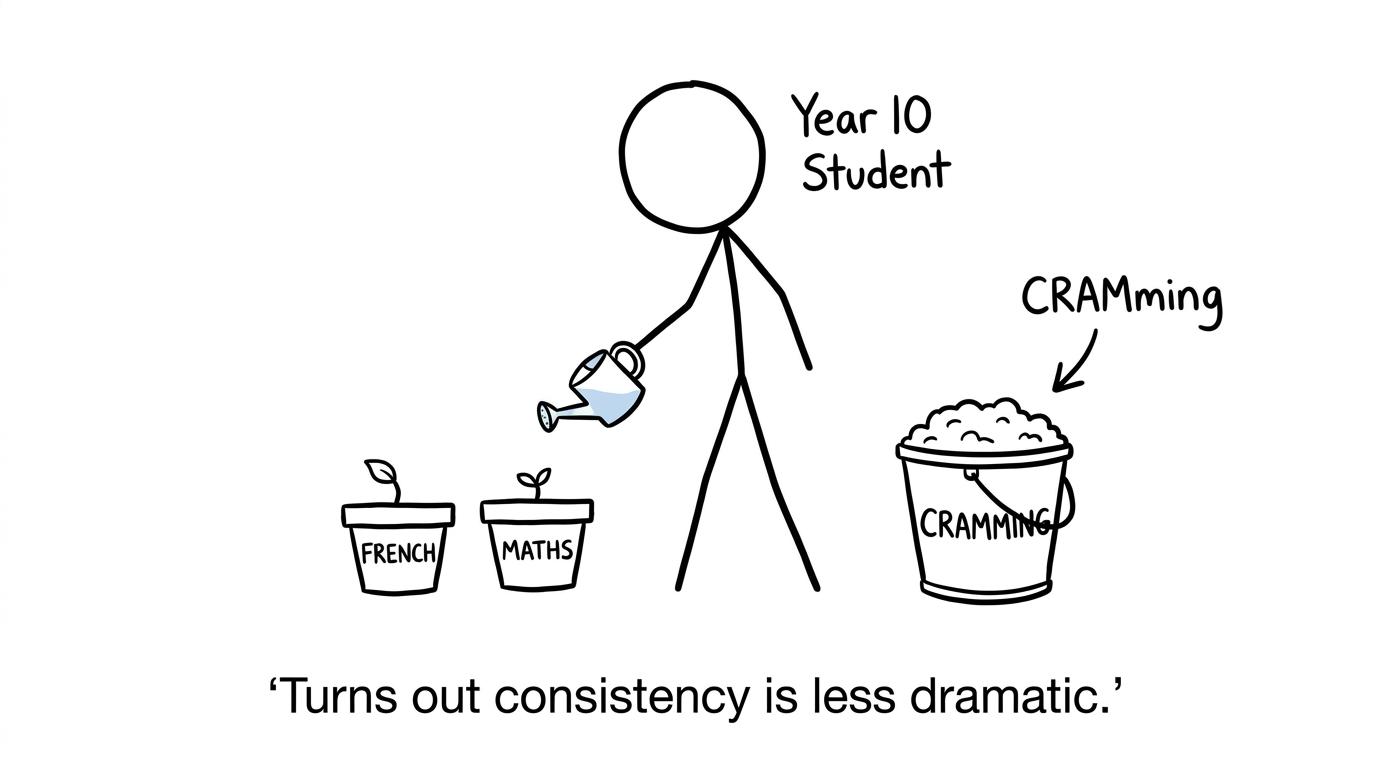 A student waters small French and maths revision plants while ignoring a giant cramming bucket
Why a GCSE French Year 10 revision head start can work
Languages reward repeated contact
A vocabulary list can feel familiar after you have read it several times, but familiarity is not the same as recall. In the exam, the answer is not printed on the back of a flashcard. You must recognise or produce the language when prompted.
Retrieval practice creates that effort. Covering an answer, recalling it and then checking it is more valuable than repeatedly reading both sides. Spacing those attempts over time gives you the chance to strengthen knowledge after it has become slightly harder to remember.
This does not guarantee a particular grade. It does, however, give you a better revision process than relying on one large vocabulary push shortly before the exams.
The current qualification contains a defined body of knowledge
The reformed GCSEs in French, German and Spanish were introduced for first teaching from September 2024, with first assessment from summer 2026. Department for Education subject content specifies 1,2001{,}2001,200 lexical items for foundation tier and a further 500500500 for higher tier, alongside required grammar and language skills.
That does not mean you should attempt to memorise the entire list independently in Year 10. It means the course has enough cumulative knowledge for steady practice to matter. Use the vocabulary and grammar supplied by your teacher and exam board rather than a random online list.
The exact assessment structure depends on whether your school uses AQA, Edexcel, OCR or Eduqas, so always check your specification. As one current example, AQA GCSE French assesses listening, speaking, reading and writing, with each paper contributing 25%25\%25% of the qualification. Its revised tasks include dictation and reading aloud. These are skills that benefit from regular practice, not just silent note-making.
Early revision leaves room for mistakes
Time is useful because it creates feedback loops. If you repeatedly confuse two verbs in October, you can fix that pattern before it appears in a Year 11 mock. If pronunciation is uncertain, you can ask your teacher while there are still many lessons left.
The same principle drives effective maths revision. A GCSE maths self-assessment and resources page helps identify weaknesses before they become expensive in an exam. In both subjects, an early mistake is information. A late mistake can become a lost mark before there is time to repair it.
What an effective Year 10 plan looks like
A good plan should look almost too small. That is often why it survives.
Start with two or three short French sessions each week, perhaps lasting 151515 to 202020 minutes. Treat this as a flexible starting point, not a compulsory target. Your teacher's homework, assessments and guidance take priority.
Use a four-part weekly cycle
Retrieve vocabulary. Test a small selection in both directions. French to English supports recognition; English to French demands production. Say the French aloud where possible.
Revisit grammar. Choose one structure already taught in class. Recall the rule, check it and use it in a few original sentences. This is revision, not an attempt to teach yourself future course content.
Train your ear and voice. Use approved audio from your school or exam board. Listen for familiar words, imitate pronunciation and practise reading aloud. A transcript can be useful after the first attempt, but not before every attempt.
Produce something brief. Write or say a short response using current vocabulary. Ask whether it is accurate, understandable and relevant. Feedback from your teacher is especially valuable here because confident repetition of an error is not productive practice.
Keep an error log, not a perfect notebook
Record mistakes that are likely to return: a misspelling, an incorrect ending, a misunderstood sound or a phrase you could not retrieve. Revisit that list in later sessions.
Maths students can use the same method after GCSE mini tests: attempt, mark, identify the precise error and return to it later. A revision record should tell you what to do next. It does not need to look beautiful.
How to protect your maths revision time
The question is not whether French matters. It is whether an ambitious French plan quietly consumes the time needed for maths, English, science and rest.
Give each subject a minimum sustainable routine. For maths, that might involve one topic session, one short mixed test and careful marking across the week. The MathsGenie GCSE maths revision hub lets you choose your exam board and work from revision lessons into practice questions rather than searching for disconnected materials.
If you are unsure where maths fits, use a realistic GCSE maths revision timetable to organise spaced sessions. Students with crowded evenings may prefer the 20-minute maths revision routine.
The principle is balance, not equal minutes. A coming French speaking assessment may deserve temporary priority. A maths mock may shift the balance back. Review the plan weekly rather than obeying an old timetable after your needs have changed.
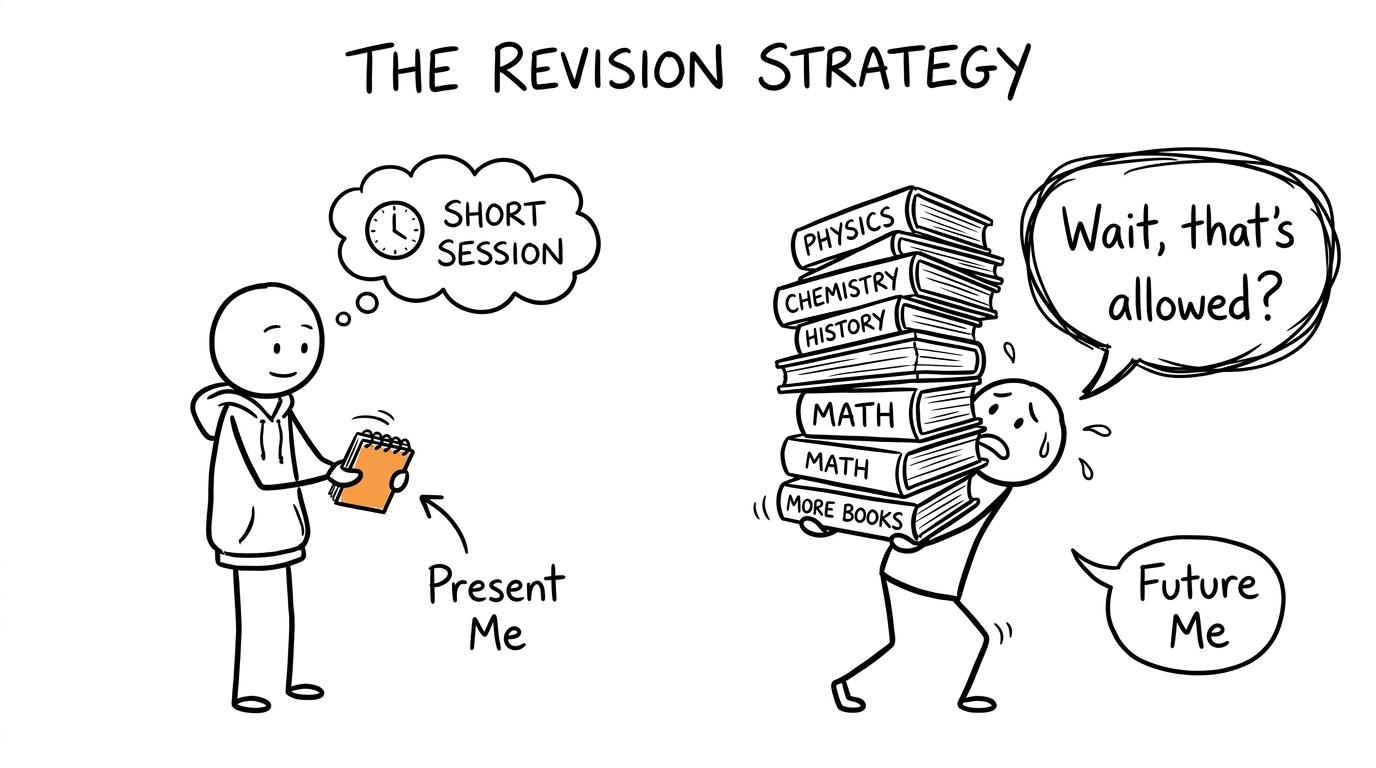 Future Me discovers that a student has finished a short revision session without exhausting themselves
When an early start turns into burnout
Burnout risk does not come simply from beginning in Year 10. It comes from an unsustainable combination of volume, pressure and too little recovery.
Warning signs include:
- sessions becoming longer because you feel guilty about stopping;
- doing full papers before you have learned enough course content;
- abandoning hobbies, exercise or sleep for routine revision;
- measuring success only by hours completed;
- feeling unable to take a planned day off;
- continuing a method that produces little useful feedback.
If that happens, reduce the plan. Keep the smallest habit that still has a clear purpose, such as a short vocabulary retrieval session and one pronunciation practice each week. Speak to a teacher, parent, carer or another trusted adult if schoolwork is causing persistent stress.
Rest is not evidence that you lack ambition. It is part of making the plan repeatable.
What to do in Year 10 and what to save for Year 11
Year 10 is well suited to building foundations: specification vocabulary already taught, core grammar, pronunciation, short listening activities and confidence producing simple language. Occasional sample questions can help you understand the task format.
Save most complete, timed papers for later, when you have covered enough content for the result to be meaningful. Even in maths, papers become most useful when they reveal gaps you can repair. MathsGenie's guide to when you should start GCSE past papers explains how to move from mini tests and sections towards full timed practice.
In Year 11, French revision can become more exam-specific: timed listening and reading, longer writing, speaking preparation and systematic use of mark schemes or examiner guidance. For maths, move towards board-specific papers such as Edexcel GCSE maths past papers, followed by carefully selected Edexcel predicted papers nearer the examination.
Predicted papers should supplement official past papers, not replace them. Their purpose is fresh practice, not certainty about what will appear.
Common mistakes with early GCSE revision
Revising only what feels comfortable
Recognising familiar French words or completing easy maths questions can create confidence without exposing gaps. Include some no-notes recall and use errors to choose the next task.
Copying vocabulary repeatedly
Copying has a place when learning spelling, but it can become passive. Close the source, retrieve the word, check it and revisit it on another day.
Ignoring pronunciation until the speaking exam
French spelling and sound are connected. Reading aloud and listening regularly can support speaking, dictation and word recognition. Use reliable audio and teacher feedback rather than guessing.
Starting full papers too early
A paper attempted before enough content has been taught may mainly measure what your class has not reached. Begin with short, relevant tasks and increase exam practice as your course knowledge grows.
Building a timetable with no empty space
A plan without rest or catch-up time assumes every week will go perfectly. It will not. Leave room for illness, homework peaks, assessments and ordinary life.
Treating one poor score as a verdict
A test result is evidence about today's performance. Identify whether the problem was knowledge, recall, accuracy, task interpretation or timing, then choose the smallest action that addresses it.
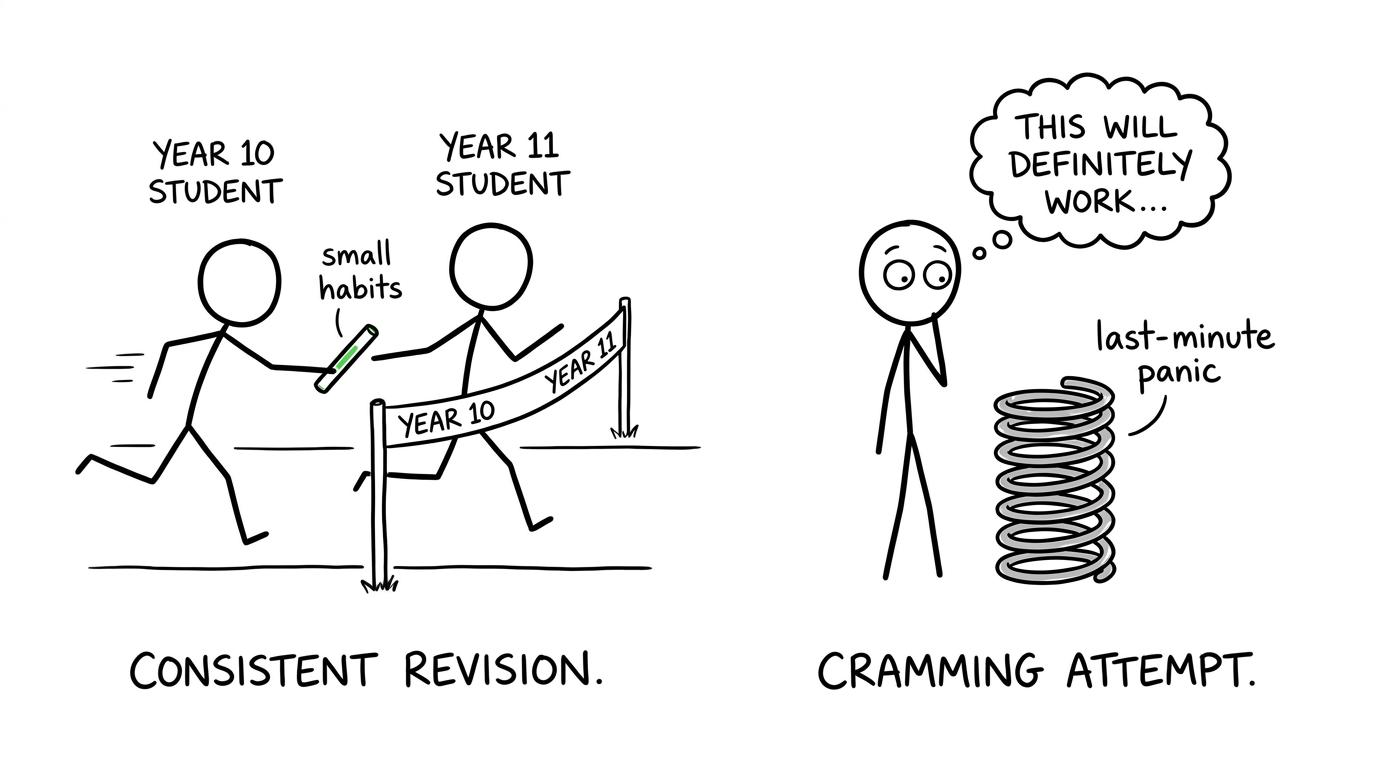 Year 10 passes a small-habits baton to Year 11 while another student tries a last-minute panic spring
Start early, but keep the start small
A GCSE French Year 10 revision head start pays off when it spreads learning across time and makes future revision calmer. It stops helping when it becomes an endless rehearsal for exams that are still distant.
Begin with a modest weekly rhythm. Retrieve vocabulary, revisit taught grammar, listen, speak and keep a short error log. Protect time for maths and adjust the balance around real assessments. The aim is not to feel as though you are revising constantly. It is to arrive in Year 11 with fewer fragile foundations.
For your maths preparation, make MathsGenie your free revision base. Use revision lessons to rebuild methods, practice questions and mini tests to test them, then progress to past papers, mark schemes, video solutions and predicted papers. Put each resource in the right stage of the journey, and an early start becomes what it should be: less pressure later, not more pressure now.