

GCSE French Weekend Revision: Final-Weeks Routine
GCSE French weekend revision made manageable: use this two-day routine for vocabulary, listening, speaking, reading and writing in the final weeks.
The final weekends before GCSE exams can feel strangely short. French vocabulary needs attention, a listening task is waiting, and maths still demands regular practice. The temptation is to spend Saturday doing whichever subject feels least uncomfortable. That usually leaves the important weaknesses untouched.
A better GCSE French weekend revision routine uses several focused sessions across two days. Cover listening, speaking, reading, writing, vocabulary and grammar, but do not attempt everything at once. Begin with a short diagnostic task, practise the weakest skills actively, check your work and finish each day at a sensible time. Keep a protected maths session in the plan so that improving French does not create a new problem elsewhere.
Your weekend revision checklist
A useful weekend should include:
- your correct exam board, tier and current specification;
- one clear French weakness to prioritise;
- short vocabulary retrieval sessions on both days;
- practice across listening, speaking, reading and writing;
- immediate checking and an error log;
- one protected GCSE maths block;
- breaks, food, movement and a firm finishing time;
- a short plan for revisiting mistakes during the week.
The aim is not to finish French by Sunday evening. It is to make Monday's weaknesses smaller and more specific.
 A student being directed into separate French and maths revision lanes by a timetable
Check what your GCSE French exam assesses
Before planning the weekend, confirm your exam board and specification with your teacher or the front of a recent assessment paper. AQA, Pearson Edexcel and Eduqas do not necessarily arrange tasks in precisely the same way, so revise from materials that match the qualification you will sit.
For GCSE French qualifications first assessed from summer 202620262026 in England, official subject requirements cover understanding and producing spoken and written French. Students encounter listening, speaking, reading and writing, alongside vocabulary and grammar. Requirements also include dictation, reading aloud, translation and the use of sound-spelling relationships. The exact task structure and timings depend on the board and tier.
On current AQA and Pearson Edexcel specifications, the four broad components are each worth 25%25\%25% of the qualification. That is a useful warning against spending an entire weekend making vocabulary cards while avoiding speaking or listening. Vocabulary supports every component, but it must eventually be used.
Foundation and higher tier expectations also differ. Do not borrow a random online task without checking whether it matches your tier and current specification.
The Saturday GCSE French weekend revision plan
Saturday is for diagnosis and deliberate practice. Work while your concentration is strongest, then stop before tired practice starts teaching careless habits.
Start with a 202020-minute diagnostic
Choose one short task from a teacher-approved sample assessment, past paper or practice paper for your board. Do it without notes. It could be a listening extract, reading section, translation or brief writing task.
When checking it, label each mistake:
- unknown vocabulary;
- grammar or verb error;
- misunderstanding the question;
- inaccurate spelling;
- missed detail in listening or reading;
- answer not developed sufficiently;
- timing or concentration problem.
This turns a vague thought such as “French is difficult” into a useful instruction such as “I miss negative expressions in listening tasks”. The same principle works in maths. MathsGenie's guide to finding your weakest GCSE topics explains why evidence from marked questions is more useful than guessing what to revise.
Retrieve vocabulary for 252525 minutes
Select a manageable group of words from your specification vocabulary list, class materials or error log. Test from English to French and French to English. Say each French word aloud as well as writing it.
Keep three piles:
- secure;
- hesitant;
- incorrect.
Spend most of the session on the final two. Copying every word again may feel productive, but retrieval is the important action: hide the answer, attempt it, check it and return to it later.
 A student carrying an enormous pile of vocabulary cards while ignoring a small useful pile
Practise listening and dictation for 353535 minutes
Use an audio task matched to your board. Read the questions first, underline what information is required and predict the type of answer you may hear. Listen under the permitted conditions rather than pausing after every phrase.
After marking, replay only the difficult sections. Identify whether the obstacle was vocabulary, speed, pronunciation, a distractor or a sound-spelling link. For dictation, compare every accent, agreement and verb ending carefully. Writing something that sounds approximately right is not the same as transcribing it accurately.
Take a proper break
Leave the desk for at least 202020 minutes. Food, water and movement are more useful than switching from a worksheet to short-form videos. A break should restore attention rather than scatter it.
Complete speaking practice for 303030 minutes
Speaking improves through speaking. Silently reading model answers cannot reproduce the decisions required when you talk.
Practise tasks that match your board, which may include role-play, reading aloud, discussion of visual material and follow-up conversation. Record yourself once, listen back and note only three improvements. Useful checks include:
- Is the pronunciation clear and comprehensible?
- Did you answer the precise question?
- Did you use verbs accurately?
- Can you extend an answer with a reason or detail?
- Can you recover calmly after hesitation?
Do not script an elaborate paragraph for every possible topic. Build flexible language you understand and can adapt.
Protect a separate maths block
If you are preparing for maths exams too, reserve 454545-606060 minutes on Saturday afternoon. Keep the subjects separate: French materials away, maths page open, one objective only.
Start at the GCSE Maths revision hub, choose your board and work on one weak topic or mini test. MathsGenie's GCSE revision timetable guide can help you balance subjects without turning the weekend into an exhausting sequence of full papers.
Finish by marking your maths questions and recording the exact error. Revision becomes more efficient when every session produces a clear next step.
The Sunday consolidation plan
Sunday should revisit Saturday's errors and apply them in new tasks. This is consolidation, not a second attempt at cramming the whole course.
Begin with 151515 minutes of recall
Retest Saturday's hesitant and incorrect vocabulary without looking at your notes. Remove words you now know securely and keep the stubborn ones for another check during the week.
Then retrieve a small set of useful grammatical forms from memory. Choose forms relevant to your course and recurring mistakes rather than creating an enormous grammar checklist.
Combine reading and translation for 404040 minutes
Complete a short reading task under quiet, timed conditions. Look for tense, negatives, connectives, opinions and references to who performed each action. Use context to infer an unfamiliar word before reaching for a dictionary during review.
Follow this with translation practice in the direction assessed by your task. Translate meaning, not isolated words. Once finished, check:
- tense and subject;
- agreements;
- word order;
- negatives;
- accents and spelling;
- whether every part of the original meaning is present.
Write, check and improve for 404040 minutes
Choose a current board-style writing prompt at your tier. Plan briefly, answer every bullet point and leave checking time. Your response should demonstrate language you can control accurately, not memorised expressions you only partly understand.
Use a final checking sweep in layers. Check content first, then verbs, agreements, spelling and accents. Trying to inspect everything simultaneously makes errors easier to miss.
Finish with a short mixed review
Spend the final 202020 minutes on one previously weak skill. This might be a second dictation, a fresh role-play or corrections to the writing task. End by choosing three items to revisit during the school week.
 French and maths practice sharing a timer while doomscrolling tries to enter
How to fit French around GCSE maths
French and maths require different forms of fluency, but both improve through active recall, immediate feedback and repeated contact with mistakes. The practical solution is not to blend the subjects. It is to give each one a defined space.
If maths is also approaching, use shorter assessment formats rather than forcing a complete paper into every weekend. MathsGenie's one-month GCSE maths revision plan shows how topic sessions, mini tests and timed practice can work together. The guide to starting GCSE past papers also helps you decide when full-paper practice is appropriate.
A balanced weekend might contain around three focused French blocks on Saturday, three on Sunday and one maths block on each day. Adjust this around your exam order and weaknesses. Equal time is not always intelligent time: the nearest exam and weakest assessed skills may deserve more attention.
For maths, board-specific revision matters too. Students taking Edexcel can use the Edexcel revision strategy, while OCR students can follow the OCR GCSE maths revision plan. Revision lessons, practice questions, mark schemes and video solutions reduce the time spent searching for suitable work.
Common weekend revision mistakes
Trying to cover every topic
A weekend is long enough to improve several skills, but too short to relearn an entire course. Choose priorities from marked evidence and carry unfinished work into next week's plan.
Revising vocabulary only by rereading
Recognition can create false confidence. Test both directions, write the French accurately and say it aloud. Revisit missed words after a delay.
Avoiding speaking because it feels awkward
The discomfort is information. Record short answers, evaluate them and repeat. Private, imperfect practice is exactly where improvement should happen.
Using materials from the wrong specification
A task may look convincing while assessing an outdated format. Check the exam board, tier and specification before investing time in it.
Marking without correcting
A score describes the past. A correction changes the future. Rewrite inaccurate French, replay missed audio and retest the error with a fresh task.
Sacrificing sleep for one more session
Late, unfocused revision often creates the feeling of effort without reliable recall. Set a finishing time, prepare Monday's short follow-up task and stop.
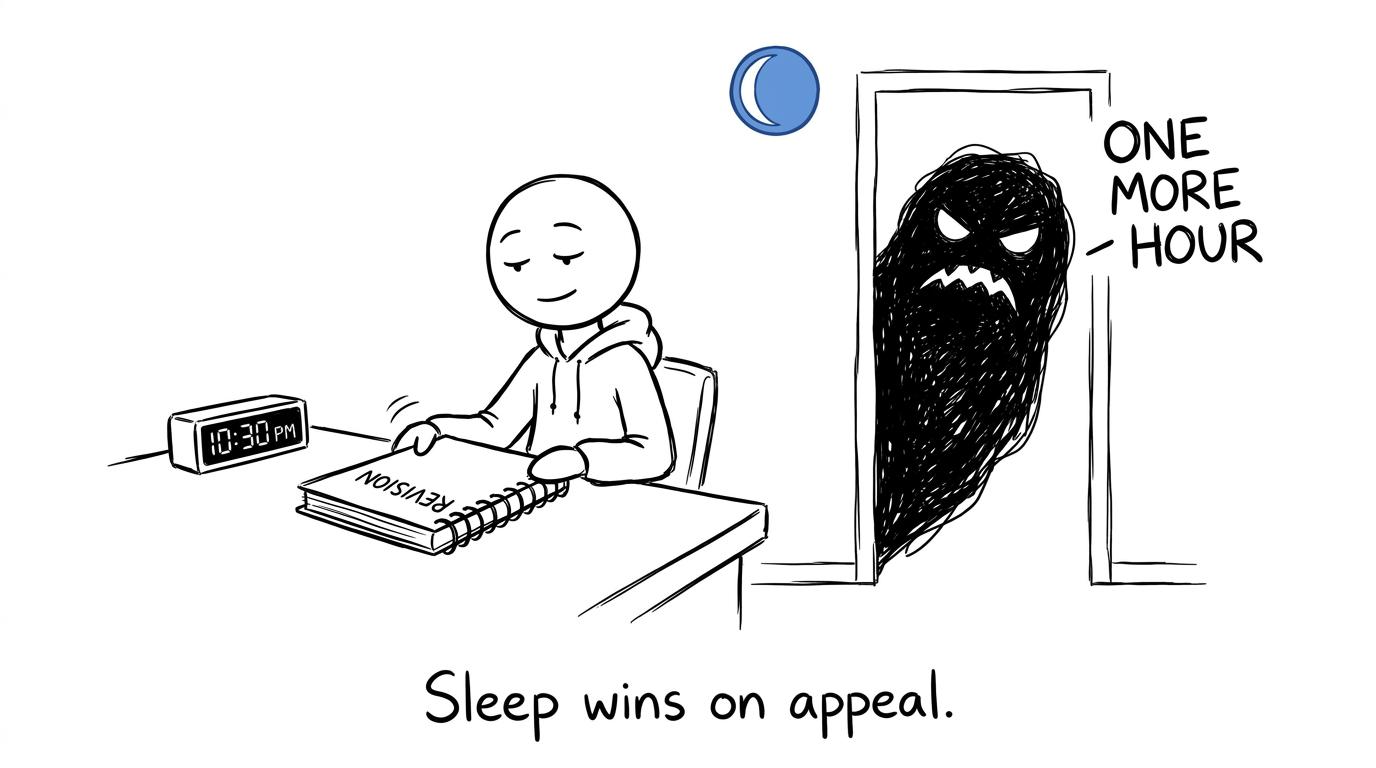 A calm student ending revision while the one-more-hour monster waits outside
Turn one weekend into a repeatable routine
The best GCSE French weekend revision plan is not heroic. It is repeatable. Diagnose one weakness, retrieve vocabulary, practise the assessed skills, check errors and revisit them on Sunday. Then carry a small number of corrections into the week.
Keep maths protected alongside it. Use MathsGenie's GCSE maths revision resources to move from revision lessons and practice questions to mini tests, past papers and predicted papers. Mark your work, use the mark schemes and watch video solutions where a method remains unclear.
Start by writing Saturday's first French task and your maths objective on paper. Two clear decisions now can remove much of the uncertainty from the weekend.










