Is the GCSE French Speaking Exam Recorded or Live?
GCSE French speaking exam recorded or live? Learn how the face-to-face assessment works, who marks it, and how to manage nerves confidently on the day.
The strange thing about a speaking exam is that it feels more personal than a written paper. In maths, your answer sits quietly on the page. In French, another person is listening while you search for a word, correct a verb or wonder whether your pause has lasted forever.
So, is the GCSE French speaking exam recorded or performed live? The short answer is: both. You normally complete the assessment face to face with a teacher-examiner, while the entire test is audio recorded. For the reformed GCSE French qualifications first awarded in summer 2026, the recording is then marked externally by the exam board.
That distinction matters. You are speaking live to a real person, but the teacher opposite you is generally conducting the assessment rather than deciding your final mark.
The answer at a glance
Before looking at the details, here is what most students need to know:
- The assessment takes place live, usually with a teacher-examiner at your school.
- Your voice and the teacher's voice are digitally recorded.
- The recording should be complete and unedited.
- The assessment is conducted under controlled exam conditions.
- For current AQA, Pearson Edexcel and Eduqas specifications, an external examiner marks the recording.
- Foundation speaking tests are generally 777 to 999 minutes long.
- Higher speaking tests are generally 101010 to 121212 minutes long.
- You normally receive supervised preparation time before the live assessment.
- The exact tasks and their order depend on your exam board.
Your school should tell you your board, tier, assessment window and precise format. Do not assume your French board is the same as your maths board.
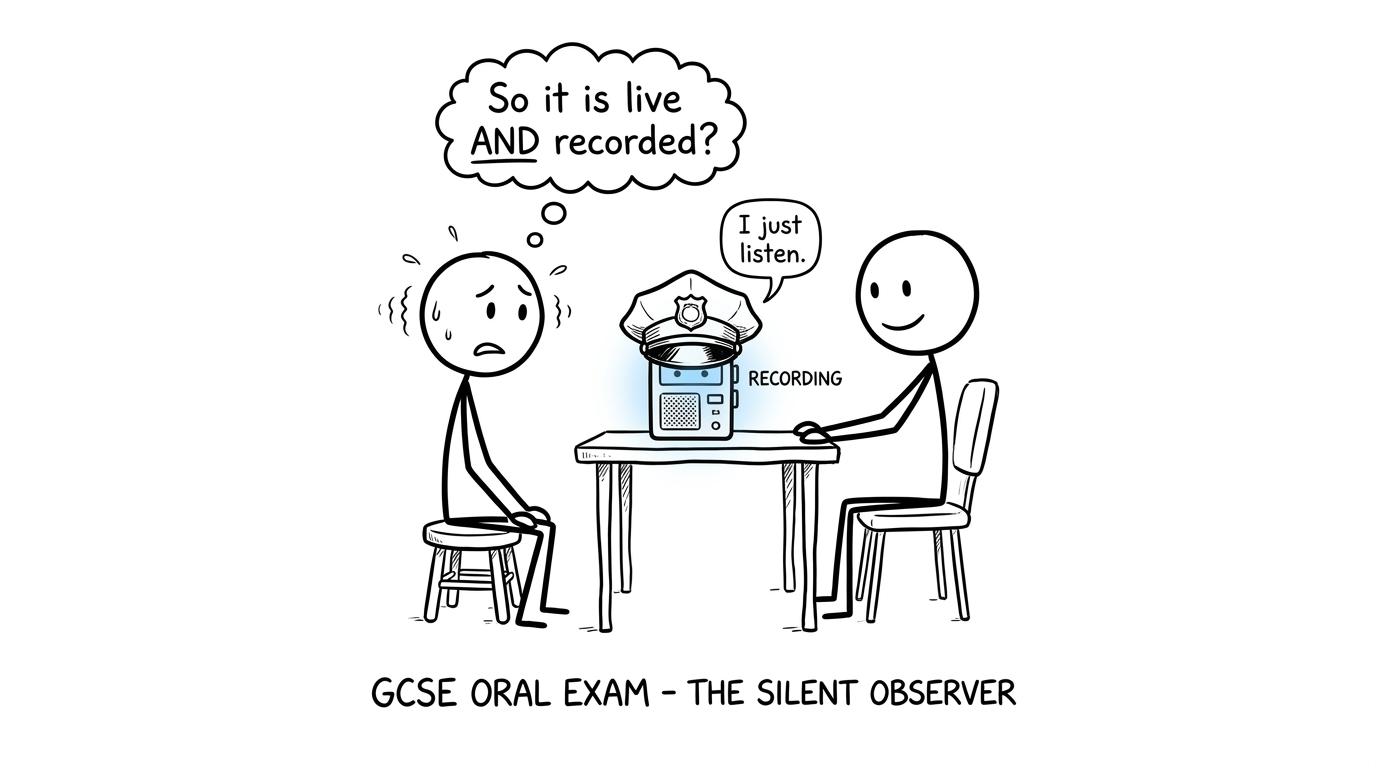 A student discovers that the French speaking exam is both live and recorded
How the GCSE French speaking exam is conducted
The experience is closer to a short, structured conversation than a speech delivered to a hall full of people. Normally, only you and the approved teacher-examiner are in the assessment room. Recording equipment is positioned so that both voices can be heard clearly.
Before the assessed tasks begin, identifying information may be announced on the recording. This can include the qualification, tier, candidate details and teacher-examiner's name. Your board's instructions determine the exact wording.
The tasks then run consecutively. The equipment is not supposed to be casually paused between tasks, and the submitted recording must be complete. This protects the fairness and integrity of the assessment.
What happens before you enter the room?
You will usually have supervised preparation time. Current AQA and Eduqas specifications allow 151515 minutes. Pearson Edexcel describes 141414 minutes of silent supervised preparation followed by 111 recorded minute in the assessment room for practising the read-aloud task.
What you may write, which materials you receive and when you must return them are controlled by your board's rules. A dictionary is not normally permitted. Listen carefully to your school's instructions rather than relying on what happened to a friend at another centre.
What tasks will you complete?
The reformed specifications assess speaking through three broad types of activity:
- a role-play;
- reading aloud, usually connected to a short conversation;
- discussion of visual material followed by unprepared conversation.
The order and naming vary. AQA begins with the role-play, while Pearson Edexcel begins with reading aloud. Eduqas also includes reading aloud, a role-play and a photo-based discussion. Materials and demands differ between foundation and higher tier even where the broad structure is similar.
This is why your own specification matters. General speaking practice helps, but task-specific practice teaches you when to ask a question, how long to develop an answer and what the examiner is allowed to repeat.
Who actually marks the recording?
For the reformed AQA, Pearson Edexcel and Eduqas GCSE French qualifications, the assessment is set by the board, conducted at the centre and marked externally. Your school submits the digital audio file securely, and an exam-board examiner assesses what can be heard.
The teacher-examiner in front of you must follow formal instructions. They cannot turn the assessment into an ordinary lesson by correcting your pronunciation, suggesting better vocabulary or quietly feeding you an answer. They may repeat or prompt only where the relevant board's instructions allow it.
That can initially sound severe. In practice, it also makes the situation more predictable. The teacher is not waiting to form a personal judgement about you. Their role is to present the tasks consistently and give you the proper opportunity to respond.
Speaking contributes 25%25\%25% of the overall GCSE on the current AQA, Pearson Edexcel and Eduqas specifications. The remaining skills, listening, reading and writing, are assessed separately. Exact mark allocations within the speaking component differ, so use the mark scheme and guidance for your board.
What being recorded means for your nerves
A microphone can make an ordinary room feel unusually important. But it does not change what the assessment is trying to measure: whether you can understand, respond and communicate in French using language appropriate to the task.
The recording is not a perfection detector. A brief hesitation, a self-correction or one inaccurate ending does not automatically destroy an answer. Examiners apply assessment criteria across your performance. Communication, response, pronunciation, vocabulary, grammatical control and development may all matter, depending on the task and board.
What matters most is recovering well enough to continue.
If you lose a word, use language you do know. If you make a grammatical mistake, correct it briefly if you can do so naturally, then move forward. If a question can be repeated under the rules, ask politely rather than guessing wildly.
There is a useful parallel with maths. One difficult question does not decide an entire paper, and one imperfect sentence does not decide an entire speaking assessment. Students often become more nervous because they mentally replay an error while the next opportunity for marks is already arriving.
The better habit is simple: finish the sentence you are in, then give your attention to the next prompt.
How to prepare without memorising a fragile script
A fully memorised paragraph can feel safe until the question changes slightly. Then the security disappears because you were remembering an order of sentences rather than communicating an idea.
Prepare flexible building blocks instead:
- opinions with reasons;
- past, present and future references;
- short descriptions of people, places and activities;
- question forms for role-play tasks;
- repair phrases for when you need time or clarification;
- high-frequency verbs you can use accurately;
- pronunciation of common sound patterns.
Practise aloud. Silent recognition is not the same as spoken recall. Recording yourself on an ordinary device can help you notice volume, pace and endings, but you do not need to imitate a native accent. Aim to be clear and comprehensible.
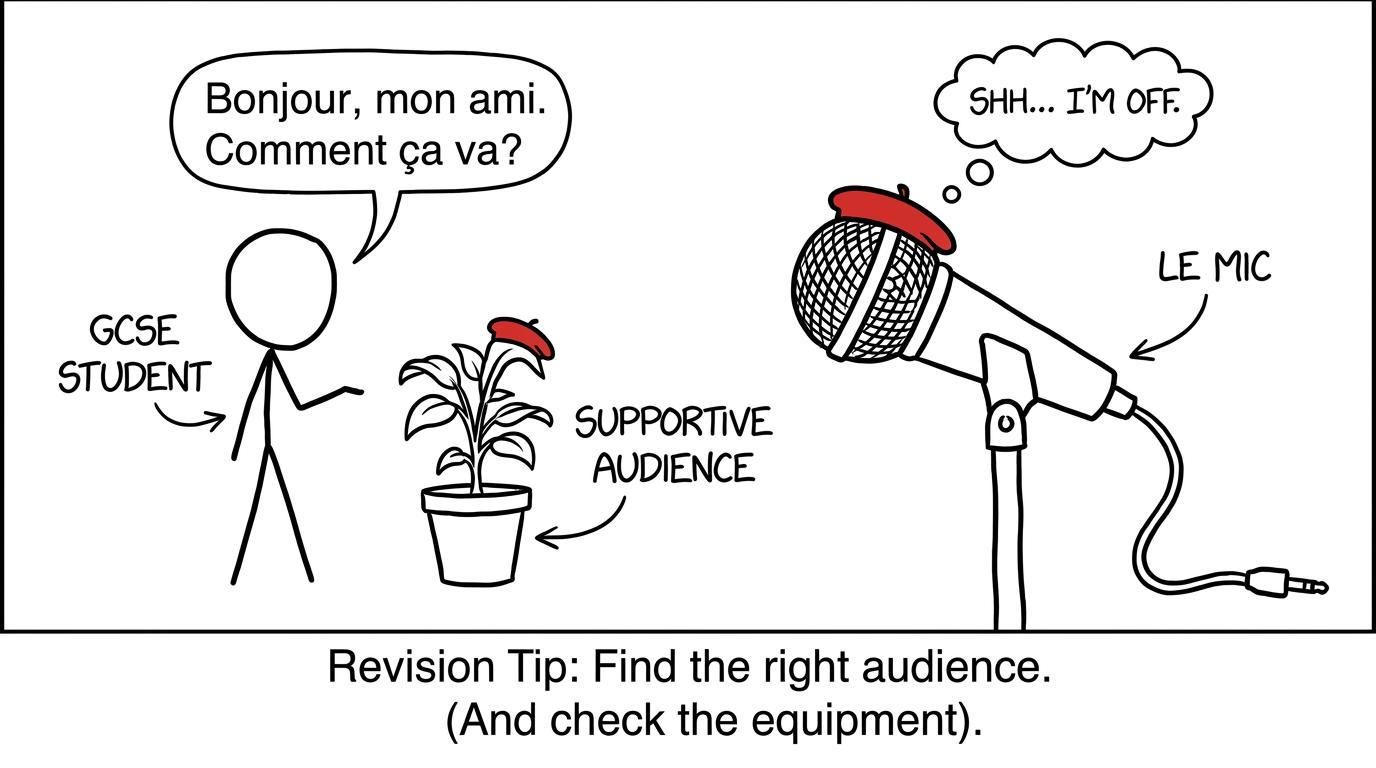 A student practises French with a very supportive houseplant
Short, repeated sessions are usually more manageable than one exhausting rehearsal. The same principle supports maths revision. MathsGenie's 20-minute GCSE maths revision routine offers a useful structure: retrieve, practise, check and decide what to revisit next.
You can adapt that rhythm to French speaking:
- retrieve useful language without notes;
- answer one task aloud;
- listen back once;
- identify one specific improvement;
- repeat the task with a changed detail.
A calm plan for the day
Your aim on the day is not to eliminate every trace of nervousness. It is to remove unnecessary uncertainty.
Check your exam board and tier. Confirm where you need to wait, what you may take into preparation and whether your school has given you a candidate timetable. Arrive with enough time to settle without spending an hour listening to other students speculate.
During preparation, read every instruction carefully. Use permitted notes as prompts, not as a complete script. Identify what each task requires, including any question you must ask in a role-play.
In the room:
- sit so that you can speak comfortably towards the recording equipment;
- use a clear voice rather than rushing;
- listen to the whole prompt;
- develop answers where the task rewards development;
- keep going after small mistakes;
- follow the teacher-examiner's transitions between tasks.
The recorder is evidence, not an audience. You do not need to perform for it.
Common mistakes to avoid
Assuming the teacher will rescue an answer
The teacher-examiner must follow the board's instructions and cannot coach you through the assessment. Practise responding independently and learn what forms of repetition are allowed.
Preparing for the wrong specification
Old videos and revision guides may describe different tasks. The reformed French GCSEs were first awarded in summer 2026. Check that your materials match your board and qualification year.
Speaking too quietly
A correct answer cannot be assessed properly if it cannot be heard. Speak clearly towards the equipment without shouting.
Letting one mistake control the next answer
A wrong tense or forgotten adjective is already behind you. Continuing to think about it consumes the attention needed for the next prompt.
Giving undeveloped answers everywhere
Some role-play prompts require concise information, while conversational sections usually offer room to extend an idea. Learn the purpose of each task rather than making every answer the same length.
Treating preparation time as memorisation time
Use preparation to understand the materials, select useful vocabulary and anticipate the shape of your response. Do not create a script so rigid that one unexpected question breaks it.
Keep the rest of your GCSE revision under control
Speaking assessments often arrive while maths revision is becoming more intense. The solution is not to abandon one subject for the other. It is to reduce the number of decisions you make each evening.
Use the GCSE maths revision hub to choose your board and tier, then focus on one weak area at a time. If you are unsure where marks are disappearing, follow the guide to finding your weakest GCSE topics.
As written papers approach, learn how to use GCSE past papers properly rather than completing papers without reviewing them. The GCSE maths exam-week checklist can also help you balance timed practice with rest.
When you need fresh exam-style material, use Edexcel GCSE maths predicted papers where appropriate, alongside official past papers. If remembering methods is the larger problem, the guide to stopping GCSE maths content from fading gives you a repeatable retrieval plan.
Recorded, live and manageable
The GCSE French speaking assessment is not a choice between recorded and live. It is a live, face-to-face assessment captured as an audio recording for secure external marking. Once you understand that process, the room becomes less mysterious: one teacher-examiner, one structured set of tasks and one opportunity to communicate as clearly as you can.
Prepare flexible language, practise aloud and expect a few imperfect moments. Calmness does not mean feeling nothing. It means knowing what to do next.
Then keep that same approach for maths. Start with MathsGenie's free revision lessons, strengthen each topic with practice questions and mini tests, and test your progress using past papers, predicted papers, mark schemes and video solutions. A clear process makes both the microphone and the exam paper feel smaller.