

Best GCSE French Flashcards and Quizlet Decks
GCSE French flashcards Quizlet guide: find accurate exam-board decks, test their quality and build effective vocabulary sets quickly for revision.
A huge French vocabulary deck can create a comforting illusion: every word is safely stored somewhere. Unfortunately, the exam tests what is stored in your memory, not what is stored in an app.
If you are searching for gcse french flashcards quizlet resources, the best choice is a current, exam-board-specific set that tests recall in both directions and includes gender, accents and useful phrases. Avoid anonymous collections that do not name their specification or tier. Better still, combine a reliable core deck with a small personal deck built from your own mistakes.
This matters especially if French is competing with maths and several other GCSE subjects. Your flashcards should reduce revision decisions, not become another project.
The quick checklist
Before using any GCSE French Quizlet set, check that it:
- names your exam board and current specification;
- distinguishes foundation vocabulary from higher-only vocabulary;
- matches the vocabulary list used for your examination year;
- includes noun gender and accurate accents;
- gives all relevant meanings where a word has several translations;
- tests English to French as well as French to English;
- uses manageable groups rather than one enormous deck;
- has been checked by your teacher or against the official specification;
- lets you edit or copy doubtful cards before learning them.
A deck that fails the first three checks may still contain useful French. It should not, however, be treated as your definitive GCSE list.
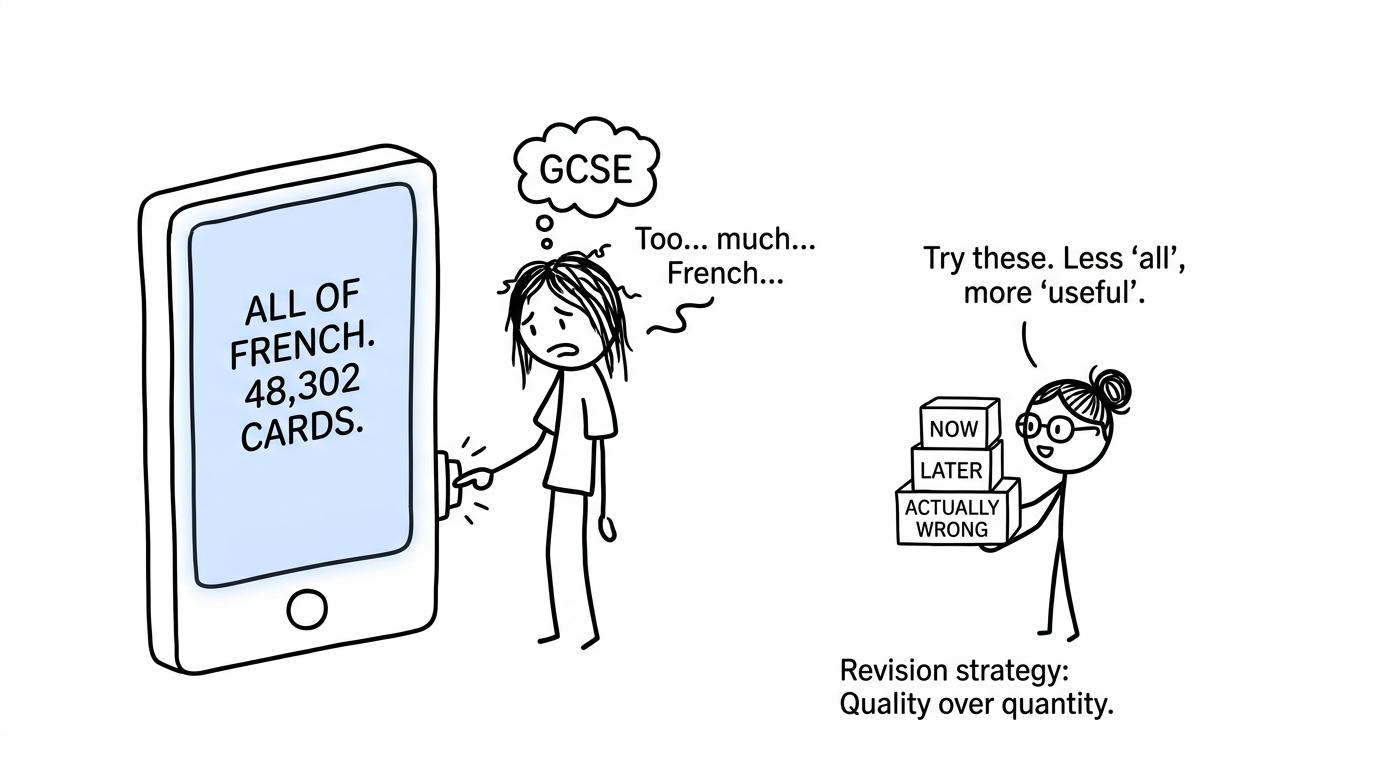 A student faces an enormous French deck while a librarian offers smaller, organised revision boxes
Which GCSE French flashcard decks are worth using?
The strongest option is not necessarily the set with the most terms or users. It is the one that most closely matches what you must know.
Current exam-board vocabulary decks
Start with decks built directly from the current vocabulary list for your awarding body. For qualifications first taught from September 2024 and first examined in summer 2026, the Department for Education subject content expects students to know 1,2001{,}2001,200 lexical items at foundation tier and a further 500500500 at higher tier. Specifications may also include short phrases and cultural or geographical items under the permitted rules.
AQA, Pearson Edexcel and Eduqas publish specification vocabulary for their current GCSE French qualifications. This makes the official list your best source of truth. A Quizlet deck is only the delivery method.
Look for titles containing:
- the awarding body;
- the specification code or the phrase “first examination 2026”;
- foundation, higher or both;
- the relevant unit, theme or vocabulary range;
- the name of a school, department or identifiable teacher where possible.
Be careful with sets labelled only “GCSE French vocabulary”. Search results can mix current decks with resources for legacy specifications. Older vocabulary is not automatically bad French, but it may omit required words, include removed content or organise material around outdated themes.
Teacher-created course decks
A set shared by your French department is often more useful than a popular public deck. It is likely to follow the order in which your class covers vocabulary, grammar and speaking themes. Your teacher can also explain whether it represents the complete specification or only one unit.
Ask three simple questions: Which specification is this based on? Is it for my tier? Has it been checked since the latest specification update?
That final question matters because awarding bodies can clarify or update lists. A deck created several years ago should not be assumed to reflect the version you will sit.
Small topic and high-frequency decks
Large specification decks are useful as reference collections. Smaller sets are usually better for daily retrieval.
Choose decks covering one coherent group, such as:
- common verbs and irregular forms;
- time expressions and connectives;
- opinions with reasons;
- school, relationships or future plans;
- adjective agreement and descriptive vocabulary;
- speaking phrases that can be adapted across contexts;
- higher-tier vocabulary only, if you are entered for higher tier.
Smaller sets make errors visible. If you miss seven cards in a set of twenty, you know what needs attention. If you miss seven cards while wandering through hundreds, the weakness is easier to ignore.
A personal mistakes deck
This is often the most valuable deck you can own because nobody else can build it accurately for you.
Add words that you mistranslate, confuse or repeatedly misspell. Include vocabulary exposed by listening practice, corrections from writing and phrases you could not produce in speaking practice. Keep this set short and remove cards once recall remains secure over several reviews.
The same principle improves maths revision: evidence should decide what you revisit. MathsGenie’s guide to finding your weakest GCSE topics explains how to turn mistakes into focused next steps rather than revising everything again.
How to judge a public Quizlet set
Public decks are convenient, but their presence on Quizlet is not proof of accuracy. Give any unfamiliar set a short audit before investing time in it.
Check the source
A useful description should identify where the vocabulary came from. “AQA GCSE French 8652 higher vocabulary” is more informative than “French words you need”. If no source is stated, compare a sample with your awarding body’s official list or ask your teacher.
Check card quality
Inspect at least ten cards from different parts of the set. Look for:
- correct accents and apostrophes;
- noun gender, preferably shown consistently;
- infinitives rather than unexplained conjugated forms, unless the form itself is required;
- multiple tested meanings where appropriate;
- clear separation between similar words;
- no English spelling mistakes or ambiguous prompts.
A prompt such as “bank” may mean a financial institution or the side of a river. If the card does not remove that ambiguity, a correct French answer could appear wrong.
Check whether it trains production
Recognising French is not the same as producing it. Reading and listening involve substantial receptive knowledge, while writing and speaking require you to retrieve language yourself.
Reverse the card direction regularly. Type or say the French answer before revealing it. Use audio to support pronunciation, but do not assume that hearing a generated voice replaces listening to complete exam-style material.
Quizlet currently offers flashcard and quiz-style study tools, including Learn and Test modes, although access to particular features can vary by account or subscription. Whichever mode you use, the important action is attempting the answer before seeing it.
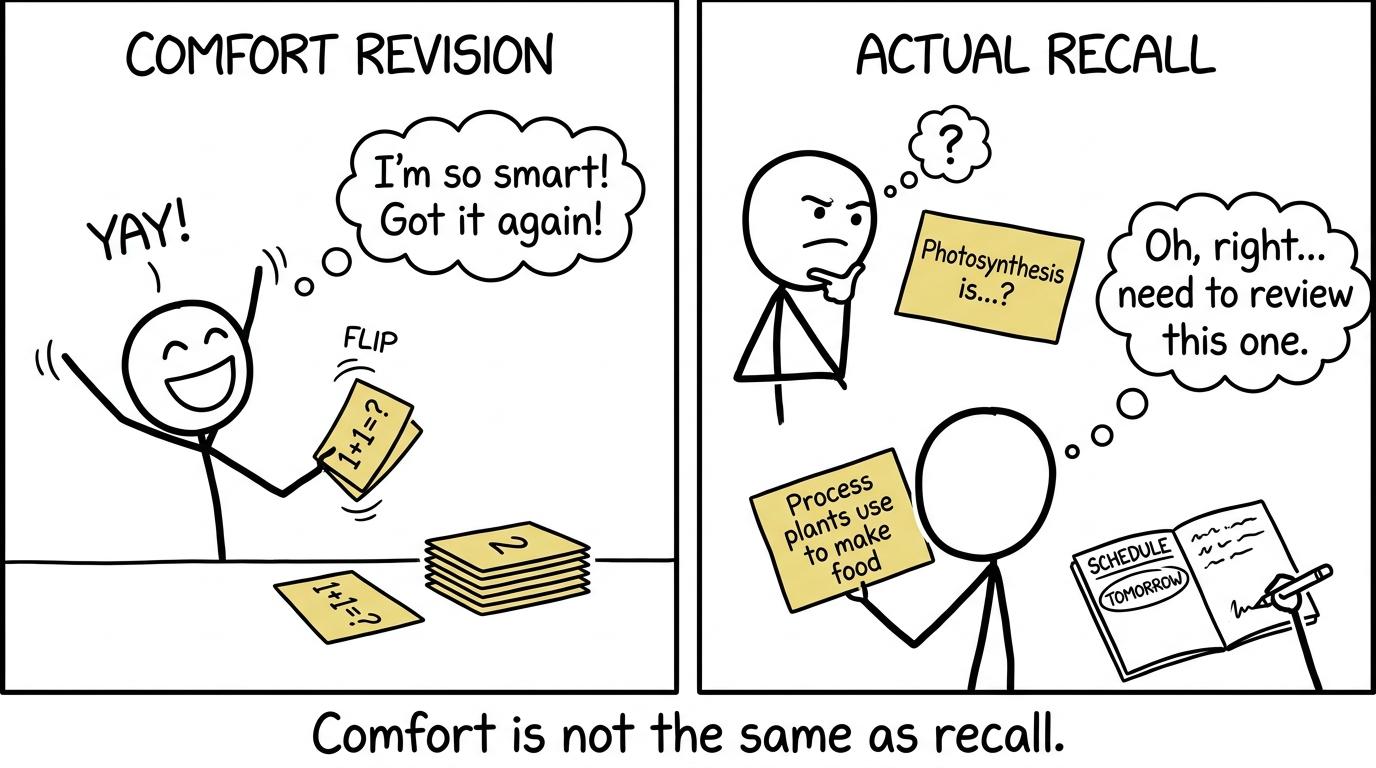 One student repeats an easy card while another uses effortful recall and schedules a review
How to build your own GCSE French deck quickly
Creating cards can become elaborate procrastination. The aim is not to design a beautiful database. It is to produce accurate prompts that you can begin using today.
Begin with an authorised source
Use the vocabulary list for your current exam board, a teacher-issued list or corrections from assessed work. Do not begin by copying another public set whose source you cannot verify.
Split the material by tier and then into practical batches. A short set of related words is easier to review and repair than a single collection containing an entire course.
Use a consistent card format
For nouns, include the article so that gender is learned with the word. For verbs, store the infinitive unless you are deliberately testing a required irregular form. For adjectives, note forms that are not predictable. Preserve accents from the start rather than planning to add them later.
Keep each prompt answerable. If one side contains several unrelated translations, split it into separate cards or add enough context to identify the intended meaning.
Add phrases selectively
Single-word recall is essential, but French is used in combinations. Add short, reusable chunks from your specification or class materials, particularly those that help you express opinions, justify ideas, refer to time or connect clauses.
Do not fill cards with whole memorised paragraphs. Long answers are hard to mark honestly and can encourage scripts that collapse when the examination question changes.
Import, audit and start
Quizlet can speed up set creation by importing term-definition pairs. Prepare a clean two-column list, import it, then inspect the result carefully. Automated tools can save typing, but they cannot confirm that every translation matches your specification and intended context.
A fast creation sequence is:
- copy a small, authorised batch;
- standardise articles, accents and punctuation;
- import the terms;
- check every card once;
- begin retrieval immediately;
- add mistakes during later reviews.
Your first version only needs to be accurate and usable. Improvements can follow from the answers you get wrong.
A revision routine that works alongside maths
French flashcards should occupy a defined space in your timetable rather than expanding into the evening. Use short retrieval sessions on several days, then combine them with listening, reading, speaking and writing practice. Flashcards teach vocabulary; they do not reproduce an entire French paper.
For maths, the equivalent step after recalling a formula or method is answering exam questions. The GCSE Maths revision hub brings together lessons, flashcards, worksheets and exam-board resources, while the MathsGenie resources collection provides mini tests, shorter papers and predicted papers.
A balanced session might contain a short French recall block followed by a focused maths block. The 20-minute GCSE revision routine is useful when time is limited. For a broader structure, use the GCSE maths revision timetable or the one-month revision plan.
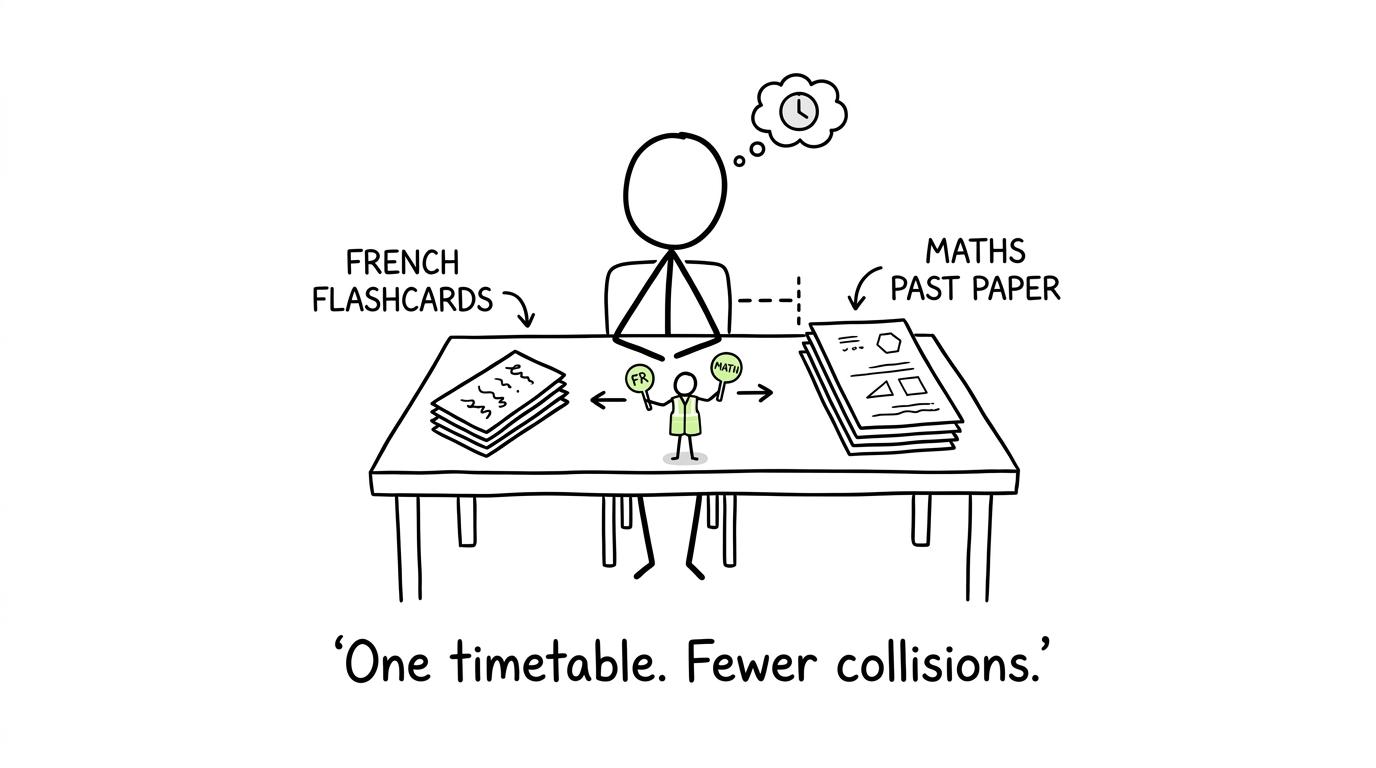 A tiny traffic controller prevents French flashcards and a maths paper from colliding in the timetable
Common mistakes with GCSE French flashcards
Choosing by popularity alone. A widely used set may belong to an old specification or another tier. Relevance beats view count.
Only reviewing French to English. Recognition can feel fluent while English-to-French recall remains weak. Reverse the direction and produce the answer before checking.
Ignoring gender and accents. Learning a stripped-down version creates corrections later. Store complete, accurate forms from the beginning.
Using one enormous deck every day. This hides patterns in your mistakes and makes sessions difficult to finish. Divide vocabulary into smaller sets and maintain a separate error deck.
Marking near-misses as correct. If the gender, spelling or meaning is wrong, record the error. Honest feedback is kinder than false confidence.
Replacing exam practice with cards. Vocabulary recall supports French performance, but you must still practise complete listening, speaking, reading and writing tasks. In maths, flashcard knowledge must likewise be converted into written solutions through GCSE past-paper practice and topic questions.
Cramming once and stopping. Return after a gap. MathsGenie’s guide to stopping GCSE content from being forgotten applies the same useful principle: retrieve, check, revisit and then test the knowledge in exam conditions.
Make the deck serve the exam
The best GCSE French flashcards are accurate, current and slightly uncomfortable. They ask you to retrieve language rather than merely recognise it. Start with an exam-board-aligned deck, verify it against an authorised source, then build a compact personal set from your recurring mistakes.
Keep French flashcards in their proper role: a strong vocabulary tool within a wider revision plan. Then protect time for the subjects where recall must become written method. On MathsGenie, you can move from free revision lessons and active-recall flashcards to practice questions, mini tests, mark schemes and video solutions, before testing yourself with past papers and predicted papers.
Choose one reliable French set today. Audit ten cards. Then open MathsGenie’s GCSE Maths revision hub, choose one weak topic and complete the next useful piece of practice. Good revision rarely begins with doing everything. It begins with making the next decision smaller.










