

GCSE French Exam Day Kit: Simple Checklist
GCSE French exam day kit checklist: pack black pens, a clear pencil case and unlabelled water, while leaving dictionaries and devices outside.
The night before an exam, small uncertainties become surprisingly loud. Do you need a dictionary? Can you take your watch? Is one pen enough? A sensible GCSE French exam day kit is much simpler than the collection of stationery, notes and emergency supplies you may feel tempted to pack.
For a written GCSE French paper, have at least two black pens in a transparent pencil case, plus an unlabelled transparent bottle of water if you want one. Leave dictionaries, revision notes, watches, phones, earbuds and smart devices outside the exam room. Above all, check your school's instructions because the front of the paper and your exams officer have the final say.
Your GCSE French exam day kit checklist
Pack these items the night before:
- At least two working black ballpoint pens
- A completely transparent pencil case
- A transparent water bottle with its label removed, if wanted
- Your school ID or candidate card, but only if your school requires it
- Your exam timetable for checking before arrival
- Any medication or approved equipment arranged through your school
- Details of where and when the exam takes place
- The school or college contact number in case of an emergency
Keep your timetable and other papers in your bag rather than taking them to your desk unless an invigilator specifically permits them. Notes written on an otherwise harmless item can turn it into unauthorised material.
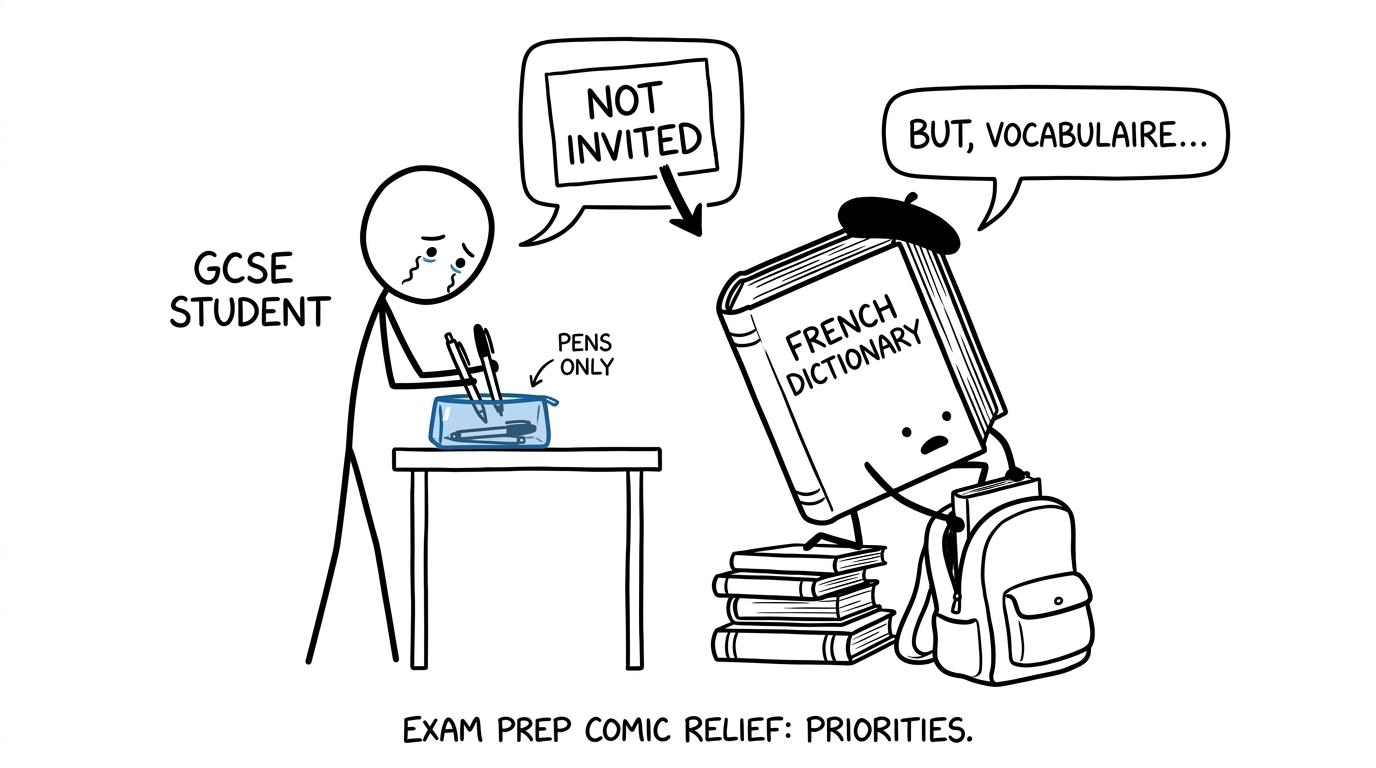 A student stops an oversized French dictionary from joining the exam kit
What you actually need in the exam room
Two reliable black pens
Current JCQ candidate guidance says written answers must be completed clearly in black ink. Pack at least two black ballpoint pens so that a pen running out does not become an unnecessary interruption.
Avoid using gel pens, erasable pens, correcting fluid, correcting tape or highlighters in your answers. Highlighters may sometimes be used on the questions, but not to write answers. The safest approach is uncomplicated: write every answer in permanent black ink and cross out mistakes neatly with a single line.
A pencil and rubber are unlikely to be essential for a French listening, reading or writing paper. Your school may nevertheless recommend including them as ordinary stationery. If so, keep them in the same transparent pencil case and use black ink for your final written responses.
A transparent pencil case
Any pencil case taken into the exam room must be see-through. A clear case lets invigilators confirm quickly that it contains only permitted equipment.
Do not add vocabulary cards, folded revision sheets or stationery carrying French phrases. The problem is not whether you intend to read them. Under JCQ rules, possession of unauthorised material can be treated as malpractice even when it was brought in accidentally.
An unlabelled transparent water bottle
Water can be useful during an exam, but the bottle should be transparent and its label should be removed. Avoid opaque reusable bottles unless your school has explicitly approved them.
Fill the bottle the night before and place it beside your pencil case. That turns one more morning decision into something already settled.
What not to bring into a GCSE French exam
The most important part of packing is often deciding what stays behind.
Do not have any of these on or near you in the exam room:
- A mobile phone
- A watch of any kind, including an analogue watch
- Earphones, earbuds or AirPods
- A smartwatch, smart glasses or another connected device
- Revision notes, vocabulary cards or loose paper
- A French dictionary
- A computer spellchecker, unless specifically authorised
- A non-transparent pencil case
- Correcting fluid, correcting tape or an erasable pen
JCQ guidance warns that possessing an unauthorised device can lead to sanctions and possible disqualification. A phone being switched off is not enough if it remains in your pocket. Follow your school's collection or storage procedure before entering the room.
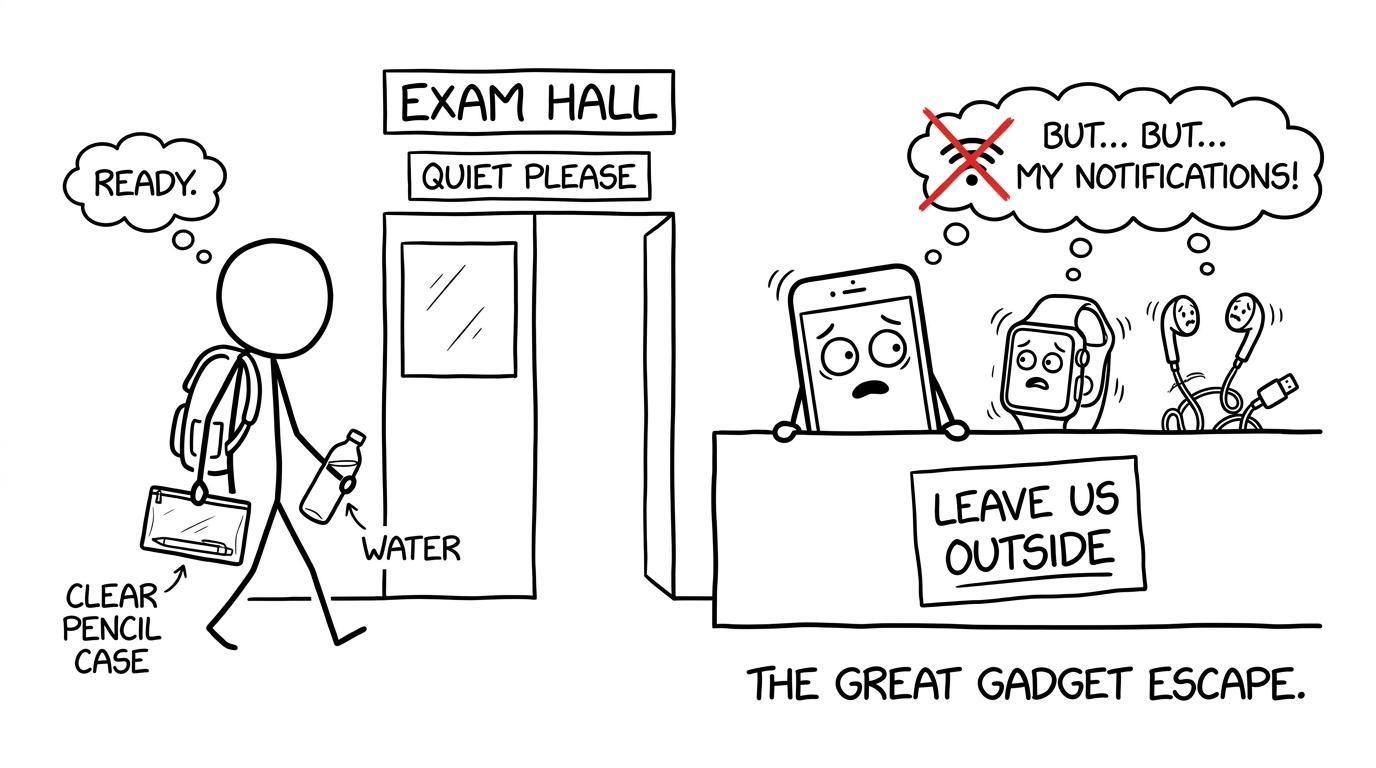 Phones, watches and earbuds wait unhappily outside an exam hall
Do you need a dictionary for GCSE French?
Normally, no. Current GCSE French specifications for first assessment in 2026 do not permit dictionaries during the assessed components. AQA explicitly states that dictionaries are not permitted in its listening, speaking, reading or writing assessments. Pearson Edexcel and Eduqas assessment materials also set out no-dictionary conditions.
This can feel counterintuitive. A dictionary seems like the most obviously useful object for a language exam. Yet the qualification is designed to assess the vocabulary and grammar you can understand and use independently.
Do not pack one "just in case". If an unusual access arrangement applies to you, it must be approved and managed through your school. Your teacher or exams officer will explain exactly what is available.
Does the kit change between French papers?
The basic written-paper kit remains almost identical, but the experience of each component differs.
Listening
Bring your normal black pens and listen carefully to the invigilator. The recording, playback equipment and question paper are organised by the centre. You do not need personal headphones unless your school has made a specific approved arrangement.
New GCSE French specifications include dictation, so accurate writing matters during part of the listening assessment. Your preparation belongs in the weeks before the paper, not on a card hidden in your pencil case.
Reading
You still need black pens rather than a dictionary. Read every instruction carefully and use the space provided. If you need an additional answer sheet, raise your hand and wait for an invigilator.
Writing
Two dependable pens matter most here because you will be producing longer responses. There is no need for a thesaurus, dictionary or prepared phrase sheet. Write in the designated spaces and make corrections clearly.
Speaking
The speaking assessment is conducted by your school or college and may involve supervised preparation time. Its practical arrangements differ from a large written examination, so follow the instructions given by your French teacher. Do not assume you can bring prepared notes, prompts or a dictionary into the preparation room.
Check the details that stationery cannot solve
A perfectly packed pencil case is not much help if you arrive at the wrong room. Before going to bed, confirm:
- The date of the paper
- The starting time
- The room or meeting point
- Whether you are entered for foundation or higher tier
- How early your school expects you to arrive
- What to do if transport fails or you become unwell
- Whether your school requires uniform, identification or a candidate card
GCSE French specifications and paper structures changed for students taking the reformed qualification from 2026. Avoid relying on an old screenshot, a sibling's timetable or assumptions based on another subject. Use the timetable and instructions issued directly by your centre.
Students balancing French with GCSE maths can use the same habit across the examination season: check the exact board, tier and paper before preparing. The GCSE maths revision hub provides board-specific resources for Edexcel, AQA, OCR, Eduqas, WJEC and CCEA.
A calm night-before routine
Packing should be the end of revision for the evening, not the beginning of another panic-filled session.
Finish useful revision first
If you have another GCSE paper approaching, choose one focused activity rather than reopening every folder. A short set from the GCSE mini tests can reveal more than an hour of passive rereading. Mark it, note one correction and stop.
For a more structured approach across exam season, follow the GCSE one-month maths revision plan. When time is much tighter, the GCSE maths night-before plan explains how to finish preparation without turning the evening into a marathon.
Put everything in one place
Place your clear pencil case, water bottle and required school identification beside your bag. Set out your clothes and arrange transport. Set an alarm with enough time for breakfast and an unhurried journey.
Keep your phone separate from the equipment you will carry into the exam room. Physical separation is useful because it prevents an automatic pocketing habit from becoming an exam problem.
Stop at a planned time
The urge to continue revising often comes from uncertainty rather than usefulness. Once your kit is packed and the essential details are checked, stopping is a rational part of preparation.
If you want a repeatable routine for other subjects, the 20-minute GCSE maths revision routine keeps revision focused on recall, questions and immediate feedback.
What to do on the morning of the exam
Check your timetable once, then leave it in your bag unless your centre says otherwise. Eat and drink something familiar. Arrive at the time requested by your school, rather than calculating the latest possible moment you could appear.
Before entering the room:
- Empty your pockets
- Hand in or securely store your phone and other devices
- Remove your watch
- Check that your water bottle has no label
- Confirm that your pencil case is transparent
- Make sure both black pens work
- Listen to the invigilator's instructions
Once you enter, remain silent and do not communicate with other candidates. Do not open the paper or begin writing until told to do so. If you feel unwell, need another answer sheet or are uncertain about an administrative issue, raise your hand. An invigilator cannot explain an exam question, but they can deal with practical problems.
Common mistakes when packing an exam kit
Taking a phone in because it is switched off
A switched-off phone is still an unauthorised device. Store it exactly as your school instructs before entering the room.
Wearing an ordinary watch
The restriction covers all watches, not only smartwatches. Leave yours outside and use the clock provided by the centre.
Bringing a dictionary without checking
GCSE French assessments are normally completed without a dictionary. Bringing one can create an avoidable problem before the paper even begins.
Using the wrong kind of pen
Blue ink, gel pens and erasable pens are not the safe choice. Bring two ordinary black ballpoint pens and test them beforehand.
Carrying notes accidentally
Check blazer pockets, trouser pockets and the compartments of your bag. Remove flashcards, scraps of paper and anything written on your hands. Accidental possession still matters under examination rules.
Treating preparation as subject-specific
French and maths require different knowledge, but reliable exam habits transfer between them. Practising papers under realistic conditions makes equipment rules and time management feel normal. MathsGenie's guide to using GCSE past papers properly shows how to attempt, mark, fix and retest rather than merely collecting scores.
Pack less, prepare better
A good GCSE French exam day kit is deliberately uneventful: two black pens, a transparent pencil case and, if wanted, an unlabelled transparent water bottle. Everything else should be checked against your school's instructions rather than added through anxiety.
Pack once. Check once. Then let the preparation you have already done carry the weight.
For the maths papers elsewhere in your GCSE timetable, make MathsGenie your next stop. Use the free GCSE maths revision resources for revision lessons and practice questions, then build exam confidence with mini tests, past papers, mark schemes, video solutions and Edexcel predicted papers. The aim is not to make exam day dramatic. It is to make it familiar.










