GCSE Food and Nutrition Revision Timetable Clash
GCSE food and nutrition revision timetable clash? Build a realistic weekly plan that protects maths, manages NEA pressure and keeps six subjects moving.

A revision timetable can look perfectly balanced on Sunday evening. Then Food Preparation and Nutrition needs research, a practical session runs late, and a maths paper exposes three weak topics at once. By Tuesday, the plan has stopped being a plan and become a list of things you feel guilty about.
A GCSE food and nutrition revision timetable clash is solved by giving each subject a minimum weekly commitment, then moving extra time towards the nearest deadline or clearest weakness. Do not divide every evening equally. Protect several short maths sessions, schedule Food and Nutrition according to whether you are completing non-exam assessment or preparing for the written paper, and leave spare capacity for disruption.
The goal is not a beautiful timetable. It is a timetable you can still follow when the week becomes untidy.
Your quick planning checklist
Before filling any boxes, collect the information that actually controls your week:
- your school’s confirmed exam timetable and internal NEA deadlines;
- your Food Preparation and Nutrition exam board and specification;
- your maths exam board and foundation or higher tier;
- fixed commitments such as lessons, practical sessions and travel;
- the weakest topics revealed by tests and marked work;
- one buffer period that has not already been promised to a subject.
For maths, use the GCSE Maths revision hub to select the correct board and resources. If you are unsure where your lost marks are coming from, the guide to finding your weakest GCSE topics gives you a practical diagnostic process.
Understand why Food and Nutrition creates pressure
GCSE Food Preparation and Nutrition is not simply a written subject with occasional cooking. Current AQA, OCR and Eduqas specifications divide assessment between a written examination and non-exam assessment, with each side contributing 50%50\%50% of the qualification. Exact task structures, examination lengths and administrative arrangements vary by board, so your own specification and teacher’s deadlines must control your plan.
That split creates two different kinds of pressure.
During NEA periods, Food and Nutrition may need longer connected blocks for investigation, planning, practical preparation, analysis and evaluation. Those tasks do not always fit comfortably into a spare 202020 minutes. Closer to the written examination, revision becomes easier to divide into shorter sessions covering nutrition, food science, food safety, food choice, provenance and practical principles, depending on your specification.
Maths behaves differently. Progress is usually easier to maintain through frequent contact: recall a method, answer questions, mark them and repair the error. This is why dropping maths completely for a fortnight can be costly even if you intend to catch up later.
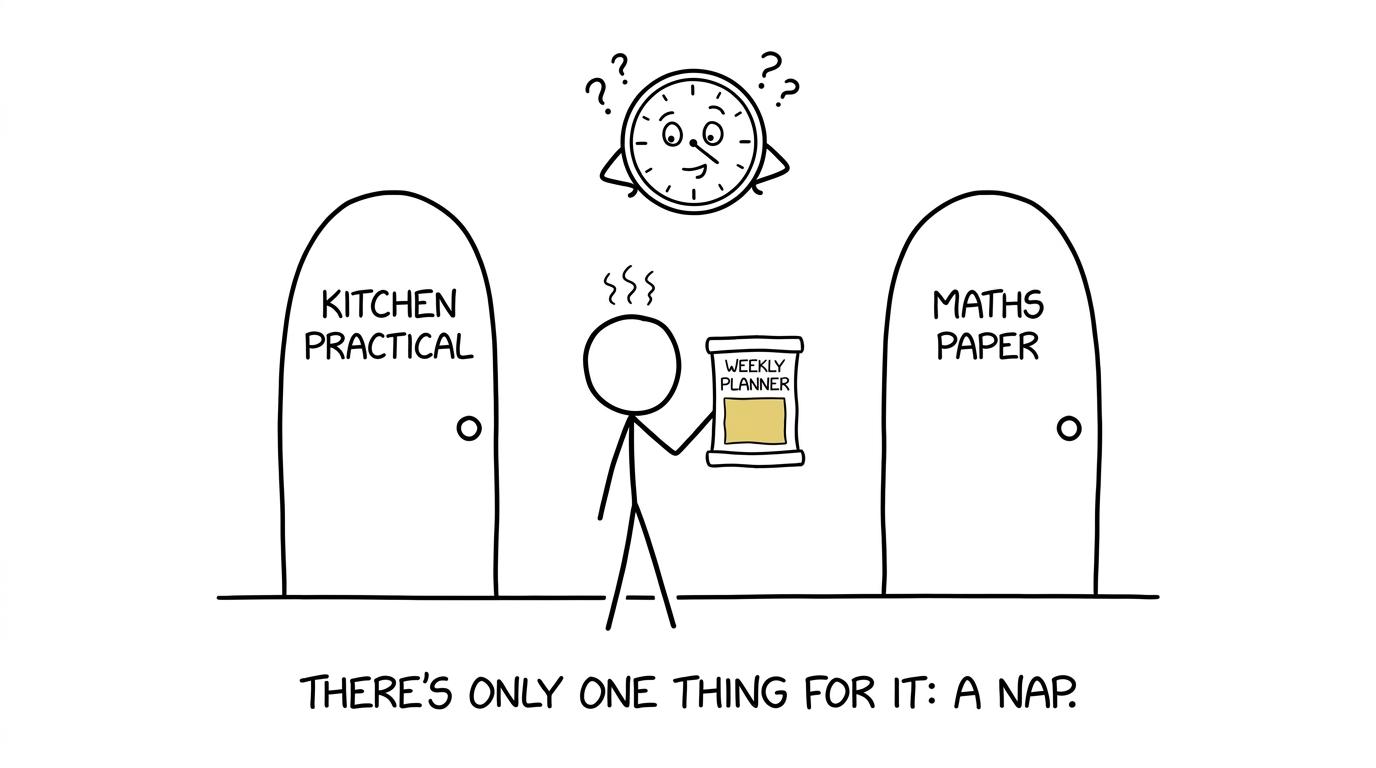 A student negotiates between a kitchen practical and a maths paper
Build a timetable from capacity, not ambition
Start with the time you genuinely have after school, meals, travel, homework and sleep. Do not begin with the number of hours you wish existed.
If your usable weekly revision time is TTT, and fixed homework or NEA commitments take FFF, your flexible revision capacity is:
R=T−FR=T-FR=T−FThat remaining capacity must cover all six subjects, breaks and unexpected work. If every minute of RRR is allocated, the timetable is already fragile. Keep roughly 10%10\%10% to 15%15\%15% unassigned as a buffer. This is not wasted time. It prevents one delayed practical or difficult homework task from destroying the rest of the week.
Set a minimum that protects every subject
Choose a small weekly floor for each subject. A floor is the amount you complete even when another deadline becomes urgent.
For maths, that might mean three short topic sessions plus one mixed or timed session. On a crowded school night, the 20-minute GCSE maths revision routine can preserve continuity without taking over the evening.
For Food and Nutrition, the floor might include:
- one retrieval session on specification content;
- one session answering or planning exam responses;
- one longer block for NEA-related work when your teacher permits it;
- a brief review of feedback, key terms or food-science processes.
Your teacher’s instructions take priority for controlled or supervised NEA work. Do not assume that every part of an assessed task can be completed independently at home.
Add priority time separately
Once every subject has a minimum, distribute the remaining sessions according to evidence:
- an approaching internal deadline;
- an examination that occurs sooner;
- repeated lost marks;
- a topic you cannot yet answer without notes;
- teacher feedback requiring a specific action.
This separates maintenance from priority. Maths does not disappear during an intensive Food and Nutrition week, while Food and Nutrition does not receive only leftover time because maths feels more measurable.
Use different session shapes for different work
Equal boxes are not always fair boxes. A 252525-minute maths practice session can be productive because it contains a complete feedback loop. A practical planning task may need a longer uninterrupted period before you make meaningful progress.
A realistic weekly pattern could use the following session types:
| Session type | Suitable work | Typical duration |
|---|---|---|
| Short retrieval | Nutrients, definitions, formulae or methods | 151515 to 202020 minutes |
| Focused practice | Maths topic questions or Food exam questions | 252525 to 404040 minutes |
| Extended block | NEA planning, a timed paper section or detailed review | 505050 to 757575 minutes |
| Weekly check | Marking, error logging and planning the next week | 151515 minutes |
These are planning ranges, not compulsory rules. Stop a short session when its intended job is complete rather than stretching it to look impressive.
For maths, a focused block should normally follow this sequence: retrieve, practise, mark, correct and schedule a retest. MathsGenie’s GCSE mini tests are useful when you need a short, measurable task, while GCSE past papers are better for mixed knowledge and examination stamina.
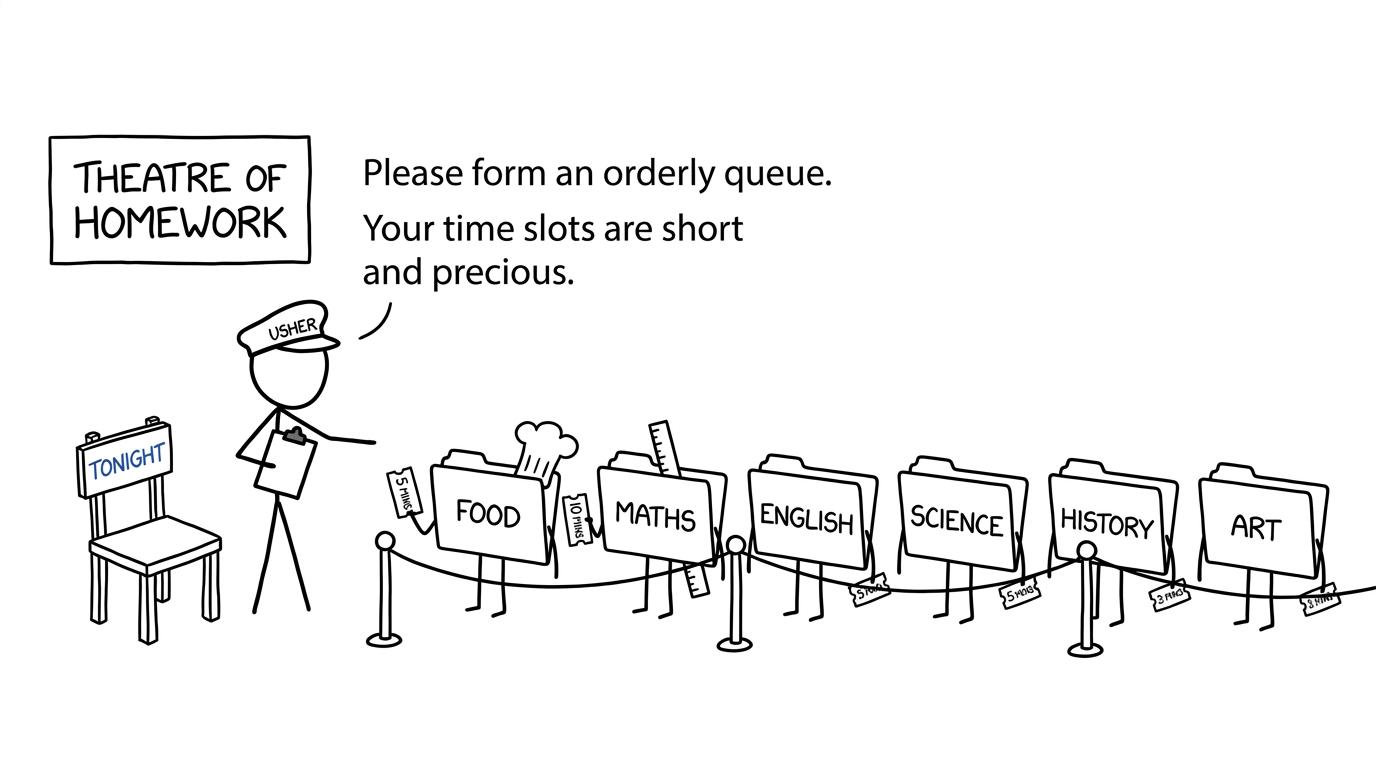 Six subject folders queue for one evening revision chair
Make the plan respond to the school year
A static timetable ignores how GCSE courses actually unfold. Use three modes instead.
During an NEA-heavy Food and Nutrition period
Give Food and Nutrition one or two extended blocks linked to the next permitted task. Keep maths alive with shorter, frequent sessions aimed at specific weaknesses. Avoid beginning full maths papers if you do not have time to mark them properly.
This is temporary rebalancing, not abandonment. Decide in advance when the extra Food and Nutrition allocation ends.
After NEA submission
Move Food and Nutrition towards retrieval and written examination practice. Reclaim one extended block for whichever subject now has the strongest evidence of need. For maths, this may be the point to introduce timed sections and regular paper review.
The GCSE maths revision timetable guide explains how to combine topic work, timed practice and revisiting weak areas across a week.
In the final examination period
Plan from confirmed examination dates rather than using the same Monday-to-Sunday pattern indefinitely. Give the next examination additional attention, but preserve small sessions for later subjects so that they do not become emergency cramming projects.
If two official examinations appear to clash, that is different from a revision clash. Tell your school’s examinations officer immediately and follow the arrangements provided by the centre. Do not try to solve an official exam clash by guessing which paper matters more.
Revise actively when time is limited
A short session must require you to remember or produce something. Re-reading can feel smooth because the page supplies the information for you. Retrieval is less comfortable, but it shows what is actually available from memory.
For Food and Nutrition, active revision can include:
- recalling the functions and sources of nutrients before checking notes;
- explaining a food-science process from memory;
- planning a response around the question’s command word;
- comparing your answer with a mark scheme or teacher feedback;
- returning to an incorrect answer after a delay.
For maths, answer questions without watching the solution first. Mark immediately and write down why each mark was lost. If the method is unclear, use a revision lesson, then complete fresh questions rather than copying the explanation.
Research summarised by the Education Endowment Foundation supports planning, monitoring and evaluating learning, as well as appropriately challenging retrieval with feedback. The practical lesson is simple: space revision across the week and let mistakes decide what returns to the timetable.
When you begin full papers, follow the MathsGenie past-paper revision process: attempt, mark, diagnose, repair and retest. Later in the revision cycle, GCSE predicted papers can provide additional practice, but they should supplement specification coverage and official past papers rather than replace them.
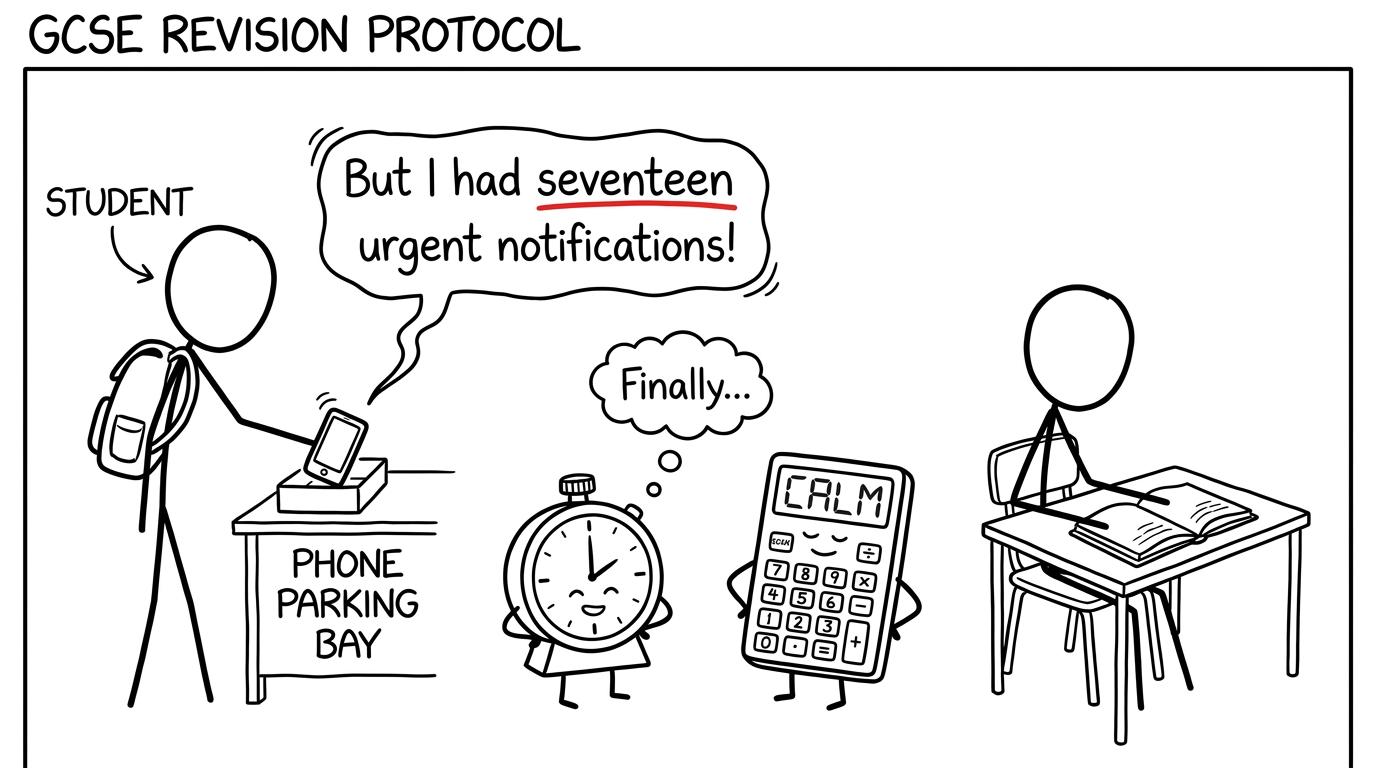 A phone protests as it is parked away from the revision desk
What to do when the timetable slips
Missing one evening does not require a complete redesign. Use a recovery rule:
- keep tomorrow’s fixed commitments unchanged;
- move only the most urgent unfinished task;
- shorten or remove a low-priority extra session;
- preserve each subject’s weekly minimum where possible;
- use the buffer before borrowing from sleep.
Do not squeeze two missed sessions into the next evening automatically. That turns a small delay into an exhausting backlog. At the end of the week, ask which tasks produced evidence of progress. A marked set of questions tells you more than an unchecked hour of notes.
Common mistakes when six subjects compete
Giving every subject identical time
Equal time ignores deadlines, assessment demands and current weaknesses. Give every subject a minimum, then allocate extra time by need.
Treating NEA work like ordinary revision
NEA has board and school rules governing supervision, authentication and deadlines. Follow your teacher’s instructions and schedule only the work you are permitted to complete independently.
Removing maths for an entire busy week
Frequent short contact is usually more manageable than rebuilding forgotten methods later. Keep a small maths floor even when Food and Nutrition temporarily receives the longer blocks.
Counting passive activity as completed revision
Reading, highlighting and organising files can support learning, but they do not prove recall. End sessions with questions, a memory check, marking or a clearly recorded correction.
Filling every available minute
A timetable with no buffer assumes that nothing will run late and your energy will never vary. Leave some capacity unallocated.
Completing papers without reviewing them
A total mark is only the beginning. Use mark schemes and video solutions to identify the method, accuracy or interpretation issue behind each lost mark.
Build a week you can repeat
The most reliable plan is rarely the most intense one. It gives Food and Nutrition enough uninterrupted time for its distinctive demands, protects regular maths practice and accepts that the priority subject will change as deadlines move.
Start by confirming your dates, setting a weekly minimum for all six subjects and reserving a buffer. Then open the MathsGenie GCSE Maths revision hub, choose your exam board and tier, and select the next task from evidence rather than mood. Use free revision lessons and practice questions to repair individual skills, mini tests to check them, and past papers, predicted papers, mark schemes and video solutions to build exam readiness.
A timetable does not need to predict every difficult evening. It only needs to make your next useful action clear.