GCSE Food and Nutrition Revision Environment
GCSE food and nutrition revision environment advice: discover what matters, what is overrated, and how to build focused revision habits that last.
The desk is tidy. The highlighters are arranged by colour. A carefully chosen playlist is ready. Yet, after half an hour, very little has actually been remembered.
This is the uncomfortable truth behind much GCSE food and nutrition revision environment advice: where you revise matters, but not as much as what you do there. A reasonably quiet, comfortable space can protect your attention. It cannot replace retrieval practice, exam questions or honest marking.
For students balancing Food Preparation and Nutrition with GCSE maths, the goal is not to create a flawless revision room. It is to build a setting in which starting is easy, distractions are controlled and proper practice happens repeatedly.
The short answer: does your revision environment matter?
Yes, but it is a supporting factor rather than the main event.
A useful revision environment should help you:
- begin without a long setup ritual;
- concentrate without frequent interruption;
- retrieve knowledge without immediately checking notes;
- complete written questions under suitable conditions;
- review mistakes while your thinking is still fresh;
- repeat the routine on ordinary school days.
Noise, phones, interruptions, poor lighting and an uncomfortable workspace can all make concentration harder. Research on environmental noise has found effects on attention, verbal memory, reading and listening, although the size of the effect varies with the person, task and type of noise.
Research on context-dependent memory also suggests that surroundings can sometimes provide retrieval cues. However, the effect is not a promise that revising in an exam hall will transform your grade. Studies using meaningful educational material have not always found a clear same-room advantage.
The sensible conclusion is modest: remove avoidable friction, practise in more than one reasonable setting and complete some sessions under quiet, timed conditions.
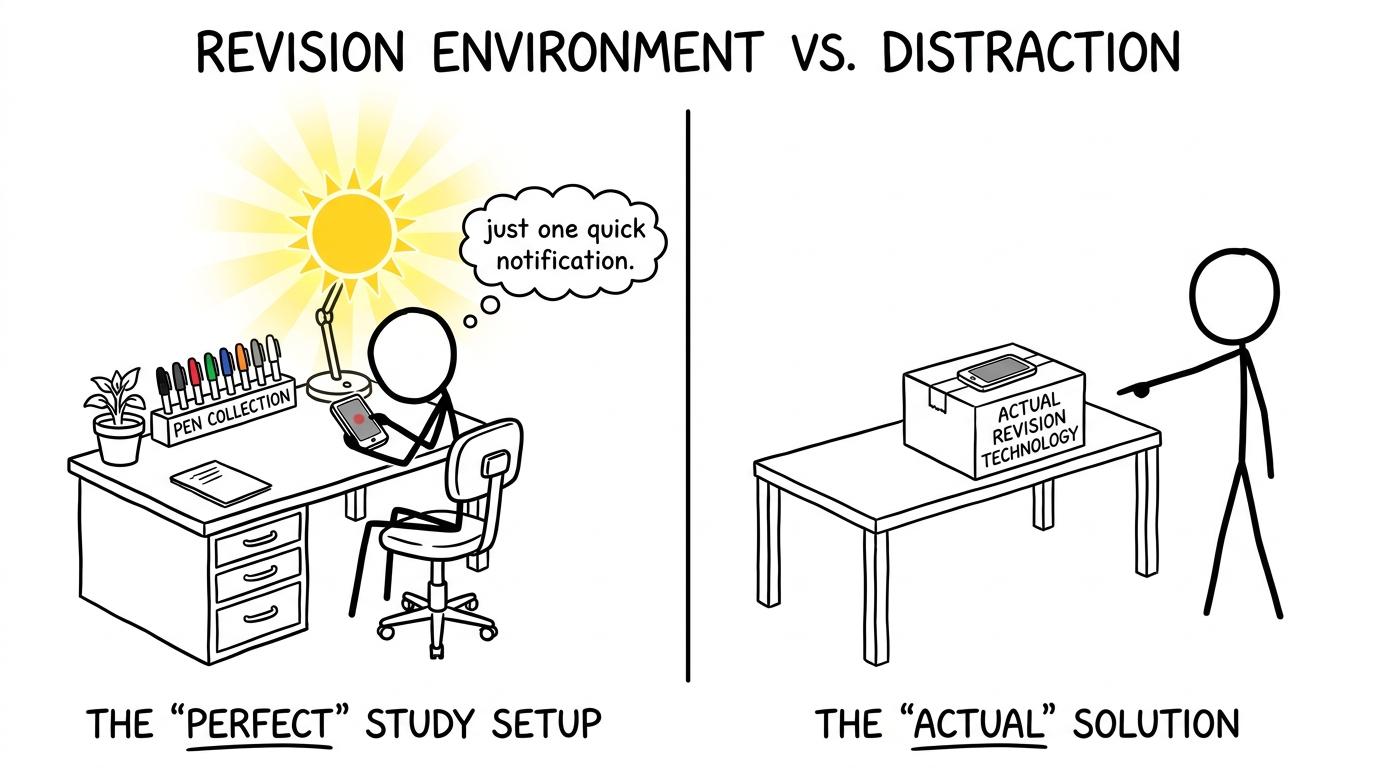 A student discovers that moving a phone matters more than arranging highlighters
What a good GCSE Food and Nutrition revision space needs
A surface that supports the task
You need enough room for the resources required by the session, not an expensive desk transformation. For theory revision, that might mean your specification checklist, questions, paper and a pen. For a timed paper, clear away notes and unrelated books.
A library table, classroom, dining table or quiet corner can all work. The best location is usually the one you can use consistently without being repeatedly moved or interrupted.
The kitchen may feel thematically appropriate, but it is not automatically effective. Food, conversation, appliances and people passing through can compete for attention. Use the kitchen when you are planning or discussing practical work; choose a calmer surface when you need sustained written concentration.
Manageable sound rather than perfect silence
You do not need absolute silence for every session. Some students find predictable background sound tolerable, while speech, changing songs and notifications repeatedly capture their attention.
Match the sound level to the task:
- Learning or organising notes: low, unobtrusive background sound may be manageable.
- Retrieving facts: remove lyrics and conversations if they pull your attention away.
- Extended responses: use quieter conditions so you can hold the structure of an answer in mind.
- Timed papers: practise in conditions reasonably close to an examination: quiet, independent and without pausing.
Do not turn this into a search for the perfect playlist. If choosing music takes longer than opening the question, the environment has become the distraction.
A phone rule you can actually follow
Evidence on the passive presence of a phone is mixed, but active mobile multitasking clearly divides attention. The practical issue is not whether every phone on every desk reduces performance. It is whether your phone leads to checking, replying or switching tasks.
Make the rule physical rather than motivational. Put the phone in another room, inside a bag or beyond arm's reach. If you need it for a timer, use flight mode or a separate clock.
The aim is not to prove exceptional willpower. It is to make distraction slightly inconvenient.
Resources chosen before the session
Searching for materials can look like revision while quietly replacing it. Before you sit down, decide on one outcome: recall food safety rules, answer questions on nutrition, plan an extended response or complete a timed section.
The same principle helps with maths. Start from the GCSE Maths revision hub, choose your board and topic, then keep only the relevant lesson and questions open. Fewer choices at the desk mean more attention reaches the work.
Environment cannot rescue passive revision
A beautiful workspace can still host ineffective habits. Rereading a page may create familiarity, but examinations require you to recall, apply, analyse and evaluate.
Food Preparation and Nutrition specifications differ between AQA, OCR and Eduqas, so check the specification used by your school. Across these qualifications, the written examination contributes 50%50\%50% of the GCSE, with the remainder assessed through non-exam assessment. AQA and Eduqas have a written paper lasting 111 hour 454545 minutes, while OCR's written examination lasts 111 hour 303030 minutes.
That matters because your environment should support more than fact memorisation. You need to practise:
- recalling sources, functions and deficiencies of nutrients;
- explaining food science processes;
- applying food safety knowledge to unfamiliar situations;
- interpreting data, labels and sensory results;
- planning structured answers;
- writing accurately under time pressure.
Retrieval practice has substantial support as a learning strategy, although its usefulness depends on the quality and challenge of the questions. Close the book and write what you know. Then check, correct and return to the same material later.
A room makes this process easier or harder. It does not perform the process for you.
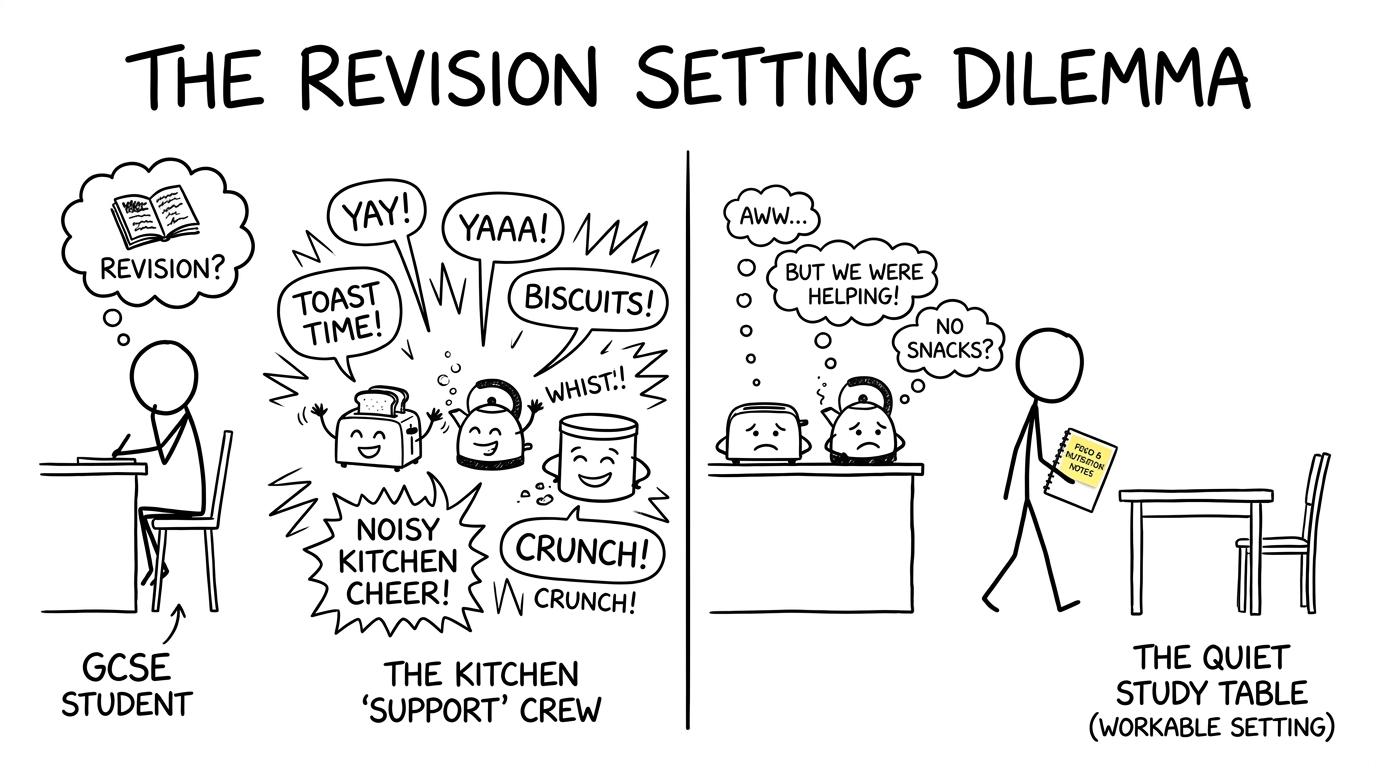 Kitchen appliances object when a student chooses a quieter revision table
Should you always revise in the same place?
Probably not.
A familiar location can reduce startup friction because the setting becomes associated with work. But relying on one exact chair, playlist or drink can make revision feel unnecessarily fragile. Your examination will take place elsewhere, under conditions you do not fully control.
Use a dependable main location, then add controlled variation. You might retrieve nutrient facts at your desk, answer questions in the library and complete a timed paper in a quiet classroom. This gives you consistency without tying recall to one highly specific context.
Some research suggests that varying context can support flexible memory, but the interaction with retrieval is complicated. Do not deliberately make every session noisy or uncomfortable. Instead, vary sensible locations while keeping the learning method strong.
A useful balance is:
- most sessions in one reliable place;
- occasional retrieval in a second quiet location;
- regular timed practice in exam-like conditions;
- no dependence on music, snacks or a particular room before you can begin.
Build an environment around the kind of session
For learning and checking knowledge
Keep your specification or topic checklist visible. Use short prompts, flashcards or blank-page recall. Check your answer only after making a genuine attempt.
Your environment can be comfortable here, but it should still make active work easier than passive browsing. Keep a pen in your hand and unnecessary tabs closed.
For written application questions
Remove notes for the first attempt. Give yourself a defined set of questions and mark them immediately afterwards. Record the reason for each lost mark: missing knowledge, weak application, unclear wording or poor timing.
This is also an effective routine for the quantitative parts of Food Preparation and Nutrition. Recipes, nutritional information and experimental results draw on numerical confidence. Students who need to strengthen this foundation can use MathsGenie's AQA ratio questions or the broader OCR ratio revision lesson.
For timed paper practice
Create a stricter setting. Use the correct time, allowed equipment and no notes. Do not pause to search for an answer. That discomfort is useful because it reveals whether knowledge is retrievable under pressure.
Students can apply the same routine to mathematics using Edexcel GCSE Maths past papers or AQA GCSE Maths past papers. The board may be different, but the environmental principle is the same: practise the performance you will eventually be asked to produce.
For short sessions on busy days
A short session needs less preparation, not lower quality. Choose one small target, retrieve first, answer a few questions and mark them.
MathsGenie's 20-minute GCSE revision routine uses this idea to reduce decision-making. For even shorter assessment, GCSE maths mini tests make it possible to practise without turning every evening into a full paper.
A simple revision environment test
Do not judge your space by how organised it looks. Test whether it produces useful work.
After several sessions, ask:
- Did I begin within a few minutes?
- How often did I check my phone or change tabs?
- Did I retrieve anything without notes?
- Did I complete questions rather than only read?
- Did I mark the work and identify a next step?
- Could I repeat this setup tomorrow?
If the answer to most of these is yes, the environment is doing its job. If not, change one variable. Move the phone, switch rooms, remove music or prepare the questions in advance.
Avoid changing everything at once. A revision environment is a small experiment: adjust one feature and observe whether your concentration and output improve.
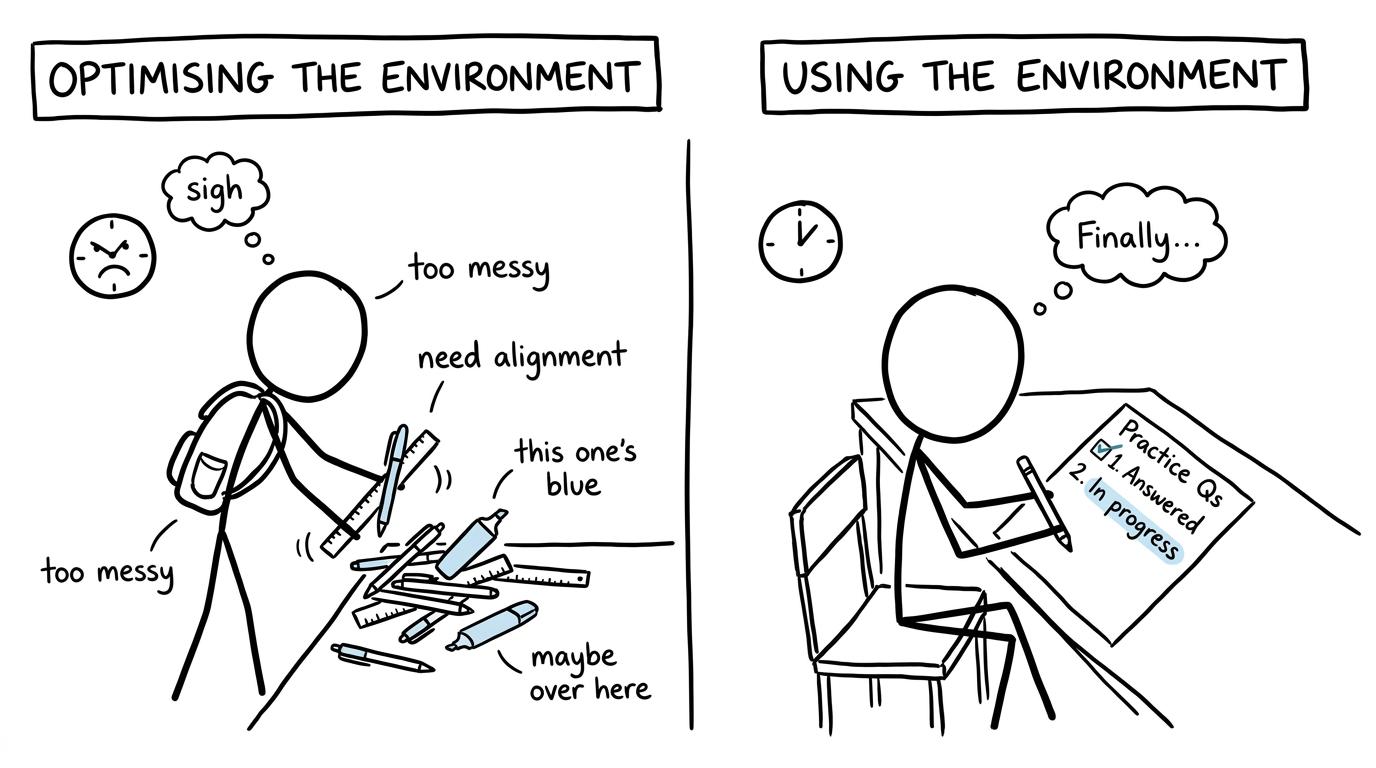 A student chooses practice questions over endlessly optimising a revision desk
Common revision environment mistakes
Treating organisation as learning
Colour-coding a folder can be useful once. Reorganising it every evening is often avoidance. Set a short limit for preparation, then begin retrieval or questions.
Waiting for ideal conditions
Real homes are not libraries. You may share a room, have family noise or lack a permanent desk. Aim for a workable period and place, not perfection. Headphones without lyrics, a school library or a pre-agreed quiet interval can be enough.
Revising beside open distractions
A television in view, active group chat and multiple browser tabs make task-switching easy. Close or move them before starting rather than hoping to ignore them later.
Making every session comfortable
Learning sessions can be relaxed, but some practice must expose uncertainty. Closed-book recall and timed questions may feel harder precisely because they show what is not secure yet.
Copying someone else's setup
A routine that looks impressive online may not suit your home, attention or timetable. Judge an environment by completed, marked work, not appearance.
Using the same approach for every subject
Food Preparation and Nutrition combines factual knowledge, scientific explanation, practical understanding, evaluation and written application. Maths requires methods, calculations and clear working. The desk can remain the same, but the task should change.
For maths, a strong session may move from a revision lesson to practice questions and then a mini test. The GCSE one-month maths revision plan shows how to organise these different forms of practice without relying on mood.
Your environment should make good revision ordinary
The best revision space is rarely remarkable. It is simply available, sufficiently quiet and easy to begin using. It keeps your materials close and your distractions farther away. Most importantly, it allows you to retrieve, practise, mark and return.
So yes, your GCSE Food and Nutrition revision environment genuinely matters. But its value lies in the behaviour it enables, not its appearance. Improve the obvious obstacles, vary your setting occasionally and rehearse some work under examination conditions. Then stop adjusting the desk and answer the question.
For the maths alongside your Food Preparation and Nutrition course, make MathsGenie's free GCSE revision resources your dependable starting point. Use revision lessons to rebuild weak topics, practice questions and mini tests to check recall, and past papers, predicted papers, mark schemes and video solutions to turn a calm workspace into measurable progress.