GCSE Exam Equipment Checklist for Resit Day
GCSE exam equipment checklist for Maths and English resits: stationery, private candidate ID, calculator rules, prohibited items and arrival advice.
Resit morning has a particular kind of tension. You may know the content, have practised the papers and be ready to improve your grade, yet still wonder whether your calculator is allowed or whether the centre expects photographic ID.
This GCSE exam equipment checklist gives you the practical answer. Bring black ballpoint pens, basic stationery, the correct calculator for a calculator paper and any identification requested by your examination centre. Arrive early, keep prohibited items outside the exam room and follow your centre's instructions if they differ from general advice.
The checklist below covers GCSE Maths and English Language resits, including the extra preparation needed for a private candidate exam day. It reflects current JCQ rules, but your centre's joining instructions remain essential because arrival procedures and identification requirements can vary.
Your GCSE resit checklist
Pack these items the evening before your examination:
- Two or more working black ballpoint pens
- A pencil and a spare pencil
- An eraser
- A ruler with clear markings
- A protractor and pair of compasses for GCSE Maths
- A compliant scientific calculator when the paper permits one
- A transparent pencil case or clear plastic bag
- Your examination confirmation, timetable or centre instructions
- Original photographic identification if your centre requires it
- A transparent, label-free water bottle, if your centre allows drinks
- Any approved medication or access-arrangement equipment agreed with the centre
Check your route, examination venue, paper time, candidate number and centre number as well. A resit may take place somewhere unfamiliar, particularly if you are entering privately.
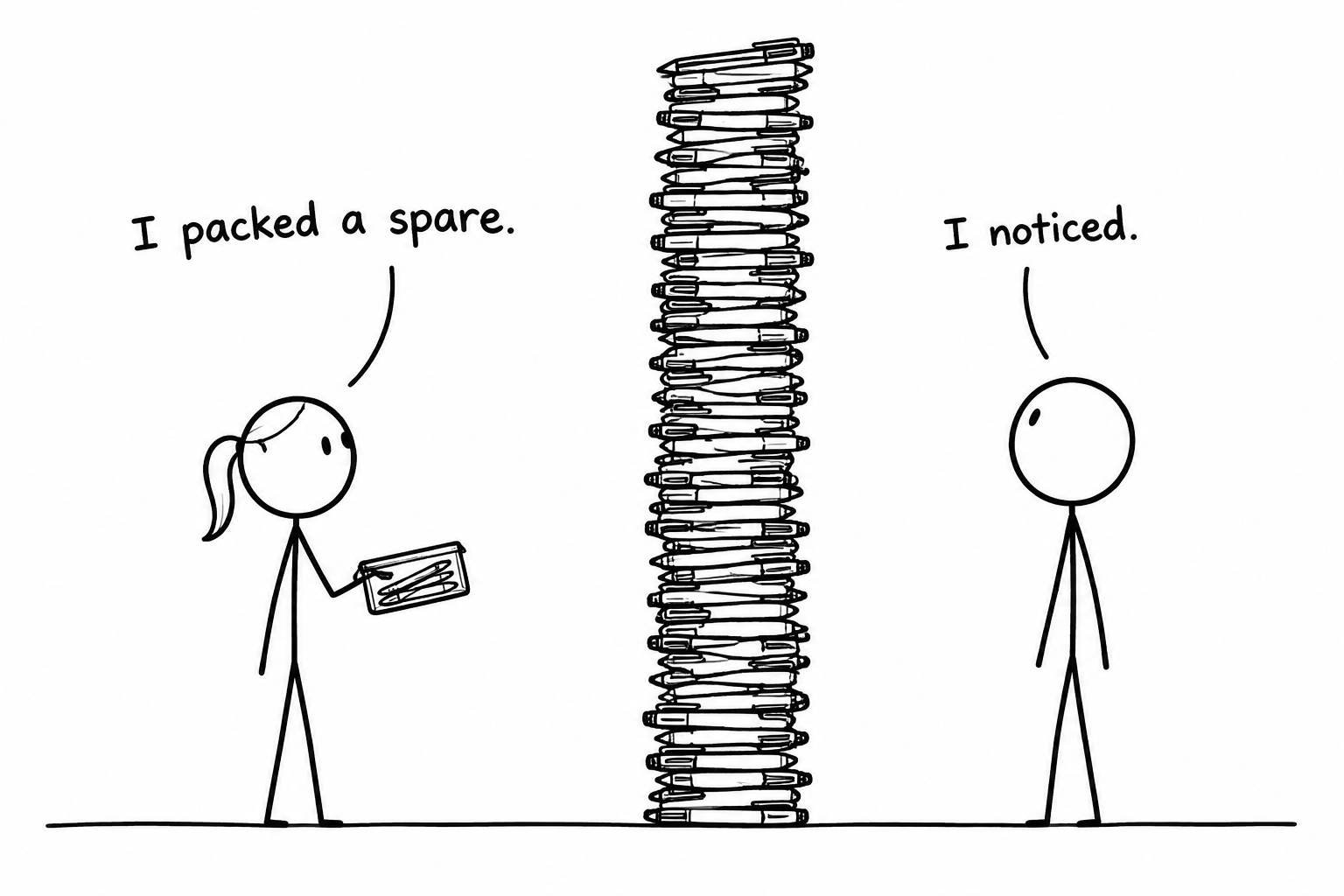 A GCSE resit student takes the idea of packing a spare pen rather seriously
What to bring to a GCSE exam
Pens and ordinary stationery
Use a black ballpoint pen for your written answers. Take at least one spare that you have tested. Gel pens, erasable pens and coloured ink should not be used for answers, while correcting fluid, correcting pens and correcting tape are not permitted.
A pencil is useful for diagrams, graphs and construction work in GCSE Maths. Bring an eraser, ruler, protractor and compasses so you are not depending on the centre to supply them. Equipment can fail in surprisingly ordinary ways: a pen runs dry, a pencil snaps or a compass loosens. A small backup removes a large distraction.
Any pencil case taken into the room must be transparent. Notes, revision cards and formula sheets must remain outside unless the examination paper specifically provides or permits them. Highlighters must not be used in your answers, although current JCQ instructions allow them for highlighting parts of the question paper.
For final preparation, use the GCSE Maths revision resources to find material for your exam board. MathsGenie includes revision lessons, practice questions, past papers and mark schemes, so the equipment you pack can support the method you have already practised.
What English Language candidates need
For GCSE English Language, reliable black pens are the priority. A pencil and ruler can still be useful for planning or keeping annotations organised, but your assessed response should be written in accordance with the instructions on the paper.
Do not take prepared quotations, model answers or planning notes into the room. Empty your pockets and check inside your pencil case before leaving home. Something forgotten in a pocket can still count as an unauthorised item, even if you never intended to use it.
Calculator rules for GCSE Maths resits
First, establish whether your paper is a calculator or non-calculator paper. GCSE Maths structures differ across Edexcel, AQA, OCR and Eduqas, so check your official timetable and the front of the question paper rather than relying on a friend's paper order.
When calculators are allowed, JCQ rules require the calculator to be suitable for the examination. It must not provide prohibited facilities such as internet access, communication, stored text, symbolic algebra or symbolic calculus. A phone calculator is not acceptable. Some graphical calculators can comply when an appropriate exam mode is activated, but you should confirm this with your centre before exam day.
Before leaving home:
- Check that the calculator works and that its battery is reliable
- Clear stored information and prepared programmes
- Activate a compliant exam mode if your model requires it
- Remove the case, lid or cover, especially if it contains instructions or formulae
- Practise using the same model during revision
There is no universal JCQ list naming every permitted calculator. If you are uncertain about a particular model, ask the examination centre in advance. You cannot assume that another candidate will be allowed to lend you one during the examination.
Practise with your calculator on the MathsGenie GCSE Maths past-paper resources, then mark your work carefully. Closer to the examination, GCSE predicted papers and short GCSE Maths mini tests can help you rehearse switching between calculator skills, written working and mental methods.
ID and documents for a private candidate exam day
Private candidates should treat identification as part of their essential equipment. Your centre must be able to identify you, but the exact documents accepted are set out by that centre.
Bring the original photographic ID specified in your booking information, commonly a passport or photocard driving licence. Also take your confirmation email or letter, examination timetable, candidate number and centre details. Keep these documents together, but leave them with your belongings if the invigilator says they cannot remain on your desk.
Do not assume that a photograph on your phone will be accepted. Contact the centre beforehand if you lack the requested ID, your name has changed or the details on your entry appear incorrect. Resolving this before the examination is far calmer than trying to explain it at check-in.
Phones, watches, water and personal belongings
Mobile phones, smartwatches, ordinary watches, earbuds and other communication or storage devices must not be in your possession in the examination room. Switching a phone to silent is not enough. Follow the centre's procedure for storing it, or leave it securely elsewhere.
JCQ guidance says any drink bottle taken into the room must be transparent and have its label removed. Food and drink are still subject to the head of centre's discretion, so check local instructions. If you need food, medication or specialist equipment for a medical reason, arrange this with the centre in advance.
When to arrive for your resit
JCQ tells candidates to arrive at least ten minutes before the start of an examination. In practice, aim earlier, especially at an unfamiliar centre. You may need to find the correct entrance, show identification, store your belongings and receive a briefing.
Use the arrival time printed in your centre's instructions if it is earlier than the examination start. Plan for transport delays and save the centre's contact details somewhere accessible. If you are delayed, contact the centre immediately and report to staff when you arrive. Do not simply decide that it is too late and go home.
A MathsGenie revision planner can hold your final practice sessions, but put the official examination date and arrival time in your personal calendar too. Revision prepares your knowledge. Logistics protect your chance to show it.
Common exam-day mistakes
The most avoidable problems are usually small:
- Bringing blue, gel or erasable pens instead of black ballpoint pens
- Leaving a watch, phone or earbud in a pocket
- Using an opaque pencil case
- Taking a calculator into a non-calculator paper
- Forgetting to remove a calculator cover containing formulae
- Arriving with a labelled or opaque drinks bottle
- Assuming the centre will provide all geometry equipment
- Forgetting the photographic ID requested for a private candidate exam day
- Travelling to the wrong venue or arriving at the published start time
Do one final pocket check before entering. Then listen to the invigilator, check that you have the correct paper and raise your hand if anything appears wrong.
Pack once, then focus on the paper
Good exam preparation is rarely dramatic. It is a collection of small decisions made early enough to become boring: the calculator has been checked, the pens work, the ID is packed and the route is known.
Once that practical uncertainty has gone, return your attention to the work. Start with MathsGenie's free revision resources, use video solutions when you are stuck, and compare your answers with the mark schemes. On the final evening, pack this checklist, stop reorganising and give yourself the quiet advantage of arriving prepared.