GCSE English Literature Results Day FAQ
GCSE English Literature results day questions answered clearly, including grade boundaries, reviews of marking, scripts, resits and practical next steps.
Results day compresses months of work into one small line on a screen or sheet of paper. That is why the most common GCSE English Literature results day questions are rarely just about a number. Students want to know whether the grade is enough, while parents want to know whether anything should happen next.
The short answer is: check the result carefully, compare it with the confirmed grade boundaries, speak to your school, and avoid making a rushed decision about a review. GCSE results for the June 2026 series are released to candidates on Thursday 20 August 2026, although schools set their own collection arrangements.
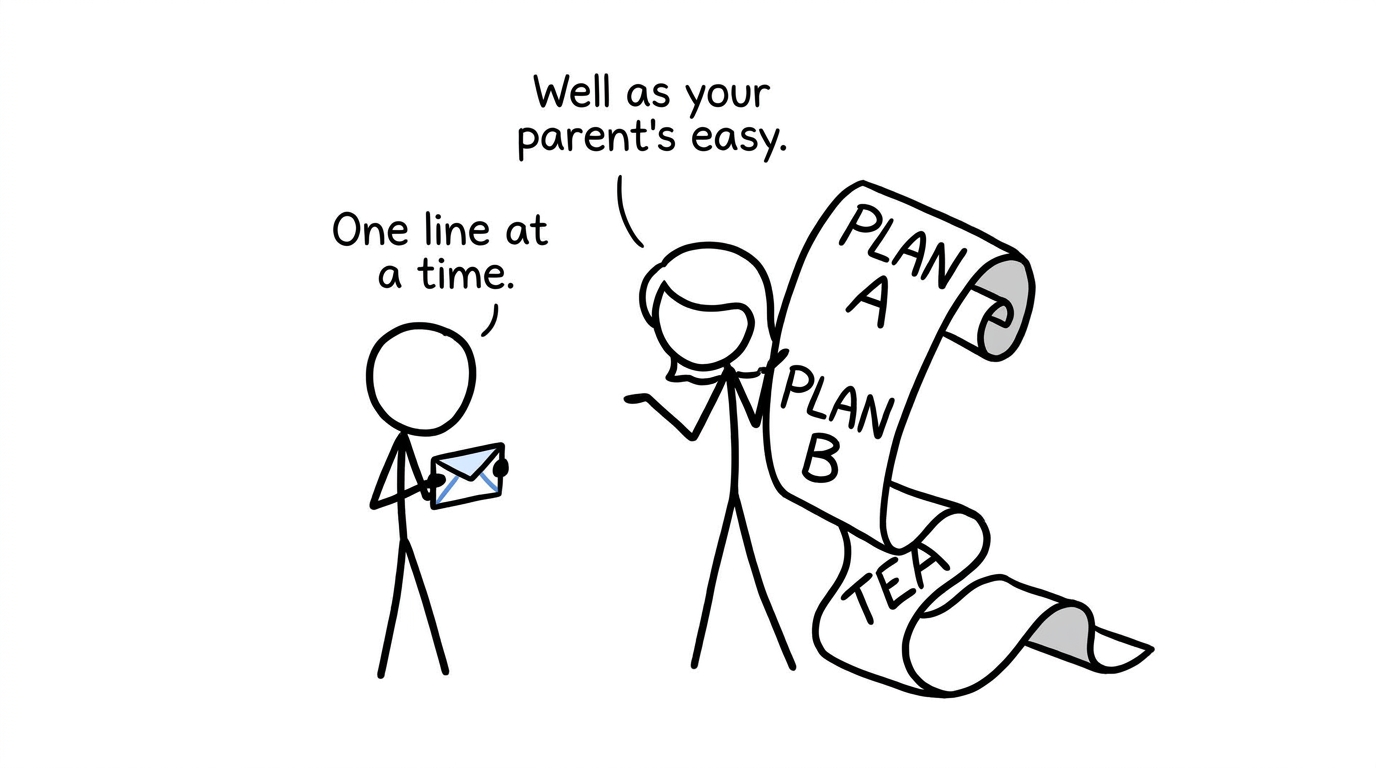 A student and parent calmly opening a results envelope
Your results-day checklist
Before worrying about individual marks, work through this short list:
- Confirm that the result is for English Literature, not English Language.
- Record the overall grade and any component marks shown.
- Check the published boundary for your exam board and specification.
- Ask whether the grade affects a sixth-form, college or apprenticeship offer.
- Speak to your English teacher or exams officer before requesting a review.
- Note your school's internal deadline for post-results services.
If you want to revisit the subject later, the free GCSE English Literature revision hub brings together resources for AQA, Edexcel, Eduqas, OCR and WJEC.
What should I check first on my results slip?
Start with the subject title and overall grade. English Language and English Literature are separate GCSEs, so do not assume one result represents both qualifications.
Your slip may also show marks or component information, depending on the exam board and how your school presents results. Ask your exams officer if anything is unclear. Results issued on the day are provisional because they can change following an accepted post-results request; the final certificate arrives later.
Most importantly, check whether your next destination has a specific English Literature requirement. Many entry conditions focus on English Language, but individual schools and courses can set their own requirements.
Is a grade 4 a pass in GCSE English Literature?
In England, GCSE English Literature is graded from 9 to 1, with 9 as the highest grade. Grade 4 is commonly described as a standard pass and grade 5 as a strong pass.
However, the word “pass” can hide an important detail: admissions decisions belong to the school, college, apprenticeship provider or employer. A course may ask for a particular grade in English Language, English Literature or both. Check the precise wording of your offer rather than relying on a general rule.
Why are this year's grade boundaries different?
Grade boundaries are the minimum marks required for each grade. Exam boards set them after papers have been marked, using statistical evidence and expert judgement to maintain comparable standards when papers differ in difficulty.
That means last year's boundary can be useful context, but it cannot reliably predict this year's result. Use only the confirmed boundary for your exam board, specification and exam series.
Students following AQA can return to the AQA GCSE English Literature resources, while those taking Pearson can use the Edexcel GCSE English Literature revision page.
What if I am only one or two marks below the next grade?
Being close to a boundary is a reason to investigate, not automatic proof that the marking is wrong. Ask your teacher to consider the component marks, your script where available, and the mark scheme.
The sensible question is not simply, “How close am I?” It is, “Is there evidence that the mark scheme may not have been applied correctly?” English Literature contains extended responses involving academic judgement, so a review does not guarantee extra marks.
Is a review of marking the same as a remark?
Not exactly. A review of marking checks whether the original marking included an administrative or marking error and whether the mark scheme was applied reasonably. It is not automatically a completely fresh mark of the paper.
Requests are normally submitted through the school or college, often by the exams officer, and student consent is required. For the June 2026 series, the JCQ deadline for reviews of marking is 24 September 2026, but schools commonly set earlier internal deadlines. Contact the school promptly rather than waiting for the national deadline.
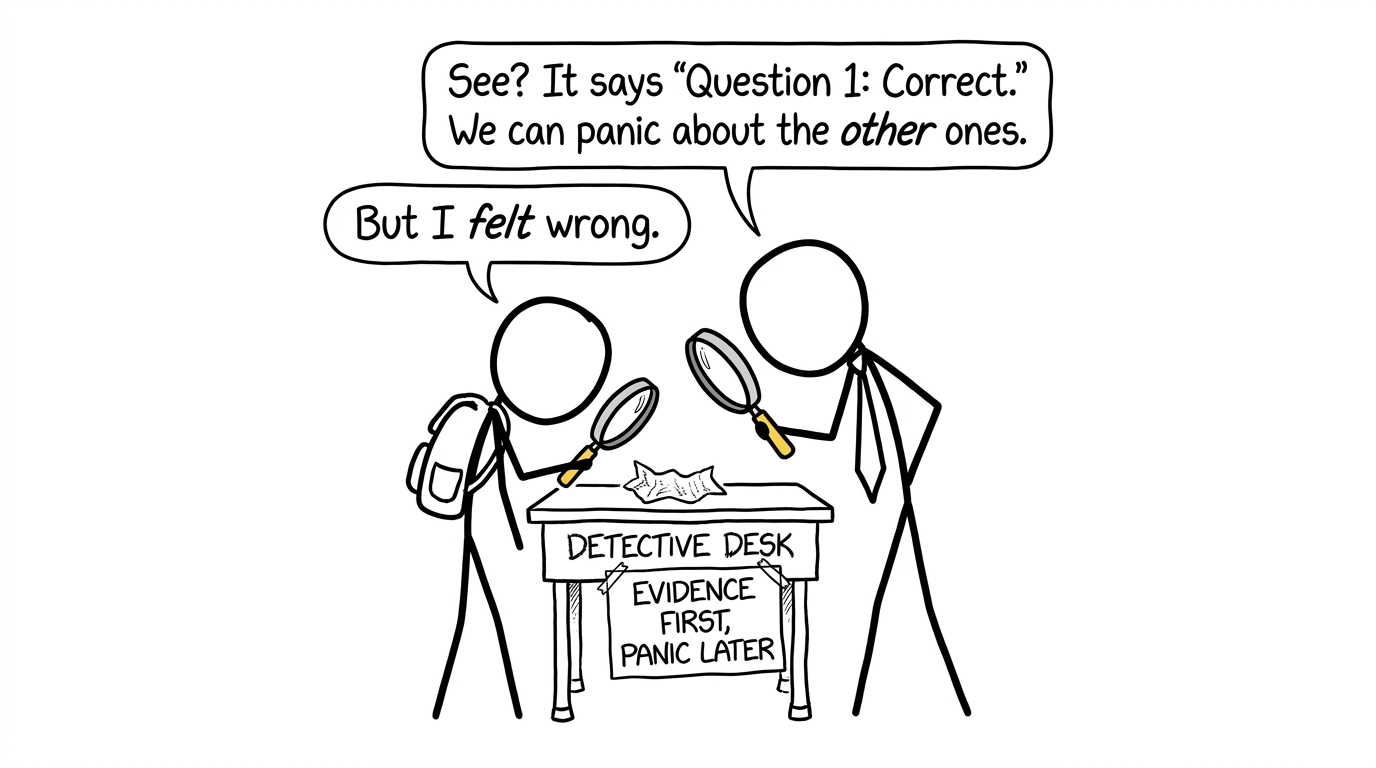 A student and teacher investigating an exam script
Can my mark go down after a review?
Yes. A reviewed mark may rise, remain unchanged or fall, and the resulting subject grade can also change. There is no automatic protection for the original grade.
That is why the school must obtain consent before proceeding. Students and parents should consider both the evidence and the consequences, particularly when the current grade already satisfies an offer.
Can I see my English Literature exam paper?
Exam boards provide access-to-scripts services for GCSE papers. Your school can request a copy, with your consent, to support a decision about a review or future learning.
Availability, fees and deadlines vary by board and service, although some boards provide digital access without charge. Ask whether your teacher can inspect the script before recommending further action. Evidence creates better decisions than boundary anxiety.
For future preparation, finding your weakest English Literature skills explains how scripts, mark schemes and timed responses can reveal gaps in analysis, evidence, structure or question focus.
Can I resit GCSE English Literature in November?
Do not assume that English Literature follows the same timetable as English Language. The November GCSE series is generally used for English Language and maths, while English Literature is normally available again in the following summer series. Confirm availability with your exam board and intended exam centre before making plans.
English Literature is also separate from the post-16 condition requiring eligible students in England without grade 4 in English Language or maths to continue studying those subjects. Nevertheless, a Literature resit may be worthwhile if a particular course requires it or if improving the grade matters to your longer-term plans.
If a resit becomes the right choice, use a focused routine rather than restarting everything. The guide to revising GCSE English Literature efficiently offers a practical structure for quotations, planning and timed writing.
What should parents do on results day?
Listen first. A disappointing grade can feel much larger in the first few minutes than it does once the available options are clear.
Help the student gather facts: the confirmed boundary, marks by component, offer conditions, script access and school deadlines. Then let the teacher or exams officer explain whether a review has a reasonable basis. Calm organisation is more useful than immediately demanding a remark.
Common results-day mistakes
- Confusing English Language with English Literature.
- Comparing a result with an old or different exam board's boundaries.
- Assuming proximity to a boundary guarantees a successful review.
- Forgetting that marks and grades can decrease.
- Contacting the exam board before speaking to the school's exams officer.
- Missing an early internal school deadline.
- Assuming English Literature has a November resit.
- Treating one result as a judgement on the student's ability or future.
Take the next step with Maths Genie
Results day is a decision point, not a verdict. Check the facts, ask precise questions and choose the next action only when you have evidence.
For English, begin with Maths Genie's free GCSE English Literature resources, including revision guides, past papers, questions and mark schemes. If you are balancing subjects for a future resit or sixth-form preparation, the GCSE Maths revision hub and GCSE predicted papers offer the same clear path from practice to feedback.
Pick the correct exam board, review what happened, and make the next piece of work smaller and more deliberate. That is how an uncertain result becomes a useful plan.