

GCSE English Literature Remark: Results Day Guide
GCSE English Literature remark explained: check your script, assess the risk, meet 2026 deadlines and understand reviews, fees and appeals before applying.
Results day can turn a single mark into the only number you can see. If your English Literature result is below the grade you expected, a GCSE English Literature remark may be worth considering, but only after your teacher has reviewed the evidence.
The short answer is this: ask your school for your component marks and marked scripts, compare them with the correct grade boundaries, then discuss whether there appears to be a genuine marking error. A review can raise, confirm or lower your mark. It is not a guaranteed second chance at a higher grade.
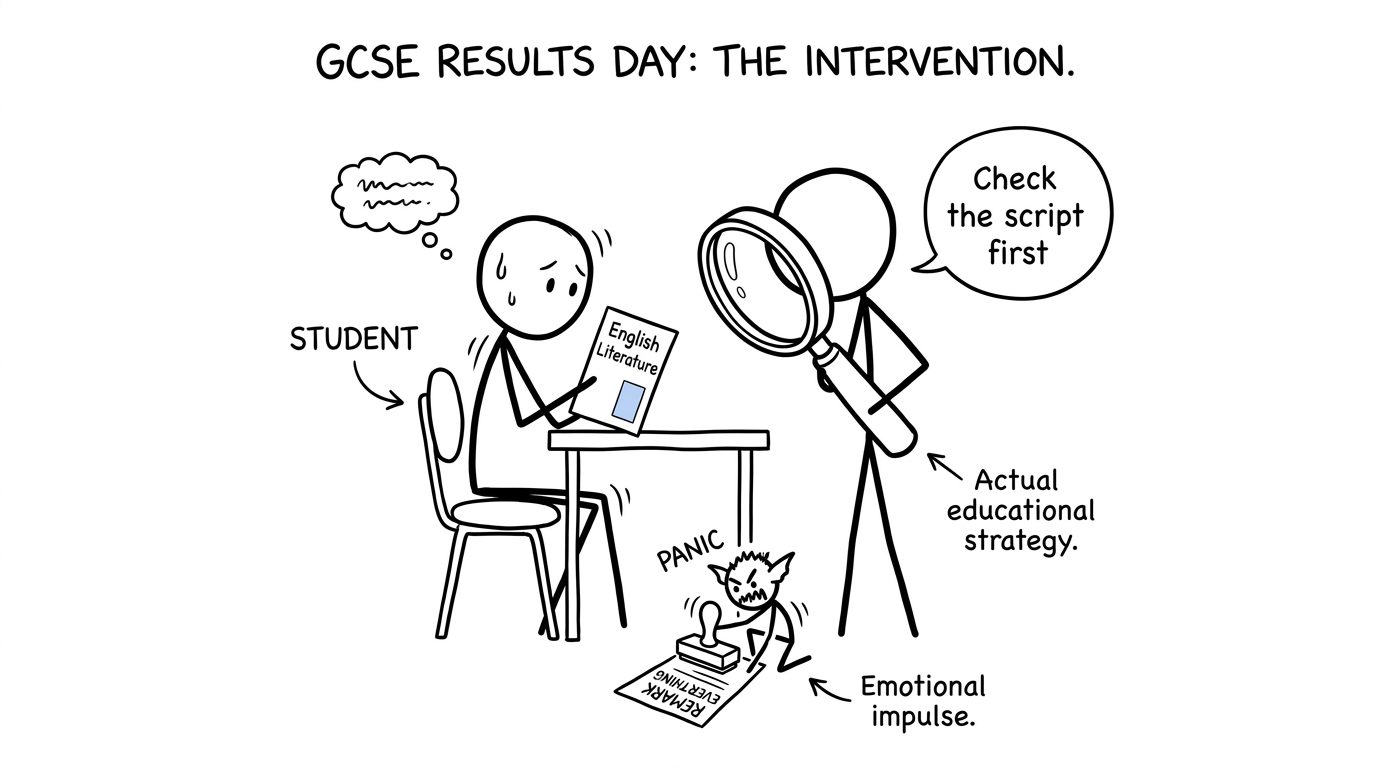 A teacher checks an English Literature script while the panic gremlin demands a remark
Your results-day decision checklist
Before requesting anything, work through this list:
- Confirm your exam board and specification.
- Find your total mark and the marks for each paper.
- Check the boundary for the grade you hoped to receive.
- Ask your school to access your marked scripts.
- Let an English teacher compare your answers with the mark scheme and level descriptors.
- Identify a specific concern, such as an unmarked response or apparently unreasonable application of a level.
- Ask what the review costs and whether your school will pay or pass on the fee.
- Consider the possibility that your mark could fall.
- Give written consent only when you understand the risk.
- Meet your school’s internal deadline, which may be earlier than the exam board deadline.
Start by checking the relevant AQA GCSE English Literature grade boundaries, Edexcel GCSE grade boundaries or WJEC English Literature grade boundaries. Use the boundary from your own exam series rather than a previous year’s figure.
How the GCSE English Literature re-mark process works
“Remark” is the everyday term, but the official service is usually called a review of marking, or Service 222.
Ask for your component marks
English Literature normally includes more than one externally assessed component. Your overall result may hide an important detail: one paper might be close to expectations while another is unexpectedly low.
Ask your exams officer for the component breakdown. A review is requested for a particular paper or component, not simply because you dislike the overall grade. If two papers are reviewed, there may be separate fees.
Request access to your scripts
Your school can use the exam board’s Access to Scripts service, with your consent, to obtain copies of your marked papers. A teacher can then look for concrete reasons to question the marking.
This matters particularly in English Literature because extended responses are assessed through level-based criteria and academic judgement. A teacher predicting a slightly different mark does not automatically prove an error. The stronger question is whether the original mark could reasonably have been awarded under the mark scheme.
Discuss the evidence with your teacher
A useful conversation is specific. Ask:
- Was every response marked?
- Were all marks totalled and recorded correctly?
- Does the awarded level fit the qualities demonstrated across the answer?
- Is there evidence that the mark scheme was applied incorrectly?
- How many additional marks are needed for the next overall grade?
Being one mark below a boundary makes the possible benefit easier to see, but closeness alone is not evidence of a marking error. Equally, being several marks away does not make a review impossible if the script reveals a substantial concern.
Give written consent
Your school must obtain your written consent after results have been published. This is required because your mark and final grade can go down, stay unchanged or go up.
For the June 2026 series, GCSE results are released on 20 August and the JCQ deadline for reviews of results is 24 September 2026. Schools commonly set earlier internal deadlines so that exams officers have time to check and submit requests. Standard GCSE reviews are normally completed within 202020 calendar days. The JCQ priority review service for the June series is reserved for relevant Level 333 qualifications, not GCSE English Literature.
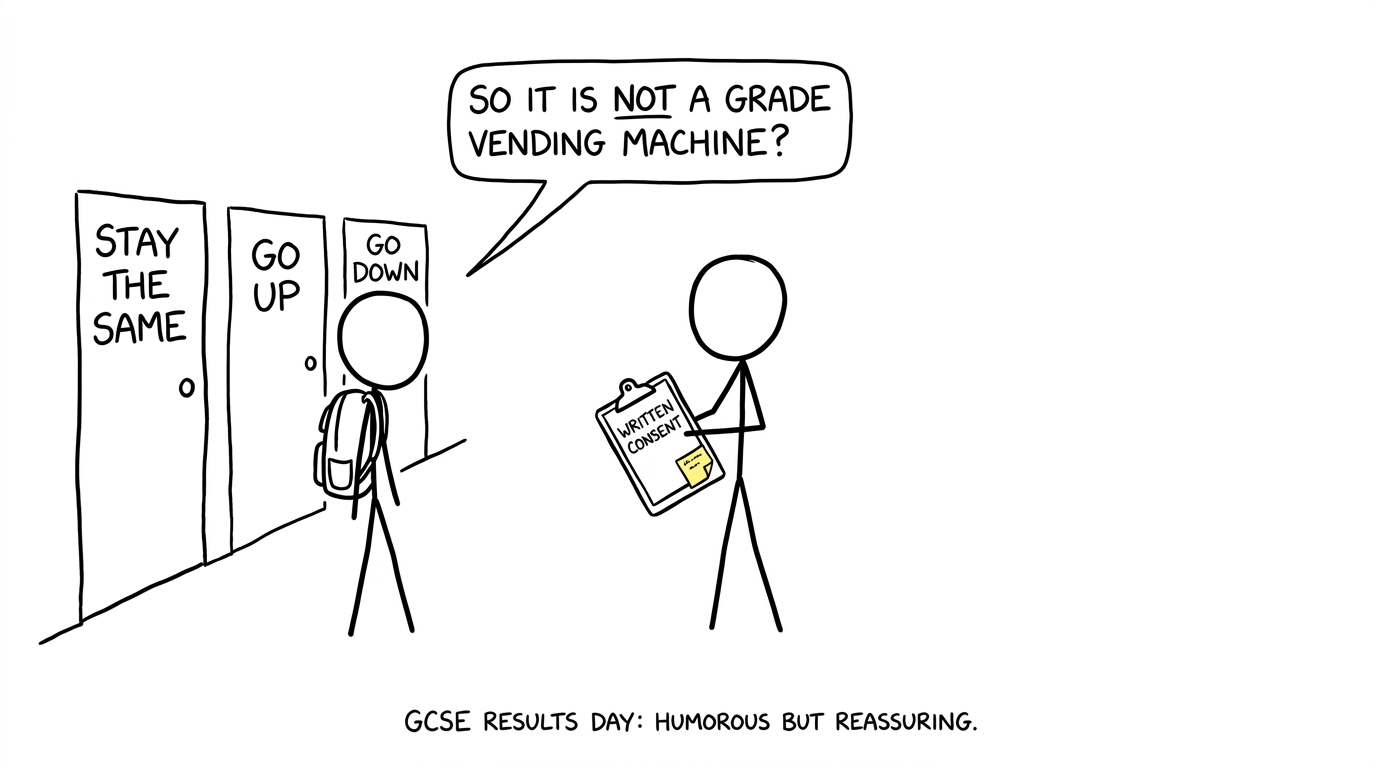 A student considers the three possible outcomes of a review of marking
When requesting a review makes sense
A review may be reasonable when your result is significantly different from consistent school evidence and a subject teacher finds a defensible concern in the script. It can also be sensible when a response appears unmarked, the total may be wrong, or the awarded level seems inconsistent with a proper application of the criteria.
The decision becomes stronger when a changed grade would affect a sixth-form course, college place or another firm progression requirement. Tell your school promptly if your place depends on the result, but do not assume this creates a priority GCSE service.
A review may be less persuasive when the only argument is “I usually get higher grades”, no teacher has inspected the paper, or you need several extra marks but cannot identify a likely error.
Appealing a GCSE English Literature grade
Appealing a GCSE English Literature grade is not the first step. Normally, your school must request a review of marking before it can appeal the outcome.
An appeal challenges a marking error that may remain after the review or a problem with the procedure followed. It is not simply a request for another examiner to award a preferred mark. Speak to your exams officer immediately after the review outcome because appeal deadlines and fees apply.
Most students must act through their school or college. Private candidates may be able to approach their exam board directly or work through the centre that entered them.
Common mistakes to avoid
- Assuming a review means fresh marking: the reviewer checks whether the original marking contains an error and whether academic judgement was exercised reasonably.
- Looking only at the overall grade: inspect the component marks and scripts first.
- Using old boundaries: boundaries vary by series and exam board.
- Ignoring the downside: marks can fall as well as rise.
- Waiting for the JCQ deadline: your school’s deadline will probably be earlier.
- Confusing English Language and Literature: they are separate qualifications with different papers, marks and boundaries.
Make the decision, then return to what you control
A review is an evidence-based administrative decision, not another exam. Once your school has the request, your job is to move forward.
If maths is your next priority, use the free GCSE maths revision hub for revision lessons, practice questions and mark schemes. You can organise weak topics with the MathsGenie revision planner, build exam confidence through Edexcel GCSE maths papers and mini tests, and practise unfamiliar questions using GCSE predicted papers.
For your English Literature decision, begin with the GCSE English Literature grade boundaries, request your script and speak to your teacher. Calm decisions usually start with better information.











